All posts by Rebecca Michelle

Educator, traveler, reader, blogger. Loves learning, black coffee, and friendly people.

My 2017 Reading List

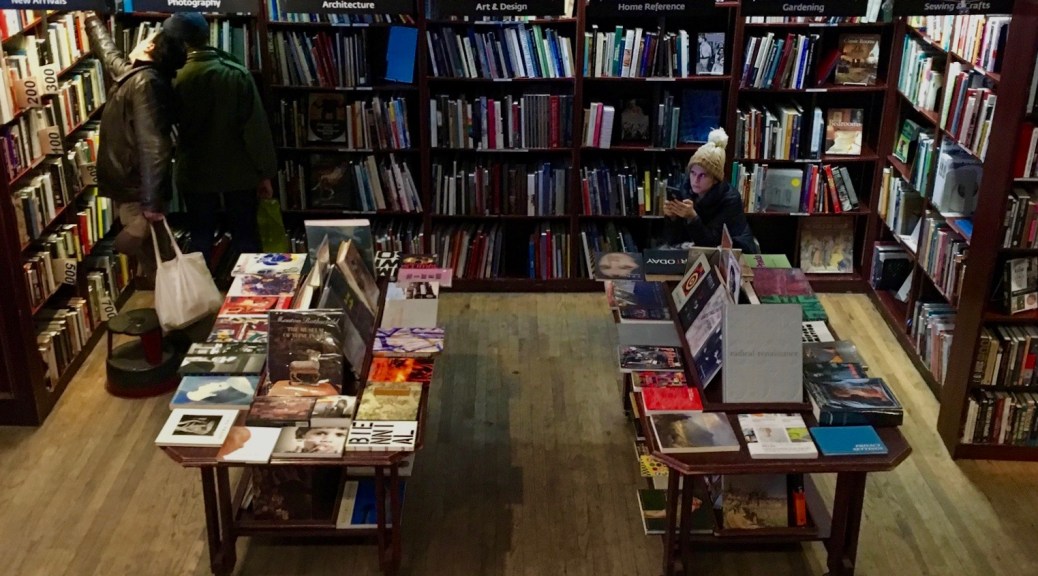
Another year gone and more books in the, well, book! My list of 2016 reads sparked some conversation with people in my life and finally convinced me to get on Goodreads, so I wanted to share this year’s list, too. The lists are in alphabetical order by title and grouped into nonfiction and fiction categories.

Nonfiction
Behave: The Biology of Humans at Our Best and Worst
Robert Sapolsky

The Better Angels of Our Nature: Why Violence Has Declined
Steven Pinker

Between the World and Me
Ta-Nehisi Coates

The Black Swan: The Impact of the Highly Improbable
Nassim Nicholas Taleb

Blended: Using Disruptive Education to Improve Schools
Michael Horn and Heather Staker

Born to Be Good: The Science of a Meaningful Life
Dacher Keltner

Caring: A Relational Approach to Ethics and Moral Education
Nel Noddings

The Conspiracy Against the Human Race: A Contrivance of Horror
Thomas Ligotti

Cosmopolitanism: Ethics in a World of Strangers
Kwame Anthony Appiah

The Courage to Be
Paul Tillich

Cultivating Humanity: A Classical Defense of Reform in Liberal Education
Martha Nussbaum

Democracy and Education: An Introduction to the Philosophy of Education
John Dewey

Emotional Agility: Get Unstuck, Embrace Change, and Thrive in Work and Life
Susan David

Empire of Illusion: The End of Literacy and the Triumph of Spectacle
Chris Hedges

Flow: The Psychology of Optimal Experience
Mihaly Csikszentmihalyi

A Fragile Life: Accepting Our Vulnerability
Todd May

Good Citizens: Creating Enlightened Society
Thich Nhat Hanh

The Hero Handbook
Nate Green

Hidden Figures: The American Dream and the Untold Story of the Black Women Mathematicians Who Helped Win the Space Race
Margot Lee Shetterly

A History of Reading
Alberto Manguel

A History of the World in 6 Glasses
Tom Standage

Homo Deus: A Brief History of Tomorrow
Yuval Noah Harari

How to Spend $75 Billion to Make the World a Better Place
Bjørn Lomborg

The Importance of What We Care About
Henry Frankfurt

The Knowledge Illusion: Why We Never Think Alone
Steven Sloman and Philip Fernbach

Life 3.0: Being Human in the Age of Artificial Intelligence
Max Tegmark

Machine Learning: The Ultimate Beginners Guide For Neural Networks, Algorithms, Random Forests and Decision Trees Made Simple
Ryan Roberts

Machine, Platform, Crowd: Harnessing Our Digital Future
Andrew McAfee and Erik Brynjolfsson

The Man Who Mistook His Wife for a Hat: And Other Clinical Tails
Oliver Sacks

Misbehaving: The Making of Behavioral Economics
Richard Thaler

Modern Romance
Aziz Ansari

Moral Politics: How Liberals and Conservatives Think
George Lakoff

Moral Tribes: Emotion, Reason, and the Gap Between Us and Them
Joshua Greene

Moving Toward Global Compassion
Paul Ekman

On Dialogue
David Bohm

On Tyranny: Lessons from the Twentieth Century
Timothy Snyder

One Student at a Time: Leading the Global Education Movement
Fernando Reimers

Philosophy in the Flesh: the Embodied Mind & its Challenge to Western Thought
George Lakoff

Political Order and Political Decay: From the Industrial Revolution to the Globalization of Democracy
Francis Fukuyama

The Portable Atheist: Essential Readings for the Nonbeliever
edited by Christopher Hitchens

Read This If You Want to Take Great Photographs
Henry Carroll

Robot-Proof: Higher Education in the Age of Artificial Intelligence
Joseph Aoun

A Room of One’s Own
Virginia Woolf

Sapiens: A Brief History of Humankind
Yuval Noah Harari

The Shipwrecked Mind: On Political Reaction
Mark Lilla

Simone Weil: An Anthology
Simone Weil

Superintelligence: Paths, Dangers, Strategies
Nick Bostrom

Thinking, Fast and Slow
Daniel Kahneman

The Tibetan Book of the Dead
Chogyam Trungpa and Francesca Fremantle

We Should All Be Feminists
Chimamanda Ngozi Adichie

Weapons of Math Destruction: How Big Data Increases Inequality and Threatens Democracy
Cathy O’Neil

What I Talk About When I Talk About Running
Haruki Murakami

What’s Worth Teaching?: Rethinking Curriculum in the Age of Technology
Allan Collins

White Trash: The 400-Year Untold History of Class in America
Nancy Isenberg

Why Buddhism is True: The Science and Philosophy of Meditation and Enlightenment
Robert Wright

The Wisdom of Insecurity
Alan Watts

Word by Word: The Secret Life of Dictionaries
Kory Stamper

World Class Learners: Educating Creative and Entrepreneurial Students
Yong Zhao

Fiction
2 B R 0 2 B – Kurt Vonnegut
As I Lay Dying – William Faulkner
Cat’s Cradle – Kurt Vonnegut
Catch-22 – Joseph Heller
East of Eden – John Steinbeck
Frankenstein – Mary Shelley
Interpreter of Maladies – Jhumpa Lahiri
Invisible Man – Ralph Ellison
Jonathan Livingston Seagull – Richard Bach
Last Night in Twisted River – John Irving
Men Without Women – Haruki Murakami
The Nun’s Story – Kathryn Hulme
Strange Case of Dr. Jekyll and Mr. Hyde – Robert Louis Stevenson
The Three Muskateers – Alexandre Dumas
Tropic of Cancer – Henry Miller

As the year turns over, I wish you a 2018 full of peace, joy, and good books. Happy reading!
IMG_0387

Playing Tourist

My sister has been here visiting since Tuesday and it has been so great having her here. It’s nice to share my life with her and show her the city that has become so important to me. It’s also a lot of fun to play tourist along with tour guide, indulgently doing all the things that are on the list for “someday”. For example, the Red Dot Design Museum was completely new to me and having my sister here was reason enough to visit the 50th storey skybridge at The Pinnacle@Duxton in Tanjong Pagar:

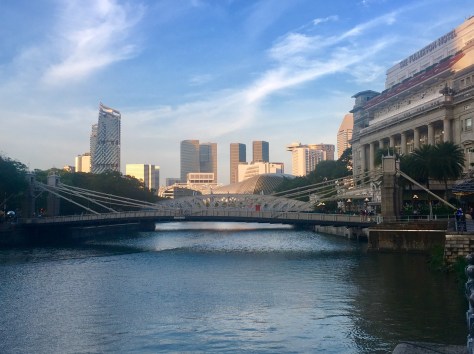
What has also been interesting is that my sister’s visit to Singapore has included visits to several religious buildings. Unlike when I travel, I don’t seek out religious buildings to admire here. I often pass by them and peek inside, but I don’t purposely find them like I do else. However, I was at Chijmes shortly before my sister’s arrival . . .

IMG_0388

. . . and have since visited Masjid Abdul Gafoor, which my sister asked to see . . .

IMG_0389

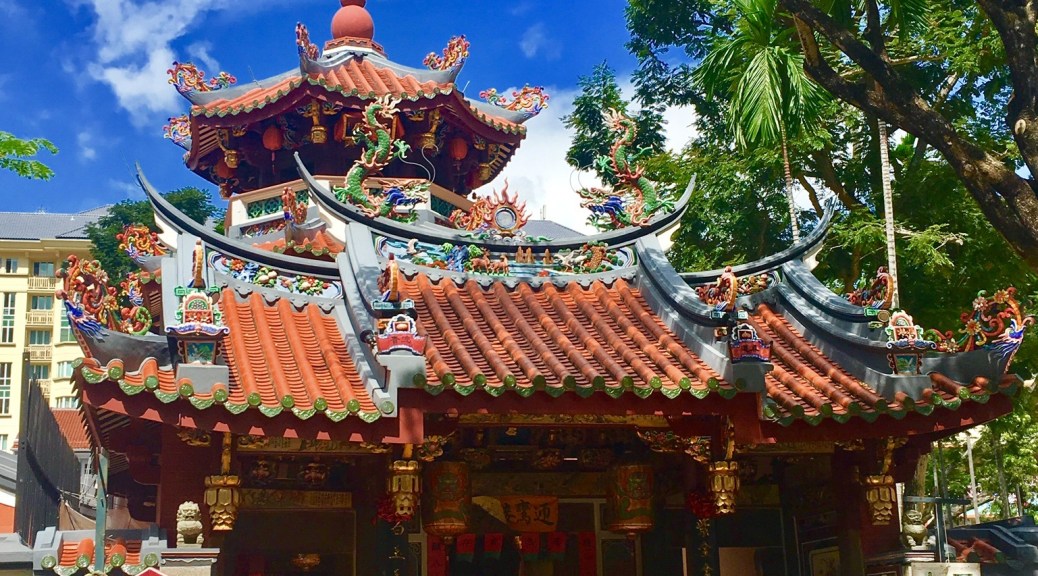
. . . and Thian Hock Keng, which we passed completely by accident while walking through Telok Ayer. . . .

There have been others, too, but these have been new for me. It’s nice to share something new with my sister, too. We don’t do that nearly often enough now that we live so far apart.

My sister’s visit has reminded me that no matter how much time you spend in a place, there’s always something else waiting to be seen. I love that about the world.

IMG_0392

In a few days, we’re off to Hanoi, Sapa (new for me!), and Chiang Mai. Looking forward to going back and looking forward to going anew!

Building Peace: Classroom Activities

The last week of the semester is always a bit of a challenge. Our second quarter grades were due last week and there’s little point in beginning something new that will be immediately interrupted by a three-week break.

For me, this week was the perfect time to do some work with peace and conflict resolution with my grade 10 students. As I’ve written before, I believe that building peace really ought to be the purpose of education and that we need to provide our students with a toolkit to build a better, more peaceful world. This year, I’ve tried to include those ideas in every topic we study.

In grade 10, we recently concluded a unit on genocide during which we discussed social enterprises, NGOs, and other organizations that are currently working to help affected communities move forward and improve the problems that have resulted from these atrocities. Spending a few days talking about peace and conflict seemed more than timely.

Below are three activities that I’ve developed and/or adapted from the United States Institute of Peace. You can download their Peacebuilding Toolkit for Educators for free! These activities require students to talk with each other and move around, which is always helpful towards the end of a semester. They tend to work best with chattier groups, but even quieter students react pretty strongly.

Defining Peace
1. In pairs, ask students to come up with a definition of peace.

2. Each pairs partners with another pair, making a group of four. Ask the group to come up with a definition of peace that everyone can live with.

3. Two groups of four form a group of eight and repeat the exercise. (Split the groups of four as needed with a small class so that the whole class is ultimately in two large groups.)

4. Continue until the class is split into two groups and have each group write their final definition on the board.

5. The last part of this activity is to see whether the class can agree on a definition of peace, either by choosing one, combining the two options, editing, or writing something new entirely.

6. Debrief as a group about this process and how the definition changed and developed (or not!) as the groups changed. Compromise, learning from others, and agreeing with different ideas are usually the topics that come up. Some groups really enjoy the language structure component of this activity, as well.

Peace Scenarios
1. Ask students to keep in mind the whole-class definition of peace (or two definitions if the class couldn’t come to consensus). Create a continuum of peace along a wall with one side as 100% peace and the opposite as 100% not peace. The middle of the room is an even split between peace and not peace.

2. Present students with a variety of peace/not peace scenarios. They should place themselves where they fit along the continuum.

3. Page 31 of the high school toolkit from USIP has a list of scenarios representing personal, local, and international conflicts. I’ve found that Personal #2 (Your teacher accuses you of cheating on a paper, but you did not. You schedule a time after class to work out the
misunderstanding.) is great starting point and then I proceed from there in this order:

  • Personal #1 – You arrive at home and your mom has taken money off your dresser without asking. This frustrates you, but you don’t say anything because you don’t want to cause a fight.
  • Local #2 – A school holds a charity event to raise money to build schools in an area affected by a natural disaster.
  • Local #3 – A high school hires armed security guards to manage school violence.
  • International #3 – Humanitarian aid with medical supplies and fresh water reaches a community affected by conflict.
  • International #4 – Children in an IDP (internally displaced persons) camp are not able to go to school for fear of violence if they leave the camp.
  • (optional) International #1 – There are 300,000 child soldiers involved in conflicts around the world.

4. Many of my students are language learners and we do pause to make sure that everyone understands both the content and concepts in each scenario. Students move according to their opinions, which is also an opportunity to share with a classmate. This is particularly helpful for language support. Then, I call on them at random to justify their views.

5. I usually start with the students at the far extremes and then choose one in the middle and one or two others before opening the floor for anyone to share. If a student moves during the activity, I ask why. Some students will purposely take the opposite perspective from the majority of the class just for the sake of discussion, which is always really fun. I also allow students to question each other.

Over the Line
This is a really quick activity that I generally preface simply by telling students that it is related to peace and conflict.

1. Divide the class into two groups and have them pair up with someone from the opposite group.

2. Tell students that you will hand out specific directions to each group and give each student the instruction sheet from page 38 of the USIP high school toolkit. The instructions are identical and read as follows: You will be sentenced to life in prison in exactly 3 minutes. Your only chance to escape is if you can get your opponent to cross over to your side and stay there before the time is up. Good luck. 

3. Students are not to look at the directions until the activity begins.

4. Tell students to stand facing each other and draw an invisible line across the floor between them. Remind students that each group has specific directions and that their task is to accomplish the goal using any means except physical violence. Announce that they have three minutes to complete the task.

5. After three minutes, ask students who thinks they accomplished the task. (The solution is for the partners to trade places.) There is usually at least one group who read their instructions to each other, realized they were the same, and figured out the solution. Ask this group how they went through this process and why they chose to share their instructions. Ask a few other groups about their experiences.

6. Debrief as a class about how this activity relates to peace and conflict. Ideas that come up generally include trust, considering different points of view, compromise, and communication.


This is the type of work that I love doing and I was really glad to do these activities with my grade 10s this week, especially coming off of our unit on genocide. The classroom can be a powerful place if we’re willing to have conversations about difficult topics. I believe that this work is essential if we aim to improve our world.

I’ve used these activities for several years in grades 9 and 10 and would love to hear how they work for you in your classrooms! If you have your own peace and conflict activities to share, please do so. I’d love to learn from you.