All posts by Rebecca Michelle

Educator, traveler, reader, blogger. Loves learning, black coffee, and friendly people.

How to Feel

Are you all packed?
Nope.

When do you leave?
Too soon.

More and more of my recent conversations have started like this.

Nearly everyone I’ve spoken to has expressed excitement for me, which I truly do appreciate. I have a handful of friends also leaving Singapore, all of whom have been here longer than I have; everyone is full of similarly mixed emotions. There’s nostalgia, uncertainty, anticipation, relief, excitement, a spirit of adventure. Some have concrete plans about what’s coming while others are still figuring that out. Everyone has made the choice to leave, but the reactions to leaving differ. This has me reflecting on how I make and respond to my own choices.

For as long as I’ve been consciously aware of decision-making, I’ve made choices that take others into consideration before thinking of myself. I believe this started when I was about 11 years old and my parents separated. While I wasn’t technically supposed to have a choice about spending every Tuesday night and every other weekend at my dad’s apartment, sometimes I did have the option to stay with my mum. That was on particularly bad days with a lot of tears, for some reason or another. I remember flicking through a collection of colorful hair elastics that I kept together on a ring chanting, “I go, I don’t go” in a perverse version of daisy petals and “he loves me, he loves me not”.

The last elastic rarely made the decision for me, but it did tell me how I felt about the choice I’d made.

I knew that a sense of relief on the last flick meant that there was congruence between the elastic’s answer and the real decision, while a sinking sensation in the pit of my stomach told me I was secretly hoping for the opposite outcome. Sometimes I felt nothing, which was even worse.

The difficulty arose when my feelings were discordant with what I imagined my dad was feeling when I raged and stormed over whether or not to spend time with him. It was a battle between choosing to make him happy (though I usually let my fury make itself very obvious, which likely had exactly the opposite result) or to make myself happy (though I often dissolved in tears anyway because I knew that I was hurting my dad, so I really wasn’t helping myself at all).

I knew that I had a lot of emotions, but I didn’t know how to balance them. I didn’t know how to handle so many conflicting emotions at once.

My discomfort with cognitive dissonance led me to avoid acknowledging my feelings. For much of middle and high school, I stopped making decisions based on my own whims so as to avoid rejection, disappointment, or fear if my choices didn’t align with others’ wishes. It was easier to consider “What will make them happy?” than “What do I want?”. I felt safer avoiding desires and expectations than admitting what I was really feeling, often because I didn’t know what that was.

Though my strongest desire is still for others to be happy, the biggest (and healthiest!) change has been considering myself at all. I am allowed to want, hope, and seek out. I am allowed to say no, change course, and propose alternatives. Considering myself has also meant embracing the conflicting emotions that I’ve recently been experiencing on a very regular basis.

I have given myself permission to admit that I am very sad to leave Singapore and both excited and nervous about returning to the US. I am excited for the next chapter, adventure, and experience. I look forward to the unknowns that lie ahead. At the same time, I have misgivings and feel apprehension and frustration. I dream about teaching internationally again.

At 11, I didn’t know that there isn’t one “right” emotion for everyone involved. There isn’t one way to feel. At 26, I have come to accept that it’s about finding a balance. The scale might tip depending on the day or even the hour, but that’s okay.

Of everything I’ve learned during my year in Singapore, how to be open and honest with myself, and by extension with those around me, might just be the most important.
 

More Than Talking

“I had some really delicious Indian and Sri Lankan food the other day. It was great!”

Silence on the other end of the line.

“Either the call dropped or you’re ignoring me.”

“No no, I’m here.”

So why the lack of response? That’s the question I was left asking myself after a phone conversation this morning. Why the lack of response?

As an educator, I am constantly looking for ways to demonstrate to my students that someone is listening to them. When they speak, I respond. When they tell me something they’ve done or something they’re excited about, I ask questions about it, wish them luck, or tell them I hope they have a great time. If they tell me that something is wrong, I ask what I can do to help. I remind them that they can always come chat if they need to. I leave sticky notes on their desks asking if they’re okay today.

A huge element of teaching is about developing relationships. If my students know that I care about them, they are more likely to learn in my classroom. We can have challenging conversations when they feel that their voices are being heard, their opinions matter, and their ideas will be taken seriously.

When classroom cultures develop around these attitudes and behaviors, real dialogue takes place. Real learning happens.

Last week, my grade ten students wanted to continue a Socratic Seminar that I thought we’d completed. They clearly had more to say, so we went with it. They started off by asking questions about the relationship between religion and violence; over an hour later, we were deep in a discussion about renewable energy.

My students’ questions drove the conversation. As vocal students willingly expressed uncertainty, they encouraged quieter peers to speak up and provide their thoughts and questions. Some students explained that they’d changed their minds over the course of our discussion, while others remained convinced of their own ideas. Some wavered back and forth and laughed at their own equivocating. Others admitted to feeling a general sense of uncertainty and apprehension that hadn’t occurred to them before our discussion.

It didn’t really matter.

The point was that they’d talked. They’d heard each other. They were willing to be open and vulnerable, question their classmates, express their ideas, and respond to challenges from their peers. They didn’t just talk; they listened. Through listening, they learned. They operated in the safe space that we’ve created this year, and they learned as a result.

Cultivating dialogue is vital with students, and equally so among adults.

But why is it so difficult?

One factor that I think makes dialogue challenging is being present. We spend a lot of time with our attention torn between one thing or another – email, social media, back-to-back meetings and deadlines, a pervasive need to “be there” with multiple people at once. We live in a society in which “busy” often denotes “good”. We feel the need to justify spending time alone or with just one other person.

I would like to advocate that we take a deep breath and a step backwards. The students in front of me are enough and they deserve my complete attention. The friend who joins me for coffee is enough and deserves my complete attention. The person on the other end of the line is enough and deserves my complete attention.

When I give you my complete attention and respond to you and what you’ve said, dialogue will take place. If I am only half-listening, if I am only partially there with you, dialogue is simply not possible.

In addition to practicing compassion, I am also working on being present. I want to listen to you. I want to hear you. I want to see you. This way, we can engage in dialogue, affect change, and make the world a better and more peaceful place.


Chinese Folklore

In today’s edition of Explore As Much of Singapore As Possible Before Rebecca Leaves, my friend Lauren and I ventured out to Haw Par Villa, located on the western part of the Circle Line. There’s nothing around it except for a car dealer and a Korean BBQ restaurant, meaning that Haw Par Villa has its own MRT stop! Neither of us had ever been out in that direction before.

P1070900

I first heard about Haw Par Villa from a friend a number of weeks ago and promptly forgot about it. Another friend asked if I’d brought Lucas there when he visited last weekend, which reminded me that I wanted to go. (Obviously, Lucas missed that experience. He’ll just have to come back!)

Haw Par Villa was built by the brothers who developed Tiger Balm and made millions. They opened the theme park as a way of giving back to society. Entry is completely free, which is always nice. It was very hot and sunny today and we walked through the whole park in about 90 minutes.

P1070842
Tiger Balm statue

Our first stop was the section of the park depicting the 10 Courts of Hell from Chinese folklore. To give you an idea, this is how each of the courts were described:

P1070825
I took a picture of this sign because I particularly loved that “urging people into crime and social unrest” was listed as a sin!

Each of the courts had a sign like the one above, and all sorts of graphic depictions of the punishments, like these:

It gets stranger:

P1070869
We couldn’t figure out why this was here . . .
P1070850
Lady Liberty? Why?

The rest of the theme park continued depicting different Chinese tales. Having Lauren around was particularly helpful because she spent four years living in Shanghai and can read and speak what she calls elementary Mandarin. It was also just fun to point out the weird sh** everywhere to someone as intrigued as I was!

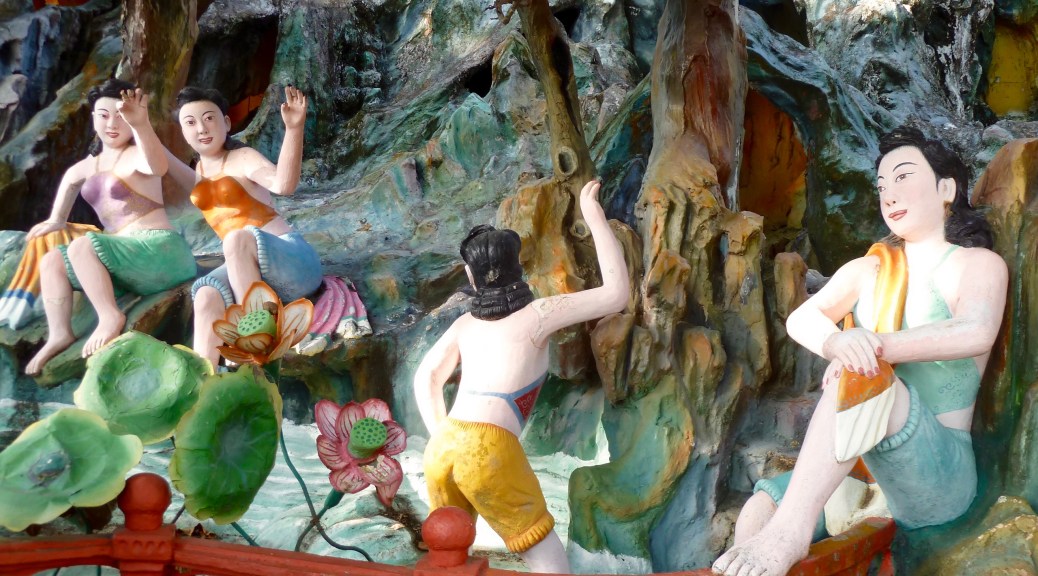
The last area we visited was called Virtues and Vices and depicted scenes of daily life, both virtues and vices, from places Lauren could identify as Shanghai and Hong Kong. I’m also pretty sure at least one scene was set in Singapore, but it’s hard to say.

It was definitely a unique and entertaining afternoon! I highly recommend a visit!

P1070874