All posts by Rebecca Michelle

Educator, traveler, reader, blogger. Loves learning, black coffee, and friendly people.

Dancing in the Rain

I haven’t spent much time in Singapore during the start of the Southwest Monsoon season, which lasts from June to September. I’m used to the hour or two of afternoon rains that characterises the new school year in August, but half a morning of pouring rain is a new experience. So is half a morning of pouring rain followed by an evening of more rain.

While I won’t be climbing rocks outdoors any time soon and while the rain has put a literal damper on morning bike rides, there are some new features to life here that I’m quite enjoying. It feels cozy, for once, which is something we rarely experience in the tropics. It’s breezy and (comparatively) cool both indoors and out; I’ve made soups and curries for dinner and I’ve been glad for their warmth.

Geylang in the rain – September 2017

When I first moved to Malaysia six years ago I learned to enjoy the rain. Where I come from, rain is cold. Rain in the tropics is not. The water is warm, the air is cool, and it’s a welcome refresher for the day. Granted, getting soaked on the way home from work is inconvenient (although getting soaked on the way to work is more inconvenient) but it’s so much fun at those times to feel like a kid again. You’re wet. Very wet. So you might as well hop off the bike, settle it safely against a wall or building, and dance in the rain.

This is what I have tried to keep in mind now that we’re in the strangest period of summer school holidays that I have ever experienced. Normally, summer for me is spent travelling between family members, catching up with friends, enjoying early morning runs on the nearby canal, and taking a complete break from my normal environment. But this year, we can’t do that. And so we adapt.

Singapore started its reopening a week ago and I have been so glad to see people out and about, to reunite with friends, and to feel my body move at the climbing gym. It has given me time to reflect on the experience of living here and what this place has to offer. And I’m not talking about museums (still closed) or fancy bars (some still closed). I’m talking about hot pot for dinner at a friend’s house and going down the street for a local coffee at a hawker stall. I’m talking about my favorite place in town to watch the world go by and the renewed joy of gathering at home in small groups. Simple things. Things that I missed when they went away.

Experiencing the small joys of an open world, although a small one right now, is what this summer is about. It might not be what I’d planned or what I’d wanted, but I am glad to have this time for what it is.

It might be raining, and that’s all the more reason to dance.

Potong Pasir in the rain – June 2018

The Story is Not the Experience

My eyes are not working as they should be right now. The words are blurry, so I’m typing with eyes closed. I suspect it’s some sort of migraine; I’ve been there before. A headache slammed into my head shortly after I returned from my run and I’ve taken painkillers and drunk a whole lot of water, and I’m almost done with my first cup of coffee. My head is far less sore than it was half an hour ago, but my eyes haven’t caught up.

And yet, I could be wrong. Perhaps the blur is because the lenses of my glasses are simply dirty. That’s easy to test, so I take them off, give them a good wipe, and aha! Problem solved.

Yes, sometimes it’s really easy to tell when something’s wrong. Physical pain, someone we love “forgetting” to return calls, a colleague crying in the office, a teenager’s choice to adopt a dramatic new hairstyle are all obvious calls that something is up. We can see it, or feel it or hear it.

But these are symptoms, and all we know is the symptom but not the cause, so we make assumptions and our assumptions might be mistaken.

If we can be wrong when something is tangible and immediate, consider how much more wrong we can be when it’s not. I have written before about the importance of listening and building relationships and, more recently, of the challenges of communication in a digital era. That piece focused on the difficulty of sharing meaning in the absence of visual cues, but did not explicitly address the challenges of communication across time, place, and space. And it is crucial to do so.

I am speaking from the lens of one living half a world away from my family. We speak daily and message almost as often, yet we still experience breakdowns in communication. Why?

As we know, the purpose and method of communication changes out of necessity when crossing time zones. We often need to wait to contact others and there is precious little real time immediacy in our conversations. Instead, we lag. I could send a message to my mum about my blurry eyes right now, but it’s the middle of the night where she is and I can’t expect her to respond, so I turn to friends nearby or other sources for help.

I would rather have spoken with my mum, but by the hour our time windows align, my eyes have returned to normal. There are far more interesting things to discuss, and really there is no point in worrying her unnecessarily. So she will never know.

Now imagine this in a much more serious context. Imagine your partner is on a business trip and has just been robbed. Wallet gone, identification gone. When you finally speak six hours later when it’s morning for you, your partner has already gone to the police, recovered the wallet, and attended the late afternoon meeting. “I was robbed” is now a very different story. Your partner might have been terrified at the time and never mention it. Perhaps the fear itself has become a memory or perhaps he was robbed at a strip club. Either way, you’ll never know.

Let’s go further. Covid-19 is a phenomenon that has spread across the globe and it has caught us in very different places. Our experiences in the last few months differ based on location, age, employment status, living situation, health, and through what we choose to read. But we do not recognize that we see things differently, even as we compare across countries. Even though we should know better, we expect that others are experiencing largely the same things as we are.

Those sharing real time and place with a person who has contracted Covid-19 have a different experience of the illness than those who are not there, and the lived experience might not be communicated faithfully. Those present who experience scary moments, for example, might for a number of reasons omit the memory of these moments from any later conversation. This can happen either intentionally much in the same way as the examples above – why worry someone who is far away and can do nothing anyway? – or unintentionally – those moments have passed and there are other things to talk about

And yet, they may well expect others to know how they were feeling or what was happening. They may be upset that the listener does not respond with as much concern as they had expected. The speaker assumes shared context, which might be mistaken. In this case, the listener misses the fact that just because we are talking about the same thing does not mean we experienced the same thing. Similarly, it is also understandable that the speaker may leave things out. But omission means that the listener does not have the same story. 

I do not think this is anything new. We know and largely accept the above when reading the news. We know that the way we respond to nationally, globally, and culturally significant events such as war, famine, festivals, and Super Bowls varies widely depending on our experiences with these events. But we often do not consider that the same might be true of personally relevant events. We might not consider the power of time, place, and space when it hits much closer to home. 

And we might therefore make the mistake of expecting others to see, understand, and behave just like us.

Acting Means Doing

The purpose of this post is not to chronicle the protests taking place across the United States and, in response, the rest of the world.

The purpose of this post is not an outcry against society or systems. It’s not a tirade against power and authority.

This is a post about love.

I’m rereading Erich Fromm’s The Art of Loving, a remarkably rich and very short book on what it means to love in all of its forms. Today I read the following:

The most fundamental kind of love, which underlies all types of love, is brotherly love. By this I means the sense of responsibility, care, respect, knowledge of any other human being, the wish to further his life. . . . If I have developed the capacity for love, then I cannot help loving my brothers. In brotherly love there is the experience of union with all men, of human solidarity, of human at-onement. Brotherly love is based on the experience that we all are one. The differences in talents, intelligence, knowledge are negligible in comparison with the identity of the human core common to all men.

Towards the end of the paragraph, Fromm quotes Simone Weil, whose writing is incredibly vibrant and actually quite apt for this current point in time. In his quotation she writes:

The same words [e.g. a man says to his wife, “I love you”] can be commonplace or extraordinary according to the manner in which they are spoken. And this manner depends on the depth of the region in a man’s being from which they proceed without the will being able to do anything. And by a marvelous agreement they reach the same region in him who hears them. Thus the hearer can discern, if he has any power of discernment, what is the value of the words.

Love is a verb. Verbs are actions. Love that is truly meant on the basis of our humanity and interdependence then requires us to act.

This post is a call to action, a call to doing something beyond what is immediately visible.

Participating in the Women’s March in New York City following the US election of 2016 was an eye-opening moment for me. I watched similar marches around the world. I watched as we were all swept up in solidarity and excitement and a sense that this was our time.

And then I watched as everything continued more or less as usual.

And I asked why. I had raised my voice in an outcry and continued to do so, but with the growing awareness that an outcry is only that. What is needed is action.

Thank you to those standing up for justice. Please do more than stand up. Please act in ways that may not be visible but play into the systems you’re trying to dismantle. If history tells us anything it is that protests are easy to organize, easy to join, and easy to let go. Although perhaps not electrifying, there are far more concrete ways to stand up and actually make the difference you believe in.

There are organizations that need your support to take cases to trial. There are organizations that need your support to provide meals, transportation, shelter, job training, clothing to those who need it. There are organizations that need your support to make laws. There are organizations that need your support to keep the doors to their clinics and offices open so that they can run campaigns to change the balance of power. And on. And on.

Yes, attend a peaceful protest and raise your voice.

And then act on what you say.

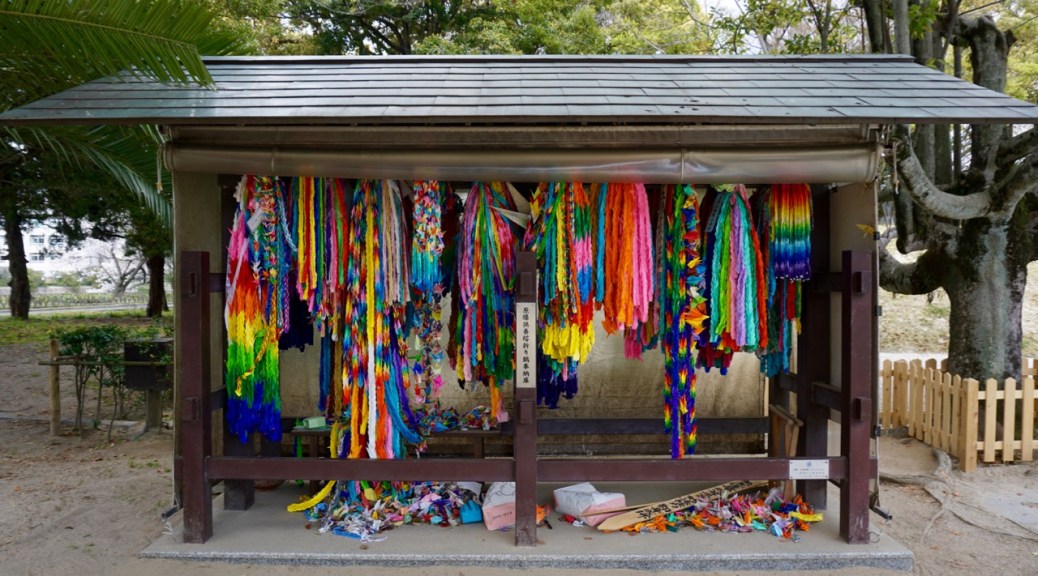
Hiroshima Peace Memorial Park – April 2019