
Category Archives: Education

How I Work with Students

Several weeks ago, I had the opportunity to speak with a group of education students at the university where I did my Bachelor’s degree. The professor was one of my advisors when I did my Master’s elsewhere and we bonded immediately over having the same advisors once upon a time, her as a PhD student and me as an undergrad. She’d invited me to Skype with her class about teaching overseas.

As I talked, I realized that I knew a few things. I realized that I’ve come to both understand and actualize, to the best of my ability, how I view my role as an educator.

To summarize: Working with students is a social contract in which I am responsible for helping young people succeed.

To clarify: Success does not have a single meaning. Social contract may not even have a single meaning; rather, it means that I walk out the gate every day knowing that I have done, to the best of my ability, what is right for young people. I owe that to them. Not to their parents. Not to the institution. I owe that to the kids.

Nearly three years ago, when writing about education became important to me, I articulated my opinions on good teachers. But there are some important elements that I missed, things that have become clearer to me as I’ve gained life experience.

I think that my work with students can be divided into three broad categories:

  1. Positive rapport
  2. Structure
  3. Tools

Positive Rapport

I care deeply about my students, both as classroom learners and as people. My students are people first (aren’t we all?) and we happen to spend time together in a classroom. This comes with constraints, rules, responsibilities, and expectations for all of us. But they know, and I know, that their experiences, their hopes and dreams, their insecurities and fears, are what drives the work that we do. That’s what drives the relationships we have.

I know who’s taking the SAT over the weekend and I know who went out to dinner because I ask and they tell me. When I mentioned that my arms were sore, they reminded me that I’d gone climbing several days earlier. They’d remembered.

When I talk excitedly about books, some students go out and buy them. When a student recommended a novel, I got a copy and read it. We laugh and we joke and after knowing each other for long enough, we tease a little bit. Because we really are all in this together.

Recently, a student asked me to look over a creative writing assignment. I’d never heard his writing like that before and was touched that he’d shared it with me. Another student sat with me last week to set up a study calendar. Three students in the last two weeks have come to talk about social dilemmas and others spend time in my classroom during break times because they know they can.

And I’m not always friendly, not at all. In fact, students usually characterize me, or so they tell me with smiles on their faces, as intimidating. But they know where my heart is and that makes a difference. Reputations are built. This matters.

The rapport I develop with young people, then, is possible because of attention to the next two categories: structure and tools.

Structure

I spent part of the weekend in a workshop about assessment and I was shocked at how new it seemed to so many people. It made me wonder what happens in their classes. It made me wonder about the learning experiences of their students.

Students report being comfortable in my class because they know exactly what is expected of them. I’m meticulously organized, which makes it easy for them to be so. I have a deep understanding of both content and what actually matters so I can guide my students through it. This matters.

At the end of the day, my job is to prepare students for the IB exam they will take at the end of grade 12, but my goal overall is for students to understand more about who they are and what exists in the world around them. My students know this because we talk about it all the time.

Class is organized and we operate in a very specific way. There’s predictability, consistency, and explicit attention to why we’re doing what we’re doing. It’s a lot easier to put pieces together when you know where you’re supposed to end up. And it’s easy to trust someone who has handed you a map and makes sure you know how to follow it.

This is not to say that students don’t find themselves stressed and anxious. On the contrary, they very much do even though it doesn’t come directly from me. But we talk about good stress, bad stress, and stress management. We explore the myths and pressures that come from “somewhere out there” and talk about what is realistic and what is important. And if today is a bad day, we talk about what to do differently tomorrow.

The point of today is to learn from the successes, errors, and experiences of yesterday and that’s what we do. That’s what we do every single day.

Tools

Over the years I’ve learned where students struggle and with what. I’ve been working to understand why they run into problems and I’ve reorganized objectives, assessments, and lessons to address these problems. I’ve talked openly with my students about what I notice and ask for their input. I’ve tried some of what they suggest and solicited feedback about what we’ve done together. I know what the most successful students do and I willingly share what I know.

I also know, because I’ve asked, what each student’s goals are. We have a “how far should we push?” conversation every now and then, and sometimes the answer changes. My students are honest with me because I demand it of them, because I am honest about my concerns and what I understand about who they are and what they want.

My students have a toolbox and I have one, too. The trick is figuring out what they do that works and what I can supplement. And yes, there are standard tips and tricks. There are ways that I, the teacher, know will work better. Sometimes it’s fine to let students play around and figure it out. Other times, however, it’s my responsibility to tell them to do it this way for this reason. It depends on the stakes, the goal, and the reason behind the learning.

And when something goes wrong the conversation begins with, “What did you do to prepare this time?” and leads to, “What can you do differently next time?” while addressing concerns, areas help is needed, and what else is going on in students’ lives. This matters.


So this is what I know. This is what I do. These are the elements of good teaching that have become clearer to me over time. There is much to be said for what happens accidentally, organically, or unpredictably with young people, but it’s vital to consider what happens when we plan and act with intent. I owe that to my students and this is what I aim to give, every single day.
Words for Students About College

My grade 12 students are applying to college and for the most part, they’re miserable about it. They’re worried about grades and transcripts, letters of recommendation and application essays. They’re worried about class assessment tasks, standardized tests, final exams.

And no matter how often I try to tell them that it doesn’t matter, I understand that to them, it does. When I was 17, applying to college was the most stressful and seemingly important thing I’d ever done, too. I do empathize with my students. Applying to college is the most stressful thing most of them have ever done, but it doesn’t have to be this way. 

I’ve been telling my students to consider the following pieces of advice based on what I know now, looking back over 11 years:

  1. Put yourself in a place you’d like to live. Think about what you want around you, the community you’d like to call home, and the access that place provides for whatever matters to you.
  2. Study something that provides you with options. You can always go back to school, continue your education, and switch tracks entirely. The more options you have, the easier it is to change your mind and do something else.
  3. Consider your passions and the best ways to find fulfillment – and then consider what you need to be able to do that. Financial security? Free time? A level of autonomy? We encourage students to follow their passions, but I’d argue that it’s more important to set yourself up to be able to do that in the long run.
  4. Remember that formal education is an option, not a requirement. It’s a choice. Take a gap year. Get a job. Go somewhere new. And then decide whether formal education is the best way to set yourself up to live a good life. Higher education isn’t going away.
  5. Figure out how you learn best. Figure out what you need to sustain yourself in an environment that drives you. Do you need a 9-5 job to afford to spend your weekends surfing? Do you need to live in a specific country? Do you need to be part of a think tank to have meaningful discussions?

I’m not saying these are the right questions for everyone, but I do believe they merit some thought. Higher education is the default option for the students that I teach, as well as for many students worldwide. I don’t think this is always appropriate, if for no other reason than we don’t often consider alternatives. We also don’t often consider why higher education is the default.

Asking questions is a step in a different direction, and hopefully in the right one.

A friend described his life path to me as “a bowl of spaghetti” and he’s one of the most interesting people I know. I followed a very linear path until I got scared and jumped off it; I’m a better person and educator as a result. Linearity and predictability are safe, easy, and obvious but there’s a lot more to the world than that.

Antisemitism Among the Internationally Minded

“How much is a taxi to the airport? I have to pay it myself. My school doesn’t give me a per diem.”
“Oh that’s too bad. Why not?”
“It’s a Jewish school so they’re stingy.”
“Hey!”
“Well that’s how they make all their money.”

And then we made eye contact and she looked away.

My only contribution to this conversation was the interjection, “Hey!”. I’m not sure whether it was enough. I’m never sure.


I’ve spent the last three days at an IB professional development workshop for the DP Psychology course that I teach. People came from all over – Singapore, Indonesia, China, Nepal, India, New Zealand, Hong Kong, and Abu Dhabi were represented among 24 psychology teachers. And that’s just where they teach now; where they’re from is a completely different list.

Context is important here. What I like most about the IB, and what gives me legs to stand on when discussing controversial topics, is its mission:

The International Baccalaureate aims to develop inquiring, knowledgeable and caring young people who help to create a better and more peaceful world through intercultural understanding and respect. . . .
These programmes encourage students across the world to become active, compassionate and lifelong learners who understand that other people, with their differences, can also be right. (emphasis added)

To this end, the IB highlights international-mindedness throughout its programs, though the way this actually looks is heavily discussed and debated. The point, however, is that this is who we’re supposed to be as an IB community. We’re supposed to be internationally minded, emphasize intercultural understanding and respect, and accept difference.

I’ve seen antisemitism all over the world and it no longer surprises me. But I was taken aback to see it in a woman about my age, also a traveler, who teaches a psychology course that includes a sociocultural unit. She’s obviously frustrated at having to pay for what was likely a required workshop, so I’m not questioning that. Frustration is why she made the claim – we blame others when things that we don’t like happen to us. My question is why the claim was antisemitic in the first place.

Since she teaches at a Jewish school, she knows more than nothing about Judaism and she knows Jewish people. She likely has Jewish friends, even if they’re friends just at work. This means that I can’t use ignorance as an explanation, which is usually the excuse that I give people. Ignorance is lack of knowledge or lack of information and that’s clearly not the case.

As a teacher of psychology, she is familiar with Henri Tajfel’s work on social identity theory, which, ironically enough, stems from his experiences of persecution during the Holocaust. In short, we compare ourselves to others and categorize ourselves into groups in order to boost our self-esteem. “We” are the in-group and “they” are the out-group. “They” are this and “we” are not. “We” do this and “they” do not. Etc.

Much of our group categorization is unconscious. We are not necessarily aware when this happens because the brain naturally categorizes things in order to simplify and streamline our thinking. As a teacher of psychology, she knows about cognitive biases, which are mental shortcuts that the brain uses to make sense of the world around us. We’d never be able to make any sort of decision if the brain first had to process every possible option.

Stereotypes are also linked to implicit associations, generalizations that the brain makes based on patterns. Again, we don’t realize this is happening. Harvard University’s Implicit Association Test, which I do with my students, can be enlightening. Sometimes these associations, or biases, have little impact on our interactions with others but sometimes they can be quite significant. As I discuss with my students, having implicit biases is normal. Checking yourself when you come to a snap judgement is what it means to be mindful before acting.


To summarize, it is troubling to me that a psychology teacher in a global program with a mission to value international-mindedness, intercultural understanding and respect, and acceptance of difference made an antisemitic comment. I don’t have an explanation for this teacher. She should know and teach everything I’ve just described. And if she hasn’t been doing that, we just spent three days discussing it. She should understand this in her own life and adjust accordingly. And maybe she will.

So why the antisemitic comment? The nagging voice in my head says that some people are just antisemitic. Some people are just racist, biased, discriminatory, prejudicial, xenophobic even when they know better. Sometimes this comes from fear or uncertainty. Sometimes this comes from prior negative experience. (As one of my friends would say, “Sounds like textbook human.”)

Haven’t an explanation doesn’t rectify or excuse the behavior, but perhaps it can suggest ways that allow us to respond constructively. And perhaps, since this woman didn’t check herself but was ultimately checked, this particular comment can be a learning experience.

It is heartening that no one else in the room engaged with her comment at all. The conversation moved on immediately, which is a perfectly appropriate response once someone speaks out and the other backs down. It seems plausible that most people in the room recognized the bias, prejudice, and stereotype behind this comment and knew it to be wrong. In light of that, maybe we’re doing okay at building a better, more peaceful world.

But in light of that, we cannot pretend the work is over.

Courage is the price that life exacts for granting peace. – Amelia Earhart

P1080876
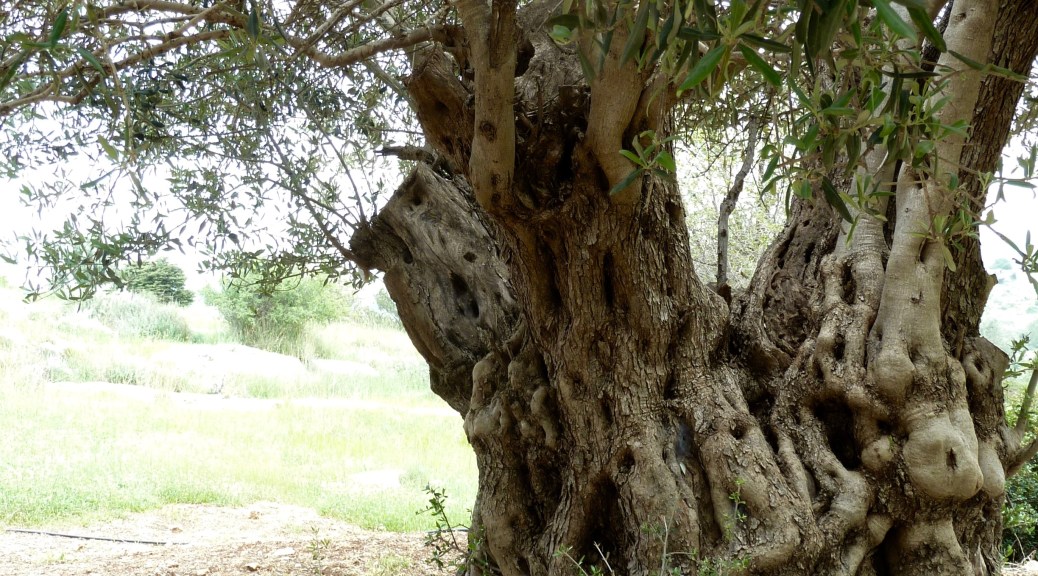
An olive tree in Neot Kedumim, Israel – March 2017