

Category Archives: Education

Why (and What) I Read

Until a couple years ago, I read almost exclusively fiction. I read for pleasure and to pass the time, to embark on an adventure to worlds I would never inhabit. I love historical fiction (i.e. The Red Tent by Anita Diamant, The Help by Kathryn Stockett, The Other Boleyn Girl by Philippa Gregory, People of the Book by Geraldine Brooks) and just about anything with a hint of magic (i.e. JK Rowling, Haruki Murakami, The Time Traveler’s Wife by Audrey Niffenegger, 11/22/63 by Stephen King, Ready Player One by Ernest Cline). I love exploring other worlds, people, places, times. I love feeling part of something that I’m not, something I will never see.

Losing track of time in a good book is an escapist behavior, one that always leaves me feeling more whole than I did when I started. There’s beauty in the pages of books; beauty, truth, and perspective on what does or does not matter. I’ve reread some of my favorite books dozens of times, particularly in times of difficulty, great upheaval, and challenging emotions. When the real world is too painful, it’s comforting to curl up with a world that I know and an ending I can trust.

But in more recent years, beginning around the time I finished my Master’s degree, I found myself greatly interested in nonfiction. My nonfiction reading had previously been course texts and research articles, some of which were terribly interesting. (Others . . . not so much.) When I finished grad school, I realized that I missed the reading that made my brain work a little harder. I missed reading that forced me to draw connections between what I knew from personal experience, empirical evidence, and prior reading. I missed learning new things and drawing more nuanced conclusions about how and why the world works the way it does. So I started picking up more nonfiction, which was initially daunting because of how much there is to read! I discovered that I enjoyed biology and neuroscience more than I had in school, was less enthralled than I used to be with historical tomes, and gravitated towards texts that explained people and ideas rather than places and things. (And yes, I understand that people, ideas, places, and things are related and not mutually exclusive.)

And what I found in that world of nonfiction has had an impact on my thinking, interactions with others, eating, daily routines, career and personal goals, and hopes and dreams. The nonfiction I’ve read especially in the last two years has provided me with knowledge, data, and facts that inform my observations of the world. It has helped me make sense of the patterns, incongruities, and possibilities that I see, seek out, and question.

Reading nonfiction has made me more eager to ask questions because I am constantly humbled by how much I don’t know. It has made me willing to admit ignorance and then prompted me to seek out answers. This path is very much a rabbit hole and I continue to find more twists and turns than I expect. I feel a swell of pride when I recognize studies cited in multiple books because I’ve read those studies and the books that explain them. There’s a little bubble of delight that comes from familiarity with an incestuous family of academics who have all the dysfunctional tendencies of most biological families.

My students often ask me why I know everything, which couldn’t be any less true. I tell them that I’ve just lived longer than they have. I tell them that I read a lot. I tell them what I’m reading. I tell them when I don’t know an answer and I tell them when I find out that answer. I answer their questions with a level of detail that is probably over their heads, but I hope the details prompt more questions. That’s how it is for me. When ideas are challenging, I find myself slowing down, looking up more words, spending more time clicking my way through Wikipedia hyperlinks and Amazon recommendations, finding more podcasts to listen to and blogs to follow. Encountering challenging ideas reminds me that there’s so much more out there and encourages me to continue exploring.  

So, since we’re somehow halfway through 2017, I thought I’d put together a list of what I’ve read so far this year. The books are listed in order of most recently finished. The five with asterisks and authors in red are the most important books I’ve read so far in 2017. Those with asterisks and authors in purple are fiction, still my greatest escape from the world. Have a look. Maybe you’ll find your next favorite! 

***Jonathan Livingston Seagull – Richard Bach
***Blended: Using Disruptive Innovation to Improve Schools – Michael B. Horn & Heather Staker
Democracy and Education: An Introduction to the Philosophy of Education – John Dewey
On Tyranny: Twenty Lessons from the Twentieth Century – Timothy Snyder
Cultivating Humanity: A Classical Defense of Reform in Liberal Education – Martha C. Nussbaum
***Cat’s Cradle – Kurt Vonnegut
The Courage to Be – Paul Tillich
***2BR02B – Kurt Vonnegut
Moving Toward Global Compassion – Paul Ekman
Read This If You Want to Take Great Photographs – Henry Carroll
Hidden Figures: The American Dream and the Untold Story of the Black Women Mathematicians Who Helped Win the Space Race – Margot Lee Shetterly
Emotional Agility: Get Unstuck, Embrace Change, and Thrive in Work and Life – Susan A. David
The Shipwrecked Mind: On Political Reaction – Mark Lilla
Thinking, Fast and Slow – Daniel Kahneman
Superintelligence: Paths, Dangers, Strategies – Nick Bostrom
Word by Word: The Secret Life of Dictionaries – Kory Stamper
***The Portable Atheist: Essential Readings for the Nonbeliever – Christopher Hitchens
Born to Be Good: The Science of a Meaningful Life – Dacher Keltner
Homo Deus: A Brief History of Tomorrow – Yuval Noah Harari
***The Nun’s Story – Kathryn Hulme
Moral Tribes: Emotion, Reason, and the Gap Between Us and Them – Joshua D. Greene
Flow: The Psychology of Optimal Experience – Mihaly Csikzentmihalyi
***Tropic of Cancer – Henry Miller
Good Citizens: Creating Enlightened Society – Thich Nhat Hanh
Modern Romance – Aziz Ansari
***Caring: A Relational Approach to Ethics and Moral Education – Nel Noddings
Simone Weil: An Anthology – Simone Weil
The Wisdom of Insecurity – Alan W. Watts
***The Three Musketeers – Alexandre Dumas
The Better Angels of Our Nature: Why Violence Has Declined – Steven Pinker
The Importance of What We Care About: Philosophical Essays – Henry G. Frankfurt
***How to Spend $75 Billion to Make the World a Better Place – Bjørn Lomborg
***World Class Learners: Educating Creative and Entrepreneurial Students – Yong Zhao
Sapiens: A Brief History of Humankind – Yuval Noah Harari
Political Order and Political Decay: From the Industrial Revolution to the Globalization of Democracy – Francis Fukuyama
The Hero Handbook – Nate Green

I’m currently in the middle of a novel, Invisible Man by Ralph Ellison, and Behave: The Biology of Humans at Our Best and Worst, a neuroscience book by Robert Sapolsky. Both are rather long and having been taking me some time to read, but I’m enjoying them very much.

If none of the above inspire you, my 2016 reading list is here for your perusal. You can also follow me on Goodreads to see what I’m reading as the year continues. Click on bookshelves and take a look! Happy reading!

Julian

A Toolkit to Improve the World

In much of my past writing on education, I discuss the need for experts at living who are caring, compassionate global citizens who aim to make the world a better, more peaceful place. Experts at living would be creative and critical thinkers, effective problem-solvers, and dedicated to altruism in order to benefit humanity. Reframing schools in terms of problem-solving would expose students to the myriad problems and suffering that exist, and provide them with experience and practice developing their expertise. Dealing with these complex problems would have the added benefit of bringing real moral, ethical, and global issues into our classrooms and conversations. This would also create opportunities for dialogue, an essential aspect of conflict resolution.

In order to build a better world and create experts at living, schools need to provide students with a clear set of values that will act as their “toolkit” for making the world a better, more peaceful place.

The values that I will discuss below – cooperation, altruism, empathy, compassion, and caring – come from an unfinished book that I began writing with a colleague over a year ago. We’ve taken a hiatus that was longer than the time spent writing, but I would like to restart; I think we have some important things to say. Consequently, this blog post is intended to introduce to some of our ideas to a real audience to gauge how our work resonates and where we need additional thought. For purposes of the post, I’ll leave out the research (though there’s extensive evidence supporting all of these ideas) and include a list of further reading at the end.

The Values “Toolkit”

Cooperation
Neuroscience tells us that humans have evolved cooperative behaviors in order to survive as a species. Being able to communicate with each other, work together, and help one another has made the growth of civilizations possible. It has also created the prosperity that is far beyond anything seen with other species, yet unevenly distributed across the world.

Learning to get along with others is nearly always part of early schooling, often beginning much earlier than formal education. We teach very young children to share and play with others. We want them to work together to accomplish tasks. However, at the same time, we also begin instilling values of competition, with an emphasis on dominating others and being the best of the group. These competitive ideas exist in contrast to the cooperation that has created human society. We need to decide what message we want to send, which ought to be the message that will have a more positive impact on our world.

With cooperation as a value explicit in schooling, we could ensure that children left school understanding that cooperation is what makes the world a better place. We need classrooms, lessons, activities, and interactions that cultivate cooperative behaviors and emphasize the importance of cooperation. This way, students would come to understand that their actions can help us all have better lives.

Altruism
In order to make the world a better place, we need to help our young people develop into adults who identify as helpers, people who believe that assisting others is their responsibility. We know that children and young people behave altruistically and help others without prompting; there is empirical evidence alongside individual personal experience to prove it. As social creatures dependent on one another, it is also in the best interests of all people to help those around them.

Working together and helping those in need generally makes people feel good about themselves and what they’re doing. People of all ages look for volunteer opportunities. Knowing that, it is only logical that altruism should play a central role in our classrooms in order to purposefully develop it as a value that we deem important. We must capitalize on the helping tendencies already present in young children to help students see that their altruistic actions can positively impact and ultimately change society.

It is deeply part of what makes us human to be able to both cooperate and show concern for the well-being of others. Without these truly human qualities, we would not survive as either a species or individuals. Recognizing this allows us to more fully embrace them and encourage these values within schools and education. We want to build a world that emphasizes deep, meaningful altruistic relationships with others so that we are all better off.

Empathy
Empathy requires us to put ourselves in another’s shoes and act accordingly, whether as a result of our feelings about the other or about ourselves in a reversed situation. Empathy takes practice. Students need to first learn to recognize that others may be feeling a certain way and then determine how to respond in a variety of circumstances. Finally, they need to learn how to communicate with those around them, particularly in cases of disagreement. Empathy will help guide students’ understanding of one another during periods of conflict, which will have an overall positive impact on their interactions.

Therefore, putting students in situations in classrooms and amongst peers that work to develop kindness will enhance the empathy that they feel for others. This will ultimately impact the choices students make when making decisions that affect those around them. Empathy also plays a role in forgiveness, which is clearly tied to creating a better and more peaceful world. If we are able to forgive others for their actions against us, we will be more inclined to cooperate and work towards the benefit of all humanity.

Practicing empathy is an essential aspect of developing citizens who work to enhance the well-being of others and strive to make the world a better and more peaceful place for all. It forces us to consider others’ needs and the value that each individual has in society. If we want our students to develop values of empathy and caring for one another, adults must demonstrate them as a central tenet of our daily interactions. We need to act in ways that emphasize our human-ness, which means working to help each other in all that we do.

Compassion
Compassion for all living beings requires us to encourage students to look beyond their everyday lives and towards the world as a whole. We need classrooms, books, lessons, and activities that emphasize the importance of care and compassion for others, as well as the desire to cultivate happiness for others. Our students need to become more open-minded and more concerned with those around them. The more we do in schools to help students think, feel, and act compassionately, the more they will behave that way on their own.

Emphasizing compassion in our students is an essential aspect of developing citizens who care about others. Students must come to understand that they are part of an interdependent human society. Thus, their actions and behaviors have an impact on others and on the world. With this foundation, having compassion for others will positively impact students’ work in and outside of school to make the world a better and more peaceful place.

If we want our students to become citizens who participate in democratic societies, work towards peace, and care for all sentient beings, we need to help them understand that their actions now can and do have an impact on the future. Focusing on how to alleviate suffering can and should be an element of daily activities in schools. Recognizing the role that compassion plays in improving the world means that it should be nurtured and developed to help us reframe education to create a better and more peaceful world.

Caring
The necessity of caring for both others and oneself is vital if we are working to solve the world’s biggest, most pressing, and most important problems. We cannot solve these problems if we operate solely along individualistic lines. We must teach students to care about others if we want to make any impact at all. Care must be infused as a value throughout our education system as well as our society.

Creating cultures in school that mirror our hopes for society means that there will be congruence between what we communicate to students and what they actually see and experience. Far too often, there is little to no follow-through on the messages that we claim to send. If caring is not a central tenet of how students are treated and how they treat one another, we cannot shift schools into a system where we focus on the good of humanity. This is important for all students in all communities, but especially in circumstances where school provides the caring that might be lacking in other environments. All students need to believe that just as they are cared for, they can care for others.

We want our students to live in a world that is better than our own, which means that we must emphasize caring among, between, and for others in all that we do. This is how we will ensure that students leave school with the qualities that make us human. We need to emphasize caring in order to create a society and culture that value all sentient beings and collectively seek to make the world a better, more peaceful place.


All sentient beings deserve to live in a peaceful, sustainable world with minimal suffering. With their central role in developing the next generation of leaders, schools are particularly suited to this task. Creating a better world is far more worth our time than assessing students’ abilities to take multiple-choice tests. Educators should embrace this responsibility and seek to promote it in their schools.

We live in a world that is changing faster than the world has ever changed, and we are currently not providing our students with the tools to work within the new world that we will all inhabit before we know it. A guiding framework of core values – cooperation, altruism, empathy, compassion, and caring – can act as a starting point for schools and education systems that are truly dedicated to improving society.

Further Reading

Why I Went to Work on International Women’s Day

I didn’t intend to write this post.

And then my eighth graders asked some questions and I realized I was missing an opportunity to explore the complexity of what it means to be a woman and educator in today’s world.

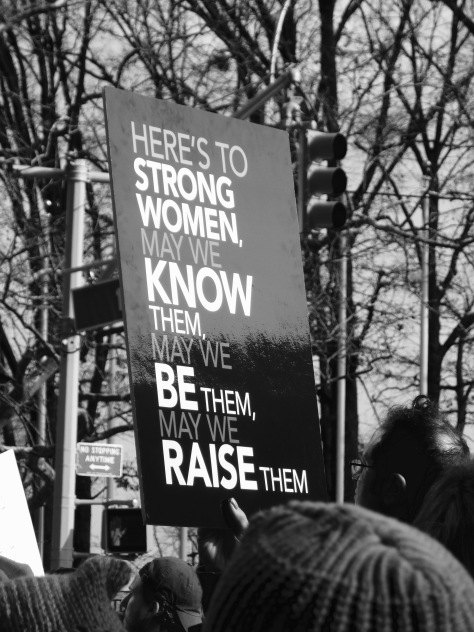
As my students noticed, I did not participate in A Day Without a Woman on Wednesday, March 8. I did not participate in the demonstrations in New York City. Instead, I went to work.

This lack of participation is a sharp contrast to my activism in the Women’s March back in January, and my students were curious about it. Many of my eighth graders read this blog (and ask me about it in class when they’re supposed to be working on other things) so this post is for and because of them.

p1080681
My favorite sign from the Women’s March in January

The Question
A number of my students come from households that talk politics. Some of them come to class echoing their parents’ conservative or liberal views, others come with questions, and still others want to be involved in the conversation but don’t know where to start. I  don’t openly discuss my political views with my students, but I’m also not completely closed off when political questions intersect with deeply held personal views.

On Thursday, March 9, the day after International Women’s Day, two young women who usually present very different political narratives quietly and separately asked me, “Why were you here yesterday? I was expecting you’d be at a protest.”

I was surprised because I hadn’t even considered skipping school to demonstrate or protest. My identity as an educator is such that I feel a sense of moral responsibility in being there for my students to guide their learning. That is what I tried to convey in my answer to both of those young women on Thursday.

The Answer

That’s a really good question. The way I see it, my job is to make sure that you’re learning. I know that I can best do that when I am here helping you learn and guiding you along. When I’m not here, I have to leave that task to someone else. Yes, someone else can do it, but I know what my goals are for you and I know what I’m doing to help you reach those goals. My not being here is potentially harmful to your learning. So, to be the best teacher I can be, it’s important to me to be here with you.

I understand why some women made the choice to protest. I understand why it’s important to show the country what happens when women are silenced and shoved aside. But I think that an alternative way to demonstrate that is to be here with you and talk about it. So I support those women who didn’t go to work. I support their decision to make their absence felt. It just doesn’t fit with my job right now. I have a different agenda, which is to do what’s right for you.

The girls nodded. Both expressed their surprise and understanding. One of them told me she respected that decision.

In truth, the more I think about it, it’s far more complicated than that.

The Challenge
The challenge for me is to “talk the talk and walk the walk”. It’s all well and good to say that I support women who took time off work, either paid or unpaid, to stand in solidarity with other women on Wednesday. However, I did not take time off work. I did not physically stand in solidarity with women. Do my actions speak louder than my words? If so, do my words of support still count?

If I want to be a role model for my students and do what is right, am I obligated to stand up on behalf of women and join them in protest? Or is sticking to my beliefs about education modeling in itself?

I’m not sure.

I could be giving myself far too much credit as essential to my students’ learning. I know they could have gotten through a day without me and that the day would not have been a loss. So maybe I’m not as important as I think I am, and maybe I could have had a greater impact missing school and joining a protest.

Similarly, there are definitely things I could have done in class on Wednesday to draw attention to A Day Without a Woman. I could have addressed it explicitly and discussed the history of women’s protest with my students. I could have asked if they knew anyone participating. I could have pulled opinion pieces and even footage of protests and demonstrations and we could have had a class discussion on the purpose and effectiveness of protests.

Picking a Side
In truth, I didn’t think about it. Perhaps I should have. Perhaps this was a lost opportunity and my students and I all missed a valuable learning experience. Perhaps this was not simply a matter of another day at school.

Unfortunately, I think that’s all too common in schools. I think we often miss valuable learning experiences because we’re tied to other priorities, whether those are selected for us or by us. I don’t know if I made the right choice in going to work. I don’t know if I made the right choice in spending the day on “normal curriculum” instead of digging into protest in America or wage inequality or women’s issues around the world.

I do know that I’m walking a line between political and personal identities and I’m having trouble finding a bridge. I feel like I’m coming from two almost opposing camps and I don’t always know where they should intersect.

On Wednesday, I chose to go to work and do my job because I felt like it was the best thing I could do for the young people under my care. Yes, there are others who care for them. But I can only control what I do and the messages that I send. It was more important for me to stand by my promise to be present with my students than it was to embrace my role as a woman and skip school that day. At this point, all I can do is recognize that choice for what it is and perhaps consider what other options I might have in the future.

Eighth graders, you ask good questions. Keep doing that.