Category Archives: Travel Guide

Travel Guide: The Negev

The Negev is Israel’s desert and my favorite region of the country. I first visited the Negev on my second trip to Israel in 2013, which was the start of my fantasy of living on a kibbutz by the Dead Sea. I’ve slightly modified that dream based on this trip to Israel and now I think I’d prefer to live on a moshav and work with Israeli and Palestinian children on conflict resolution and restorative peace practices. If my next life plan doesn’t work out, there’s always that!

Having fallen in love with the desert in the past made me even more excited to bring students there on our eighth grade Israel trip. We began with four nights in Jerusalem and then drove to the Negev to hike Masada, an ancient fortress where Herod built palaces for himself in the late first century BCE and where Jews hid after the destruction of the Second Temple. We hiked the winding snake path, built by the Romans in 73CE to reach the hiding Jews. Those Jews, known as Zealots, committed suicide rather than be taken by the Romans. Or so the stories tell us!

It was a hot day and the hike was difficult for many students, which tells me that there’s not enough (or proper or effective) physical education in schools and physical activity in general. The staff on our trip, all of which exercise regularly, had little trouble.

P1090056
I love pictures of waving flags but there was no wind when we reached the top, so this was the best I could do.

To the sounds of prayer and singing at the top of Masada, I wandered off alone to meditate and take some pictures. I love the desert because of its colors and its desolation. Such emptiness makes me feel close to the sky and reminds me that in the grand scheme of the world and life, I am nothing, not even a speck on the trajectory of evolutionary history. Those feelings remind me that my own problems are easy to solve and really don’t matter very much at all.

Guards accompany large tour groups in Israel and it was so interesting to see the different responses of each guard to our group’s prayers that afternoon. Most Israelis are secular Jews but we had Jews of many kinds in and among our group throughout our two-week trip.

That afternoon, we visited the Dead Sea, the lowest point on Earth. It is receding at a terrifying rate of about one foot per year. I noticed the shrinking size of the Dead Sea, which is actually a lake, upon seeing it for the second time in 2013 as compared to my 2007 trip, and it was even more obvious this time. The hotels that used to sit right on the shore are now a short car ride away.

P1090106
Across the Dead Sea is Jordan!
P1090101
Salt from the Dead Sea, which gives it its the Hebrew name Yam HaMelach, or Salt Sea

We spent our two nights in the Negev at Kibbutz Mashabei Sadeh, which had really fun and eclectic decor in front of the reception office:

The following morning we visited Makhtesh Ramon, a geological phenomenon that requires a little explanation. Makhtesh Ramon is often translated as “Ramon Crater”, which is inaccurate. A crater is formed by impact, usually from a meteorite. A makhtesh, however, is formed by erosion and geological changes occurring over hundreds of millions of years. Visiting a makhtesh is basically a journey through evolutionary time. The only examples of a makhtesh are found in Israel’s Negev and Egypt’s Sinai peninsula.
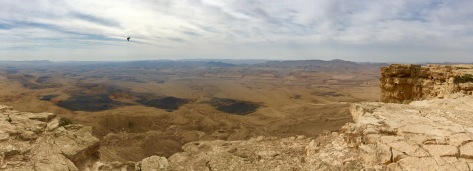
img_3491

I spent more time at Makhtesh Ramon back in 2013 and took a lot more photos. For your viewing pleasure, and because I love it there, here they are:

The next morning, we visited an alpaca farm that also raises llamas, camels, donkeys, sheep, and other animals. The owners actually brought the alpacas and llamas to Israel from South America and now have an organic farm where they give tours and sell wool that they make on site.

That afternoon, we hiked Ein Ovdat, a desert canyon. By this point in the trip, we had a number of students ill with a stomach virus and others struggling with dehydration so we didn’t climb the waterfall but that’s supposed to be really beautiful, too.

In addition to hiking Masada, no trip to the Negev is complete without a stop at a Bedouin tent to learn about this group of nomadic people who used to inhabit the desert. In Israel today, 100% of Bedouins live in villages and towns so their desert hospitality tents, complete with dinner, a camel ride, and the option to spend the night, exist only for tourism and education. While camel riding is one of those activities that everyone does when visiting Israel, it is simply the Middle Eastern equivalent of elephant riding, the problems of which I learned about on a trip to Chiang Mai, Thailand about 18 months ago. If elephant riding is animal abuse and needs to be stopped, so does riding camels. And considering one of them bit a student and the rest were stubborn, snorting, and protesting the entire time, I’d say the camels more than agree.


We left the Negev after two nights and I was sorry to say goodbye. The desert is beautiful and I hope you make it there someday, to any desert. I love waterfalls and trees as much as the next person, as my post about the north of Israel will demonstrate, but the desert is special. It’s nothing and everything all at once.


Travel Guide: Jerusalem

I recently had the pleasure of chaperoning a two-week trip to Israel with the eighth grade class at my school. The purpose of the trip was to develop strong cultural connections with Judaism and the land of Israel, celebrate their B’nai Mitzvah together as a grade, and form new and better friendships with their classmates. Based on the reflection that the guides led on final night, I’d say that mission was accomplished.

Many organized trips to Israel like ours cover the three regions of the country; the north, the south, and the central region, which includes Jerusalem and its surroundings. We spent the first four and last three days of our trip in and around Jerusalem, and that’s what I’ll walk you through in this post. Stay tuned for the others!

We hit the ground running after a 12-hour flight that landed at Ben Gurion International Airport at 6:30am! Despite kids’ pleas to go to bed, we headed to Neot Kedumim, a biblical garden and land reserve that highlights animals, plants, and plant products mentioned in the Old Testament.


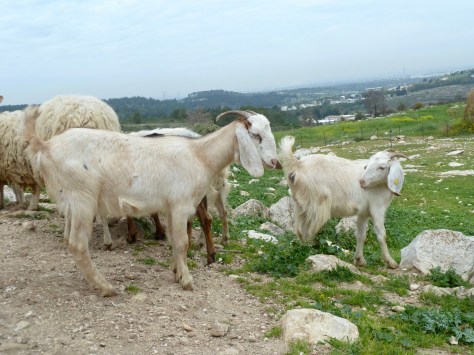
Highlights included herding sheep . . .

P1080870

. . . and planting trees, a vital part of every first trip to Israel as a way of “giving back” to the land and contributing to its continued prosperity.

P1080881

It was the first trip to Israel for many of our students and we spent some time singing and celebrating on the Talpiyot Promenade that overlooks the Old City.

P1080886

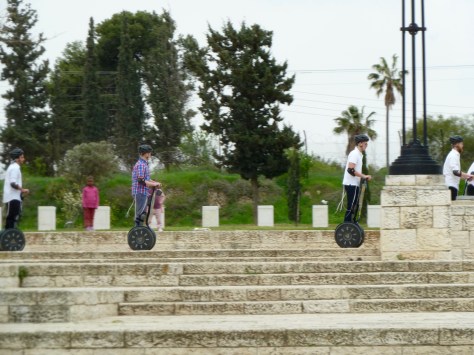
This was also a perfect location to experience some of Israel’s idiosyncratic juxtapositions of religious and modern life.

P1080893

We spent most of the following morning at the City of David, the archaeological sites that date back to the Second Temple period (about 530 BCE-70 CE). Attractions included a walk through Hezekiah’s Water Tunnel, an underground tunnel built in the 8th century to protect Jerusalem’s water from Assyrian invaders. As it was a bit chilly that day, I opted to wait outside and take pictures overlooking the Old City, but my students said it was a lot of fun.


We also visited the Davidson Center, which is a museum dedicated to the ongoing archaeological excavations around the Temple Mount area of the Old City.


No visit to Jerusalem, at least for Jews, is complete without a visit to the Kotel, or Western Wall, part of the ancient retaining wall of the Second Temple. Most of the wall is reserved for men and therefore all of my pictures come from the women’s section. The segregation irritated me more this time than it has in past visits to Israel. There’s something truly fundamentally wrong with separating men and women because of invented notions of purity.


We walked back through the Old City as the sun was setting. It was beautiful.

P1080985

The next day we visited Beit Guvrin, an active archaeological dig that is a lot of fun no matter how many times I’ve done it. There are so many artifacts yet to find! Spelunking there is great, too, because some of the completed excavations are best experienced in the darkness by candlelight. This time, we visited a columbarium dating back to 200BCE! And the park itself is beautiful.


After celebrating Shabbat together in Jerusalem, we went to the famed Ben Yehuda Street to eat and shop. I bought some gifts and had a delicious and overpriced falafel – my gift to myself!


We returned to Jerusalem for the final two nights of our trip after traveling through the country. Our first stop when we got back was to Latet, an organization that aims to reduce poverty and create a better, more just society in Israel. We volunteered by sorting boxes of food for delivery to needy families for Passover. The kids received very little instruction, someone hooked up an iPod full of Israeli folk songs, and suddenly everyone had organized themselves into groups sorting different food products. In moments, without talking about it at all, everyone knew who was packing boxes of canned vegetables, grape juice, matzah, chocolate spread, and others. There was so much excitement and energy in the room, cheering as boxes filled, laughter as we threw food products to one another (until we smashed a wine bottle and had to clean that up . . . and then promptly continued), and genuine joy in the work we were doing. We participated in two service projects on our trip and I absolutely loved both of them. Doing service work with students is high on the list of my favorite things.

The same day, we visited Yad Vashem, Israel’s Holocaust memorial and museum. Our visit started in the Avenue of the Righteous Among the Nations, the area of Yad Vashem that honors non-Jews who saved Jews during the Holocaust. Remembering that there were people, however few and far between, who risked their own lives to save others is the only way to go through the rest of the memorial without losing all hope.

The museum itself is designed to mirror the darkness of Hitler’s rise to power – you are literally underground in a close, constrained environment. Yad Vashem does not allow visitors to freely walk from one room to the next. Instead, all must pass through each room in turn, zigzagging across a long hallway the way Hitler’s persecuted people had no choice of where to go or how to get there. By the time the war ends, visitors are at ground level and the museum opens to a beautiful view of the world outside. Unsurprisingly, most students were especially moved by the Children’s Memorial. The fact that it even exists is enough to say about it.

But two days later, we visited Yad LaKashish, a beautiful contrast to the Holocaust. Yad LaKashish is an organization that teaches the elderly different types of crafts, like metalworking, bookbinding, jewelry making, and silkscreening. The artwork is then sold in the gift shop to finance the whole program. The artists love visitors, especially young people, and they make truly beautiful things. I was not alone in wishing aloud that I had any artistic ability whatsoever. Clearly it’s never to late to learn!


That afternoon, to bring the story of Zionism to a conclusion, we visited the Herzl Museum and reviewed much of what we’d learned in social studies class (a nod to my department – we done good!) prior to the trip about the Dreyfus Affair, Theodor Herzl, and the origins of the idea of a Jewish state.

Our final evening was spent reflecting on what we’d learned and experienced, thanking all of those who had been part of the trip, and enjoying one another’s company before heading to the airport in the wee hours of the morning.


I love Israel because it feels like home. This was my third time there but that feeling was present within me from the first moment I landed at Ben Gurion International Airport back in 2007. There’s an unspoken understanding among Jews in Israel, and this is most certainly a sign of privileged status in the country, that you’re welcome to visit, to explore, to ask questions, and to call Israel home. I did a lot of exploring this time around. I asked a lot of questions, specifically about the relationship between being religiously Jewish and culturally Jewish. Israel answered a lot of the questions I’d been asking before the trip and as always, I left wanting more.

Stay tuned for my posts on our time in the south, my favorite part of the country, the much greener but equally beautiful north, and the vibrant city of Tel Aviv.

Travel Guide: New Orleans, LA

Prior to leaving on this long weekend with my mum (the first time we’ve traveled somewhere together!), I had the following conversation with more than a few friends and colleagues:

Curious person: Oh cool, New Orleans! Are you going for Mardi Gras?
Me: No, that’s not until next week.
Curious person: Oh right, of course.

To all of you who asked such a good question, I owe you an apology. I was completely wrong and you seemed to believe what I said without question (likely because I go a lot of places and do a lot of things and usually sound pretty confident when I speak, the latter of which is largely smoke and mirrors anyway). Mea culpa. Lessons learned: Factually, trust no one (as aptly phrased by a friend) and always, always research.

The Mardi Gras season, as the extremely friendly and hospitable New Orleanians (I may have made up that word) told me, runs from Epiphany in January to actual Mardi Gras day (Fat Tuesday). As the locals explained it, Mardi Gras is an excuse to do as much sinning as possible for 5+ weeks in order to have something to atone for over Lent.

So yes, I was in New Orleans for part of Mardi Gras. And it was amazing. There were parades everywhere at all times of the day and night. Most of these photos are from the Krewe of Cork parade in the French Quarter:

My mum and I thoroughly enjoyed collecting as many beads as we could and ogling in astonishment at the parades, costumes, and general debauchery, especially on Bourbon Street. There are no open container laws in New Orleans, which was a lot of fun and probably explains much of what we saw:

More importantly, we learned a lot about the rich history and culture of New Orleans, which has been Spanish, French, and American throughout its history, creating Creole and Cajun cultures that give the city a flavor and a pulse unlike anything I’ve ever experienced. The food is darn good, too, and this is coming from a vegetarian. If I was impressed, omnivores will be even more so.

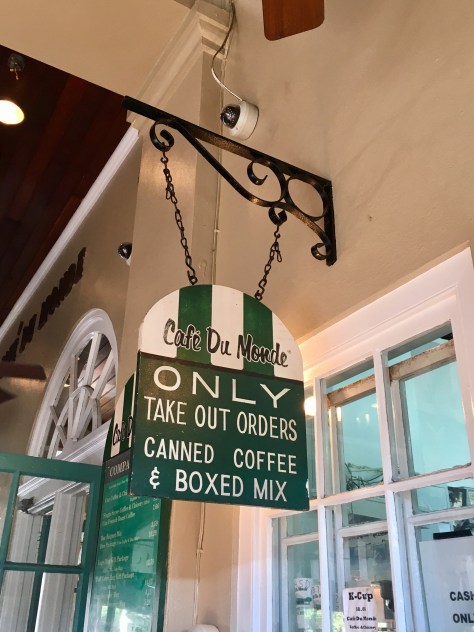
I have to admit, however, that I still don’t like doughnuts. It was a lot of fun to eat beignets and drink café au lait while walking down the street, but I just don’t like doughnuts. That said, I’d still recommend a visit to Café du Monde, if for no other reason than to say you did. We got there around 8:15am on Saturday morning and beat the lines by about a minute. And the café au lait was truly delicious.

img_3242

Mum and I really love wandering along streets and in and out of shops and galleries wherever we are, which is how we spent most of our time. We explored the French Quarter and French Market on our own and also took a French Quarter walking tour to actually learn a thing or two about how New Orleans came to be. We were amazed at the beauty of the streets and buildings, and delighted with the art and music that were everywhere:

Another really excellent walking tour took us through Lafayette Cemetery and the Garden District. There were some incredible homes in the Garden District, with a remarkable diversity of architecture based on sheer whim of the wealthy homeowners.We learned about the burial laws of New Orleans (as long as you wait a year and a day, you can open a tomb and shove another body inside) and some of the history of the city’s wealth from trade. The first burial in Lafayette Cemetery took place in the 1840s and the cemetery is still active, which is really neat:

We also spent one evening on Frenchmen Street where there was jazz everywhere, as well as an art market. The hard part was picking a bar to visit (we chose The Spotted Cat based on several recommendations) and a place to eat afterwards! And then we were interrupted by the Krewe of Chewbacchus parade in Marginy, which was so much fun. Unfortunately, I’m a rather petite person and couldn’t get close enough to the police barrier to take any decent photos of the parade itself. But here’s Frenchmen Street:

On our last night in the city, we took a ghost tour to learn about the haunted history of New Orleans. I’m glad that we did the French Quarter tour first because the histories are obviously intertwined, but I don’t know that I’d seek out another ghost tour. I enjoyed hearing the stories and visiting a possibly haunted bar that doesn’t have electricity, but I got a lot more out of the daytime walking tours. That’s probably not surprising, considering the supernatural is questionable at best.

I’ve always admired the “doors of” posters of various cities that are often on the walls in waiting rooms, so I decided New Orleans was a good opportunity to work on my own collection of “doors of” photos. My favorites, including one set of mailboxes:

The most surprising aspect of New Orleans was the culture of the city and the genuinely open, receptive, and free spirits of all the people I encountered, from the man in the suit to the young couple in togas to the woman wearing only glitter. People playing music on the streets seemed genuinely excited to be doing it and artists hung their work anywhere they could and worked wherever they were standing. Palm and tarot readings were readily available and the voodoo shop we visited could not have been more welcoming; they even suggested a different shop when we couldn’t find what we wanted!

(Full disclosure here: Friends have read my tarot cards twice and palm once, and while I don’t know if I “believe” any of what they said, it sure was telling. And, in hindsight, frighteningly accurate.)

Maybe it was Mardi Gras or Southern hospitality, but there’s something truly wonderful about a place where what is normally considered “subculture” is just everyday being.

img_3374