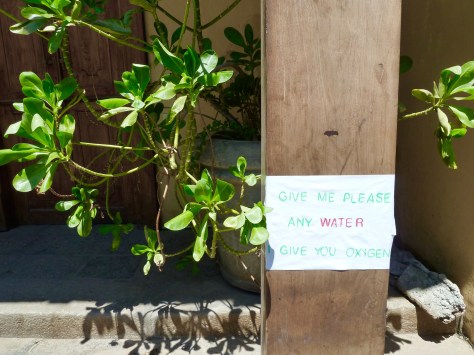
Please Hire Me.

It’s time I made this public: I’m moving again.

Yup, again. I love Singapore and I love my school. I love my friends here and I love the travel I’ve been doing throughout my time in Southeast Asia. More importantly, I love my department and I love the curriculum we’re developing. I am actually excited to develop this curriculum, which is something I never thought I’d say. We’ve made the decision (and been given permission) to completely redesign the MYP Individuals and Societies courses at school and we’re doing it through a lens of sustainable development with a focus on scientifically and morally based problem solving. And it’s really going to happen, which is the coolest part. I so wish I could be here to teach the ninth and tenth grade iterations of this curriculum next year. That would be such a wonderful experience, and I am so excited for all of my colleagues and for all of the students who are going to part of it. I would love to join them.

But I also love a really wonderful man and he’s in New York City. Because of his job, Mitch is likely to be in New York City for a very long time. Our rough estimate is a decade at the minimum before we can even entertain the thought of going elsewhere. For better or for worse, going through the rest of my life without Mitch isn’t an option I’m willing to consider, awesome curriculum or not.

So it’s time to go back.

I made this decision a few months ago and took the necessary HR steps back in December. Most of my colleagues know that I’m leaving, but I haven’t said anything to my students. I have a lot of unfinished business as far as they’re concerned (this curriculum, only developing the first of two years of DP Psych) and I’m not entirely comfortable letting go. I have no doubt that whoever takes my place will be more than qualified. I have no doubt that my very capable colleagues will do brilliant work with the curriculum and really change what we’re teaching and how we’re doing it. And there’s really no reason I can’t continue that reevaluation in my own classroom, wherever it happens to be.

I’ve been looking for jobs for over a month, which I know is not a very long time. I’ve applied to a lot of wonderful schools and even more less wonderful schools. I’m waiting to hear about my application to the NYC public school system. I’m waiting to hear from nearly everywhere I’ve applied. There’s only been one flat-out “no”, but I honestly prefer that to silence. It’s a competitive market, so I’m trying not to be too picky. I’m also trying to find a school that will let me teach and let me do it well.

One day, I’ll find myself back in a progressive school in which I’m allowed to teach what should be taught, not what has always been taught. That’s been the best part about teaching the MYP this year, and it’s only going to get better. We have so much freedom to do what’s right as long as we’re working towards the IB aims of responsible action and creating a peaceful world. And who doesn’t want to do that?

At the moment, I’m not ready for my time in Singapore or overseas to be over. I never really planned on reaching that point, but I haven’t planned on a lot of things. So here’s to the next five months – to making them count.

Travel Guide: Ubud, Bali

To recover from our grade 10 trip to Cambodia and to celebrate Chinese New Year, I headed to the city of Ubud on the Indonesian island of Bali. The stereotypical Bali experience is one of beaches and parties, but Ubud is actually located inland without a beach. This helpful map comes from Lonely Planet:

map_of_bali

I honestly didn’t do much while I was in Ubud and it was fantastic. My very wonderful Airbnb hosts directed me to the Yoga Barn where I bought a three-class pass and thoroughly enjoyed myself. Not only was the studio beautiful, but they also had a delicious juice bar! I took the photos below standing on the deck of Yoga Barn’s complex:

P1060798

P1060799

When I wasn’t in the studio, I walked around town, visited a few must-see sights (the market and palace), ate top notch vegetarian food (Ubud is perfect for those on a health kick with all the yoga and organic restaurants), drank local wine, and wandered in and out of shops.

P1060796
I loved this.
P1060797
Balinese people love beautiful objects. This was set on the sidewalk in front of a jewelry store.


P1060793
Example of the offerings I saw everywhere. There was one in front of my door each morning when I woke up.

Most families live in compounds, each of which contains the family temple. Balinese Hinduism is quite different from the more familiar Indian Hinduism, and I was glad to learn about it from my hosts. All around Bali people were erecting bamboo poles like the one below to prepare for the Galungan celebration, marking the return of gods and ancestors. I saw multiple families sitting outside and around their homes stapling together the bamboo flower decorations that wrap these poles, as well as putting together other offerings like the ones seen above.

P1060901

As I wandered, I took pictures. While many of the photos below are the exteriors of temples, others are family compounds. Many of these, like the one where I stayed, are used in part for guest houses. The hospitality and tourism sector is the primary industry in Bali right now, thanks in part to the artists who came to Bali in the 1980s in search of an “untouched” place for inspiration. Rice farming, which still happens in Bali though not in trendy Ubud, was basically the only industry before the tourists arrived.

The architecture was probably the most interesting aspect of Ubud for me. I loved the stonework and the solidity and stateliness it gave to the city. Ubud felt solid, strong, and anchored in tradition. The more I talked to my hosts, the more I learned how family and religion are the center of Balinese life. In a very old world way, most people know each other, are related in some manner, and have been in their homes for generations. As a result, people are happy and comfortable and crime is relatively low. Add that to the yoga and it is no wonder being in Ubud left me feeling calm and centered.

Ubud Market, on the other hand, is the opposite of calm and centered. It is as cluttered and chaotic as any market I’ve seen, which made it a wonderful spot to take pictures:

Yes, it started to pour shortly after I took these photos. I ran into a nearby cafe for cover.


And that was my time in Ubud. Yoga, food, shopping (I actually made purchases for once!), and wandering. I took it very easy this trip (for once) and thoroughly enjoyed myself. How can you not in a place that has flower patterned sidewalks?

P1060904


Travel Guide: Battambang

This week-long adventure was different from any I have ever experienced. This was my first time in Cambodia and my first traveling internationally with students. I visited Battambang with the entire grade 10 class of my school (about 90 students) along with the seven other teachers. Upon arrival, we joined JUMP!, a very wonderful experiential education social enterprise with which school is currently working to plan the annual field studies trips for all secondary school students. I am in awe of what JUMP! planned and how their plans came to fruition.

But I’m getting ahead of myself.

The focus of the grade 10 week in Battambang, Cambodia’s second largest city, was to get students thinking about community development, both as communities of advisories (groups of about 15 students that meet daily) and global communities. We spent the week learning from and working with different social enterprises that aim to make Cambodia a better place. All the restaurants where we ate were social enterprises, as well. As part of the program, we explored privilege, voluntourism, sustainable development, Cambodia’s history, and how to bring about positive social change. Throughout the week, I saw my students’ hearts and minds open up, not only to these ideas but also to each other as individuals and as friends. I can say without a doubt that every student returned to Singapore wiser, humbled, empowered, and with new friends.

This post will chronicle my week in Battambang as best as I can based on the photos that I can share. Most of my photos for the week were of and with students, and there are a variety of reasons (i.e. privacy, confidentiality, just plain propriety) why I won’t share them in an unprotected online space. Heartfelt thanks both to JUMP! for their incredible work and to John, the extraordinary JUMP! facilitator assigned to my advisory for the week.

To get oriented, here is a very helpful map from Lonely Planet:

map_of_cambodia
We flew into Siem Reap on Saturday and drove the 3+ hours to Battambang the next morning

One of our first activities was a tuk tuk ride to visit Phnom Sampow. We took a difficult climb up a steep hill, pausing along the  way to see Buddhist temples and learn about Cambodian agriculture from our guide. We could see farms for miles from various lookout points.


The temples were exquisite, as well. I have a few Buddhist students who stopped to pray along the way.


We also encountered a number of monkeys and actually had to alter our route at one point to get away from them. Monkeys are vicious and will grab any food item or even backpack in site. My favorite monkey was this one:

P1060457

The highlight of this trip, though not photographed because I felt weird about that, was the killing caves, a site of Khmer Rouge slaughter. The caves contained a memorial to victims, including skulls of those who died there and a Buddha statue for those who wished to pay respects.

Probably my favorite morning of the trip started with a trip to a local market to pick up ingredients for the Cambodian lunch we would learn to prepare! The market was wonderful (and sold more than vegetables, though my photos might have you believe otherwise) and the cooking school was incredibly accommodating to my vegetarian needs. Even better: We received cookbooks to take home!


Another really transformative experience was our visit to COMPED, a social enterprise that collects organic material, turns it into compost, sells it to farmers for fertilizer, and uses the money to run enrichment programs for children. To learn about what they do, we visited a market, collected rotten produce, and shoveled it onto the compost pile at a local dump. While there, we also learned that the families who live on the dump are paid more than they would be in other jobs. Despite health risks from being around burning trash, they choose this life to feed their children.


Another social enterprise, Coconut Water Foundation, also runs after school and summer enrichment programs for students. We joined them at a school for about an hour one morning to play games with some of the students. Rather than sharing pictures of children, here are a few artsy shots:

P1060710

P1060718

Our last full day found my group on a bike ride with Soksabike, a social enterprise that pays families to produce traditional products, therefore putting money into the economy, and brings tourists to see these products. Soksabike’s tour guides are local university students who are working to enhance their English skills as they do their jobs.

Among other things, we learned how rice paper is made . . .

P1060772

. . . and sampled some delicious dried and fried bananas.

P1060777

The final stop on the tour was a very moving memorial to another killing fields site across the street from a Buddhist temple that the Khmer Rouge turned into a prison and interrogation facility. I didn’t have the heart to take pictures of the memorial, mostly because it broke my heart. The 1970s weren’t that long ago, and the Khmer Rouge existed in Battambang until 1991. 25 years ago is not very many years. The detachment with which Cambodians speak about the Khmer Rouge genocide is painful to witness.

I don’t have photos to share, but other social enterprises that we visited and worked with were Phare, FEDA, and Cambodian Children’s Trust. All of these organizations work with and for community development, specifically targeted at children. CCT was the most moving for me because they taught us about orphanages and orphanage tourism. We learned that 80% of children in Cambodian orphanages have living family and are in orphanages (and often exploited and abused as a result) because their families were tricked into thinking their children would have better lives and a better chance at education.

It was a week of growth, that’s for sure. I’ll be back in Cambodia in March to spend a weekend in Siem Reap to visit Angkor Wat. I’m so grateful for the opportunity to travel with my students to Battambang to learn how real Cambodians live. The trip we took and experiences we had would not have been possible for me to orchestrate. JUMP!, thank you for opening my eyes to this beautiful country and its proud, hopeful citizens.

P1060627
At the old abandoned airport one night


Photos, travels, musings, and ideas on education by someone trying to make the world a better and more peaceful place