This is the first of three blog posts that illustrate the week Mitch and I spent in Sri Lanka. You can see the posts for Kandy and Galle here and here, respectively.
Mitch and I met up in Sri Lanka for the week I had off for spring break. Going to Sri Lanka had been in the back of our minds since we met two Sinhalese Sri Lankans at the guesthouse we all stayed at in Langkawi, which was my and Mitch’s first travel experience in Malaysia. When I was in the States back in December Mitch and I spent a considerable amount of time evaluating travel options for this week. We considered a variety of places – Japan, Korea, Nepal, Kenya, Iceland, Latvia – before settling on Sri Lanka because it was relatively halfway (4 hours for me and 20 hours for Mitch, which was better than 17 hours for each of us) and quite affordable (the entire week ultimately cost only $300 more than flights to Kenya). And, of course, we have friends in Sri Lanka. Who we met in Malaysia. Which I just think is so damn cool.
One of these friends in particular, Janitha, was instrumental in helping us plan what we were going to do for the week. He also made sure we were able to work around the Sinhalese and Tamil New Year, which fell during our travels. We had a useful guidebook, Rough Guides, but having a friend is even better.
My flight landed in Colombo a few hours before Mitch’s, so I had some time to explore on my own.
This cracked me up, but should have warned me about Sri Lanka’s attitude towards women.
I didn’t go inside the temple (rare for me, I know) but enjoyed looking at it as I walked around the lake.
The highlight of Colombo was meeting up with Janitha and Jayamin for drinks and dinner (yes, in that order). They took us to a bar at the Old Dutch Hospital (exactly what it sounds like) and then to a restaurant where Jayamin ordered me a plate of cheese kotthu, which, though considered standard local fare, was everything drunk food should always be.
The next day, Mitch and I took our first Sri Lankan tuk tuk ride. Tuk tuks were the easiest and most accessible mode of transport everywhere we went. Janitha told us about a very useful app, Pick Me, to hail tuk tuks in Colombo. It’s basically Uber for tuk tuks and worked really well!
We couldn’t help but notice this “water bottle” in our tuk tuk . . . based on his driving, its contents are questionable.
We wandered through the colonial district to take a look at some of the buildings left over from the Portuguese, Dutch, and British colonization periods:
By far my favorite part of Colombo was our visit to the Pettah, Colombo’s bazaar district. I’ve been to markets literally all over the world and felt so out of my element here! It was big and loud and crowded, divided as it would have been when guilds were in power, and totally overwhelming. I thoroughly enjoyed it, though I would not have been comfortable attempting to haggle over any purchase. I haven’t had a problem doing that anywhere I’ve been in the past, but this felt very different to me, perhaps because of the sheer numbers of scams and general harassment we had encountered by that point (more on that below).
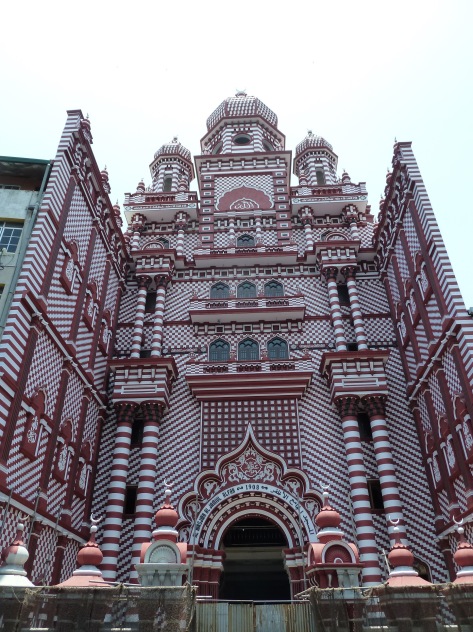
The Pettah district is also home to a stunning mosque:
We spent the rest of the afternoon exploring Independence Arcade (used to be the Colombo Asylum and is now a pretty spiffy mall) and Viharamahadevi Park. I particularly liked that bike rentals were available!
At the end of the day, we watched the sun set from the rooftop of our hotel and enjoyed espresso martinis. Coffee time had passed and we both wanted the caffeine, so we improvised. It worked.
Later that evening, we headed to Galle Face Green to have dinner at a different hotel located by the shore of the Indian Ocean. We could hear and smell the sea and I felt completely at peace. The ocean has always been my happy place.
As this is a travel post, I’m going to close with a note of caution:
Sri Lanka is the only place I’ve been where I wouldn’t have felt comfortable alone. However, even being with a buddy (in this case, a pretty tall guy) didn’t diminish the amount of harassment we experienced everywhere we went. The Pick Me app likely saved us from extortion, just based on how much regular tuk tuk drivers suggested for a rate. The location of one of our guesthouses had disappeared so we had to find a new one. Boys and men hurled dirty comments in broad daylight, regardless of whether I was alone or with Mitch. It was the sexual harassment and its various forms that surprised me the most. I’d definitely still advocate a visit, but I’d also suggest getting out of Colombo as soon as possible. We much preferred Kandy and the hills and simply loved Galle. Click on the links to read about them!
This trip was a bucket list item for me. I wasn’t able to visit Siem Reap and the Angkor temples while I was in Malaysia and there was no way I was leaving Singapore without having that experience. I’d been hoping to visit the temples while in Cambodia in February with the grade 10 students (my post about that trip is here) but that didn’t happen. So, armed with what I’d learned about Cambodian history and culture, a water bottle, and a camera, and accompanied by my friend Rachel, I visited Siem Reap and the Angkor temples over our long weekend for Good Friday. If you’re unfamiliar, take a look at this useful page from UNESCO.
It was amazing.
I cannot emphasize that enough. As we experienced in Battambang with the kids, the Cambodian people are friendly and welcoming and excited to share their culture with foreigners. Our hotel organized a tuk tuk driver who collected us from the airport, gave us a brief historical overview of Cambodia, and then drove us around the temples the following day. Kina was able to answer all of the questions that we had and constantly made sure that we were happy and comfortable. The food in Siem Reap was delicious and cheap and very vegetarian friendly – we even ate at a vegetarian restaurant our first night in town! It is so much fun to be able to order literally anything off a menu! (Is this how other people feel all the time?!)
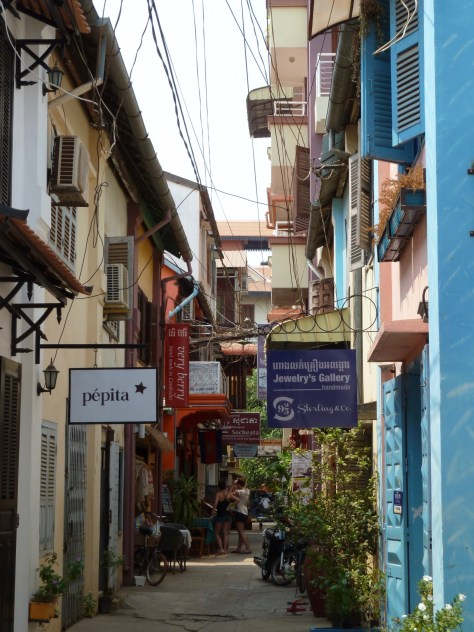
Adorable street with shops and restaurants
Siem Reap has similar markets to elsewhere in Southeast Asia and we did a fair amount of browsing, as well as some solid purchasing. There are a number of social enterprises and NGOs around Siem Reap (I’ll reference my Battambang post again), which meant that I bought a bracelet, wristlet, dress, and a few birthday gifts in order to show my support. Yes, that is my story and yes, I am sticking to it.
But onto the important part and the entire purpose of this trip: Temples.
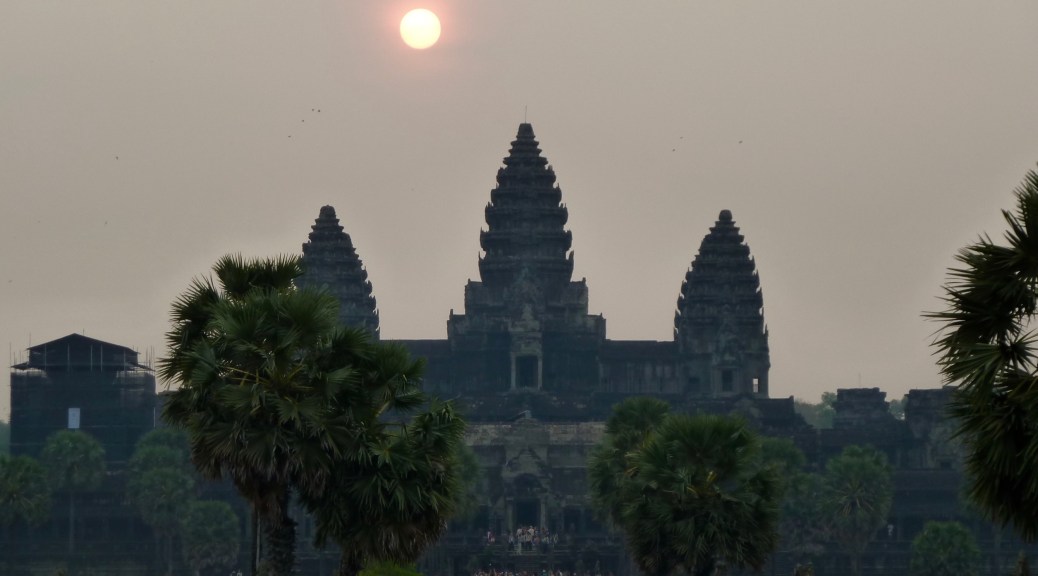
Everyone I talked to and every guidebook says it is worth it to visit Angkor Wat, the largest and best known of the temples, at sunrise. That meant waking up at 5, meeting Kina at 5:30, purchasing our temple pass, and eating breakfast while waiting for sun to come up. Unfortunately, the haze is slowly returning and we did not see the stunning sunrises that appear in every advertisement for Angkor Wat. But it was beautiful all the same.
I would still recommend visiting the temples at sunrise because it was rather cool and pleasant out and there were relatively few people. As the day went on, it got much hotter and much more crowded. Kina told us to spend three hours at Angkor Wat and we did. We left just as everyone else was arriving (at the very late hour of 9:30am).
Tuk tuk parking on our way out of Angkor Wat
Kina did not walk around Angkor Wat with us, and Rachel and I agreed that it was easier that way. We’d done some pre-reading in her guidebook the night before and I’ve taught about the Khmer Empire in the past so we were happy to simply explore and enjoy the architecture. We climbed up many flights of stairs, modern but not up to Western safety standards, and were able to look down on our surroundings. I could not stop taking pictures! It’s taken me three nights of editing and curating to even get to the point of writing this post.
The painted stone, carvings and motifs, and sheer size and scale of Angkor Wat all took me by surprise. I was utterly delighted with the beauty of the stone, with its solidity and sense of permanence; I must have said “Wow” a hundred times. The intricacy and detail that went into the design of the temples clearly indicates the care, hopefully love, and presumably desire for power that are all part of Angkor Wat. Spending time among Khmer history, culture, tradition, and temples still standing after 1,000 years made me wonder about what we build and create today. Will our structures be standing in 1,000 years? Will our writings, digital as they often are, remain for future generations?
Again, I did not understand the scope and scale of the temples at all. They are massive and stretch over 400km, which I didn’t realize until we arrived.
After our three hours at Angkor Wat, we met up with Kina and he took us on a short drive to Angkor Thom.
These soldiers guard the way to Angkor ThomI really loved the enterprising lady selling fruit shakes as we waited in line. Yes, her cart is a tuk tuk.Tuk tuk traffic on the way to Angkor Thom
Kina gave us two hours to wander through the Angkor Thom complex. We encountered even more and steeper stairs than we had previously and the weather was a lot sunnier and a lot hotter. There were also a lot more people. The most amazing part about Angkor Thom for me was the well-known Bayon temple, also known colloquially as “the faces temple.” I loved that each carved face was different. It actually felt like there were eyes looking down on us as we gazed up at them. It was sobering, in a sense, to be surrounded by people and feel pierced by stone eyes that are 1,000 years old. The sheer size of the faces was once again a surprise.
And, of course, the colors and symbols were beautiful:
The other temples at Angkor Thom are less famous than Bayon, but similarly beautiful. Lots of climbing here, too!
Our walk through Ankgor Thom to find Kina gave us a little taste of what we would see later at Ta Prohm.
Our third and final temple was Ta Prohm, better known as the Tomb Raider Temple. As in the movie. With Angelina Jolie. We ended up had dinner at a restaurant called the Red Piano, which Ms. Jolie apparently frequents when in town. Naturally, we each sampled a Tomb Raider cocktail. Rachel lucked out and got a free one (presented to her with the loud ringing of a bell) because every tenth Tomb Raider at the Red Piano is free!
But I digress.
It was hot by the time we made it to Ta Prohm and we were tired. We discussed heading back to the hotel to cool off and relax (remember that we’d been up since 5am) but neither of us felt like we’d be excited about returning to the temples the next morning so we decided to just go for it. This would be the biggest advantage of a three-day pass, I think. Plan on getting up early, going to temples for a few hours, and getting to bed early that night. Temple fatigue would likely not come on as strongly that way.
Ta Prohm was really different from Angkor Wat or Angkor Thom because of the trees. It’s quite overgrown and really does have a very creepy atmosphere as a result. We walked through Ta Prohm much more quickly than the previous temples but did enjoy the massive trees growing up and over the stone.
We actually made it back to the tuk tuk before Kina who had not suggested any sort of time guidelines for Ta Prohm (he was spot on with the other two). I expect we were there for roughly an hour. Kina tried to talk us into seeing more temples that afternoon but we were rather done by that point. Sitting in air-conditioning for a while and getting something to eat were tempting propositions.
We succumbed to temptation and it felt great.
Here are my general recommendations if you’re planning a trip:
Before you go . . .
Buy extra bottled water at a mini-mart that you can keep in the tuk tuk (they sell water and refreshments at the temples but it’s expensive and less convenient)
Buy some nuts and dried fruit at the same mini-mart
Hire a tuk tuk driver
When you’re there . . .
Do the sunrise thing
Cover your knees and shoulders (everything I wore was tech and that worked well for me; Rachel had a coverup top for her tank top, which she said got sweaty)
Rachel would recommend a hat (I don’t do hats ’cause they make me look like I’m 16 but she was glad she had it)
Be prepared to climb (so you’ll need appropriate shoes – I had Tevas and Rachel had Toms and we were very happy with those decisions)
There are a few entry pass options for visiting the temples. We bought the one-day pass for $20. You can buy a pass after 4pm for the following day if you’re so inclined. We knew we would only be there for a maximum of two days so there was no financial incentive for us to buy the three-day pass, which is $40. As I mentioned above, if you think a few hours over a few mornings will work for you, buy the three-day pass. It is substantially cooler in the mornings (as in, I was a bit chilly in my t-shirt and leggings when we left the hotel and couldn’t even remember what chilly meant by the time we got back) and a lot less crowded. I believe there’s also a seven-day pass available.
I normally don’t mind traveling alone, but I was particularly glad to have Rachel with me for this adventure. She’s a wonderful photographer and it was fun to follow her around to see how and what she photographed. I also really enjoyed sharing this experience with someone else. As much as I do enjoy solitude and personal reflection every so often (see the post about my trip to Ubud), I think my time in Siem Reap and visiting the Angkor temples was so delightful because I was able to point out what I thought was cool, hear what someone else thought was cool, and just exclaim aloud. It gets a little weird doing that alone. Rachel and I laughed and talked all weekend long, which is exactly how I hoped to spend my three days away. I came back to Singapore feeling happy and rejuvenated, which is precisely the point of a holiday.
To recover from our grade 10 trip to Cambodia and to celebrate Chinese New Year, I headed to the city of Ubud on the Indonesian island of Bali. The stereotypical Bali experience is one of beaches and parties, but Ubud is actually located inland without a beach. This helpful map comes from Lonely Planet:
I honestly didn’t do much while I was in Ubud and it was fantastic. My very wonderful Airbnb hosts directed me to the Yoga Barn where I bought a three-class pass and thoroughly enjoyed myself. Not only was the studio beautiful, but they also had a delicious juice bar! I took the photos below standing on the deck of Yoga Barn’s complex:
When I wasn’t in the studio, I walked around town, visited a few must-see sights (the market and palace), ate top notch vegetarian food (Ubud is perfect for those on a health kick with all the yoga and organic restaurants), drank local wine, and wandered in and out of shops.
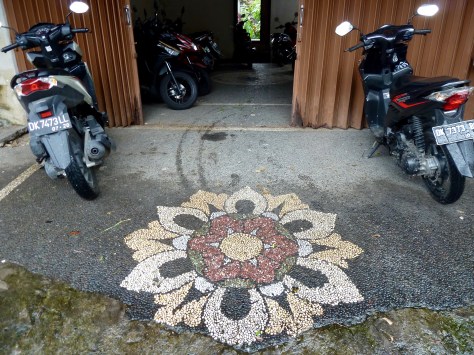
I loved this.Balinese people love beautiful objects. This was set on the sidewalk in front of a jewelry store.
Example of the offerings I saw everywhere. There was one in front of my door each morning when I woke up.
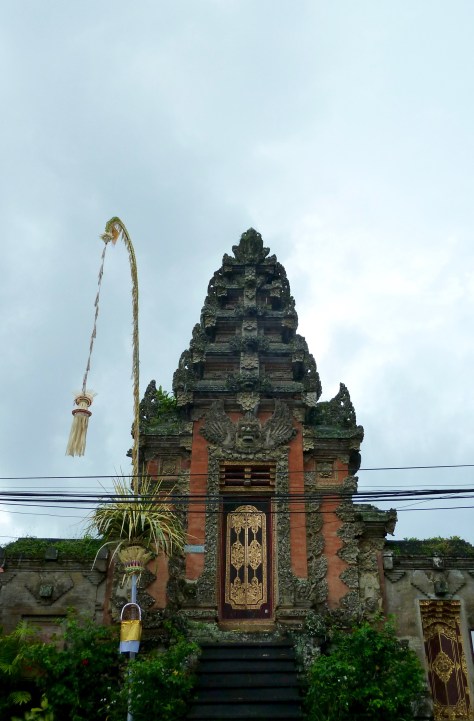
Most families live in compounds, each of which contains the family temple. Balinese Hinduism is quite different from the more familiar Indian Hinduism, and I was glad to learn about it from my hosts. All around Bali people were erecting bamboo poles like the one below to prepare for the Galungan celebration, marking the return of gods and ancestors. I saw multiple families sitting outside and around their homes stapling together the bamboo flower decorations that wrap these poles, as well as putting together other offerings like the ones seen above.
As I wandered, I took pictures. While many of the photos below are the exteriors of temples, others are family compounds. Many of these, like the one where I stayed, are used in part for guest houses. The hospitality and tourism sector is the primary industry in Bali right now, thanks in part to the artists who came to Bali in the 1980s in search of an “untouched” place for inspiration. Rice farming, which still happens in Bali though not in trendy Ubud, was basically the only industry before the tourists arrived.
The architecture was probably the most interesting aspect of Ubud for me. I loved the stonework and the solidity and stateliness it gave to the city. Ubud felt solid, strong, and anchored in tradition. The more I talked to my hosts, the more I learned how family and religion are the center of Balinese life. In a very old world way, most people know each other, are related in some manner, and have been in their homes for generations. As a result, people are happy and comfortable and crime is relatively low. Add that to the yoga and it is no wonder being in Ubud left me feeling calm and centered.
Ubud Market, on the other hand, is the opposite of calm and centered. It is as cluttered and chaotic as any market I’ve seen, which made it a wonderful spot to take pictures:
Yes, it started to pour shortly after I took these photos. I ran into a nearby cafe for cover.
And that was my time in Ubud. Yoga, food, shopping (I actually made purchases for once!), and wandering. I took it very easy this trip (for once) and thoroughly enjoyed myself. How can you not in a place that has flower patterned sidewalks?
Photos, travels, musings, and ideas on education by someone trying to make the world a better and more peaceful place









 By Rebecca Michelle