Tag Archives: Asia

Travel Guide: Ho Chi Minh City

This trip was my first solo travel experience. We didn’t plan it that way, but Mitch wasn’t able to come at the last minute so I made the trip to Vietnam by myself. I am not a person who does well alone; I’ve written about that before. I am not a person who travels to foreign countries alone. But, this weekend, I became a person who can do that and do it well. This whole Malaysia experience has taught me that I’m a lot braver and more adventurous than I thought I was. To be quite honest, I have to be grateful to Malaysia for helping me grow into a stronger, more independent woman.

And onto the trip!

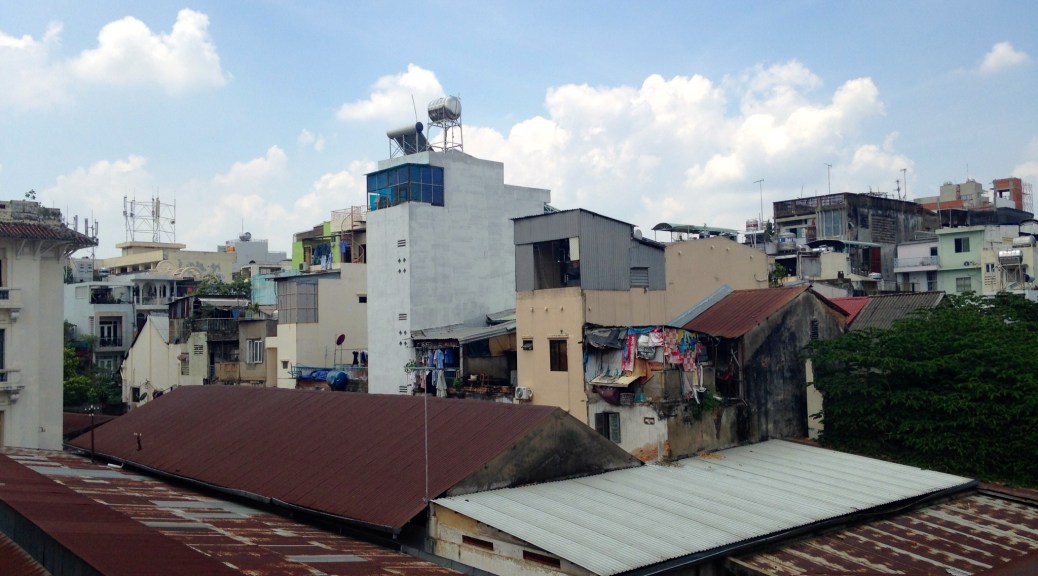
I absolutely loved Ho Chi Minh City, still better known as Saigon. (The airport code is SGN – how cool is that?!) The French influence in Ho Chi Minh, and in District 1 in particular, is obvious everywhere, from tree-lined boulevards with sidewalks and numerous public parks to a plethora of cafes. Anywhere with coffee culture holds a special place in my heart. There are aspects of Ho Chi Minh City, too, that make it distinctly Asian – more people have motorcycles than cars, traffic lights are in short supply, and when stuck in traffic, many bikers prefer to ride on the sidewalks. The gallery below contains general shots of the city. Then, I’ll get into specifics about what I saw.

My first stop was the War Remnants Museum, formerly known as the Museum of American War Crimes, which tells you basically everything you need to know about the museum’s bias and perspective. Since I’m an American History teacher, I can’t say that anything in the museum surprised me, but it was very interesting to see the Vietnam War (they don’t name the war in English, but multiple museums referred to it as the “war against US aggression”) presented from the other side. I took pictures of a few exhibit explanations and quotations posted on the walls to share with my students the next time I teach the war. (Sorry, not going to display those here – shoot me a message if you’re interested.)

Independence Palace, also known as Reunification Palace, was my next stop. I have to admit that I was less than thorough in my exploration due to stifling heat, oppressive humidity, and lack of air conditioning. Since I’m much more used to the architecture of old European palaces, it was interesting to see a modern palace. My photos of the interior didn’t come out very well because I wasn’t using the flash, but I did get some decent shots of the coolest part of the palace, which was the bunker in the basement. The bunker acted as a command center during the war and was completely equipped for people to stay for extended periods of time. The old radio equipment (ironically supplied by the US when Ngo Dinh Diem was in power) was fascinating.

The Central Post Office is famous for its interior (old French maps, phone booths) and is a popular spot to take wedding photos! The massive portrait of Uncle Ho (so called by numerous posters around the city and explanations in museums) surprised me.

Central Post Office with newly married couple! Central Post Office Uncle Ho

Saigon Notre-Dame Basilica, built by the French in 1880, is located on the same square as the post office. Most of it was closed to visitors and reserved for people praying, which I really liked. Again, no flash so not the best photos.

To see the Saigon River, I walked down a wonderful street called Dong Khoi. While in that area, I had a cup of coffee (one of many) and window shopped in all the little boutiques. I returned to that area Saturday night for dinner and drinks. I didn’t see the river by night, but I saw it as the sun was beginning to set.

IMG_0099 IMG_0100 IMG_0102

By night, I did see . . .

The Opera House
The Opera House
People's Committee Hall (not sure what this does or is supposed to do and my guidebook didn't have anything to say about it)
People’s Committee Hall (not sure what this does or is supposed to do and my guidebook didn’t have anything to say about it)

Sunday morning I went to Ben Thanh Market. The chaos and odor of Asian wet markets no longer surprises me, and I am no longer rattled by vendors constantly calling after visitors to purchase this or that. Instead, I simply enjoyed the people-watching and the coffee.

I also ventured to the Fine Arts Museum, intriguing because I have no experience with Asian art. Interestingly, the museum was un-air conditioned and very few of the pieces were protected by glass. I don’t know anything about art conservation, but I can’t imagine that’s good for the art. The Ho Chi Minh City Museum was also excellent. This is where I found a collection of actual artifacts from the Vietnam War. The War Remnants Museum told its story in photos, but this is where newspapers, uniforms, weapons, official documents, old uniforms, and ingenious objects like a boat with a false bottom are housed.

Despite all that I saw and did, I can’t say I really feel that I experienced Vietnam. When Mitch and I were in Bangkok in November, I thought I understood how people in Thailand really live. I don’t have the same feeling about Saigon, or Ho Chi Minh City, or whatever you want to call it. All of my exploring took place in District 1, which I know is incredibly Western and the most frequented by tourists. Next time, I’d love to take a boat up the Mekong River to see fishing villages (friends did this and their photos were wonderful), I want to see the pagodas in Chinatown, and I really want to go to Hanoi. Obviously, there’s a lot out there; hopefully I’ll get to see and learn more!

Safe travels!
Spotted in Singapore

We had a long weekend in honor of Labour Day and Wesak Day (a Buddhist holiday). Mitch and I left the planning too late, so I flew down to Singapore for the weekend. If we’re still in Asia next year, we will make it a point to know when the holidays are! Just like in the US, if you want to travel on a holiday weekend, you book your travel months in advance before prices increase and availability decreases.

As you might know, this was my sixth trip to Singapore. (You can find my notes on previous trips here, here, here, here, and here.) Each time I go, we spend less time in tourist land and more time just doing normal things like a normal couple who lives in the same city. We run, we buy groceries, we go for walks, we hold hands. When Mitch visits me, we spend a lot of time cooking because that’s something he can’t really do in Singapore. (Seriously, people, it’s the little things.) This time, though, we did two touristy things!
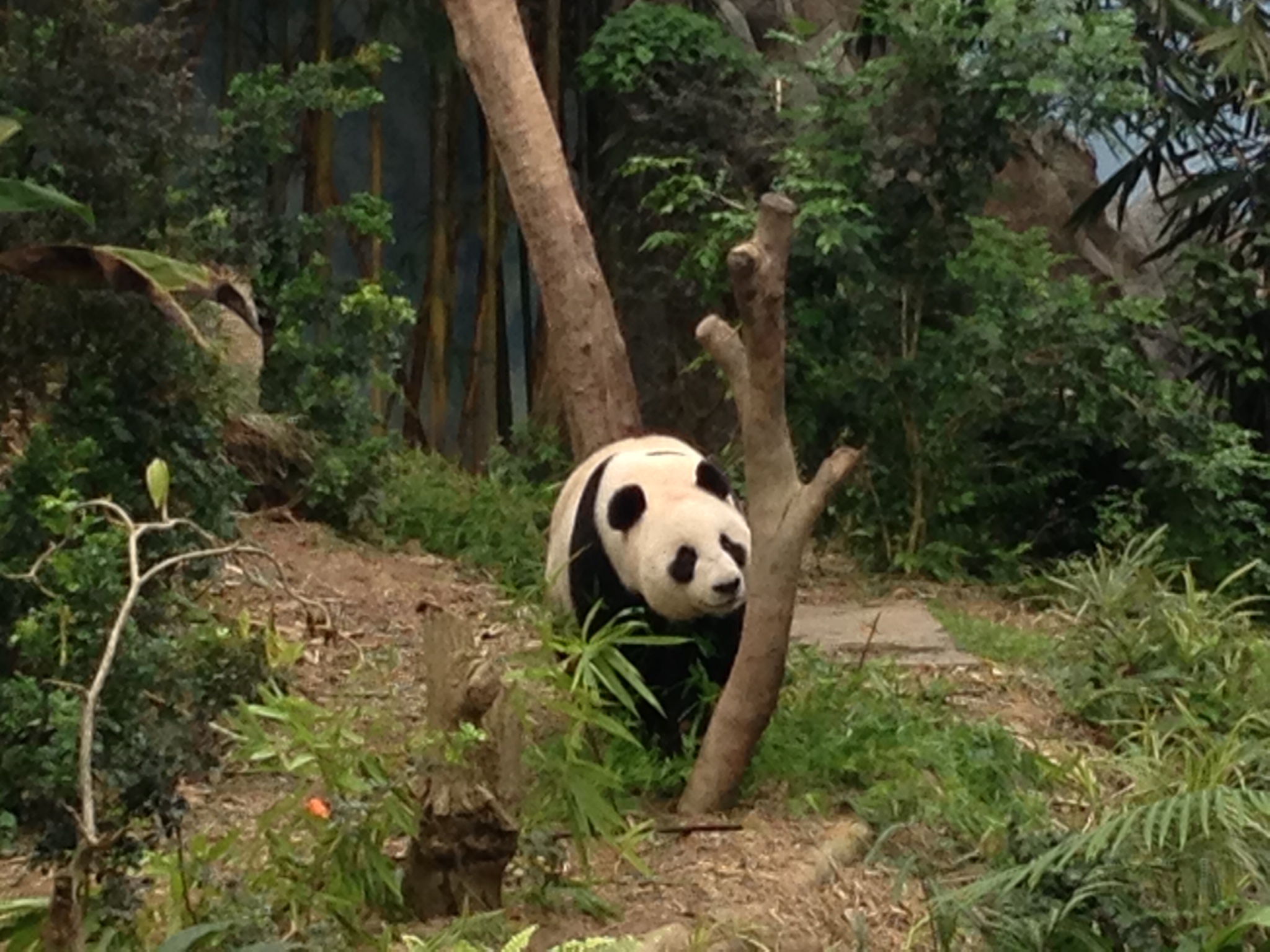
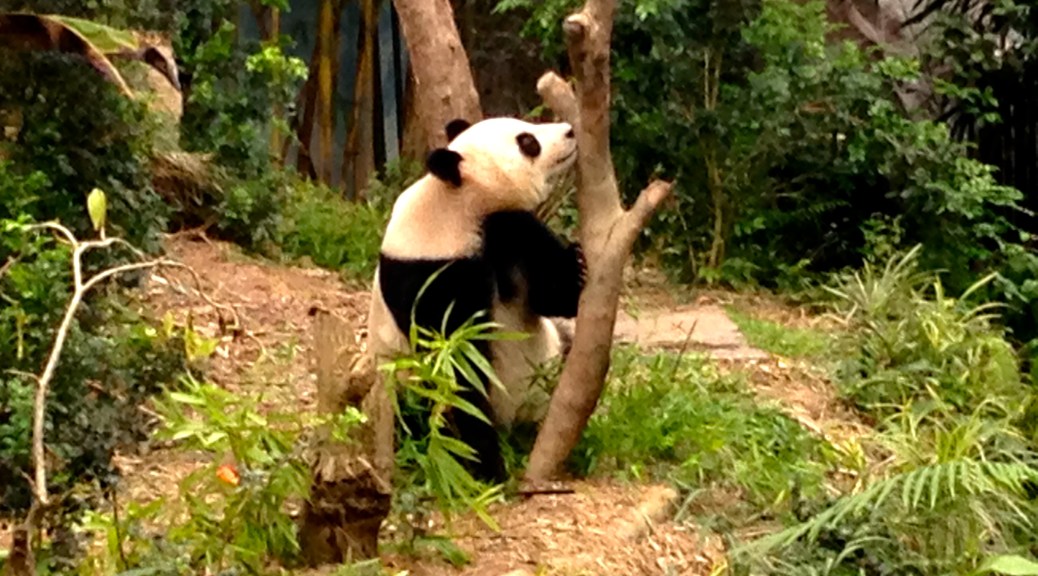
Singapore has a really amazing zoo with multiple parks. Last time I was in Singapore, we went to the Night Safari with Mitch’s mum. This time, we went to the River Safari, which is a really interesting concept. It’s basically a zoo and educational center built around the world’s major rivers – Nile, Amazon, Mississippi, Yangtze, Congo, Mekong, and Ganges. Very cool and I highly recommend it! Another cool thing about the River Safari is that they have pandas! One was hiding, but two were out and about!

Red panda
Adorable red panda! I didn’t know they were so small.
Red panda 2
It was climbing and running and jumping around like a squirrel. I wonder if they’re related?
Panda
This panda started out hiding behind a rock but we got lucky!
Panda 2
“Lumbering” is honestly the best way to describe this panda . . . they are very large, larger than I expected.
Panda 3
I just thought this was a cool shot.

The other touristy thing that we did actually might not even count as a tourist thing.There’s a reason people go to Singapore for urban life and to Thailand, the Philippines, Indonesia, and Malaysia to go to the beach! That’s what Mitch and I wanted to do, but we couldn’t afford it by the time we figured out it was a long weekend. Singapore is not known for its beaches, and that’s for a good reason. They’re man-made and on the Straits of Johor, a major shipping lane. The horizon is blocked by oil refineries. The sand isn’t soft because the ground underneath it isn’t real. There aren’t crashing waves, either. But Sentosa’s beaches did give us a day to walk along the sand, pop in and out of the water, and take in a ukelele festival complete with food trucks. (Get this: There was a coffee food truck. Amazing.) A Singaporean we met at a party this weekend told me that going to the beach on Sentosa was a nice way to spend a day about once a year. She’s right. I didn’t even take pictures!

Sentosa made me miss childhood summers on Myrtle Beach something fierce, but I was glad we went. There’s just something about sun and sand and water that has always put me in a very happy place.

As always, Mitch and I had a wonderful time together. Hopefully soon, I’ll be able to stop saying that because it won’t be news.

More travel is in the works! I’ll keep you posted.

Travel Guide: Hong Kong

Recently, Mitch and I met up with our friend Lucas in Hong Kong. Lucas has been a best friend for years; we met as freshmen in high school, went to college together, and have kept in very close touch since he moved away to California not too long before I moved to Malaysia. Lucas has a very cool job that lets him do things like travel the world. About six months ago, Lucas told us that he was going to be travelling to Hong Kong sometime in November or December. Along the way, that turned into March. The knowledge that one of my best friends was going to be a four-hour plane ride from me acted like a tonic; whenever I considered throwing in the towel and heading home after returning to Malaysia from Spain after Christmas, I remembered that Lucas was coming. And then March showed up and the three of us spent a fantastic weekend together exploring Hong Kong.

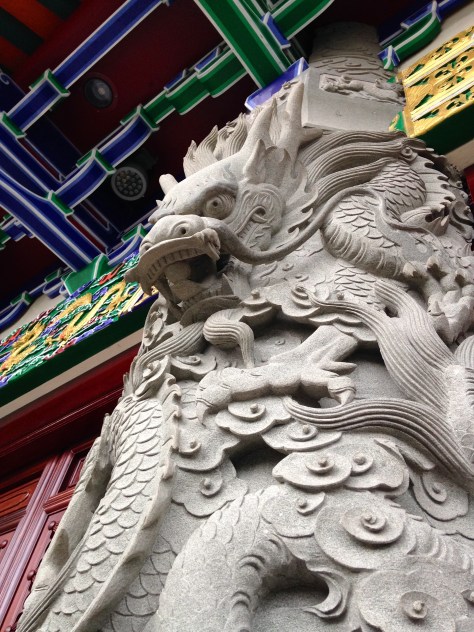
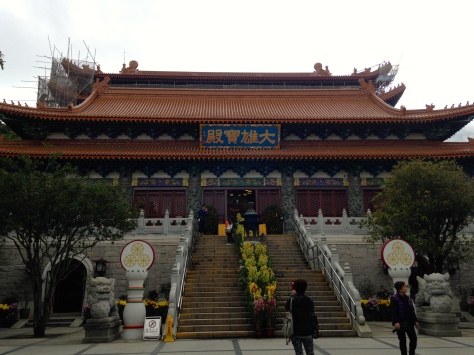
Our first destination was the Po Lin Monastery, located on the island of Lantau. It’s a bit of a trek to get there from where we were staying on Kowloon. Taking public transit took just under 2 hours. It would have been quicker had we been able to take the cable car upon arriving on the island, but it was under repair so we took a bus up windy, twisty roads. That is always a potential recipe for disaster, but we pulled through. Monasteries seem to always be built in beautiful places, and it’s no surprise why. Look around and there’s some sort of breathtaking moment or view or setting that causes one to think of higher powers that could have created such an image.

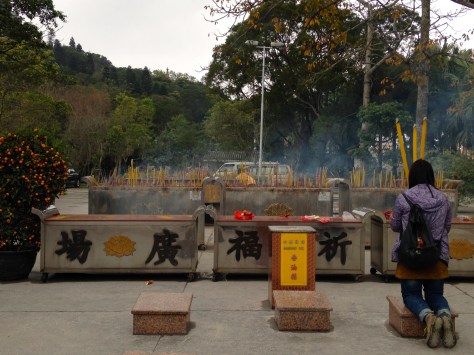
I’ve really enjoyed visiting Buddhist sites around Southeast Asia because they are so different from the types of religious sites to which I am accustomed. I particularly like seeing worshippers, also because their religious practices are unfamiliar to me. As a social studies teacher, I can list Buddhist principles and the history of Buddhism in my sleep, but seeing devotees practice is always eye-opening.

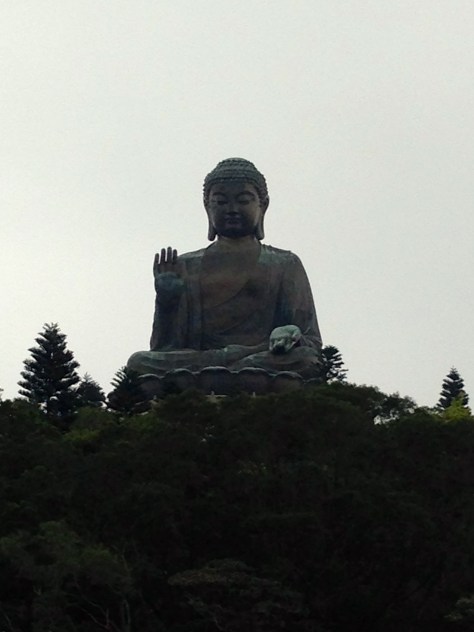
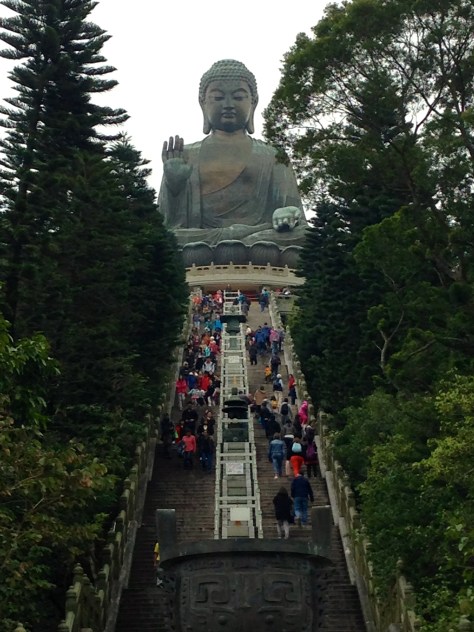
One of the main attractions at the monastery is the Tian Tan Buddha, also referred to as Big Buddha on the signs. We climbed a whole lot of steps and were enthralled with what we saw. This monastery is home to a bone relic from Siddhartha Gautama, The Buddha with a capital T. (And a capital B, I guess.) Big Buddha sits on top of the temple containing this relic. It’s so small that the only way to see it is on a video screen that has a photo of the bone under a microscope.

It was from Big Buddha that we were able to see the valley that Po Lin Monastery calls home.

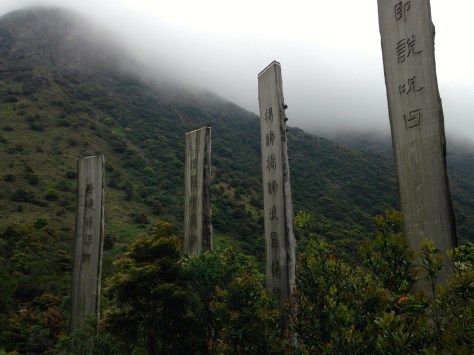
There also walking and hiking trails around the monastery, which we decided to visit. We found ourselves in clearing of unexplained trees carved with Chinese characters. Mitch said he expected druids to come out any minute, which is probably the best way to describe it.

That evening, we went to Temple Street Night Market to show Lucas what night markets are and also to eat cheap local food. In my mind, the market was notable for its vegetable satay and the prevalence of stands selling very naughty lingerie next to stands selling key chains. Something for everyone. We also ventured to the Goldfish Market the next day, which is not an experience I plan to repeat. We’d been warned and now that I’ve seen it with my own eyes, I can assure that it is no place for anyone even remotely concerned with animal welfare. The entire street was lined with pet shops and all of the animals were in tiny cages and being poked and prodded by buyers and people who simply seemed to enjoy the novelty. We looked around, walked up and down half the street, and called it quits. There are some cultural barriers that are too high to breach.

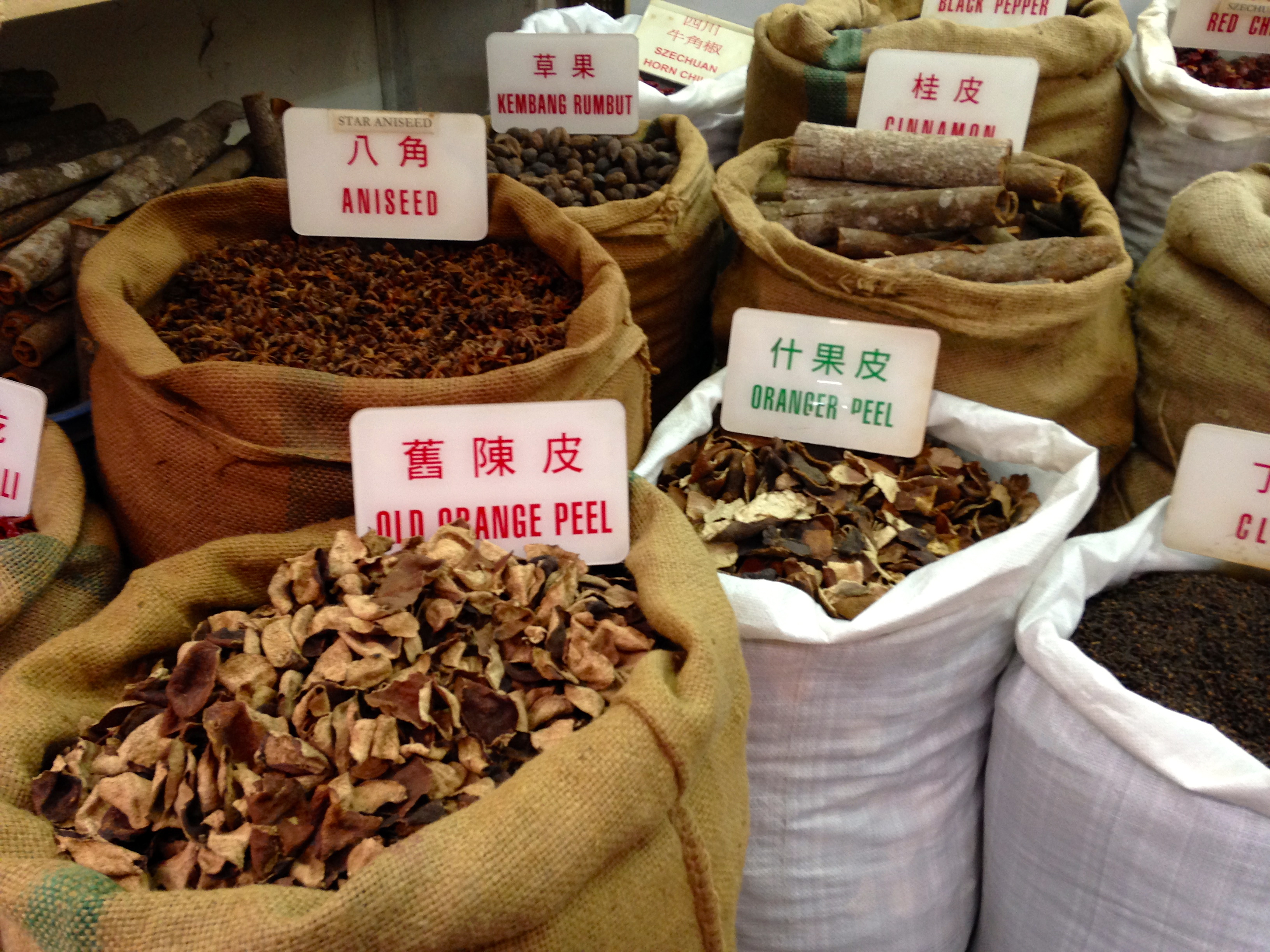
The next day, we wandered through Hong Kong Central, basically following the crowds. We made our way down windy streets where antique stores sold porn along with very old coins. (My personal favorites were the holographic cards that show a voluptuous clothed woman and a voluptuous naked woman, depending on which way they’re twisted. Fascinating stuff.) We went through streets of grocers’ markets and found multiple stands full of fish that had probably been caught that morning. Personally, I preferred the smells coming from the spice shops.

Spices
The only items in the market I could stand in front of long enough to get a picture
More spices
How old are oranges before the peel is considered old? What color is the peel if it’s considered oranger?

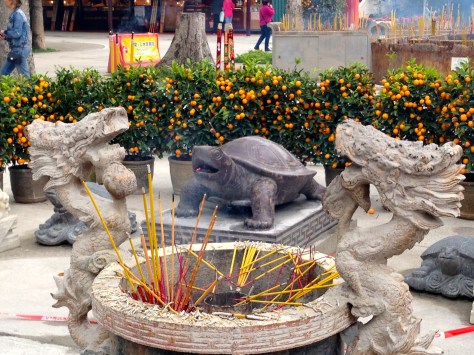
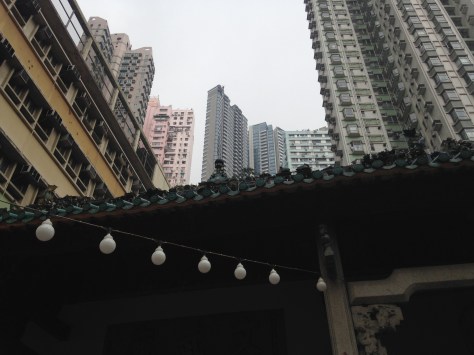
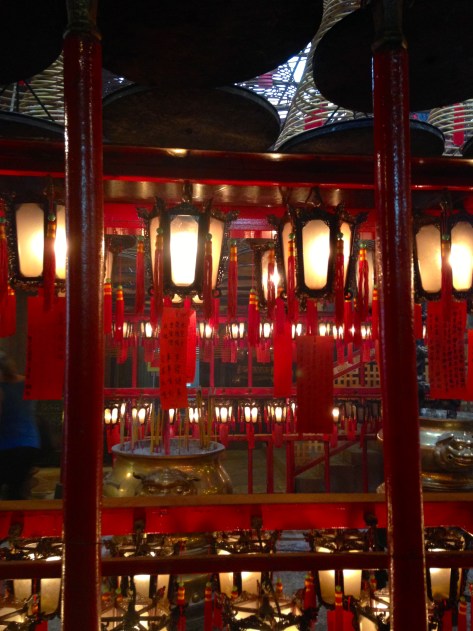
                                                                                                                                                                                                                                                                                                                                                One of the things I love about Southeast Asia are temples located in the middle of big, bustling cities. Hong Kong’s oldest temple, Man Mo Temple, dates to 1847. It sits next door to massive high-rises and crowded with Buddhists lighting incense and praying. The smoke was so thick inside that it was hard to breathe, even more difficult than in the rest of Hong Kong. (The fire alarm in our hostel went off early one morning because of the smog.)

We went to A Symphony of Lights at Tsim Sha Tsui Waterfront on Kowloon, which is the island where we were staying. The symphony wasn’t much to speak of, but it was neat to see the skyline lit up. I also really loved the ferry we took from Kowloon to Central in the dark.

Hong Kong at Night

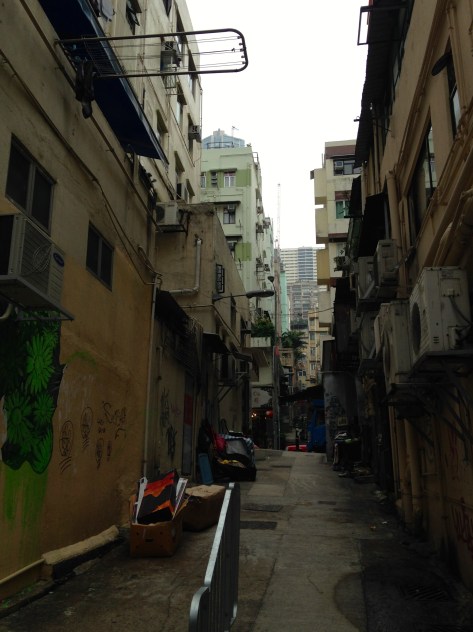
Probably my favorite aspect of travelling is experiencing life as locals do. I love unique signs and shops and neighborhoods that would never be found in guide books because of their normalcy in everyday life. From the outside looking in, however, these are what make people and places real and liveable.

Like building techniques . . .

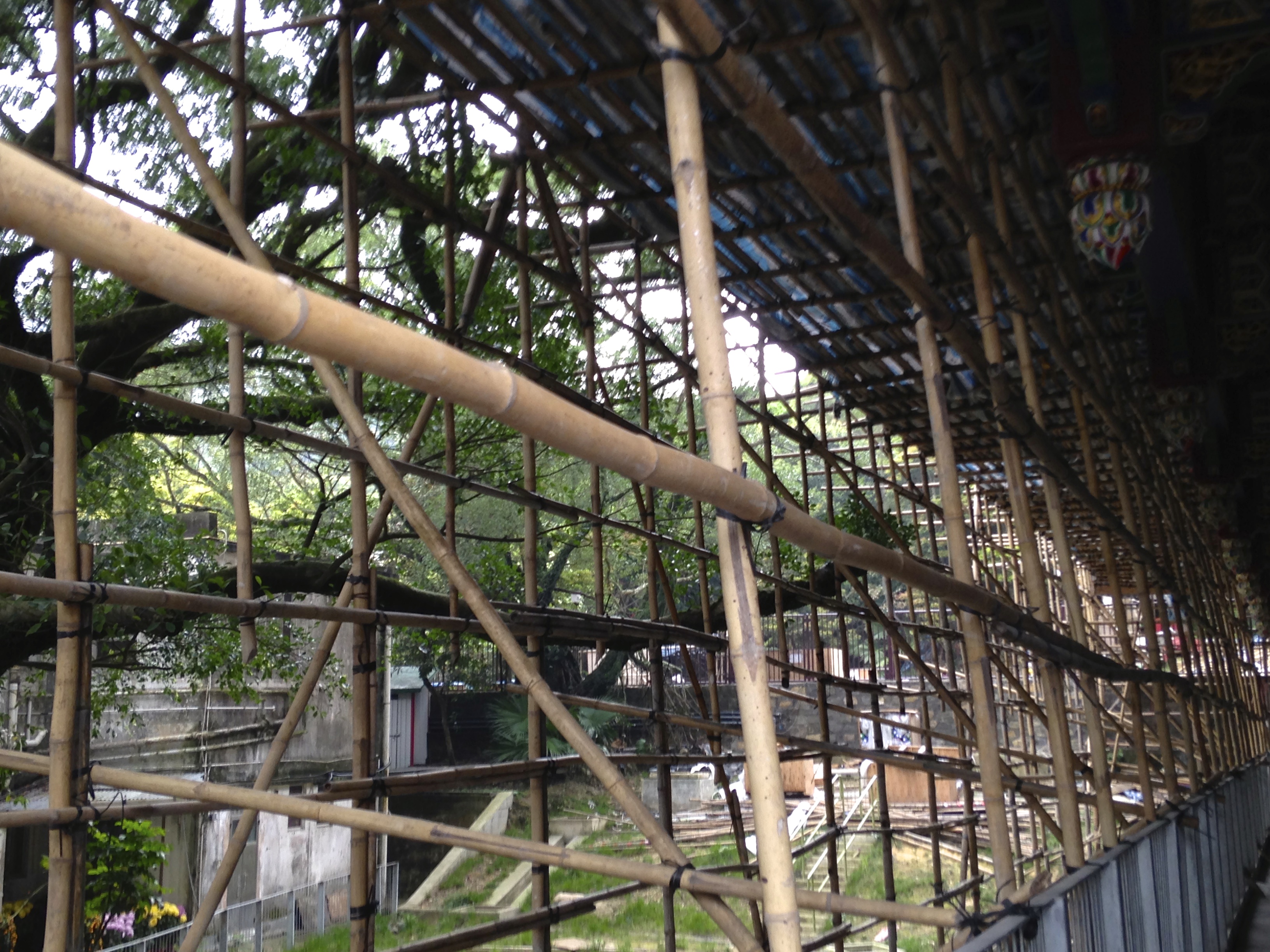
Scaffolding
Bamboo scaffolding – They’ve probably been using it for thousands of years and see no need to stop. If it ain’t broke, don’t fix it.
Scaffolding
Yes, this was at Po Lin Monastery but we saw scaffolding like this all over Hong Kong. It made quite the contrast against concrete!

                                                                                                                                                                                                                                                                                                                             nightlife culture . . .

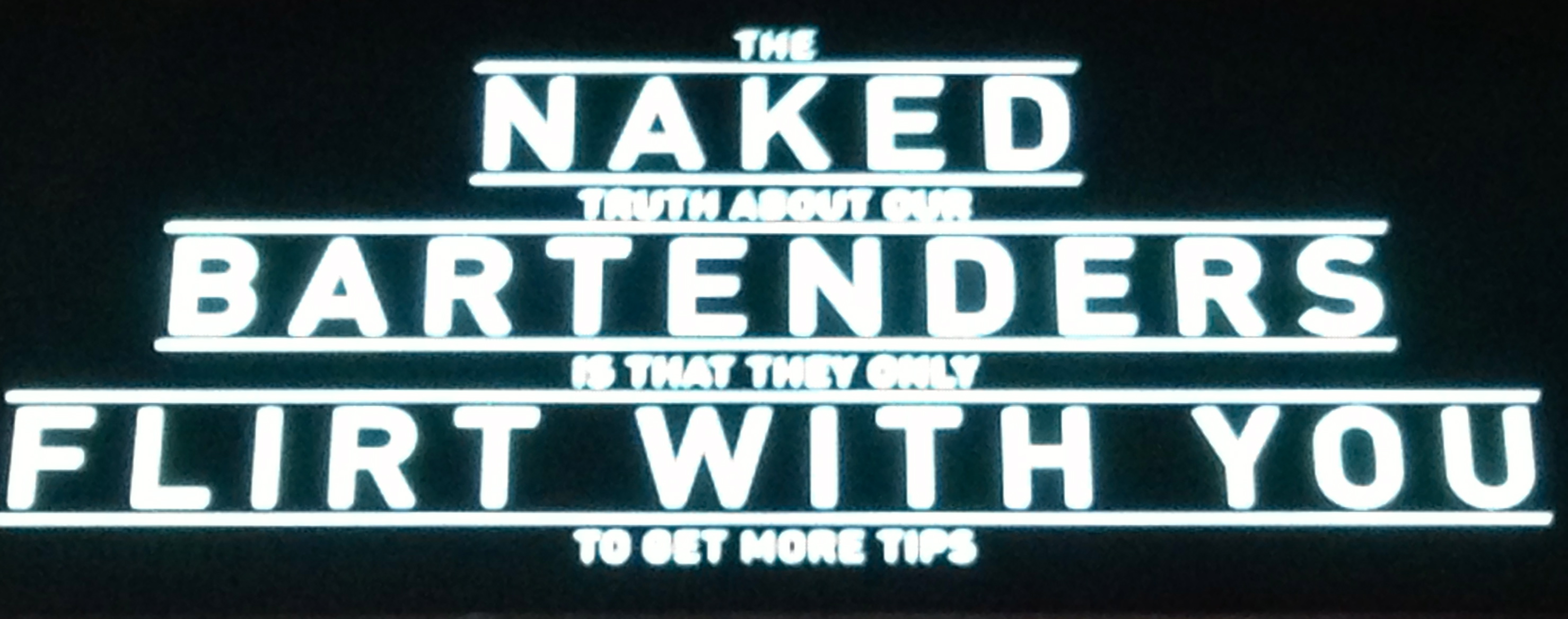
Nothing beats telling it like it is!
One of the many trendy and expensive bar streets in Central
Had we known Operation Leprechaun was on, we would have come prepared

                                                                                                                                                                                                                                                                                                                     home decor . . .

We found these mugs in a store window selling Taiwanese products. The whole area was full of high-end desginerly home goods - made me want to buy lots of things when I grow up!
We found these mugs in a store window selling Taiwanese products. The whole area was full of high-end desginerly home goods – made me want to buy lots of things when I grow up!

and a very important aspect of Hong Kong life . . . subway etiquette!

HK subway sign
Thank you, helpful sign. The best part is that “do do do” is exactly how one would describe that specific sound
HK subway sign 2
I also like that these helpful signs are color-coded

Safe travels and remember to keep your ears pricked for “ding-dong!”