

Two years ago, I spent a week in Battambang, Cambodia’s second-largest city, as part of my school’s field studies program. That week completely changed the way I see education, my role as an educator, and what is possible with and for students. Last week, I had the opportunity to return to Battambang with about sixty grade 10 students for the same program, a week that has left me again convinced that young people can do anything as long as we support them.
On this trip, I acted as the school trip leader and worked closely with the program lead from the JUMP! Foundation, the organization that really puts together the whole experience. I can’t say enough good things about the work they do for students and communities and I am so proud to partner with them.
As trip leader, I wasn’t attached to a particular group of students and instead filled in for staff as needed, managed all student issues from discipline to illness to homesickness, switched groups daily to get to know each student, and met nightly with school staff and JUMP!’s lead to hear feedback about the day. Prior to the trip, I arranged airplane travel and rooming assignment, worked with teachers on curriculum coordination, communicated with parents, and managed petty cash. And, despite mental fatigue that hasn’t quite worn off, I really enjoyed it!
Welcome to Battambang, the arts and culture center of the Kingdom of Cambodia!
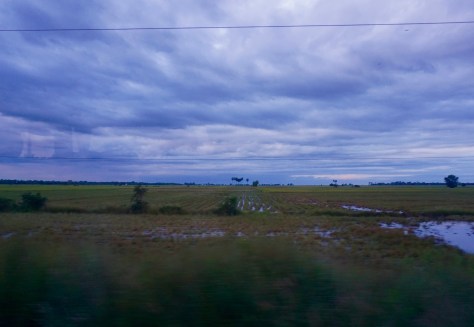
We flew into Siem Reap and immediately drove the three hours to Battambang where we spent the rest of the week. One of my friends immediately pointed out how much greener Cambodia is in November than it was in February on our last trip. It was really nice to be back in a city I had come to know a couple years before and see how it had changed.
On our first full day, I went with a group taking a tuk tuk ride to Phnom Sampov. Many of the students had never been on a tuk tuk, which is a really lovely way to see and engage with the countryside. The ride itself is beautiful and provides insight into how people live in a country still recovering from decades of civil war.


Phnom Sampov is a mountain dotted with Buddhist temples. We paused in front of several, but the goal of our time there was to visit a killing cave, one of the many legacies of the Khmer Rouge. Each group was partnered with a local facilitator for the week, in addition to teachers and a JUMP! facilitator, which gave the students a cultural connection to Cambodia that they would not have had otherwise. That was a change from the first trip and made a great impact on the students’ understanding of where they were and why.


That afternoon we visited Buddhist University and two monks led us on a tour of the campus temple and then guided us through a short meditation. From there we visited teh university library, which, in addition to the novel sight of monks on laptops, had a specific section for writings by peacemakers. That made me very happy!


As our last activity of the day, we met the dancers of Cambodian Living Arts, one of the many organizations working to revive the arts and culture that were destroyed during the Khmer Rouge era. They performed for us and then taught us a traditional dance involving coconuts, leaving everyone laughing and in high spirits. This was an uplifting change from the somber feel of the morning.
We caught a gorgeous sunset on our way to dinner, still travelling by tuk tuk. The sun rises and sets very early in Cambodia, something I always forget, but that also means that the stars are out when it’s still early enough to enjoy them.

The next day I joined a group at FEDA, an educational organization we used to work with that had just stopped its operation. Now, the visionary leader behind FEDA is working to build a peace museum on FEDA’s campus to chronicle Cambodia’s history and ongoing reconciliation work. That afternoon, we visited Banteay Srei, an NGO working for women’s empowerment in a country where there is a clear status difference between men and women from childhood onward.
It rained the following day, which was delightful because it cooled everything down and left the air quite pleasant. It’s always amazing to me how great of an impact weather has on the way we experience pretty much anything.
Another group started their morning with COMPED, an NGO that focuses on waste management and composting. The students learn about what COMPED does before going to the market to pick up organic waste. They then deposit it at COMPED’s dump sight. I missed it this year but remember the lesson very vividly: Everything goes somewhere and nothing disappears; we leave traces of ourselves wherever we are and that impacts people the world over.
Laster that day, I joined a group heading to Cambodian Children’s Trust. This is the organization that had the greatest personal impact on me from our last trip. CCT opened my eyes to the realities and dangers of orphanage tourism and the astonishing statistic that 80% of children in residential facilities worldwide have living parents. CCT works to support families by providing holistic care and services to the children they work with and their family members.

I went to bed laughing after spending the afternoon with a particularly entertaining group of young people. There’s a certain ease and genuineness that comes from eating together, learning together, and playing games together outside in sweaty clothes. It’s my favorite way to interact with students because everything I want for them, everything that leads to real questions, connections, and ideas, comes naturally.
The next morning we visited the Phare Ponleu Selpak, a non-profit providing children with academic education as well as arts education, specifically centered on circus skills, as a way of providing them with future work opportunities. I’d seen Phare’s show in Siem Reap on this trip two years ago, but this time we were able to participate in an amazingly fun circus skills workshop! We learned tumbling and how to juggle, took a tour of the campus, and got to watch some of the students rehearsing. We saw Phare’s Battambang show on the last night of the trip and were excited to see the same students perform.


That afternoon, in keeping with the arts theme, we visited Lotus Gallery to meet a local artist and make some art. The gallery itself was beautiful and had a very calming influence on the students.


I spent most of the afternoon chatting with the artist about the creative process and how she gets inspiration from her love of nature and purposely surrounds herself with plants and flowers, even building a garden sidecar for her motorcycle!

I also enjoyed chatting with her husband about his work in drugs education through theatre. He told me that the drug of choice in Cambodia is methamphetamine, which likely comes into the country from Thailand. It was a real joy to meet a couple who have invested their lives in work that they are passionate about and can also make a positive impact on others.
I spent our last full day on a cycling tour with Soksabike, which had been a highlight for me the first time around. We stopped periodically to learn about local livelihoods and the local families that Soksabike supports. We visited a family making rice paper . . .


. . . Cambodian scarves, which are called krama . . .


. . . banana chips . . .


. . . and bamboo sticky rice, which is a popular street snack. . . .

The bridge that we would normally take to cross the river had been dismantled, so we crossed by ferry instead. Needless to say, I loved this part. Water and I get along really well.


After the cycle tour, we continued that day’s local living theme by visiting the market, which was just such a joy. The students had a scavenger hunt to help them interact with locals and my job was to follow a group and make sure they didn’t get into any trouble. We saw food stalls . . .


. . . the usual array of meat, fish, and produce (my favorite!) . . .


. . . textiles, toys, and dry goods . . .


. . . cosmetics and toiletries (and hairdressers and nail salons!) . . .

. . . and a surprising number of jewelry counters! (Hint: This is where we found the most English speakers.)

I love markets. They are always my favorite part (or pretty close) of any place I visit. I love seeing people come together for the same needs the world over. I love watching people interact and engage in the common pursuits of humanity. I love watching life happen in its most natural ways.
After Phare’s circus performance to round out the program, it was time for an early night before a 3am wakeup so that we could make the three-hour drive to the airport in time for our 10:30 flight. Absolutely worth it.
JUMP!, I can’t thank you enough. I watched students learn, grow as individuals, become closer to each other, create new friendships, engage with new ideas, and experience a culture and a place that is very different from what they usually see in Singapore. Thank you for bringing out the best in our young people. Thank you for all that you do.




 By Rebecca Michelle