Tag Archives: Election

Courage in the Time of Fear

We could never learn to be brave and patient if there were only joy in the world. – Helen Keller

It has been a difficult week. I wrote earlier about my struggle to process the results of this election, which has involved a great deal of effort.

I’ve spent more time on Facebook this week than I ever have and I’ve participated in more than a few political discussions. More than anything, this election highlighted that we don’t understand each other. Every single political post in my Facebook feed right now echoes my own thoughts and feelings. I will continue to fight for justice, equality, reconciliation, compromise, peace, and security for all. However, I am also trying to understand the other side. I’m trying to understand the half of America that does not see this country or the world the way I do.

That’s one of the reasons why I haven’t joined any of the protests taking place in New York City right now. This country, in all its history, has always managed a peaceful transfer of power and I do not want to be part of tearing that down. However, I do believe in using the political process to work for justice, which is why I signed a change.org petition asking the Electoral College to vote the way the people voted and elect Hillary Clinton as president when they vote on December 19.

In my efforts to use the peaceful, democratic tools available to make my voice heard, I donated to the ACLU and NAACP. I have no doubt that these organizations will be front and center fighting for the rights that the people of this country thought they’d already won.

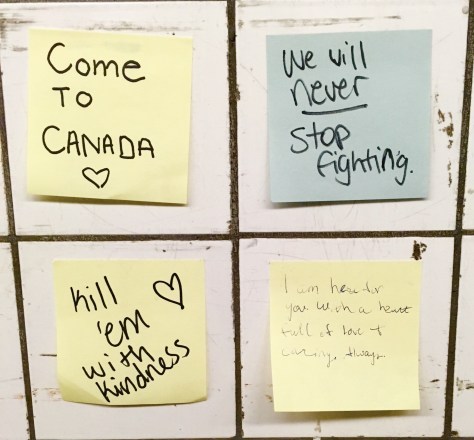
I was walking between the L train and 1, 2, 3 trains on my way to meet friends last night when I came across the following beautiful display of solidarity and support:

Of course I added my own sentiments to the messages of love, hope, and unity:

img_0291
Mine is on the bottom right: “I am here for you with a heart full of love and caring. Always.”

After all, it’s not the first time I’ve written a note to a stranger.

We need each other, now more than ever. It doesn’t matter whether we’re family, friends, acquaintances, or whether we’ve never crossed paths. I will stand up for what I believe is right and I urge you all to do the same.

Well done, New York. Keep fighting.

US Election 2016

As you know, I try to keep this blog away from politics. There are areas of my life that are highly political and politicized, but this is generally not one of them. However, this election is important enough to me, to the United States, and to the world that I would be negligent as both a concerned citizen and an educator if I did not discuss it.

When I got to work today, for the first time ever, I cried in a school bathroom. And then in a dean’s office. And then in the faculty room. And then during an all-school assembly.

I am in shock. I am afraid. I am deeply concerned about the rhetoric that we are permitted. I am sick over the devastation and human suffering that we are allowing. I am watching the world change and I will forever look at it differently.

I still don’t know what to say to my students.

I spent the morning listening to the news and reading articles about what happened, what to do now, and what to do next.

This is an article from The Washington Post that evaluates modern (Clinton) and postmodern (Trump) values. I think does a nice job of explaining how society has shifted its priorities to bring us to where we are. Author Barton Swaim:

Intellectual historians refer to the period from 1600 to 1945 (more or less) as the “modern” period. It’s always risky to generalize, but truth in the modern era was something objective and knowable, and knowable through material and scientific means (thus not through divine revelation). During the second half of the twentieth century, however, that view of truth was undermined in various ways. Poststructuralism in philosophy, abstraction in art, twelve-tone serialism in music, absurdist fiction in literature — all these things, variously categorized as “postmodernism,” posed direct challenges to the older “modern” view of truth….

For two generations or more, American liberals have cheered postmodern attitudes in art, literature, music and philosophy. Now it has entered politics, and it’s time to panic.

We can panic, but we also need to act. This article from The New Yorker addresses what we are facing with a Trump presidency and how we must uphold the American ideals of democracy, fairness, justice, freedom, and compromise as we move forward. Author David Remnick:

The most hopeful way to look at this grievous event – and it’s a stretch – is that this election and the years that follow will be a test of the strength, or the fragility, of American institutions. It will be a test of our seriousness and resolve….

Trump was not elected on a platform of decency, fairness, moderation, compromise, and the rule of law; he was elected, in the main, on a platform of resentment. Fascism is not our future – it cannot be; we cannot allow it to be so – but this is surely the way fascism can begin….

It is all a dismal picture. Late last night, as results were coming in from the last states, a friend called me full of sadness, full of anxiety about conflict, about war. Why not leave the country? But despair is no answer. To call out authoritarianism, to call out lies, to struggle honorably and fiercely in the name of American ideals – that is what is left to do. That is all there is to do.

There is a lot to think about going forward. We have put the United States in a place that was unimaginable even yesterday. We can no longer stand by and wait for things to change. We must change them.

Gratitude, Forgiveness, and Listening

Yesterday was Canadian Thanksgiving, which my family has not celebrated since we moved to the US and the US version of Thanksgiving became my mum’s favorite holiday. It has been years since I started keeping track (sorry about the photos!) of who or what I’m grateful for on a daily basis, and this is as good a time as any to make some of those thoughts public.

I am grateful for the family and friends who have held me up over the past year during which I’ve made some really hard choices and have restarted everything – twice. I am grateful to those who stand beside me as I continue to make choices about what to do next.

I am grateful for the technology that allows me to keep in touch with people all over the world from anywhere in the world.

I am grateful for the people I’ve called at all hours when I couldn’t breathe, couldn’t think, and couldn’t see tomorrow. I am grateful for those who have reached out just to see how things are going.

I am grateful for everyone who has helped in the three big moves that I’ve made over the last twelve months. Sorry that my book boxes were so heavy!

I am grateful for all the people who make me laugh, certainly including my students. I am grateful for the compassion of those who have seen me cry (including a group of grade ten students in Cambodia).

I am grateful for everyone who has helped me learn and grow, and who believe in me when I don’t believe in myself.

I am grateful for my travel experiences and all the travel partners I’ve had along the way.

I am grateful for the roof over my head, clothes in my closet, food in the fridge, and for getting paid to do my favorite thing – teach.

For all this and more, I am grateful and I thank you.


These reflections leave me acutely aware that today is Erev Yom Kippur, the night before the Day of Atonement on the Jewish calendar. (I’m a huge fan of this website for all things Judaism, so have a look if you want to investigate Yom Kippur further.) Since I’m teaching at a Jewish day school this year, I have time off for all the Jewish holidays, which is the first time that has happened since my own day school days. Overseas, I struggled to get the time to be part of a religious community, which is really important to me. With the tumultuousness I’ve been experiencing lately, I’m glad to have one fewer thing keeping me up at night.

Yom Kippur is considered the holiest day on the Jewish calendar. It is a day of self-reflection, connection with others, and an exploration of individual spiritual relationships. Judaism teaches that the only way to be forgiven for wronging other people is to seek their forgiveness. The goal is to begin a new year with a clean slate based on the new connection formed between both parties.

Forgiveness changes who we are because we are required to relate to each other in uncomfortable ways. Not only am I admitting what I have done wrong, but I am asking your forgiveness because I care about you, about myself, and about our relationship. It’s easy to brush off a negative conversation, walk away, and never mention it again. Acknowledging that someone has been left hurt, when that happens, means looking outside yourself to the impact your actions have on others.

It is very important, however, to keep in mind that many things that we do cause harm, pain, or discomfort. There’s a huge difference between actions and words that are malicious and those that hurt because of misunderstanding or miscommunication. While I am by no means advocating avoiding challenging and uncomfortable conversations, I do believe that my responsibility over the course of these conversations is to talk with you rather than at you, listen to and hear what you are saying, and respond to your ideas without attacking you personally.

When I don’t do that, I will ask your forgiveness. I will not apologize for my ideas or perspectives, but I will apologize for the way I treated you during our conversation. I have learned that the most difficult conversations need to be had sooner rather than later, with open minds and care towards others.

I believe this is important, especially in such a corrosive political climate. There’s a lot to be said about Hillary Clinton’s experience and policy proposals over Trump’s shockingly violent, hateful rhetoric. But there are also ways to have these conversations so as to actually hear one another.

On our way home from school last week, my carpool friends and I discussed our own failures to listen to and hear the other side. In our case, we’re too quick to dismiss Trump supporters as “crazy” or “ignorant”. What we need to do instead is provide evidence for why we believe what we believe and ask for their evidence in return. When political conversations move towards facts and evidence and away from personal feelings, we all learn a lot more. And we’ll cause a lot less anger, hate, and violence towards each other as a result.