Tag Archives: Flowers

Travel Guide: Kuching x2

I left Malaysia in the spring of 2015. I hadn’t been back until four girlfriends and I decided to take a quick weekend trip to Kuching, a wonderful town in Sarawak, one of the two Malaysian states on Borneo.
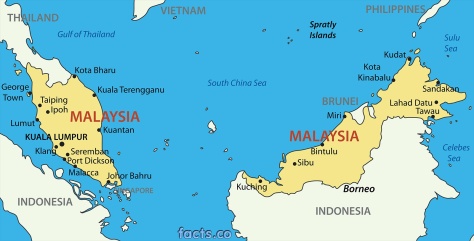
political-map-of-malaysia

I visited the area once before (though my photos are way better this time, thanks to a fancy camera) and was excited to go back. Other than booking flights and a hotel, the entirety of our planning took place in the airport.

Friends: What are we doing in Kuching?
Me: Seeing the orangutans.
Friends: Anything else?
Me: Eating. Drinking tuak.
Friends: Cool. Anything else?
Me: Last time, I visited the Annah Rais Longhouse. Really enjoyed it and would go back, but I really don’t mind. It’s a nice town to wander through.
Friends: Sounds good.

And that was that!

As promised and planned, Semenggoh Nature Reserve was the highlight of our trip. We arrived in time for the morning feeding, which begins around nine. I love rainforests (or any forests) and enjoyed the walk to the reserve’s feeding platform.

The purpose of Semenggoh is to teach rescued or orphaned orangutans how to live in the wild, so the orangutans really only come to the reserve for a meal when there’s no food in the forest. They mostly stay away during fruiting season. My last visit was in October and we saw groups of orangutans during both feeding times, but this time around wasn’t as lucky. We did see the resident crocodiles, though!

DSC04044

We also saw some really cool pitcher plants, which are really fun to look at because a) they’re carnivorous and b) they come in a surprisingly wide array of sizes. We didn’t know it at the time, but we were going to learn more about them later in the day.
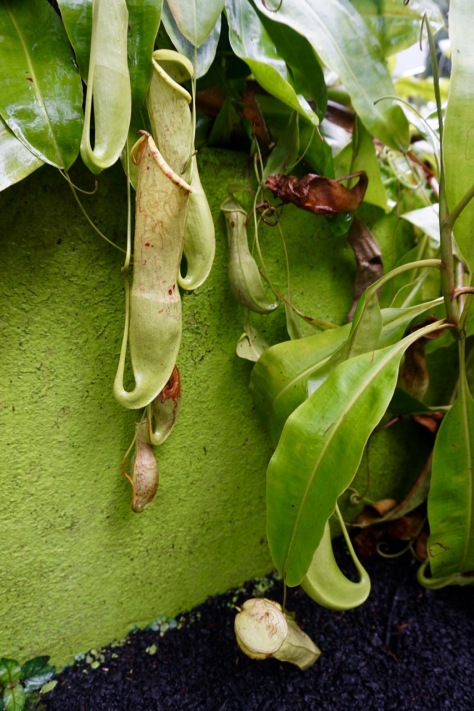
DSC04049

One friend and I decided to leave the reserve on foot, doubling back on the one kilometer path we’d followed on the way in. The rest of the gang went ahead in a car and I thought we’d meet at the gate to decide what to do for the rest of the morning. Since we hadn’t seen any orangutans, we agreed to return to Semenggoh for the afternoon feeding but that was as far as we’d planned.

When my friend and I got to the bottom, however, our other friends were nowhere in sight. We asked the guard if he’d seen them and he gestured vaguely down the road, telling us they’d walked. One look at the two-lane shoulder-less highway convinced us otherwise. We waited 15 minutes and then, as if answering an unspoken cry, a man in a small purple car pulled up and asked if we needed a ride.

We looked at each other. Yes, we did. We got into the car and asked him to take us to the closest town in the direction of Kuching. The hornbill statue indicated that we’d arrived in Padawan and the man in the purple car, who may or may not have been a taxi/Grab, drove off.
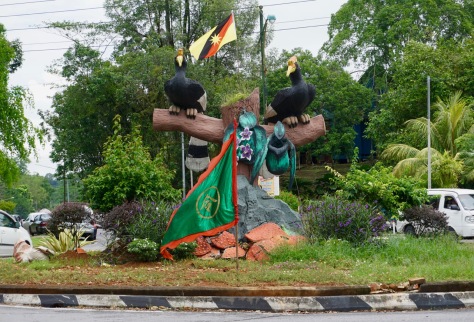
DSC04135

We went immediately to the closest hawker for bowls of soup and noodles and cups of strong coffee. After lunch, we saw a sign for a pitcher plant museum, so of course we went!

Padawan was also home to a wonderful market. I love markets in all forms and we leisurely wandered through it, wishing we could buy some vegetables and take them home. I was less enthralled with the fish and meat, but that’s local life.

The market was also exciting because the lady selling jewelry told us she’d seen our friends! They’d been looking for a short one and tall one, they told her, and that certainly described us. And truly, how likely was it that two groups of white women wandering through a wet market in a tiny town in Borneo didn’t know each other? The woman knew they were heading back to Semenggoh and we went off to join them. The woman didn’t know, however, how we should get back. There was no bus, she told us, and while I had my phone, I didn’t intend to turn it on to call a Grab.

Luckily, my friend talks to literally anybody and after we stood on a corner for a few minutes and tried making eye contact and looking friendly and in need of help, she walked up to a man and asked how to get a taxi. Someone else overheard and told us he’d give us a ride. We followed him to his white truck and hopped in. We looked at each other. All I could think was, “Oh gosh, her husband will kill me if she doesn’t get back!” How I stayed alive in that scenario, I’m not quite sure.

But the man was lovely and pointed out several landmarks along the way. He took us exactly where we needed to be and even agreed to take our money after we asked twice. After all, we would have paid a taxi! We were greeted by our friends and a really cute lizard!
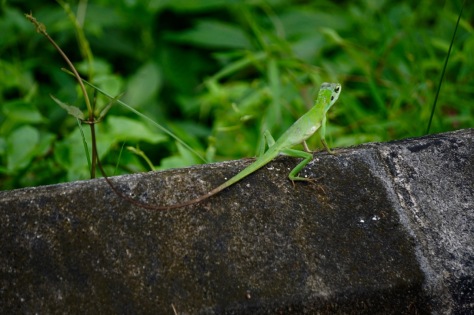
DSC04140

We saw another neat lizard later on . . .

DSC04159

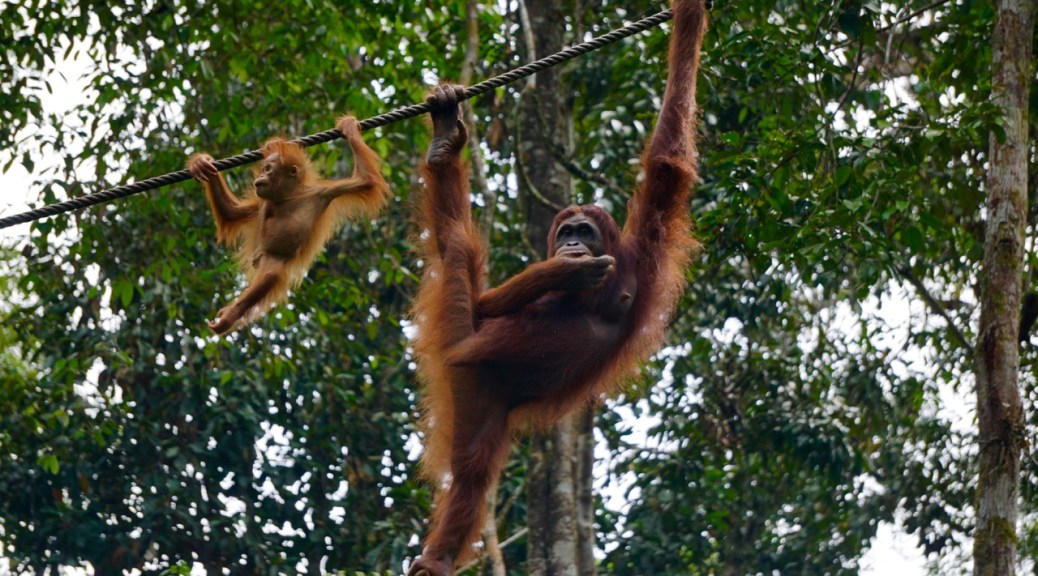
. . . and then were back in forest looking for orangutans. In Malay, “orang utan” means “people of the forest” and that’s exactly what they are. Watching the orangutans is breathtaking because it’s like watching evolution. It’s watching yourself in a different form. Watching the orangutans play and interact leaves no doubt that we are very close relatives and that they have been around for a long time. Visiting the orangutans at Semenggoh was, and remains, the single most amazing experience I’ve had in Southeast Asia.

We took a very long bus ride back to Kuching and agreed that we probably should have turned on the cellular data and taken a Grab, mostly because we were all hot and tired by that point. The walk along the water from the bus station, however, which we repeated in the opposite direction the next morning, was really lovely and I was not sorry to end the afternoon there. Orangutans and boats, all in one day!

In addition to being located on the Sarawak River, which I like very much, Kuching is home to brightly colored buildings and a few cat statues (because “kuching” is the Malay word for “cat”) . . .

. . . and a great array of street art. I liked that very much, too!

Our wandering through the street art district took us to a few lovely cafés and one of the proprietors suggested we check out the Textile Museum. We did, and were pleasantly surprised at the range of artifacts on display. Since we decided to have an easy coffee morning and not visit a longhouse, the textiles provided us with a glimpse of traditional life that I think is important for any trip to Sarawak.

And, of course, there were temples. We only stopped into one and it was lovely and colorful, which is really the best way I can describe the city of Kuching itself.

All in all, it was a great weekend. Kuching is a quick hour and twenty minutes from Singapore and there are cheap flights that leave after work. It was fun to be back in Malaysia both because of what I remembered (accurately and inaccurately) and what I’d forgotten. It’s fun to experience a bit of your own past every now and then.

But most importantly, this trip to Kuching was a great break from real life with a wonderful group of women. Thanks, ladies!

Travel Guide: Amsterdam and Haarlem

The impetus for my trip to Europe was to visit my brother during his semester studying in London, but prior to meeting him, I spent time in Leiden and The Hague, Brussels, and Ghent and Bruges. We chose to meet in Amsterdam because KLM has a direct flight from Amsterdam to Singapore so it would be easy on both of us.

It was raining, windy, and unpleasantly cold when we found each other in Amsterdam’s central train station. I was reading a book next to a baby grand piano that invited travelers to sit and play, heard my brother call my name, and looked up. I hadn’t seen him since July and it was so great to reunite, give him a hug, and go off on an adventure in a place new to both of us. As travelers, we both enjoy just walking around and seeing what there is to see. So, after dropping our backpacks at a storage facility in the middle of the city, that’s mostly what we did for the couple days we were there.

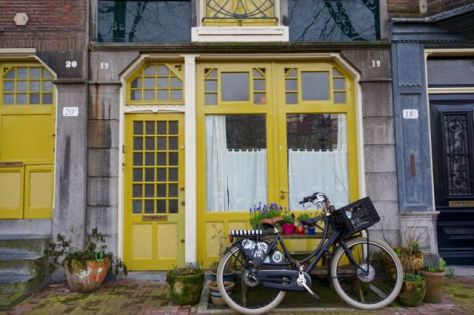
Growing up in the Finger Lakes of upstate New York in a city built around a canal and a river, we’re both used to life along the water but Amsterdam was constructed differently from any city we’d been to. It felt like it was designed for people instead of people fitting themselves around the design. Being in Amsterdam made it easy to understand the emphasis on commerce and exploration that made the Netherlands a European imperialist power. Of course, we loved all the bikes and houseboats, too.

As we wandered, we spent a few minutes in the Begijnhof, the former residence of a Catholic sisterhood who took no vows lived like nuns . . .

. . . stepped into De Krijtberg to verify that it was indeed a church (the Jewish stars above the doors left us a little uncertain) . . .

. . . and walked through a lovely flower market. It’s April in Amsterdam, after all!

Before returning to pick up our bags to take them to our Airbnb, we snacked on Dutch waffles (very different from Belgian waffles) at Albert Cuypmarkt. It sells everything, as markets do, and is located in a cool neighborhood. Market visits are my favorite travel activity because of the diversity of people and products. Look through a market and you’ll know what people buy, what they eat, the cost of living, and how people get along with one another.

We were lucky to find Café Gollem Amstelstraat our first afternoon in Amsterdam and made friends with the bartender while enjoying the largest cheese plate we’d ever seen. I loved that the bar had wifi and people were there working on laptops. Reading the chalkboards on the walls, my brother noticed that they sold Westvleteren 12, often voted the best beer in the world (though this may be changing). Oddly enough, we’d talked about that beer earlier in the day and just looked at each other for a moment.

We asked the bartender if the bar indeed had it in stock. They did. We asked if it was actually the best beer in the world. He hesitated. He told us that it’s been called the most perfect beer and that it’s unique, special, and really indescribable. He confirmed that the scarcity and mythology around it only add to the appeal and assured us that we’d enjoy it, but that we should be aware that we were unlikely to immediately experience a “wow” moment.

At 10.2% alcohol, our second drink of the afternoon, and a price tag of €15, we figured we’d split a bottle. Koen, the bartender, poured the beer into two glasses that looked like wine glasses, reserving the last couple swallows to split into two shot glasses. He told us to wait until the beer warmed up a bit and to drink the shot glass pour, where all the yeast settled, slowly, alongside the glass of beer.

The first thing we noticed was the aroma. Koen was right that we wouldn’t be able to describe it, but it was indeed unique and special. As advertised, the taste of the beer was not a “wow, how delicious” moment; it was more like experiencing beer for the first time in its most perfect, pure form as in, “Oh, this is what beer tastes like.” The liquid in the shot glasses tasted and felt completely different; it had more texture and a deeper taste than the rest of the drink. The whole experience was new and interesting and one that my brother and I were glad to share.

Before we left, Koen told us he’d be hanging out at the bar that night if we wanted to stop by again. He taught us the word gezellig, which I had recently come across (though had no idea how to pronounce) in a book on language and emotion. It means feeling pleasant and cozy with friends, which is certainly how we felt leaving the bar and when we returned later that night.

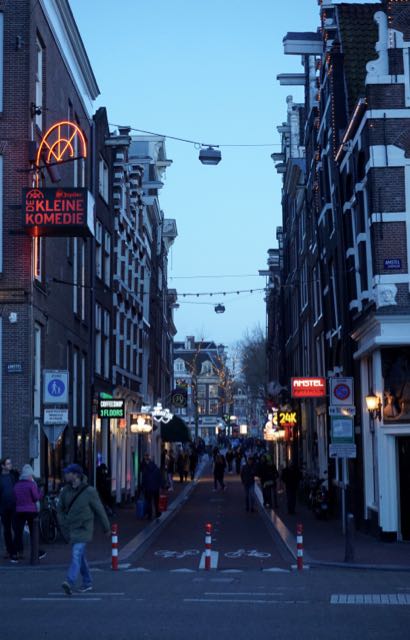
After it got dark, we spent some time in De Wallen, Amsterdam’s infamous red light district. For obvious reasons, photography isn’t allowed there. (Though everything else seems to be, so maybe it’s not that obvious.) The red light district is full of bars, weed cafés, and shops selling all sorts of interesting objects. And women beckoning provocatively behind glass doors. And promoters advertising shows of all kinds. It took me until much later that night to accurately articulate my reaction to what we’d seen. Without knowing it, and as a result of its absence, I realized that I had expected the atmosphere to playful; it was anything but. Human bodies were up for sale and people were shopping and buying. Sex is an industry and one can buy, sell, and commoditize any and every part of it. The whole thing becomes really dark and grim when you realize you’re walking through a flesh market alive and well on city streets.

DSC03795

We got up late the following morning and decided to escape the city for a while. We took a train to Haarlem, just 20 minutes west of Amsterdam. After the busy day and late night were glad to be in a much quieter, sunny little town. We stopped for hot chocolate, the special kind where you choose a real piece of chocolate and stir it into steamed milk, and followed my usual plan without a plan of walking towards the tallest building. We found the town’s central square and toured St. Bavo’s Church . . .

. . . and then spent our time wandering through the cobblestone streets and looking into windows of shops and restaurants. We mostly just enjoyed being away from the hustle and bustle of Amsterdam and looking at pretty gardens down little alleys in front of homes and small businesses.

We also enjoyed the architecture outside of the Cathedral of St. Bavo (Bavo was born in Ghent but is the patron saint of Haarlem) . . .

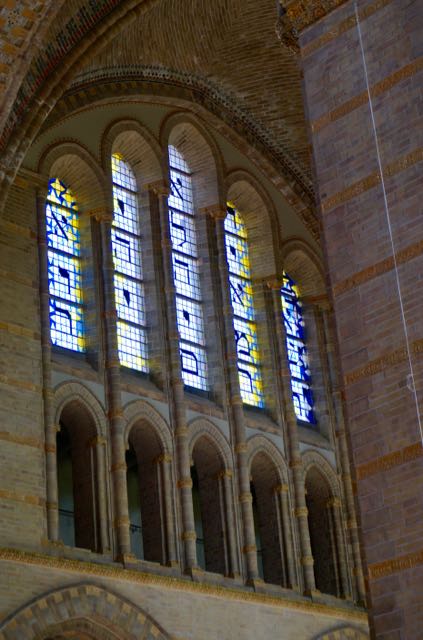
. . . and only stepped inside for a moment to see some very interesting stained glass. Hebrew and other Judaica are very common in Christian buildings if you know where to look, but somehow always surprise me.

DSC03882

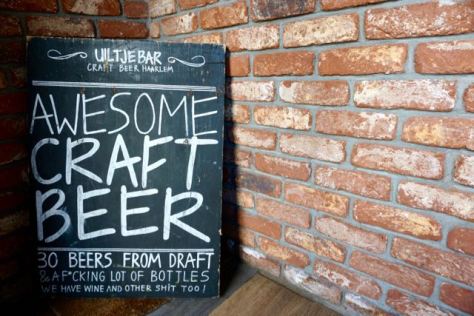
Our bartender friend suggested we check out one of his favorite bars in Haarlem, and naturally we did. My tiramisu stout was delicious and my brother had his first sour. Of course, there was cheese to go along with it.

DSC03889

Haarlem also had a bit of an attitude, which made us laugh:

The sun was still out when we walked through Kenaupark along a canal on our way back to the train station late that afternoon. We agreed that Haarlem would be a lovely place to live, both because it’s really nice and because it’s close to a real city.

Back in Amsterdam, desiring to maintain some of the peace and quiet that we had experienced in Haarlem, we followed the canals towards their source in the tributaries off the North Sea. The sky had grown cloudy but I was glad to be on the docks with the boats.

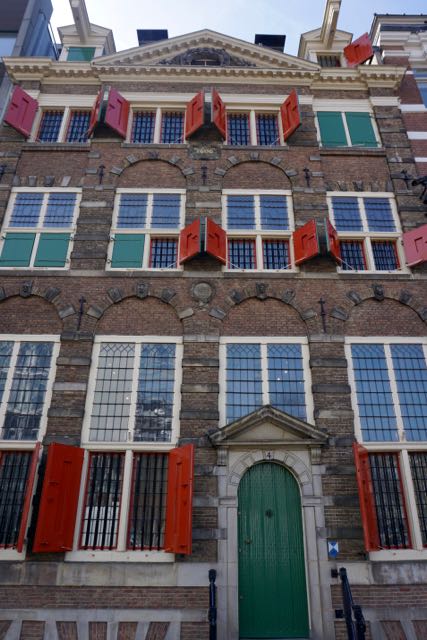
The next morning, we brought our bags to the same storage facility in city center and made our way to the Rembrandt House Museum. I really love seeing how people lived way back in the day. Rembrandt’s life looked quite comfortable and, as my brother pointed out, it’s rare that an artist was so celebrated while still alive.

DSC03934

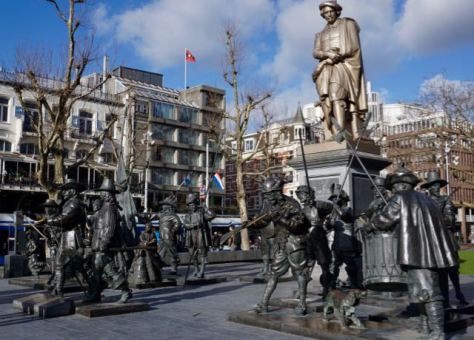
Amsterdam also has a really cool statue dedicated to Rembrandt in the aptly-named Rembrandtplein, the city’s central square:

DSC03782

Feeling cultured, we decided we’d visit one more museum that day. On our way to the museum district, we walked through a flea market selling clothing, shoes, and cool pieces of art . . .

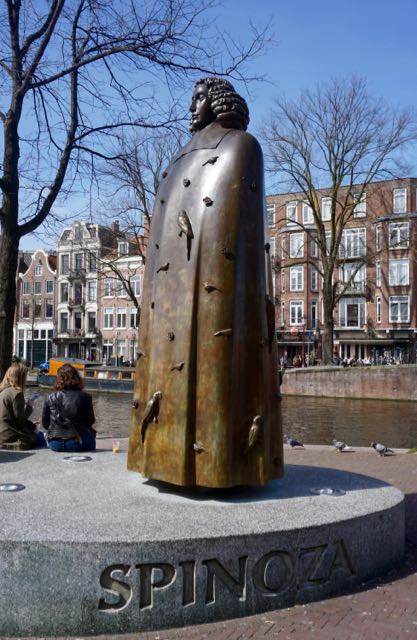
. . . which led us to a statue of Amsterdam native Baruch Spinoza (the birds were symbolic, but I can’t remember why) . . .

DSC03940

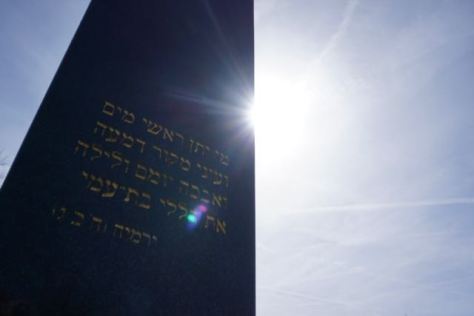
. . . and a memorial to the victims of World War II. . . .

DSC03942
“O that my head were (full of) waters and my eyes a fountain of tears, that I might weep day and night for the slain of the daughter of my people.” – Jeremiah 8:23

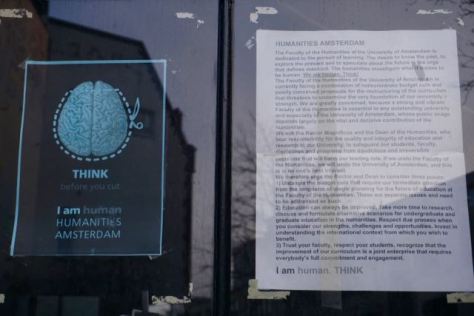
Amsterdam has a historic Jewish Quarter but we didn’t spend much time there. We happened across the Portuguese Synagogue one evening and meant to come back, but that’s the day we went to Haarlem instead. Normally, we would have visited the Anne Frank House, but it was unfortunately closed for Passover until the night that I left. Lucky brother went without me.

Our plan for the last afternoon was to visit the Van Gogh Museum in Vondelpark, full of people on the first warm day all week. On arrival, though, we learned that new rules meant tickets were timed and only available online. Unable to get tickets for that day, we opted for the Rijksmuseum just across the park, which houses very famous Dutch art, including several pieces by Rembrandt we’d learned about that morning.

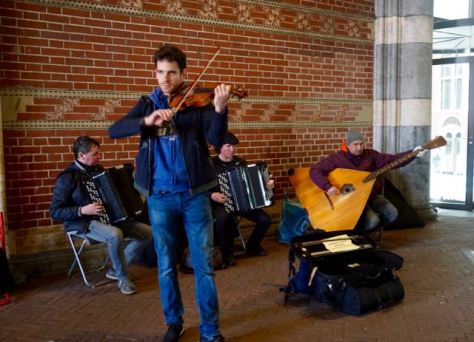
There were street musicians playing in the covered museum courtyard and we stopped to listen. I’m always impressed with just how talented some people are and it reminds me over and over how difficult it is to make it in the arts worlds.

DSC03960

We had a very late lunch after the museum and wandered around a little while longer, enjoying the canals and the sunshine, before I took a train to the airport. There was a lot I enjoyed about just being in Amsterdam because the people of this city have something to say and want to be heard.

DSC03933

As usual, I appreciated the flavor and feel that street art and graffiti lend to a city. It’s a way of getting to know the people of a place and understand a bit about who they are and what matters to them.

In all, we really enjoyed being in Amsterdam. A city built on canals and for bicycles feels different than many places I’ve been. The graceful bridges and buildings that go right up to the water lend a lot of beauty to the city and I think the locals have a right to be concerned with negative impacts of tourism. Our Airbnb away from city center helped us understand what it means to live in Amsterdam and made me like it a lot more than I did in the crowded tourist areas. As usual, I haven’t seen everything yet, which means I’ll have to come back. Amsterdam, thanks for having us!

DSC03909

Travel Guide: Chiang Mai x2

After time in Hanoi and Sapa, my sister and I arrived in Chiang Mai, Thailand on New Year’s Eve. I was excited to be back as soon as we landed.

We dropped our bags and headed straight for Sunday Walking Street, one of Chiang Mai’s many night markets. It sells food, clothing, art, home decor, and just about anything else that one might need or desire. For those who love to shop, there’s a regular night market and a Saturday Walking Street, too.

It was busier than usual because of New Year’s Eve so we ducked out for dinner once the crowds became unpleasant. Once it was dark, we joined groups of locals and tourists setting off paper lanterns along the river, just inside the walls that cordon off central Chiang Mai from the rest of the city. (I’d love to go to the Lantern Festival one day.) Encouraged by a friendly Thai man, we scribbled messages on our lantern before finding someone with a candle who helped us light it. With his help, we held the lantern to the ground until he decided, seemingly arbitrarily, that it was ready to hold itself up in the sky. We let go and watched the lantern float up and over the river, following hundreds of others. Such a cool way to send off positive wishes for a new year.

A few hours later, we rang in 2018 from Zoe in Yellow, a Chiang Mai club that absorbed the parties from every bar on its street. Security and bartenders were kind enough to look the other way as all patrons wandered from bar to bar, dancing wherever the best song was playing.

IMG_0407

On New Year’s Day, we visited one of several massage centers in Chiang Mai where female ex-convicts are trained in the art of massage. Thai massage is very different from any massage that I’ve had (and I don’t always like being touched, so massages are infrequent) and I really enjoyed it. You’re fully dressed and the masseuse is right up on the bed with you, using her entire body to pull, twist, and stretch yours. She was contorted into as many positions as I was throughout the process. It was a new physical experience for me and a lovely way to spend an hour.

We spent the afternoon wandering around, the streets blissfully empty this time, and found some really lovely street art that basically exemplifies why I love Chiang Mai so much. It’s a small town with so much personality and so much good will. Really delicious cafés and coffee shops, too! We visited at least one every afternoon. Chiang Mai is laid-back, calm, and friendly, all of which were greatly appreciated after the hustle and bustle of Hanoi.

We also saw some of Chiang Mai’s many temples. They’re ornate, colorful, incredibly detailed, and very impressive. They can also get a little tiring and all start to look the same after a while. Since Chiang Mai has so many, though, one way of getting to know the city is by going from temple to temple and creating a mental map. That’s what I did the first time I was there and I was surprised at how much I remembered.

Visiting temples at night, however, was a new experience and a very different one. What is beautiful in the light can take on a very eerie, creepy quality in the dark. That was only enhanced by the man riding his bike in circles whispering, “Beautiful . . .” over and over.

We actually spent most of our time in Chiang Mai out of town and in the wider province. On our second full day we went on an excursion to Phuping Palace, the royal family’s holiday home, and Doi Suthep, Chiang Mai’s most famous temple. We were far more interested in the latter but I’m glad we saw the palace, too. We weren’t allowed inside but the gardens were lovely!

If you’re planning to go, one word of caution. Just like the Grand Palace in Bangkok, there’s a dress code that is more strict than the regular temple dress code. For men, it’s long pants (no shorts, even if they cover the knee) and a shirt that covers the shoulders. For women, it’s a skirt or long pants (no leggings, though fine in a temple) and a shirt that covers the shoulders (no scarves for this part, though that’s fine in a temple). Luckily, there are clothes to buy or rent if you’re in a bind.

After some time at Phuping Palace and a short drive, we reached Wat Phra That Doi Suthep and walked up 306 steps to reach it. Like every temple that we visited in and around Chiang Mai, this one was full of monks and worshippers giving offerings and saying prayers in the hope of a prosperous new year. Doi Suthep is actually the name of the mountain on which the temple is located and there were really beautiful views of the city from the summit. It was a cloudy day so I’ll keep those pictures to myself because they really don’t do it justice.

The primary reason I had wanted my sister to visit Chiang Mai was because of Elephant Nature Park. That’s what first brought me to Chiang Mai a couple years ago and I could not wait to share it with my sister. ENP is a rescue center for elephants previously in captivity from logging operations, circus performances, or as tourist attractions on city streets. ENP also has an expansive dog rescue program with its own set of volunteers. There are other animals living there, too, like cats and water buffalo. At ENP, no one rides the elephants. You feed them, learn about their individual personalities and life stories, bathe them when it’s warm enough (it is in September but some were wearing jackets in January!), and touch them if they’ll let you. It’s a beautiful place with beautiful animals and I was so glad to be back.

We spent our last day in Chiang Mai up in the mountains. We headed to Doi Inthanon National Park, which is part of the Himalayas and home to the highest mountain in Thailand that gives the park its name. The climate of Doi Inthanon is always chilly, hovering around 10ºC or 50ºF during the day, and I was glad for my jacket.

After about two hours of driving, we stopped at Wachirathan Waterfall. I grew up in upstate New York and spent summers camping in Letchworth State Park and this waterfall reminded me a little bit of home. I loved climbing down on the rocks to get as close to the spray as possible. We used to stand in the gorges trying to catch whatever fish darted around in there. We called them crayfish, but I’m not sure that’s what they were.

After some time at the waterfall, we took a quick drive to Kew Mae Pan Nature Trail, the real reason we’d come to Doi Inthanon. We hiked for two hours through the cloud forest, which was really neat because we’d visited Singapore’s Cloud Forest in Gardens by the Bay two weeks earlier and here we were in a real one! Normally, the guide told us, there’s a stunning view of the mountain range and nearby temples from the summit. The day we were there, however, was an anomaly. We could see . . . nothing.

Knowing what I was missing because of a photo from the guidebook, I was initially disappointed. And then I started paying attention to everything I could see and my emotional response, attitude, and interpretation of the experience completely changed. I started looking around and found myself feeling calm and peaceful. I felt wrapped up in mist from the clouds, hugged by everything around me. Only being able to see a few meters in any direction forced me to focus more deeply than I often do when I’m outside and there’s so much to see. With less distraction, it was easier to experience beauty and serenity in everything that there was.

While I could have happily spent many more hours hiking in the mountains, we followed the guide to the burial site of the ancient Lanna kings. As everywhere in Thailand, there were people praying and leaving offerings, which I always like to see. Religious devotion is always interesting to me because I grew up understanding it so completely. My thoughts have changed a lot since then.

Another major attraction of Doi Inthanon National Park are the pagodas dedicated to the king and queen. Normally, you can see them from the top of the mountain but we had the additional surprise of not being able to see them at all because of the fog. The guide shrugged and told us to wander around the gardens, which we did. It’s still amusing to watch monks taking selfies, especially when there’s nothing to see. As we wandered, though, the sun broke through the clouds and the fog cleared for just long enough to allow us to see what we’d come to see.

The King Pagoda was surrounded by really beautiful scenes of the life of the Buddha and was absolutely empty inside, which is unusual. I really liked the brown and gray with hints of purple, which is also unusual. Temples are so pretty when they’re simple.

The Queen Pagoda was decorated with purple mosaics. This I had never seen and this I loved. This queen loved purple, the guide told us. So do I.

After some time at the pagodas, we went to a nearby market just for a quick look. Though my sister and I told each other we weren’t hungry, we used that quick look to buy a cup of strawberries and another cup of gooseberries!

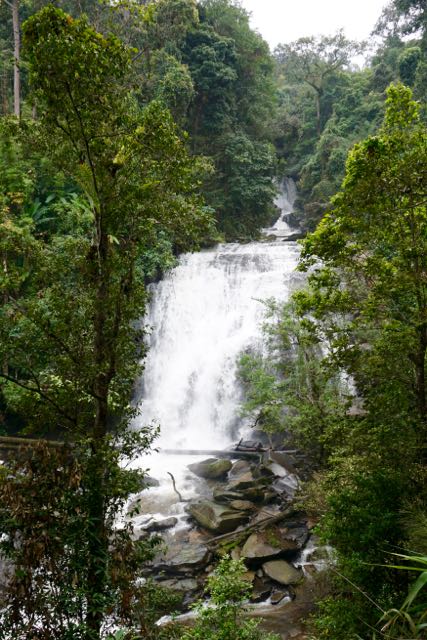
According to the guide, the last stop with this particular tour is usually the Sirithan Waterfall. Though smaller and initially less impressive than the first, I enjoyed listening to the water.

DSC03125

However, since so many people in our group had asked about local livelihoods, he took us to a village that grows rice in the summer and coffee throughout the year!

Our visit to Doi Inthanon was such a great day and it was a little difficult to know that our trip was at an end. But it was such a wonderful way to say goodbye to a place I really love. Here’s to hoping I’ll be back soon!
DSC02799