Tag Archives: History

Travel Guide: New Orleans, LA

Prior to leaving on this long weekend with my mum (the first time we’ve traveled somewhere together!), I had the following conversation with more than a few friends and colleagues:

Curious person: Oh cool, New Orleans! Are you going for Mardi Gras?
Me: No, that’s not until next week.
Curious person: Oh right, of course.

To all of you who asked such a good question, I owe you an apology. I was completely wrong and you seemed to believe what I said without question (likely because I go a lot of places and do a lot of things and usually sound pretty confident when I speak, the latter of which is largely smoke and mirrors anyway). Mea culpa. Lessons learned: Factually, trust no one (as aptly phrased by a friend) and always, always research.

The Mardi Gras season, as the extremely friendly and hospitable New Orleanians (I may have made up that word) told me, runs from Epiphany in January to actual Mardi Gras day (Fat Tuesday). As the locals explained it, Mardi Gras is an excuse to do as much sinning as possible for 5+ weeks in order to have something to atone for over Lent.

So yes, I was in New Orleans for part of Mardi Gras. And it was amazing. There were parades everywhere at all times of the day and night. Most of these photos are from the Krewe of Cork parade in the French Quarter:

My mum and I thoroughly enjoyed collecting as many beads as we could and ogling in astonishment at the parades, costumes, and general debauchery, especially on Bourbon Street. There are no open container laws in New Orleans, which was a lot of fun and probably explains much of what we saw:

More importantly, we learned a lot about the rich history and culture of New Orleans, which has been Spanish, French, and American throughout its history, creating Creole and Cajun cultures that give the city a flavor and a pulse unlike anything I’ve ever experienced. The food is darn good, too, and this is coming from a vegetarian. If I was impressed, omnivores will be even more so.

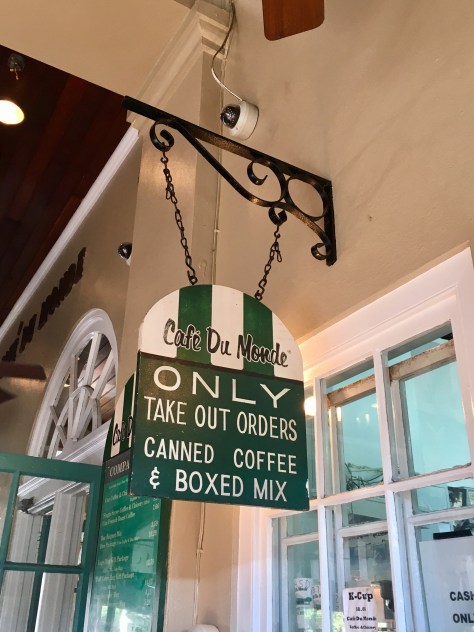
I have to admit, however, that I still don’t like doughnuts. It was a lot of fun to eat beignets and drink café au lait while walking down the street, but I just don’t like doughnuts. That said, I’d still recommend a visit to Café du Monde, if for no other reason than to say you did. We got there around 8:15am on Saturday morning and beat the lines by about a minute. And the café au lait was truly delicious.
img_3242

Mum and I really love wandering along streets and in and out of shops and galleries wherever we are, which is how we spent most of our time. We explored the French Quarter and French Market on our own and also took a French Quarter walking tour to actually learn a thing or two about how New Orleans came to be. We were amazed at the beauty of the streets and buildings, and delighted with the art and music that were everywhere:

Another really excellent walking tour took us through Lafayette Cemetery and the Garden District. There were some incredible homes in the Garden District, with a remarkable diversity of architecture based on sheer whim of the wealthy homeowners.We learned about the burial laws of New Orleans (as long as you wait a year and a day, you can open a tomb and shove another body inside) and some of the history of the city’s wealth from trade. The first burial in Lafayette Cemetery took place in the 1840s and the cemetery is still active, which is really neat:

We also spent one evening on Frenchmen Street where there was jazz everywhere, as well as an art market. The hard part was picking a bar to visit (we chose The Spotted Cat based on several recommendations) and a place to eat afterwards! And then we were interrupted by the Krewe of Chewbacchus parade in Marginy, which was so much fun. Unfortunately, I’m a rather petite person and couldn’t get close enough to the police barrier to take any decent photos of the parade itself. But here’s Frenchmen Street:

On our last night in the city, we took a ghost tour to learn about the haunted history of New Orleans. I’m glad that we did the French Quarter tour first because the histories are obviously intertwined, but I don’t know that I’d seek out another ghost tour. I enjoyed hearing the stories and visiting a possibly haunted bar that doesn’t have electricity, but I got a lot more out of the daytime walking tours. That’s probably not surprising, considering the supernatural is questionable at best.

I’ve always admired the “doors of” posters of various cities that are often on the walls in waiting rooms, so I decided New Orleans was a good opportunity to work on my own collection of “doors of” photos. My favorites, including one set of mailboxes:

The most surprising aspect of New Orleans was the culture of the city and the genuinely open, receptive, and free spirits of all the people I encountered, from the man in the suit to the young couple in togas to the woman wearing only glitter. People playing music on the streets seemed genuinely excited to be doing it and artists hung their work anywhere they could and worked wherever they were standing. Palm and tarot readings were readily available and the voodoo shop we visited could not have been more welcoming; they even suggested a different shop when we couldn’t find what we wanted!

(Full disclosure here: Friends have read my tarot cards twice and palm once, and while I don’t know if I “believe” any of what they said, it sure was telling. And, in hindsight, frighteningly accurate.)

Maybe it was Mardi Gras or Southern hospitality, but there’s something truly wonderful about a place where what is normally considered “subculture” is just everyday being.

img_3374

Building Peace: Reflecting on Conversations in the Classroom

This post is the fourth in a series of posts where I’ve explored the importance of peace in the classroom and how we are working (or need to work) to cultivate peace with students. Previous posts discussed peace as the purpose of education, ways we view and need to reframe masculinity and femininity, and words that we use with and around young people.


Back in April, I read Peace Education: How We Come to Love and Hate War by Nel Noddings as part of an ongoing personal mission to become more conscious of how I discuss peace and war with my students. I’d been interested in the Freedom Schools movement and restorative justice since graduate school and was looking to enhance my understanding of what peace means in a classroom context where, as a social studies and humanities teacher, I spent a lot of time talking about war. In most curricula, conflict and war are central themes. Noddings highlights that our history textbooks are often organized chronologically around wars, our literature glorifies warriors, and we emphasize competition, power, and patriotism as we attempt to tell the stories of who we are and how we got here. It should come as no surprise that our society is less peaceful than we would like, and less peaceful than it should be.

Three particular instances in my classroom have stood out to me as essential examples of why we need to rethink how we talk about peace and war in the classroom.

Today in History
Since the day I began teaching, I’ve kept a Today in History section of my whiteboard where I post a fun fact about something that happened in history. I almost always use the History website section devoted to this particular feature to get my fact of the day. When I can, I use a fact that relates to something my students are learning or have learned. When I can’t, I try to find something they’ll connect to or find particularly compelling.

As I’ve become more focused on discussing peace rather than war (i.e. we’re currently studying the Civil War’s social, political, and economic impacts on the United States rather than what happened militarily during the war), however, it’s become harder to use the History website to find facts for my students. History categorizes its daily factoids into seventeen sections, six of which are devoted to the major wars that the US has fought. If I skip all of those, I’m down to eleven options. I don’t want to include crime or disasters, so that’s nine options. Automotive, Hollywood, and Sports don’t seem relevant enough, and my students are generally unfamiliar with anything pertaining to Music, Literary, and Old West. That means I have three options: Lead Story, General Interest, and Presidential. There have been some years where I don’t teach American history, which means Presidential is out, too.

Not a lot of choice when I want my students constantly confronted with collaborative, constructive, global events.

Dissatisfied with History’s options, I’ve started turning more regularly to On This Day, which reaches far more broadly in providing three categories (Miscellaneous, Music, Birthdays) and upwards of thirty events in each category. It’s not that some days are historically busier than others, as any avid news reader knows. Instead, it’s that History curates information to a population fed stories of war, patriotism, and nationalism. These are divisive ideas and not what I want in front of my students on a daily basis.

ISIS
At the end of the last school year, my tenth graders sat in a circle and we discussed ISIS. One of their ongoing class assignments was a current events report that asked them not only to find an event and summarize it, but also to consider it in a local, national, and global context, as well as consider whether the event would have been handled or approached differently in different time periods.

Understandably, ISIS was constantly a topic in their write-ups. Students submitted their assignments via GoogleDocs, which allowed us to have digital conversations about what they’d written. Many students expressed anxiety, fear, anger, frustration, and uncertainty about the stability of the world and about their own futures. I commented back to them in the most positive ways that I could, encouraging them to consider solutions that were diplomatic, dialogic, and international. More than one student replied to my comments explaining that they found these suggestions unrealistic.

That’s when I decided to have an open conversation as a class instead of repeating myself to individual students. Together, we chose our first discussion question: How can we peacefully resolve global conflict?

My students were creative thinkers and suggested everything from global partnerships of young people to add a new voice to increased efforts towards volunteering for organizations that raise money to aid developing countries.

And then came the second discussion question: What should we do about ISIS?

Almost unanimously, all of my tenth grade students in two class periods suggested war, economic sanctions, bombing, and providing the UN with an army.

I called the discussion to a halt and pointed out the inconsistencies between what they’d just said about global conflict and how they suggested responding to ISIS. My students countered with statistics of death and destruction, which have unfortunately become common knowledge. When I brought up anti-radicalization programs like this one in Denmark, most students said that the problem is that there aren’t enough resources and there isn’t enough time. I suggested community building to stop radicalization and pointed to several of the many examples that exist. Students were frustrated, again pointing to the numbers. This would take generations, they said. We don’t have generations.

We might not have generations, but the “solutions” that we’ve tried – economic sanctions, airstrikes, increased access to arms – to stop ISIS aren’t working either. Again, peace is not nearly as much a part of our discourse as war. And this is a problem.

Farmers and Artisans
Just last week I introduced my sixth graders to the concept of civilizations. We started by making a flowchart of how civilizations form. When we began discussing the job specialization that results from increased food supply (as a result of settling and farming rather than being nomadic hunter-gatherers), the following conversation (edited to highlight main points) took place:

Me: Let’s assume this half of the class are farmers and growing all the food we need for our civilization.
Farmer half of class: Woohoo!
Me: The other half are artisans.
Artisans: Woohoo!
Me: So the artisans don’t farm and the farmers don’t make anything (As I’m saying this, the kids start pointing fingers and laughing and saying things like “You’re gonna starve!”) But our civilization has to come together.
Farmers: They’re gonna steal all our food!
Me: No, something else has to happen because we all need to survive so we have to work together.
Artisans: Oh, we’ll trade.
Me: Exactly.
Farmers: Oh.
Me: So then we have a civilization of great artisans . . .
Artisans: Yay!
Me: . . . and great farmers . . .
Farmers: Yay!
Me: . . . and we’re so successful that lots of other people come join our civilization.
Farmers: So THEY steal all our food!
Me: . . .

After class, I reflected on this conversation. What was going on here? My students came across extremely aggressively and competitively but then recognized the interdependence that existed between the two groups. I thought we’d had a breakthrough. We’d peacefully resolved a conflict that my students thought they saw . . . but then headed straight back to conflict when faced with an outside group. I understood that my students saw the outside group as a threat, even though I hadn’t explicitly framed it that way. That certainly has not been a thread of discussion in my classroom, which suggests a narrative of conflict and competition in their previous experiences. How much of this comes from schooling?

Ending Friday afternoon like this was uncomfortable and I’m looking forward to Monday so we can discuss the role of government figures in early civilizations. I’m curious to know whether they’ll see government as a leader in justice or a dispenser of punitive measures necessary to maintain order. In either case, I need to clearly articulate the goal of peace if I want my students to begin thinking in that framework. Peace is rarely an explicit discussion in our schools and I firmly believe that it needs to be.

Why It Matters
We do not live in a peaceful world. But we can. We need to begin to talk about peace and actively work on it instead of devolving into conflict. Peace will undoubtedly improve the world for all who inhabit it, which is why peacebuilding should be a central component in education. We need to agree to create an educational climate that develops world citizens who actively work to end suffering, creating a better and more peaceful world for all.

We will not find the solution to problems of violence, alienation, ignorance, and unhappiness in increasing our security, imposing more tests, punishing schools for their failure to produce 100 percent proficiency, or demanding that teachers be knowledgeable in the subjects they teach. Instead, we must allow teachers and students to interact as whole persons, and we must develop policies that treat the school as a whole community. – Nel Noddings

Travel Guide: Philadelphia, PA

In all my travel blogging, this is only the second blog post about the US! I’ve been other places, really.

Last week my parents and I turned a wedding in New Jersey into a short vacation that included three days in the City of Brotherly Love. My dad has been there a number of times for conferences, but neither my mum nor I had ever visited. We loved the architecture we saw, the history we learned, and the food we ate.

Philadelphia looks like this:


Anyone who has ever studied American history knows that many discussions about the formation of the US took place here. We visited Independence Hall where the Declaration of Independence was signed . . .


. . . Congress Hall where the first US Congresses met, way back when Congress actually did anything . . .


. . . and the Liberty Bell, so named because it has been the symbol of liberty for various groups working for freedom and justice in this country. . . .

P1080393

We spent a while in the National Museum of American Jewish History, too. I particularly liked the section on Judaism in colonial America because that’s what I know the least about. My knowledge of modern Jewish history is much better. As a result, I wasn’t as captivated by the museum’s exhibits as someone new to the topic might be. The museum was really well done, and I’d recommend a visit.

For a dose of local life and fresh vegetables, we visited Reading Terminal Market on three separate occasions, which I absolutely loved:


Philadelphia is also home to Eastern State Penitentiary, which struck me as ironic considering the love infused in so much of Philadelphia’s portrayal of itself. There is a dark side to everything human, a side that reminds us that there is more than one story. Through audio testimony, we learned how prison design and the purpose of prison in the US has changed over time. The exhibits also asked visitors to consider important questions about the prison system today, like whether prison is rehabilitative, whether it is objective, and whether punishments truly fit crimes. That was the most important section for me because it put visitors in uncomfortable positions and asked them to think about humans rather than numbers.


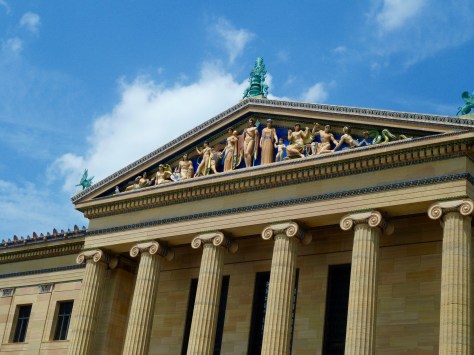
We also spent a good deal of time at the Philadelphia Museum of Art, which has multiple buildings with a wide variety of exhibits. Tickets are good for the day of purchase and the following day, so we took advantage of that. That’s where the Rocky statue and steps are, too. Yes, I ran up the steps and I’m pretty sure my mum took a video as proof.

P1080498 (1)

P1080471

Everything I’ve heard about food in Philadelphia turned out to be true. We enjoyed the following:

Breakfast: Pearl’s Oyster Bar and Dutch Eating Place, both at Reading Terminal Market and both delicious
Lunch: Lucha Cartel and OCF Coffee House
Dinner: VedgeZahav, and Abe Fisher
Coffee: La Colombe Coffee Roasters

The DNC is taking over now and that’s pretty cool, too!


As an added bonus, I got to meet up with my friend Lauren from Singapore! That was the icing on the cake, really.

If you have a couple days, I’d recommend a visit. After all, what’s not to love about a city with a sense of humor?

P1080468

P1080467