Tag Archives: Learning

What I’ve Learned About Acceptance and Forgiveness

Misunderstood signals.

Confused feelings over a piece of writing.

An old friend knocking on the door.

Acknowledgement of a shared painful experience.

All of the above have occurred in the past two weeks, though not in that order, and I’ve been talking about these experiences with a few people. What has struck me is that I’ve actually learned something over the past year about acceptance and, from that, about forgiveness. What I’ve learned has profoundly impacted my reaction to and understanding of the situations above. The following attempts to explain.


Acceptance

I don’t understand it any more than you do, but one thing I’ve learned is that you don’t have to understand things for them to be. – Madeline L’Engle, A Wrinkle in Time

People sometimes react to things we say or do in ways that are surprising, and such surprises may be unpleasant. I have learned, however, that an individual’s reactions say a lot more about that person than they do about anyone else.

It is very important not to internalize nastiness that might come your way. People can disagree and disagreements can be healthy, informative, and an opportunity for growth. But a negative response to something I have said or done is not because of me. If I do or say something you don’t like, consider why you don’t like it. Consider what bothers you and why. Consider why you reacted the way that you did. You know yourself better than I do and chances are, your reaction has more to do with you than it does with me. I might bring up emotions, feelings, memories, or areas of discomfort that you do not like – but your reaction is about you and not about me.

This does not mean that I should not consider your feelings and try to gauge how you might react in a given situation. This does not mean that I can do and say what I like with blatant disregard for the affect it might have on others. It does not mean that I can be intentionally or unintentionally cruel and walk away like nothing has happened. It simply means that as long as I am acting as a decent person and treating you with that dignity that you deserve as individual, I should feel neither guilt nor shame when you react in a way that I do not expect or understand.

People are surprising in positive and negative ways and that demonstrates that we should always give people a chance because they may be experiencing something we are unaware of or cannot imagine. This means that we cannot condemn others for behaviors that we don’t understand. Rather, we can meet others where they are and accept who they are with open hearts and open minds. Since we still may not like or agree with everything people do it is also vital to practice compassion in all of our interactions.

Forgiveness

It’s no use to go back to yesterday because I was a different person then. – Lewis Carroll, Alice’s Adventures in Wonderland

When we practice compassion towards others and accept them simply because they, like us, are doing the best they can with the lives they lead, being angry with others is nonsensical. Ignorance causes suffering and suffering causes harm. People who harm are hurting and they need our love and support. Our anger only hurts ourselves.

I’ve read a lot about Buddhismmeditation, and how the brain is wired to help others. It has taken me a long time (and six months of chatting with a therapist – best decision I’ve ever made) to internalize what this means. It means that I can’t be angry with you if you hurt me because you’re hurting, too. And whatever you’ve done to me is reflective of whatever has happened to you. I don’t need to know what that is to forgive you for your actions.

When we find ourselves angry or hurt, it is helpful to consider why. Consider what it was that brought up negative feelings for us. Exploring those negative feelings is an opportunity for personal growth and development. When we find ourselves angry, we can stop. We can take a breath. Acknowledge and lean into our emotions. We can allow ourselves to feel.

And then we can return to the people who brought up these emotions and forgive them for causing us harm. Likely, that harm comes from their own suffering. Likely, they did not mean to hurt us.

When we forgive each other, we become different people. We become more knowledgeable about ourselves and others. We become more aware, more open-minded, and probably happier than we were. Even if we choose not to continue our relationships with people who have angered us, we are not allowing negative feelings to take over other aspects of our lives. It is far healthier to live without anger, either at ourselves or others.


It has taken me my entire life to learn these lessons. As someone who feels very deeply, I know that it’s very challenging to step away from emotions that arise without invitation and often claim our attention for longer than we’d like. Recently, I’ve noticed that I’m far calmer now in the face of adversity than I ever have been. I’m not driven to anger as readily and when I am hurt or upset, it’s much easier and less painful to find a quiet mind and state of equanimity again.

Mindful awareness of how I intuitively react and why I do so has been extremely helpful in developing a clearer mind, deeper understanding of others, and a renewed desire to be vulnerable in relationships with others. I no longer try to be right because it does not bother me as much when I’m wrong. I am much happier accepting people for who they are and forgiving them for what they do than I ever was when I constantly kept score or internalized what others said or did. I am not nearly as important in anyone’s rational or irrational decision-making as I used to think. Knowing this makes it much easier to respond with love when others are clearly hurting.

If I’ve hurt you, I apologize. I was likely suffering and certainly did not mean to cause you harm.

If you’ve hurt me, you’re forgiven. I love you, too.

To forgive is to set a prisoner free and discover that the prisoner was you. – Lewis B. Smedes

Travel Guide: Battambang x2

Two years ago, I spent a week in Battambang, Cambodia’s second-largest city, as part of my school’s field studies program. That week completely changed the way I see education, my role as an educator, and what is possible with and for students. Last week, I had the opportunity to return to Battambang with about sixty grade 10 students for the same program, a week that has left me again convinced that young people can do anything as long as we support them.

On this trip, I acted as the school trip leader and worked closely with the program lead from the JUMP! Foundation, the organization that really puts together the whole experience. I can’t say enough good things about the work they do for students and communities and I am so proud to partner with them.

As trip leader, I wasn’t attached to a particular group of students and instead filled in for staff as needed, managed all student issues from discipline to illness to homesickness, switched groups daily to get to know each student, and met nightly with school staff and JUMP!’s lead to hear feedback about the day. Prior to the trip, I arranged airplane travel and rooming assignment, worked with teachers on curriculum coordination, communicated with parents, and managed petty cash. And, despite mental fatigue that hasn’t quite worn off, I really enjoyed it!

Welcome to Battambang, the arts and culture center of the Kingdom of Cambodia!


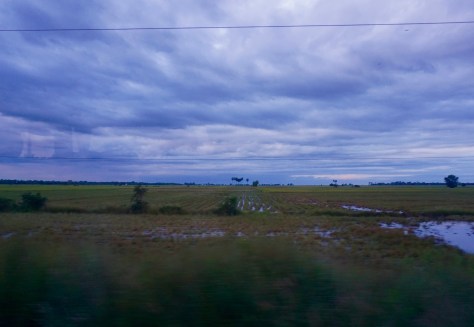
We flew into Siem Reap and immediately drove the three hours to Battambang where we spent the rest of the week. One of my friends immediately pointed out how much greener Cambodia is in November than it was in February on our last trip. It was really nice to be back in a city I had come to know a couple years before and see how it had changed.

On our first full day, I went with a group taking a tuk tuk ride to Phnom Sampov. Many of the students had never been on a tuk tuk, which is a really lovely way to see and engage with the countryside. The ride itself is beautiful and provides insight into how people live in a country still recovering from decades of civil war.


Phnom Sampov is a mountain dotted with Buddhist temples. We paused in front of several, but the goal of our time there was to visit a killing cave, one of the many legacies of the Khmer Rouge. Each group was partnered with a local facilitator for the week, in addition to teachers and a JUMP! facilitator, which gave the students a cultural connection to Cambodia that they would not have had otherwise. That was a change from the first trip and made a great impact on the students’ understanding of where they were and why.


That afternoon we visited Buddhist University and two monks led us on a tour of the campus temple and then guided us through a short meditation. From there we visited teh university library, which, in addition to the novel sight of monks on laptops, had a specific section for writings by peacemakers. That made me very happy!


As our last activity of the day, we met the dancers of Cambodian Living Arts, one of the many organizations working to revive the arts and culture that were destroyed during the Khmer Rouge era. They performed for us and then taught us a traditional dance involving coconuts, leaving everyone laughing and in high spirits. This was an uplifting change from the somber feel of the morning.

We caught a gorgeous sunset on our way to dinner, still travelling by tuk tuk. The sun rises and sets very early in Cambodia, something I always forget, but that also means that the stars are out when it’s still early enough to enjoy them.

DSC01971

The next day I joined a group at FEDA, an educational organization we used to work with that had just stopped its operation. Now, the visionary leader behind FEDA is working to build a peace museum on FEDA’s campus to chronicle Cambodia’s history and ongoing reconciliation work. That afternoon, we visited Banteay Srei, an NGO working for women’s empowerment in a country where there is a clear status difference between men and women from childhood onward.

It rained the following day, which was delightful because it cooled everything down and left the air quite pleasant. It’s always amazing to me how great of an impact weather has on the way we experience pretty much anything.

Another group started their morning with COMPED, an NGO that focuses on waste management and composting. The students learn about what COMPED does before going to the market to pick up organic waste. They then deposit it at COMPED’s dump sight. I missed it this year but remember the lesson very vividly: Everything goes somewhere and nothing disappears; we leave traces of ourselves wherever we are and that impacts people the world over.

Laster that day, I joined a group heading to Cambodian Children’s Trust. This is the organization that had the greatest personal impact on me from our last trip. CCT opened my eyes to the realities and dangers of orphanage tourism and the astonishing statistic that 80% of children in residential facilities worldwide have living parents. CCT works to support families by providing holistic care and services to the children they work with and their family members.

DSC01986

I went to bed laughing after spending the afternoon with a particularly entertaining group of young people. There’s a certain ease and genuineness that comes from eating together, learning together, and playing games together outside in sweaty clothes. It’s my favorite way to interact with students because everything I want for them, everything that leads to real questions, connections, and ideas, comes naturally.

The next morning we visited the Phare Ponleu Selpak, a non-profit providing children with academic education as well as arts education, specifically centered on circus skills, as a way of providing them with future work opportunities. I’d seen Phare’s show in Siem Reap on this trip two years ago, but this time we were able to participate in an amazingly fun circus skills workshop! We learned tumbling and how to juggle, took a tour of the campus, and got to watch some of the students rehearsing. We saw Phare’s Battambang show on the last night of the trip and were excited to see the same students perform.


That afternoon, in keeping with the arts theme, we visited Lotus Gallery to meet a local artist and make some art. The gallery itself was beautiful and had a very calming influence on the students.


I spent most of the afternoon chatting with the artist about the creative process and how she gets inspiration from her love of nature and purposely surrounds herself with plants and flowers, even building a garden sidecar for her motorcycle!

DSC01991

I also enjoyed chatting with her husband about his work in drugs education through theatre. He told me that the drug of choice in Cambodia is methamphetamine, which likely comes into the country from Thailand. It was a real joy to meet a couple who have invested their lives in work that they are passionate about and can also make a positive impact on others.

I spent our last full day on a cycling tour with Soksabike, which had been a highlight for me the first time around. We stopped periodically to learn about local livelihoods and the local families that Soksabike supports. We visited a family making rice paper . . .


. . . Cambodian scarves, which are called krama . . .


. . . banana chips . . .


. . . and bamboo sticky rice, which is a popular street snack. . . .

DSC02045

The bridge that we would normally take to cross the river had been dismantled, so we crossed by ferry instead. Needless to say, I loved this part. Water and I get along really well.


After the cycle tour, we continued that day’s local living theme by visiting the market, which was just such a joy. The students had a scavenger hunt to help them interact with locals and my job was to follow a group and make sure they didn’t get into any trouble. We saw food stalls . . .


. . . the usual array of meat, fish, and produce (my favorite!)  . . .


. . . textiles, toys, and dry goods . . .


. . . cosmetics and toiletries (and hairdressers and nail salons!) . . .

DSC02058

. . . and a surprising number of jewelry counters! (Hint: This is where we found the most English speakers.)

DSC02052

I love markets. They are always my favorite part (or pretty close) of any place I visit. I love seeing people come together for the same needs the world over. I love watching people interact and engage in the common pursuits of humanity. I love watching life happen in its most natural ways.

After Phare’s circus performance to round out the program, it was time for an early night before a 3am wakeup so that we could make the three-hour drive to the airport in time for our 10:30 flight. Absolutely worth it.

JUMP!, I can’t thank you enough. I watched students learn, grow as individuals, become closer to each other, create new friendships, engage with new ideas, and experience a culture and a place that is very different from what they usually see in Singapore. Thank you for bringing out the best in our young people. Thank you for all that you do.

DSC02101


What does learning look like?

Play a game with me. (I love games.)

Picture a teacher. Any teacher. A teacher you’ve had or a teacher you wish you’d had. A teacher you liked or a teacher you didn’t. Picture that teacher in a classroom. What does the classroom look like? Where’s the teacher? What’s the teacher doing? Put some students in that room. Where are the students? What are the students doing?

Try to keep that picture in your mind while reading the description of what my grade ten classroom looks like on a typical day.

Current Classroom
All students have laptops. They’re working, some talking with others but mostly just sitting quietly. Some are listening to music. The desks are in three clusters of four, one cluster of five, and two rows of three. I’m not sure who set them up that way. The students go back and forth from our class blog, which contains links to all resources they’ll need for the day, to whatever it is they’re working on. Some have printed copies of the linked resources and some are using pocket translators to help. There are notes from whatever we’ve recently discussed on the board. As the teacher, I’m either sitting in a spare student desk or on top of the cabinets at the side of the room. I have a laptop, too, and I’m probably on it.

We spend the beginning of each class reading through and then sharing the news. We discuss or review a few things together as a large group. Students complete a task, we discuss, students complete a task, we discuss. Sometimes these tasks are done independently and sometimes they work together. Sometimes students submit responses or assignments on GoogleDrive and sometimes they comment straight onto the blog. Often, they do neither and we periodically discuss for a few minutes after students have talked in their groups.

I’m willing to bet my classroom doesn’t look much like the one in your head.

The classroom in your head probably involves a teacher standing at the front of the room. Depending on how old you are, the students are probably in rows, though maybe groups of four. If you’re picturing a high school class, the students are probably taking notes while the teacher talks. Maybe there’s a PowerPoint presentation that the teacher is using, or maybe there are notes written on a transparency or perhaps on the board, again depending on how old you are. In this classroom, I’m willing to bet that the teacher is “teaching” and the students are “learning” and that the roles and responsibilities of both are clear. Anyone walking in could see that the teacher has the information and the students are supposed to take it in and understand it.

And if that’s not the classroom in your head, I’d love to hear what the classroom in your head looks like!

Even though my classroom might not match what we often think of when we hear “classroom” or “teacher” or “learning”, I have no doubt that my students are indeed learning. I can make this claim based simply on what they say in class, whether we’re having a discussion or they’re asking for clarification while working. I can make this claim based on individual conversation I have with students while checking up on their progress. If necessary, and sometimes it is, I can also provide samples of student work and show you the data I’ve collected and tracked on each student.

Anxiety
And yet.

And yet there’s some anxiety, anxiety for me as the trained educator in the room. What am I actually doing when others walk in or walk by the room? What am I actually doing that requires me to be there? I feel a sense of insecurity because I’m doing what I think is right by my students but looks inactive as compared to what others may do in their classes. The reason my classroom looks the way it does and I organize my classes the way I do is because I know, because I have learned, that with access to curated resources, assistance as needed, and feedback on their progress, my students will be just fine.

I might not be “teaching” in the traditional sense, but the point isn’t that I teach; it’s that students learn.

A few months ago, I read Michael Horn and Heather Stacker’s book Blended, which argues for disruptive innovation in schools. The authors explain that disruptive innovation comes from attempts in the business world to make products and services available to more people at lower cost. It was while reading this book that I began to rethink (yet again) the way that schools run and, more specifically, what I could do within my own classroom to meet students where they are and let them learn in the ways that make the most sense to them.

Future Classroom
Disruptive innovation in schools means making education and educational opportunities available to more people in ways that education may not have been in the past. In order to receive a diploma, everyone used to attend a building called a school. Considering schools in the context of disruptive innovation makes us ask, is that necessary anymore? Horn and Stacker describe models of schools that are a mix of remote and in-person learning experiences, either determined by the students themselves, by a the student in conjunction with a counselor, or by the student’s results on assessments. The very idea of a classroom, then, is called into question.

If I could, I’d design a school that looks like the one described in earlier writing here. I still believe that building peace is the purpose of education and that our students need a toolkit to make the world a better place. As much as I can, I design my grade ten curriculum around the real learning that is necessary for solving world problems and realizing one’s role and responsibilities as a citizen of the world. While my students have due dates, deadlines, and specific assessments, I’m trying to make my classes more flexible by providing students access to a wide range of resources and a choice about which ones to use.

There’s a long way to go. I know. There’s a lot of working, dialoguing, and understanding that has to happen. None of this happens quickly and I’m trying to be patient. I’m trying to be satisfied with one small change at a time. This isn’t the type of change that happens quietly, either, which is why I write about it.


Play a game with me. Design your ideal classroom or school or learning environment. Why do you think it should be this way or look like this? Comment below or send me a message.

Thank you for your thoughts, as always.