Tag Archives: Learning

Fair Is Not Equal

My new teacher orientation finally starts on Thursday. I’m teaching grades 6 and 8, which are both new to me. Teaching, however, is not new. This will be my sixth year as a teacher and each year has gone faster than its predecessor. By the end of this year, I will have taught every grade that my 5-12 social studies certification allows and I’m pretty excited about that.

I wanted to put together a short post on the difference between fairness and equality. The ideas reflected here are also found elsewhere on my blog, but I hope to clarify why I find this distinction so important in the classroom. Many of my personal beliefs on this topic stem from my Master’s program in inclusive education and my experiences teaching at two international schools where students speak literally dozens of languages.

What follows is an explanation of the difference between fairness and equality, how I encourage student discussion on the topic, and why I feel differentiation and conversation about it are necessary.

Background

We spend a lot of time discussing fairness with young children. We teach them about taking turns, about sharing, and about making sure each child has the same number of cookies. We might call it fairness, but we are actually promoting equality, which is not the same thing. Equality means treating everyone the same way. It means providing each child with the same number of turns on the swings, the same number of carrots, and the same choices between which two books to read.

As children grow older, they begin to realize that they are not treated the same way as their siblings or classmates. They cry out, “That’s not fair!” when parents  or teachers treat different children differently. (In my parents’ house, my dad’s stock response was, “Tough” while my mum preferred a calmer but equally devastating, “Life’s not fair”.)

What children mean is that what they are seeing is not equal. It is likely, however, completely fair.

From an educational perspective, fairness means providing each student with what he or she needs in order to be successful. Different students need different supports to achieve a desired outcome. As parents and teachers know, fairness means approaching each child differently based on different needs. Treating everyone equally, as though the are the same, is counterproductive to the goal of success.

Discussing Fairness in the Classroom

I like to discuss the difference between fairness and equality with my students. It leads to really interesting discussions about students’ individual needs, backgrounds, experiences, and goals. Most importantly, openly discussing fairness helps students realize the danger of assuming that a single way of helping others will work for everyone who needs help. It also helps them understand why so many people struggle in so many different ways.

Generally, I start the discussion of fairness and equality by showing students one of my favorite educational cartoons and asking for initial reactions:

6a00e54f8c25c98834017c317442ea970b-500wi
Source: http://scholasticadministrator.typepad.com/.a/6a00e54f8c25c98834017c317442ea970b-500wi

The cartoon usually gets a laugh and responses like, “That’s stupid” and “Fish can’t climb trees” and “Obviously the monkey will win”.

This, I assure my students, is precisely the point. The next question I ask is whether they have had this experience in their own lives, particularly in school.

Students are usually quiet for a few moments. Inevitably, one student will volunteer to share a time when he or she was unprepared for a test because of switching schools, missing class time, difficulty understanding material, language barriers, struggles at home, etc. Once one student begins to talk, the rest of the class draws similar conclusions. (Pedagogical note: I am a huge fan of think-pair-share activities during discussion.)

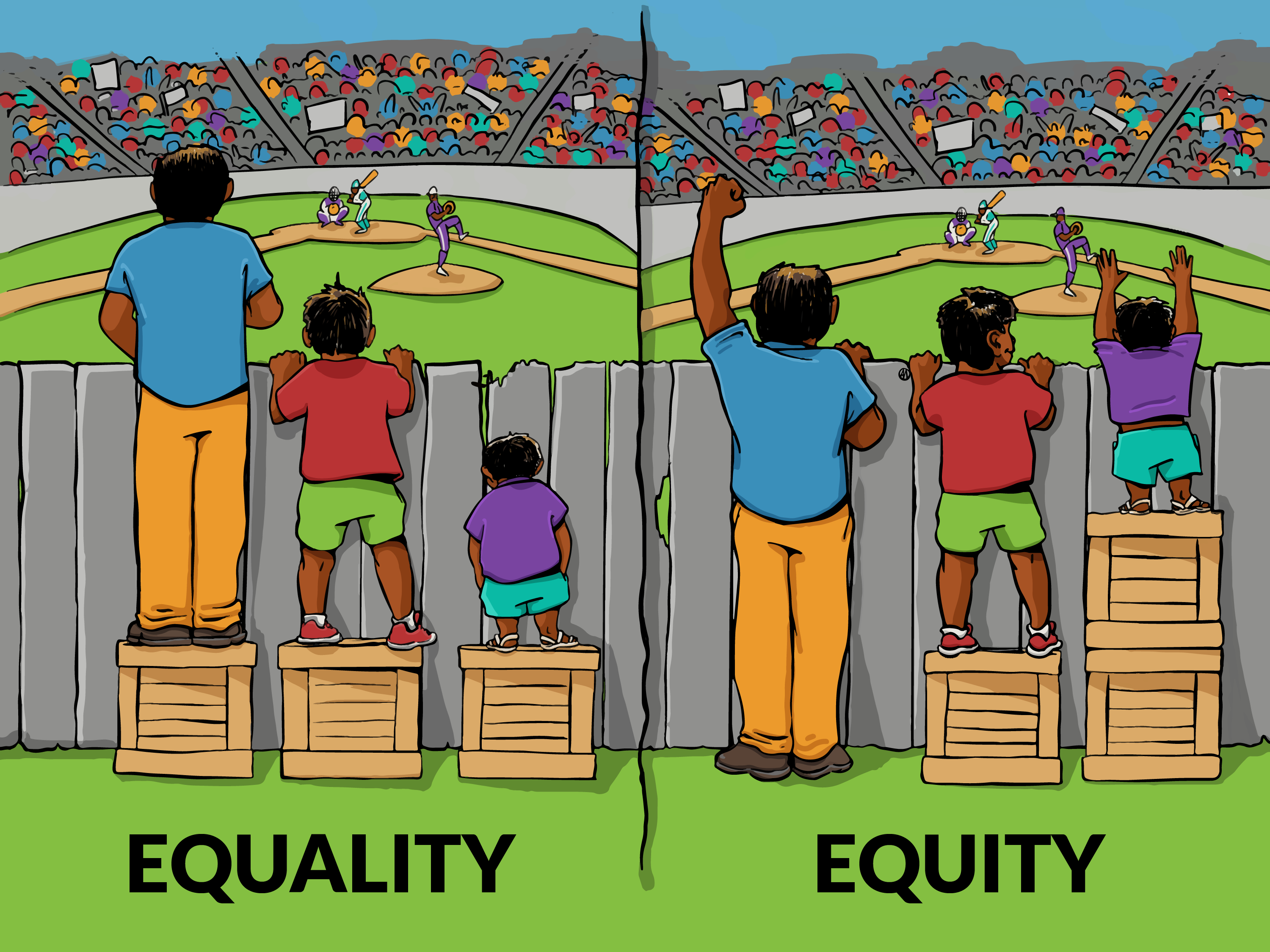
This image above acts as our example of equality for the discussion that follows. All the animals in the image are being treated equally, by simple fact of definition. They are being treated the same way.

I can usually count on a student to point out, “Yeah, but that’s not fair.”

Once that happens, I know my students are ready for the second image:

IISC_EqualityEquity
Source: http://interactioninstitute.org/wp-content/uploads/2016/01/IISC_EqualityEquity.png

This is the first time many students will interact with the word equity, so we discuss it in context of fairness, a word they already know. We discuss the situation students would prefer to be in. I ask whether or not they believe that it is okay for the people on the right to have extra support.

When I then ask students to reflect on where they see this in their personal lives, many of them draw on relationships with their siblings. They talk about times when they weren’t necessarily treated equally (i.e. being responsible for different chores) but they do understand how they were being treated fairly (i.e. everyone had a chore, but you can’t expect the youngest sibling to walk the dog alone).

Students also talk about their school experiences, often using each other as examples. One of my English language learners last year pointed to his best friend and said, “I think Daryl is super lucky because he can use a translator for the test but I’m really the one with an advantage because my English ability is better than his. If Daryl didn’t have the translator, the test wouldn’t actually show what he knows about the topic. It would just be another language test.”

That’s precisely the point.

Students are very, very practiced at seeing the differences between themselves and their peers. They miss relatively little. Giving students the words to talk about what they’re seeing allows them to understand why there are differences in the ways teachers approach different members of the class. It also helps them understand the purpose and necessity of government policies that provide aid to certain groups of people in a variety of contexts.

Addressing Opposing Arguments

I have always had students who argue that giving each student in the room the same test is the only way to truly be objective and unbiased in finding out who knows the most. (In case you were unsure, I am against everything that resembles a traditional sit-silently-and-race-the-clock model of filling in bubbles to find out what students know.)

Since I work really hard to cultivate students’ individual voices in the classroom, I can usually rely on other students to challenge this position and provide evidence that helps the rest of the class develop more nuanced understandings of fair and equal. Depending on the age level of the students and the political bent of the school (unfortunately, this is actually important to be aware of) I may choose to segue this discussion into politics and economic policies, specifically addressing facts and myths surrounding public assistance.

However, in school environments where educators’ academic freedom is more limited or with younger students, it is generally more productive to pose a version of the following question: How can we find out what students know in ways that are fair rather than equal?

I have found that reframing the conversation around fairness, rather than letting students get hung up on their understanding of objectivity, is the more useful discussion. It challenges students to focus on what different individuals need to be successful, while also providing them with an opportunity to talk about formative and summative assessments that think best allow them to demonstrate their knowledge.

Why It Matters

Each student brings a unique background, perspective, set of circumstances, hopes, dreams, and experiences to the classroom. Assuming that an individual student needs exactly what his or her classmates need is harmful not only to the student, but to the rest of the class, as well. Some students need breakfast before we can expect them to learn, while others need additional learning activities to reinforce what they did in class that day. Still others need more difficult questions to consider that help them understand information in a more complex way.

Considering all of these student needs and coming up with one set of activities, one set of questions, one homework assignment, and one assessment might mean that we are treating all students equally.

But in doing so, we would not be treating them fairly.

I am not saying that we need a different lesson plan for every student. What I am saying is that we need to carefully consider what our students need to be successful, and we need to adjust accordingly. We need to take into account who our students are and where they come from. Ignoring all of this and assuming a tabula rasa model of the mind does a disservice to students’ individuality and diversity.

Conclusion

Differentiation takes time, practice, and collaboration with colleagues. It means preparing multiple modes of exploring and interacting with new ideas and concepts. It also means providing variety or choice in assessment of knowledge and learning.

The more differentiation students see in the classroom, the easier time they will have discussing and exploring the difference between fairness and equality.

I believe this is an important conversation to have with students because it draws on their experiences in and outside of the classroom and will prompt them to look around at their world. Students will begin to see circumstances in which fair does not mean equal and circumstances in which equal is actually harmful.

Encouraging students to question what they see is a key part of working to make the world a better place for all. Change is certainly possible, but not if we don’t point out what needs to change. We need to encourage the questions, help students evaluate solutions, and take into account what differences exist and why. Being open to these discussions is necessary for developing a better, more peaceful world


And speaking of being open to discussion . . . If you’ve had similar conversations with students, I’d love to hear about them. Other ideas on differentiation or fairness in the classroom? Comment below!

More Than Talking

“I had some really delicious Indian and Sri Lankan food the other day. It was great!”

Silence on the other end of the line.

“Either the call dropped or you’re ignoring me.”

“No no, I’m here.”

So why the lack of response? That’s the question I was left asking myself after a phone conversation this morning. Why the lack of response?

As an educator, I am constantly looking for ways to demonstrate to my students that someone is listening to them. When they speak, I respond. When they tell me something they’ve done or something they’re excited about, I ask questions about it, wish them luck, or tell them I hope they have a great time. If they tell me that something is wrong, I ask what I can do to help. I remind them that they can always come chat if they need to. I leave sticky notes on their desks asking if they’re okay today.

A huge element of teaching is about developing relationships. If my students know that I care about them, they are more likely to learn in my classroom. We can have challenging conversations when they feel that their voices are being heard, their opinions matter, and their ideas will be taken seriously.

When classroom cultures develop around these attitudes and behaviors, real dialogue takes place. Real learning happens.

Last week, my grade ten students wanted to continue a Socratic Seminar that I thought we’d completed. They clearly had more to say, so we went with it. They started off by asking questions about the relationship between religion and violence; over an hour later, we were deep in a discussion about renewable energy.

My students’ questions drove the conversation. As vocal students willingly expressed uncertainty, they encouraged quieter peers to speak up and provide their thoughts and questions. Some students explained that they’d changed their minds over the course of our discussion, while others remained convinced of their own ideas. Some wavered back and forth and laughed at their own equivocating. Others admitted to feeling a general sense of uncertainty and apprehension that hadn’t occurred to them before our discussion.

It didn’t really matter.

The point was that they’d talked. They’d heard each other. They were willing to be open and vulnerable, question their classmates, express their ideas, and respond to challenges from their peers. They didn’t just talk; they listened. Through listening, they learned. They operated in the safe space that we’ve created this year, and they learned as a result.

Cultivating dialogue is vital with students, and equally so among adults.

But why is it so difficult?

One factor that I think makes dialogue challenging is being present. We spend a lot of time with our attention torn between one thing or another – email, social media, back-to-back meetings and deadlines, a pervasive need to “be there” with multiple people at once. We live in a society in which “busy” often denotes “good”. We feel the need to justify spending time alone or with just one other person.

I would like to advocate that we take a deep breath and a step backwards. The students in front of me are enough and they deserve my complete attention. The friend who joins me for coffee is enough and deserves my complete attention. The person on the other end of the line is enough and deserves my complete attention.

When I give you my complete attention and respond to you and what you’ve said, dialogue will take place. If I am only half-listening, if I am only partially there with you, dialogue is simply not possible.

In addition to practicing compassion, I am also working on being present. I want to listen to you. I want to hear you. I want to see you. This way, we can engage in dialogue, affect change, and make the world a better and more peaceful place.


Building Peace is the Purpose of Education

Lately I’ve been doing extensive reading, thinking, and writing about the purpose of education. Why do we have schools? What are they for? What should they be for?

I alluded to the plethora of research and opinions on precisely this question in my last post on education and I’d like to take the opportunity to explore this idea further. This post is the result of my reflections on research that rang true to me.

In a student paper for the Morehouse College newspaper in 1948, Martin Luther King, Jr. wrote, “The function of education is to teach one to think intensively and to think critically. But education which stops with efficiency may prove the greatest menace to society. The most dangerous criminal may be the man gifted with reason but no morals. . . . We must remember that intelligence is not enough. Intelligence plus character—that is the goal of true education.” (emphasis added)

King is by no means the only one to claim that teaching intensive, critical thinking is an essential aspect of education. He does, however, highlight an equally important point about why education must go further. Developing humans involves so much more than efficiency and intelligence. King clearly recognized this with the addition of character. Education must be about more than intelligence; it must also encompass humanity.

In this article, Jonathan Cohen, cofounder and president of the National School Climate Center, answers precisely the question I posed at the start of this post. He says, “I think that my view, and most people’s view, is that the purpose of education is to support children in developing the skills, the knowledge, and the dispositions that will allow them to be responsible, contributing members of their community—their democratically-informed community. Meaning, to be a good friend, to be a good mate, to be able to work, and to contribute to the well-being of the community.” (emphasis added)

As the article suggests, there is a disconnect between what we claim we want out of education and the values that exist in today’s society. If we want our students to become good friends and good mates we need to do more than tie curriculum, teacher evaluation, and school funding to standardized tests.

Cohen’s explanation includes the necessity of “soft skills” that are not measurable. If we want to create communities, societies, and environments that are democratically informed, we need to include civics in our schools. Teaching and learning civics involves real-world situations in which students interact with people who are different from them, engage in real projects in their communities that mirror what we hope they’ll do as adults, and participate in much-needed dialogue about how to improve neighborhoods, cities, countries, and ultimately the world.

This is not happening in schools right now.

One reason that the purpose of education is so hard to pin down is simply that there are multiple purposes. There is more than one right answer to this question, unlike many of the questions students encounter on the standardized tests that serve as our measures of what they know.

In a piece for Forbes, Kim Jones, CEO of the nonprofit online education service Curriki, captures precisely this point. “Education does not have a single purpose; it serves multiple objectives, and the relative importance of each of these objectives can be very personal.  The varied emphasis is a result of the diverse economic, social, spiritual, cultural, and political realities of our individual lives. Likewise, how we deliver instruction, and how we measure success in school as a predictive indicator of our future success in society and, indeed, one could argue the metrics for society’s success as a whole, must be updated to match.” (emphasis added)

If we want our students to do more than answer closed questions with no opportunity for creative thinking, we need to emphasize concepts rather than facts in our curricula. The diversity of society provides students with wonderful opportunities to learn, grow, communicate, and be part of a larger whole.

When interacting in the real world, no one tests facts. We use Google. We do, however, rely on concepts in all areas of our thinking. In daily activities, we understand ideas like change, relationships, global interaction, identity, development, communication, connection, systems, and culture. These concepts can and should drive our teaching and learning. If this is what we expect of adults, why do we approach students and schooling any differently?

To return to Cohen’s point, does our society encourage such thinking? If not, as Jones suggests, society needs to definitively decide what we want. If we want informed, participatory citizens whose knowledge and experiences are based in the diversity of our daily lives, is that what we are creating in schools?

What we say we want and what we are doing do not match up. Therefore, education reform is necessary to align real life goals and success.

In an article for the Washington Post, Arthur H. Camins, director of the Center for Innovation in Engineering and Science Education at the Stevens Institute of Technology, writes, “Education should prepare young people for life, work and citizenship. Knowledge of the natural and engineered environments and how people live in the world is critical to all three purposes of education. Critical thinking, creativity, interpersonal skills and a sense of social responsibility all influence success in life, work and citizenship.” (bolded emphasis added)

Success in life, work, and citizenship clearly requires more than what we currently allow for students.

At this point, it seems clear that these stated purposes of education do not reflect the reality of our current educational system. We might claim, holistically, that we want community-minded citizens who interact with one another in a variety of contexts to work towards developing societies that are better than we what have today. However, the inflexibility of the school day, lack of teacher input in curriculum, lack of teacher and student collaboration, minimal room for dialogue, and prescriptive testing do not allow us to develop those citizens.

I argue further, however, that it is not enough to develop better societies. I will explore the word “better” so that we have a clearly defined idea in mind.

To me, better means more peaceful. I desperately want to educate well-rounded, community-oriented citizens who are productive members of societies that work together to create a more peaceful world. That peaceful world is inherently better than the world we have today.

Red tape and government aside, what do we do? How do we develop the people who are necessary to create this peaceful world?

I came across the closest thing to an answer that I could find in a wonderful article in Psychology Today, a publication that I sometimes use in my psychology teaching.

In the article, Buddhist physician Alex Lickerman explains, “To achieve world peace—to create a world in which war ceases to break out—seems impossible because of the sheer number of people who haven’t yet mastered themselves, who haven’t tamed their ambition to raise themselves up at the expense of others, and who haven’t learned to start from today onward, letting past wrongs committed by both sides remain in the past. In short, it seems an impossible dream because we’re in desperately short supply of human beings who are experts at living.”

Yes, the bolded emphasis is mine and yes, I am aware that I bolded the whole thing. If you’re only going to read one of the articles I’ve linked, I vote for this one.

When I read Alex Lickerman’s words, for the first time, I had one thought in my head: Of course this is what we want. Of course.

The concept of using education to develop human beings who are experts at living seems like the obvious solution to all of our problems. Experts are people who have been trained in some sort of specialized skill or knowledge area. Using their training, they yield results in their fields. They are the people we turn to with our questions. We rely on them, trust them, and sometimes even admire them.

By definition, experts at living will be successful, which we have already determined is one stated purposes of education. Furthermore, they will be intensive and critical thinkers, creative, and uphold a sense of social responsibility towards others in order to make the world a better, more peaceful place.

Developing experts at living obviously requires much, much more than we are currently doing in our schools.

In the Forbes piece, Jones suggests a practical model for exposing students to the real-world problems that they will later face as experts. She explains, “The children should be making things. The children should be writing computer programs. They should be learning by doing. The thing is not to learn excel or such programs, it is to learn to learn.” (bolded emphasis added)

Giving our students access to complex problems and gradually increasing that complexity over time has the added benefit of bringing very real moral, ethical, and global issues into our classrooms and conversations. This will help create human being of intelligence and character, as King mentioned, who are responsible members of communities.

Altruism, empathy, caring, and compassion must all play a role in creating these experts at living.

In this vein, Lickerman further specifies his vision for how to build peace. He writes, “An expert at living isn’t a person who never experiences greed, anger, or stupidity but rather one who remains in firm control of those negative parts (which can never be entirely eliminated), who’s able to surmount his or her darkest negativity, and displays a peerless ability to resolve conflict peacefully.” (bolded emphasis added)

We need to be teaching our students how to get along in the world. How to live in the world, how to be part of the world, how to care about the world and its people, and how to improve the world. Again, this means peace.

My ninth and tenth grade students write and share analyses of current events every two weeks in class. Predictably, war comes up ore often than not. They write about being so tired of war and I ask about how we can build peace. My students have seemingly endless ideas about waging war, but rarely consider the alternative – building peace. More importantly, they’re very skeptical about the viability peace processes. This indicates that we are not doing enough to bring peace to the forefront of our classrooms, our communities, our societies, and our world. We expect the next generation to fix the problems of today, but we first need to decide as a society that we are going to give them the tools to do that.

We don’t have to focus exclusively on how and why we have war. We can choose to create experts at living instead, and we can train those experts at living to build peace.

As a society, we have an education system in which we claim to want critical, democratic, participatory, inclusive thinkers and citizens, but that is not what we are building. Instead, we have an overemphasis on numbers, scores, tests, and measuring. There is dissonance in what we say we want and what we are currently doing.

That can change.

It needs to change.

But how? I’m in the midst of working on a project with a friend to articulate what education should actually look like in terms of developing experts at living who work for peace. There will be more thoughts on this in the future.

In the meantime, I’d love to know what you think! The comments section is your section and it’s open to ideas. Hope to hear from you!

Peace does not mean an absence of conflicts; differences will always be there. Peace means solving these differences through peaceful means; through dialogue, education, knowledge, and through human ways. – The Dalai Lama