
Tag Archives: Peace

Building Peace: What’s Missing in the Definition

It has recently come to my attention that my use of the word “peace” extends far beyond the colloquial definition of “nonviolence”. A friend suggested that I write about my broader view of peace in order to provide context to my blog posts on peacebuilding in the classroom. So far, I’ve written about building peace as the purpose of education, redefining masculinity and femininity, use of words and language around students, and specific classroom situations that highlight the need for increased attention to peace. The purpose of this post is to clarify what peace means to me and how I envision a better, more peaceful world.

Definition
When I asked my students to define the word peace, most of them replied that peace means nonviolence, or the absence of war. They’re only partially correct. Merriam-Webster defines peace in four ways:

  • a state of tranquility or quiet: as
    • freedom from civil disturbance
    • a state of security or order within a community provided for by law or custom
  • freedom from disquieting or oppressive thoughts or emotions
  • harmony in personal relations
  • a state or period of mutual concord between governments or a pact of agreement to end hostilities between those who have been at war or in a state of enmity

The bolded definitions above are what I see as missing from much of our conception of what peace is and how it plays a role in everything that we do on a daily basis, as well as everything we are. Seeking freedom from disquieting or oppressive thoughts or emotions, whether as an individual or working to do so with others, is a peaceful act. Working towards harmony in personal relations is a peaceful act.

It is those acts that are often missing from our interactions, society, and wider discussion of what it means to develop a peaceful world.

Going Further
I propose expanding this definition, however. I see peace as the keystone in the arch of what comprises a better world.

019
The keystone is the last piece that goes into an arch during construction. The keystone holds the rest of the arch into position and allows it to bear weight. Without the keystone, the arch is unstable and falls. Without peace, we cannot build a better world.

We have to want a society that allows all people to be free from any sort of oppression, far beyond that of thoughts or emotions. That means working to reduce causes of suffering, including poverty, homelessness, preventable disease, hunger, and lack of clean water. The same is true for developing harmony in personal relations. We need to act with kindness, compassion, and caring towards all others, whether we know them or not. This would open the possibility for dialogue as a way of resolving conflicts, which is an aspect of the “nonviolence” definition of peace. These behaviors need to become part of social norms on local and global scales if we want to develop a better world.

A broader definition of peace also requires concern for the environment. The purpose of peace among humanity is to create a world that is better and more sustainable than the world we have today. Being peaceful in actions towards the environment, working to protect and preserve Earth’s existing resources, and developing technology like renewable energy are all essential components of creating a better world for all. As Planetwalker John Francis explains in his TED Talk, “I learned about people, and what we do and how we are. And environment changed from just being about trees and birds and endangered species to being about how we treated each other. Because if we are the environment, then all we need to do is look around us and see how we treat ourselves and how we treat each other.”

Because if we are the environment, then all we need to do is look around us and see how we treat ourselves and how we treat each other.

Do we treat the environment peacefully? Or are we destructive, harmful, greedy, competitive, aggressive, and violent in our actions towards the planet? What does that say about how we view sentient life?

Peace and Sustainable Development
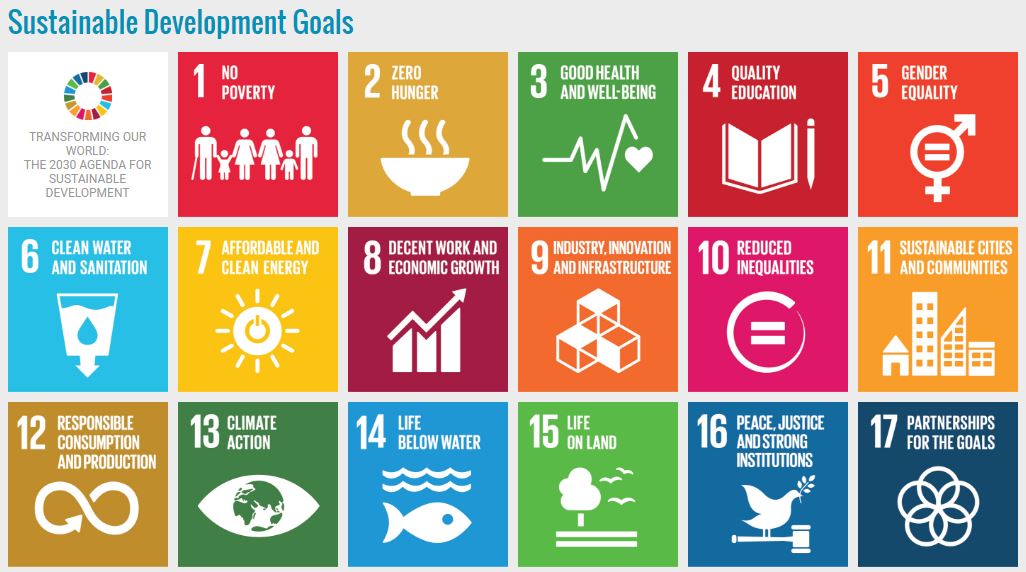
At the end of last school year, I spent a few days discussing the UN Sustainable Development Goals with my grade nine students.

un-sdgs

Pairs of students chose a goal to research. They prepared presentations to teach the rest of the class what their goal means, work in progress towards the goal, and ways that students might be able to get involved in advancing the goal.

The way I see it, all of these goals reflect a peaceful world in which we care about those around us. The state of tranquility or quiet in Merriam-Webster’s definition will be realized when we end poverty and prevent diseases, assure that Maslow’s basic needs are met, and all humanity is guaranteed a financial safety net that provides the freedom to make choices, create, explore, develop, and achieve.

When we decide that we want to develop an age of sustainable development, we are choosing peace. Developing a peaceful world requires us to commit to treating those around us with dignity, and actively work to help all people increase overall well-being. Altruistic action is necessary towards humanity and towards the environment. These are inherently peaceful actions because they support those around us in the aim of improving our world for all. As Matthieu Ricard explains in Altruism, “In essence, altruism does indeed reside in the motivation that animates one’s behavior. Altruism can be regarded as authentic so long as the desire for the other’s welfare constitutes our ultimate goal, even if our motivation has not yet been transformed into actions.” This is how we will build and maintain a better world for ourselves, our children, and the rest of humanity. Choosing peace in this context requires active commitment to developing a sustainable world.

Peace
Truly choosing peace means looking at the world and its people and cultivating an attitude that reflects the messages we want to send. I think of peace as a state of mind and a way of being, which is what I try to explore with my students. It’s not enough to claim that we want peace for our world. We have to act, be, and think peacefully in order to make that world a reality.

That is the world I am working to build. I invite you to join the conversation about how to create our better, more peaceful sustainable world.

There can be no peace as long as there is grinding poverty, social injustice, inequality, oppression, environmental degradation, and as long as the weak and small continue to be trodden by the mighty and powerful. – Dalai Lama


Building Peace: Reflecting on Conversations in the Classroom

This post is the fourth in a series of posts where I’ve explored the importance of peace in the classroom and how we are working (or need to work) to cultivate peace with students. Previous posts discussed peace as the purpose of education, ways we view and need to reframe masculinity and femininity, and words that we use with and around young people.


Back in April, I read Peace Education: How We Come to Love and Hate War by Nel Noddings as part of an ongoing personal mission to become more conscious of how I discuss peace and war with my students. I’d been interested in the Freedom Schools movement and restorative justice since graduate school and was looking to enhance my understanding of what peace means in a classroom context where, as a social studies and humanities teacher, I spent a lot of time talking about war. In most curricula, conflict and war are central themes. Noddings highlights that our history textbooks are often organized chronologically around wars, our literature glorifies warriors, and we emphasize competition, power, and patriotism as we attempt to tell the stories of who we are and how we got here. It should come as no surprise that our society is less peaceful than we would like, and less peaceful than it should be.

Three particular instances in my classroom have stood out to me as essential examples of why we need to rethink how we talk about peace and war in the classroom.

Today in History
Since the day I began teaching, I’ve kept a Today in History section of my whiteboard where I post a fun fact about something that happened in history. I almost always use the History website section devoted to this particular feature to get my fact of the day. When I can, I use a fact that relates to something my students are learning or have learned. When I can’t, I try to find something they’ll connect to or find particularly compelling.

As I’ve become more focused on discussing peace rather than war (i.e. we’re currently studying the Civil War’s social, political, and economic impacts on the United States rather than what happened militarily during the war), however, it’s become harder to use the History website to find facts for my students. History categorizes its daily factoids into seventeen sections, six of which are devoted to the major wars that the US has fought. If I skip all of those, I’m down to eleven options. I don’t want to include crime or disasters, so that’s nine options. Automotive, Hollywood, and Sports don’t seem relevant enough, and my students are generally unfamiliar with anything pertaining to Music, Literary, and Old West. That means I have three options: Lead Story, General Interest, and Presidential. There have been some years where I don’t teach American history, which means Presidential is out, too.

Not a lot of choice when I want my students constantly confronted with collaborative, constructive, global events.

Dissatisfied with History’s options, I’ve started turning more regularly to On This Day, which reaches far more broadly in providing three categories (Miscellaneous, Music, Birthdays) and upwards of thirty events in each category. It’s not that some days are historically busier than others, as any avid news reader knows. Instead, it’s that History curates information to a population fed stories of war, patriotism, and nationalism. These are divisive ideas and not what I want in front of my students on a daily basis.

ISIS
At the end of the last school year, my tenth graders sat in a circle and we discussed ISIS. One of their ongoing class assignments was a current events report that asked them not only to find an event and summarize it, but also to consider it in a local, national, and global context, as well as consider whether the event would have been handled or approached differently in different time periods.

Understandably, ISIS was constantly a topic in their write-ups. Students submitted their assignments via GoogleDocs, which allowed us to have digital conversations about what they’d written. Many students expressed anxiety, fear, anger, frustration, and uncertainty about the stability of the world and about their own futures. I commented back to them in the most positive ways that I could, encouraging them to consider solutions that were diplomatic, dialogic, and international. More than one student replied to my comments explaining that they found these suggestions unrealistic.

That’s when I decided to have an open conversation as a class instead of repeating myself to individual students. Together, we chose our first discussion question: How can we peacefully resolve global conflict?

My students were creative thinkers and suggested everything from global partnerships of young people to add a new voice to increased efforts towards volunteering for organizations that raise money to aid developing countries.

And then came the second discussion question: What should we do about ISIS?

Almost unanimously, all of my tenth grade students in two class periods suggested war, economic sanctions, bombing, and providing the UN with an army.

I called the discussion to a halt and pointed out the inconsistencies between what they’d just said about global conflict and how they suggested responding to ISIS. My students countered with statistics of death and destruction, which have unfortunately become common knowledge. When I brought up anti-radicalization programs like this one in Denmark, most students said that the problem is that there aren’t enough resources and there isn’t enough time. I suggested community building to stop radicalization and pointed to several of the many examples that exist. Students were frustrated, again pointing to the numbers. This would take generations, they said. We don’t have generations.

We might not have generations, but the “solutions” that we’ve tried – economic sanctions, airstrikes, increased access to arms – to stop ISIS aren’t working either. Again, peace is not nearly as much a part of our discourse as war. And this is a problem.

Farmers and Artisans
Just last week I introduced my sixth graders to the concept of civilizations. We started by making a flowchart of how civilizations form. When we began discussing the job specialization that results from increased food supply (as a result of settling and farming rather than being nomadic hunter-gatherers), the following conversation (edited to highlight main points) took place:

Me: Let’s assume this half of the class are farmers and growing all the food we need for our civilization.
Farmer half of class: Woohoo!
Me: The other half are artisans.
Artisans: Woohoo!
Me: So the artisans don’t farm and the farmers don’t make anything (As I’m saying this, the kids start pointing fingers and laughing and saying things like “You’re gonna starve!”) But our civilization has to come together.
Farmers: They’re gonna steal all our food!
Me: No, something else has to happen because we all need to survive so we have to work together.
Artisans: Oh, we’ll trade.
Me: Exactly.
Farmers: Oh.
Me: So then we have a civilization of great artisans . . .
Artisans: Yay!
Me: . . . and great farmers . . .
Farmers: Yay!
Me: . . . and we’re so successful that lots of other people come join our civilization.
Farmers: So THEY steal all our food!
Me: . . .

After class, I reflected on this conversation. What was going on here? My students came across extremely aggressively and competitively but then recognized the interdependence that existed between the two groups. I thought we’d had a breakthrough. We’d peacefully resolved a conflict that my students thought they saw . . . but then headed straight back to conflict when faced with an outside group. I understood that my students saw the outside group as a threat, even though I hadn’t explicitly framed it that way. That certainly has not been a thread of discussion in my classroom, which suggests a narrative of conflict and competition in their previous experiences. How much of this comes from schooling?

Ending Friday afternoon like this was uncomfortable and I’m looking forward to Monday so we can discuss the role of government figures in early civilizations. I’m curious to know whether they’ll see government as a leader in justice or a dispenser of punitive measures necessary to maintain order. In either case, I need to clearly articulate the goal of peace if I want my students to begin thinking in that framework. Peace is rarely an explicit discussion in our schools and I firmly believe that it needs to be.

Why It Matters
We do not live in a peaceful world. But we can. We need to begin to talk about peace and actively work on it instead of devolving into conflict. Peace will undoubtedly improve the world for all who inhabit it, which is why peacebuilding should be a central component in education. We need to agree to create an educational climate that develops world citizens who actively work to end suffering, creating a better and more peaceful world for all.

We will not find the solution to problems of violence, alienation, ignorance, and unhappiness in increasing our security, imposing more tests, punishing schools for their failure to produce 100 percent proficiency, or demanding that teachers be knowledgeable in the subjects they teach. Instead, we must allow teachers and students to interact as whole persons, and we must develop policies that treat the school as a whole community. – Nel Noddings

Building Peace: Choosing Our Words

This post was initially supposed to be about mental health in the classroom because of a PD from this week. However, I was sidetracked by a conversation I overheard on the train on the way to the  café where I am now. (If you clicked on the link and are imagining the delectable smell of cinnamon rugelach, you’re right here with me.)

As a result, I’ve reframed this post as a discussion about the power of language with a specific focus on how we talk to children and to students in our classrooms.

The Conversation
I don’t always eavesdrop on the people on either side of me on the subway platform, but I generally start to pay attention when I hear the voices of very young children. That’s mostly because I think they’re adorable but also because I’m curious about parenting. My mother is an early childhood educator and has always maintained a running commentary on how people dress, talk to, and generally treat their children in public. Though I am not a parent myself but really hope to be someday, my mother’s ideas have influenced my opinions on parents and parenting. As an educator, I know that deliberate language makes a huge difference in many activities that take place in the classroom, including the formation of relationships between teachers and students.

The conversation I overheard just a few minutes ago reminded me how important it is for parents to also be cognizant of how they talk to their children and what they say when their children are around. I wasn’t paying attention until the little girl in a tutu and ballet bun tried to break into her parents’ heated discussion. I caught phrases like “if we have a boy” and “you can’t just save all that money” and “she also wants to have a career”. The child tried three times before being able to complete a sentence, stopping herself when neither parent glanced at her as they continued speaking. When her parents finally paused, the little girl announced, “Yeah, Dad, and you don’t do nothing with me!”

Both ignored her. The train arrived and all three squeezed inside.

The non-interaction made my heart hurt.

How We Talk
Two things in particular stood out to me regarding the parents’ dismissal of their child and what the child had actually said:

  1. Need for acknowledgement. When a child clearly wants to speak, the adults in discussion need to acknowledge the child’s desire to participate and let the child know when it is an appropriate time to do so. We want our children and students to be able to engage in dialogue, a true back-and-forth exchange of ideas and opinions. We want them to develop autonomy, agency, and a sense of empowerment in their ability to express themselves. If we ever expect them to talk, we need to listen when they’re ready. This happens constantly in the classroom when students want their voices heard. I can’t try to count the number of times I have said something like, “Hold on, someone else is talking now” and then followed up with, “Okay, what would you like to add?” when the other student had finished. I remember my parents telling us, “Mummy and Daddy are talking right now and in one minute you can say something. Please wait.” Acknowledging that children want to speak and then helping them determine when to do so is essential if we truly want to listen to and interact with one another in any capacity.
  2. Awareness of surroundings. Regardless of what her parents were arguing over, I know that this girl had heard too much. She was probably around four years old and clearly parroting what she’d been told about her father or what she’d overheard others say. I expect she’d heard her parents engage in a similar exchange more than once before since she was so intent on this particular phrase. “You don’t do nothing with me.” Does she even know what it means? She very happily grabbed her dad’s hand as they boarded the train, so I suspect not. When we speak, we are modeling behavior. If we want our children to grow into respectful young people and ultimately respectful adults who care about those around them, we need to model respectful language. Students hear the words that we use and absorb them. We send messages that we don’t realize we’re sending. Certain words and phrases stand out more than others and we don’t necessarily know what children will latch onto. Young people hear a lot and interpret what they hear. If we want to cultivate certain ideas over others, we need to be careful that it is those ideas we express when we’re speaking.

Why It Matters
Actions and words create environments and expectations. This is true at school, at home, and in the workplace. In the heat of the moment, that’s easy to forget. We all make mistakes and we all say things that should be left unsaid. From a pedagogical perspective, I try to be very aware of what I say and do in order to create a classroom environment where students feel accepted, validated, safe, and important. I make choices about the words I use, ideas I express, how I deal with challenges, and how I interact with students in order to create that classroom environment and culture. I can’t expect my students to act a certain way if I don’t explicitly show them what that is and insist that they engage that way with each other.

“People will forget what you said. People will forget what you did. But people will never forget how you made them feel.” – Maya Angelou

We all know that words matter. A lot. In each of our interactions, we need to remember that the connection we form with others does not disappear when we stop talking and part ways. I don’t always know what the people around me take away from the time we’ve spent together, but I do know what I take away. Young people are constantly learning from example, which is why I urge mindfulness in all interaction, verbal and nonverbal. If I want my students to work to construct a better, more peaceful world I have to work on that with them at a micro level before I can expect them to do that on a global scale.


The conversation I overheard on the subway platform is also relevant in terms of a really excellent presentation from PD this week about dealing with mental health issues in the classroom. I have always been interested in mental health and I’ve taught psychology in the past so little in this presentation was new in itself, but it was refreshing to attend a PD session focused on supporting students with mental health issues.

We don’t talk about mental health often enough. I’ve been trying to raise awareness about educational issues lately, which is why I want to share some thoughts on mental health in the classroom and a resource the presenters introduced that I find very useful.

The Numbers
Most of us are experts at pretending we’re okay when we’re not. When’s the last time someone asked, “How are you?” and you actually answered the question instead of providing the cursory, “Finethankyouhowareyou?” response? Society has decided that we’d rather delude ourselves than actually see the people around us.

This is a problem because many people are not fine at all. In 2014 alone, one in five American adults experienced some kind of mental health issue. It’s also a problem with young people. There has been increasing research about the number of adolescents who are struggling with mental health issues. Suicide rates are the third leading cause of death in young adults ages 15-24, and 90% of those who committed suicide struggled with mental health problems. Being able to talk about openly about mental health is a step in the right direction towards an emphasis on greater well-being for all.

The Need to Talk
Stigma is a huge problem when addressing mental illness. As noted above, we have decided that we are all “fine”. Many people would probably be taken aback if a polite, “How are you?” was followed up with, “I haven’t slept in three months, my appetite is gone, I have almost constant headaches, and I can’t stop thinking about my parents dying in a car accident. How are you?”

The simplest thing for a concerned educator to do is to make mental health awareness part of the classroom community. Teachers are in a position to indicate to students that it is okay for them to feel anything they’re feeling. It is okay for them to ask for help. Many schools have already developed (yay!) a culture around safe spaces for LGBTQ students and we are beginning to do the same for students with mental health concerns. Students need to know that they do not have to be okay all the time. They need to know that mental illness is a very real part of being human. Look at the numbers. We hide it when we avoid talking about it, but it’s more than common.

The clinicians and researchers who ran the PD session provided this website that they have developed as part of their work. This is the first time I’m sharing a teacher resource on this blog and I’m doing it because I think it is so important to allow mental health to be a very real part of classroom dialogue. My AP Psych teacher in high school said that society will have come a long way once we decide it’s as necessary to seek medical help for mental illness as it is for a broken arm. That was 2008. We talk more now than we did then, but it’s still not enough.

From Talk to Action
Let me preface this by saying that I am not trained to treat anyone for anything. That’s not my job. My job is to get to know my students so that I know when something is not right. My job is also to provide a safe space for students who want to talk, have questions or concerns, or need somewhere accepting to go during the day. The language I use, behaviors I model, topics I discuss, and the ways in which I interact with my students are very powerful in shaping relationships. There is the necessity of congruence in what I believe, what I claim to want for my students, and how I show that to them.

As I’ve written before and linked above, I believe that peacebuilding is the goal of education. That means purposefully developing real connections with one another, working towards increased well-being for all, and creating a culture in which we are caring and compassionate towards each other. The language that we use goes a long way in promoting this overall aim. With a new school year either very fresh or about to begin, I urge all educators to think about the messages they want to send and they way they go about doing that. Our students deserve a better, more peaceful world. Together, we can build that.


In addition to my educational interests, I am always intrigued about the way language has changed over time. One of my favorite papers in graduate school had me researching the clinical uses of words like “moron” and “idiot”. The next book on my ever-growing To Read list, How Happy Became Homosexual, will likely address some of my curiosities but I’m eager for your thoughts!

Please feel free to comment below. I’d love to hear about the use of language in your classroom/workplace/any area of your life (always aiming for inclusivity here), any educational resources you have about mental health, or your thoughts on/experiences with parenting. Really, I’d like to hear about anything you want to say. I love learning. Thanks for reading!