
Tag Archives: Politics

For, Not Against

When I accepted a job in Weimar, Germany, I knew exactly two things about the town:

  1. Its location on a map.
  2. Its historical significance as the place where the Weimar Republic was founded in 1919.

I didn’t know that Weimar’s position in founding Germany’s first democracy continues to hold political significance today, but this is very much the case. The Weimar Republic period brought a flourishing of arts and literature, much of which was due to the new focus on civil liberties that was written into the Weimar Constitution. Women received the right to vote, freedom of speech was protected, censorship banned, the right to education guaranteed, and the freedom to negotiate for better working conditions granted.

These and other social and political rights are critical to a functioning democracy, and it is for this reason that Weimar is still a gathering place for people who have something to say. A significant point for many are the Monday Walks, in which far-right supporters and activists come to town with drums, whistles, flags, and placards. The march routes are protected by police, as are the gatherings from other groups often located along the route, accompanied by their own music and placards.

A particularly large far-right demonstration was scheduled for Saturday and the city put out a statement urging anyone without essential business to avoid the city centre. In response, left-wing activist groups did what they usually do and gathered in pedestrian zones of town around the square where the right-wing demonstration was set to take place. In doing so, they effectively blocked the route the demonstration was supposed to follow through town. Considering that the counter-protest wasn’t registered in advance, it wasn’t legal. But this would only become a problem if the counter-protest and far-right protest actually came into contact.

Following a breakfast discussion about freedom of expression, Germany’s laws against hate speech, and the role of discourse in a democracy, my partner and I headed into town. Listening to the far-right tropes made me nauseous, but I didn’t feel much better standing with the counter-protestors. The music they had chosen was largely political and aggressive, and the slogans they chanted were not much better. Although a number of people sported pride flags and t-shirts with statements like “Love is love” or “I greet all people”, the mood did not reflect these sentiments. Why, I asked my partner, were we not listening to Summer of Love music? Where were the guitars and the hand holding? Why was the counter-protest, in being against a group of people, just as negative as the far-right protest?


What would the world be like if we were for peace, for love, for humanity rather than against these people and their idea of peace and their idea of humanity? Wouldn’t finding commonality be much more effective if we spoke for people rather than against them?

This is not to say that far-right extremists, many of them the very definition of neo-Nazis with clothing and tropes only thinly vailed, should be allowed to spread the hate that they spread. And due to hate speech laws in Germany, there are limits on speech. This is rather to say that we, the people for justice and diversity, do not have to sink to their level. We can be for our beliefs rather than being against theirs. And considering that the rise in far-right extremism has not been accompanied by a rise in support of democratic ideals, it seems that the “against” message has turned people off or away.


As the newspaper reported the next day, there were no clashes between the two groups. Fewer right-wing protestors had come to town than expected and nearly the same number of ad-hoc left-wing protestors had turned out. Through force of numbers alone, opinions were made apparent.

Nevertheless, I was left with a feeling of disquiet that I cannot quite shake. There is something very wrong when one side speaks of freedom and screams, “Foreigners out!” and the other side speaks of equality and screams, “Nazis out!”. What these groups actually stand for is hidden behind the curtains of what they are against.

We live in a time in which there is a political weakness in standing for. Online and social media have created an environment in which the air time is given to those who are against, regardless of which side. Anger receives more clicks than attempts at common ground, but anger does not win. It destroys, and then something else picks up the pieces.


I am not an activist, but an educator. It’s my job to listen to young people and their ideas, my job to ask them where the evidence comes from, why they believe what they believe. I ask them to try on different hats, to empathize. We talk about what was surprising or challenging, what was comfortable or uncomfortable. My job is to encourage the formation of informed opinions, not to tell young people which opinions to have. I work in a school, one of the few places where, changing one’s mind is normal and it’s a sign of learning, not of weakness.

And I didn’t feel comfortable out on the street, just behind a crowd of counter-protestors lying in wait for another group of protestors. I might be on their side if we have to pick sides, but these were not my people. Their slogans were not my slogans.

Without discourse, the exchange of beliefs, only hate and anger remain. I refuse to do nothing, which is why I was there, but I also refuse the detestation with which these two sides regard one another. Over a glass of wine a couple weeks ago, I learned that the evening’s host had voted for the AfD, Germany’s far-right political party. Reminding myself that I stand for democratic values, I asked about his opinions and then gave him mine. A tiny drop might not make a difference, but a few more drops could do just that.
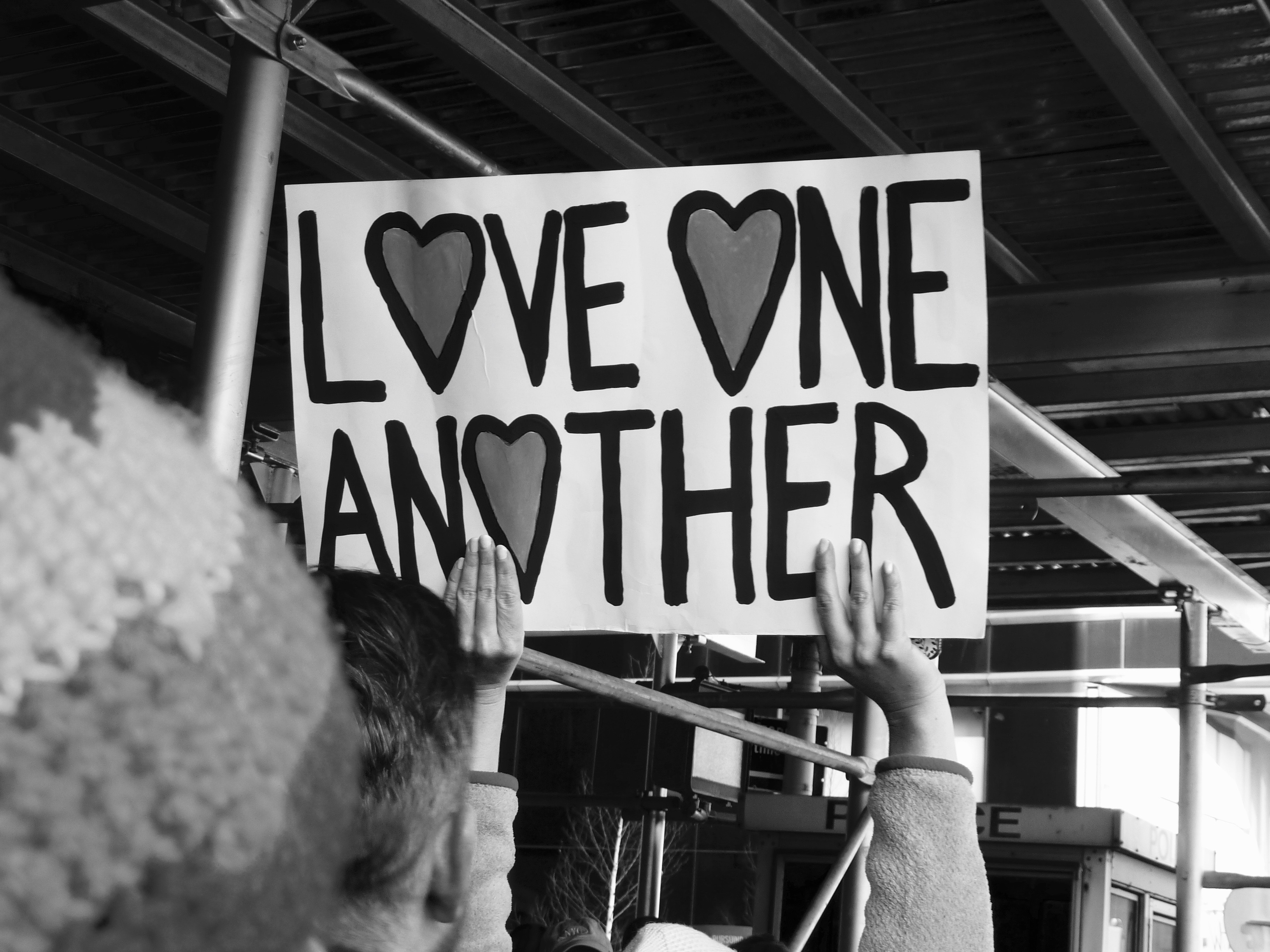
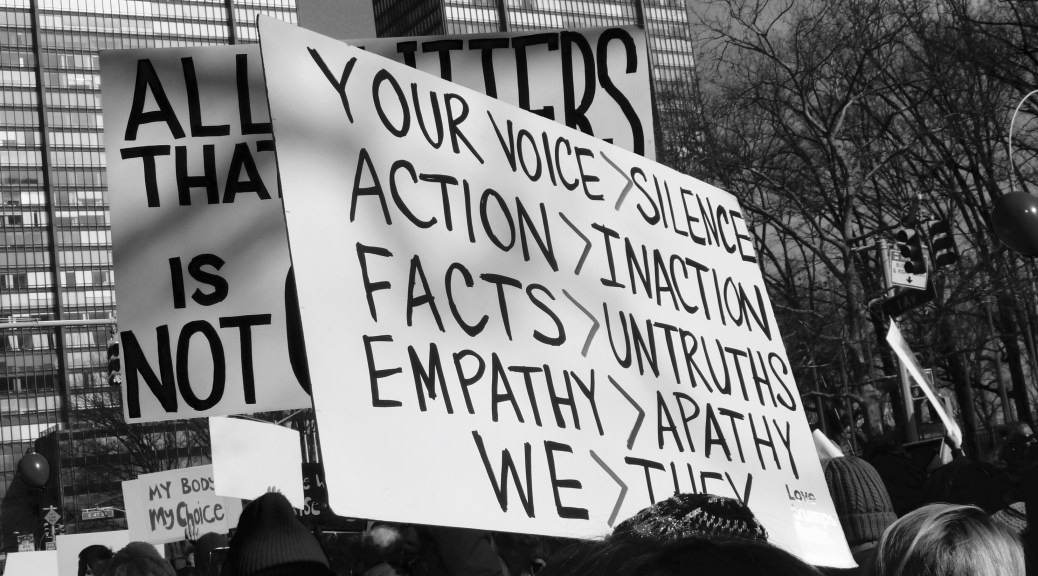
New York City Women’s March – January 2017

An Outside/Inside Look at German Politics

We had elections in Germany on Sunday and I went with my partner to vote. I waited on the playground of the school, hoping that my presence there counted as doing my part for democracy. Political discussions have remained at the forefront of many conversations between friends and colleagues, so I thought I’d summarize for those interested in, but not following, German politics.

In short, the results were unsurprising. The conservative Christian Democratic Union (CDU) won with the far-right Alternative for Germany (AfD) coming in second and sweeping the East, where I live. The Social Democrats (SPD), coming in third with the worst showing in modern history, are the most-likely coalition partner for the CDU because all parties have unequivocally ruled out working with the AfD. Two parties, the libertarian Free Democrats (FDP) and the new quasi-communist BSW, did not cross the 5% hurdle necessary to sit in the Bundestag (Parliament), but the Greens and Left will be represented, leading to a Bundestag comprised of five parties.

The current political task, while the old Parliament continues the business of governing, is building a governing coalition, which takes as long as it takes. The CDU has announced hopes to have a coalition by mid-April, but the conditions must first be discussed, debated, and agreed upon between the parties, which takes time. From a good English news source, the process is here. As noted in this article, even though a CDU/SPD coalition is the only sensible option, it still has to happen. And we’re not there yet.

The difficulty lies in the fact that the CDU and SPD are very different parties, which is why the SPD didn’t invite the CDU into a coalition after winning the 2021 elections. (That the FDP was there instead, along with the Greens, directly led to the failure of the coalition and the need for new elections.) Conservatives and social democrats tend to stand on opposite sides of moderate, and Germany is no exception. Like other states with social welfare systems, Germany’s right-of-centre is definitely left of American right-of-centre, but that also places the left-of-centre further to the left. As a result, there are significant differences in values and political programs that need to be addressed, and the discussion of what to do with the “debt brake” will most certainly play a role. Yet, a Grand Coalition is the only sensible option because these are two historic parties who aim to preserve democracy. Together, they have a majority, and it’s easier to govern with fewer coalition partners, as the recent failure of the “Traffic Light” SPD/FDP/Greens shows us.

However, the AfD will say that the choice for a Grand Coalition does not reflect the will of the people because the AfD received more votes than the SPD. They will continue to vote against everything that anyone else supports (evidence here, though only in German) because their goal is to destroy regardless of a political campaign to rebuild.

This is why the CDU and SPD need to put aside their differences and rebuild. Understandably, voters leaning towards different parties identified different issues of importance (informative diagrams, though only in German), meaning that the two parties need to attend to a vast swath of concerns in order for the people to feel that politicians have heard them. If they cannot, the AfD will be even stronger by 2029 and democracy will be at risk.

The question of why those from East and West Germany voted so differently (scroll to the middle of the page for a map) is important and relevant. The answer is not to demonize the East as being backward and provincial, but rather to think about the last 30 years of history. A reunified Germany was not an economically equal Germany and we are still feeling the effects of this today. This article addresses the economic, social, and cultural transitions after the fall of the Berlin Wall that, in many ways, dismantles former East Germany and left its people, their skills, and their education behind.

In my analysis, and I am not unique here, this leaves one choice. The choice is to think of the good of the collective rather than the goals of a single party. This is the choice because life needs to improve for all of us in order to protect the democracy and the country that we live in. Germany is not the United States and this gives Germany an opportunity to forge a different path, one more closely tied to the EU, which needs the support of its member states more than ever. Eighty percent of Germans, represented by a historic (since reunification in 1990) high 82.5% of those eligible to vote, voted against the AfD. They voted for democracy and for Europe and for the future.

As a freshly-minted permanent resident, I have chosen to be part of this society and yet have no say in it. So here it is: It is my hope that the CDU and SPD see the necessity of working in a strong partnership to bring this country back together. The alternative would let Germany drift further down a path that threatens to erode what this country claims to stand for.

The people have spoken. And now we need the politicians to do the same.

Vote!

My political coming of age occurred during the Obama years, a different time that seems like it came out of a different world. The question that hung around my university in the fall of 2008 was whether America was ready to choose a Black man as president. There was discourse, discussion, and dialogue. There were conversations about policies and expertise, the economy and foreign affairs. I went to at least one student-run forum to analyze policy positions of different candidates. Like my peers, I made what I thought was the best choice, and I voted in my first election.

For years after that, I continued to look into policy statements and records. I read the websites of everyone running for local and state office for every election, and I voted in every local and state election. I subscribed to newsletters and read the emails that poured into my inbox. I made lists of pros and cons and tried to do what I had been taught in school, which was to inform myself and make a decision.

And then came 2016.

I’d just returned from two years living overseas and moved back to a country I didn’t recognize. Dialogue and discourse were no longer words that were used. It was a time of rallies rather than campaign events, insulting rather than debating, catastrophe and failure rather than hope and change. With a group of friends, I attended gatherings and marches, signed petitions, called elected officials and left messages whenever their mailboxes weren’t full. This was the game plan before the election and it remained the game plan thereafter. The game wasn’t over.

Now here we are in 2024. And we are asking a similar question to the one that was humming through my university in 2008: Is America ready for a Black woman as president?

But this is very different from 2008. Now, the questions about specific policies have become less important because answers about other policies loom large. The dialogue that occurs takes place between people who already know one another’s opinions, and probably agree with them. There are deep feelings rather than deep discourse.

The front page of The New York Times today proclaims, “WORRY AND HOPE ON LAST DAY OF VOTING”. In 2008, the front page read, “The ’08 Campaign: A Sea Change for Politics as We Know It”.

My political awakening occurred not so long ago, but in a different time. The world will be a different place still as a result of who wins this election. The only way to be part of that decision is to exercise the most basic democratic right, which is to vote. And if voting feels good, vote for those who believe in your right to make your voice heard.

Vote for those who believe in the democratic system that allows for dialogue and discourse, questions and answers.

Vote for those who want to build up a country for its people rather than tearing it apart.

Vote for the people who wanted to and couldn’t, who tried to and were condemned, who fought for it and died.

Vote. Because it matters.

New York City – January 2017