
Tag Archives: Protest

For, Not Against

When I accepted a job in Weimar, Germany, I knew exactly two things about the town:

  1. Its location on a map.
  2. Its historical significance as the place where the Weimar Republic was founded in 1919.

I didn’t know that Weimar’s position in founding Germany’s first democracy continues to hold political significance today, but this is very much the case. The Weimar Republic period brought a flourishing of arts and literature, much of which was due to the new focus on civil liberties that was written into the Weimar Constitution. Women received the right to vote, freedom of speech was protected, censorship banned, the right to education guaranteed, and the freedom to negotiate for better working conditions granted.

These and other social and political rights are critical to a functioning democracy, and it is for this reason that Weimar is still a gathering place for people who have something to say. A significant point for many are the Monday Walks, in which far-right supporters and activists come to town with drums, whistles, flags, and placards. The march routes are protected by police, as are the gatherings from other groups often located along the route, accompanied by their own music and placards.

A particularly large far-right demonstration was scheduled for Saturday and the city put out a statement urging anyone without essential business to avoid the city centre. In response, left-wing activist groups did what they usually do and gathered in pedestrian zones of town around the square where the right-wing demonstration was set to take place. In doing so, they effectively blocked the route the demonstration was supposed to follow through town. Considering that the counter-protest wasn’t registered in advance, it wasn’t legal. But this would only become a problem if the counter-protest and far-right protest actually came into contact.

Following a breakfast discussion about freedom of expression, Germany’s laws against hate speech, and the role of discourse in a democracy, my partner and I headed into town. Listening to the far-right tropes made me nauseous, but I didn’t feel much better standing with the counter-protestors. The music they had chosen was largely political and aggressive, and the slogans they chanted were not much better. Although a number of people sported pride flags and t-shirts with statements like “Love is love” or “I greet all people”, the mood did not reflect these sentiments. Why, I asked my partner, were we not listening to Summer of Love music? Where were the guitars and the hand holding? Why was the counter-protest, in being against a group of people, just as negative as the far-right protest?


What would the world be like if we were for peace, for love, for humanity rather than against these people and their idea of peace and their idea of humanity? Wouldn’t finding commonality be much more effective if we spoke for people rather than against them?

This is not to say that far-right extremists, many of them the very definition of neo-Nazis with clothing and tropes only thinly vailed, should be allowed to spread the hate that they spread. And due to hate speech laws in Germany, there are limits on speech. This is rather to say that we, the people for justice and diversity, do not have to sink to their level. We can be for our beliefs rather than being against theirs. And considering that the rise in far-right extremism has not been accompanied by a rise in support of democratic ideals, it seems that the “against” message has turned people off or away.


As the newspaper reported the next day, there were no clashes between the two groups. Fewer right-wing protestors had come to town than expected and nearly the same number of ad-hoc left-wing protestors had turned out. Through force of numbers alone, opinions were made apparent.

Nevertheless, I was left with a feeling of disquiet that I cannot quite shake. There is something very wrong when one side speaks of freedom and screams, “Foreigners out!” and the other side speaks of equality and screams, “Nazis out!”. What these groups actually stand for is hidden behind the curtains of what they are against.

We live in a time in which there is a political weakness in standing for. Online and social media have created an environment in which the air time is given to those who are against, regardless of which side. Anger receives more clicks than attempts at common ground, but anger does not win. It destroys, and then something else picks up the pieces.


I am not an activist, but an educator. It’s my job to listen to young people and their ideas, my job to ask them where the evidence comes from, why they believe what they believe. I ask them to try on different hats, to empathize. We talk about what was surprising or challenging, what was comfortable or uncomfortable. My job is to encourage the formation of informed opinions, not to tell young people which opinions to have. I work in a school, one of the few places where, changing one’s mind is normal and it’s a sign of learning, not of weakness.

And I didn’t feel comfortable out on the street, just behind a crowd of counter-protestors lying in wait for another group of protestors. I might be on their side if we have to pick sides, but these were not my people. Their slogans were not my slogans.

Without discourse, the exchange of beliefs, only hate and anger remain. I refuse to do nothing, which is why I was there, but I also refuse the detestation with which these two sides regard one another. Over a glass of wine a couple weeks ago, I learned that the evening’s host had voted for the AfD, Germany’s far-right political party. Reminding myself that I stand for democratic values, I asked about his opinions and then gave him mine. A tiny drop might not make a difference, but a few more drops could do just that.
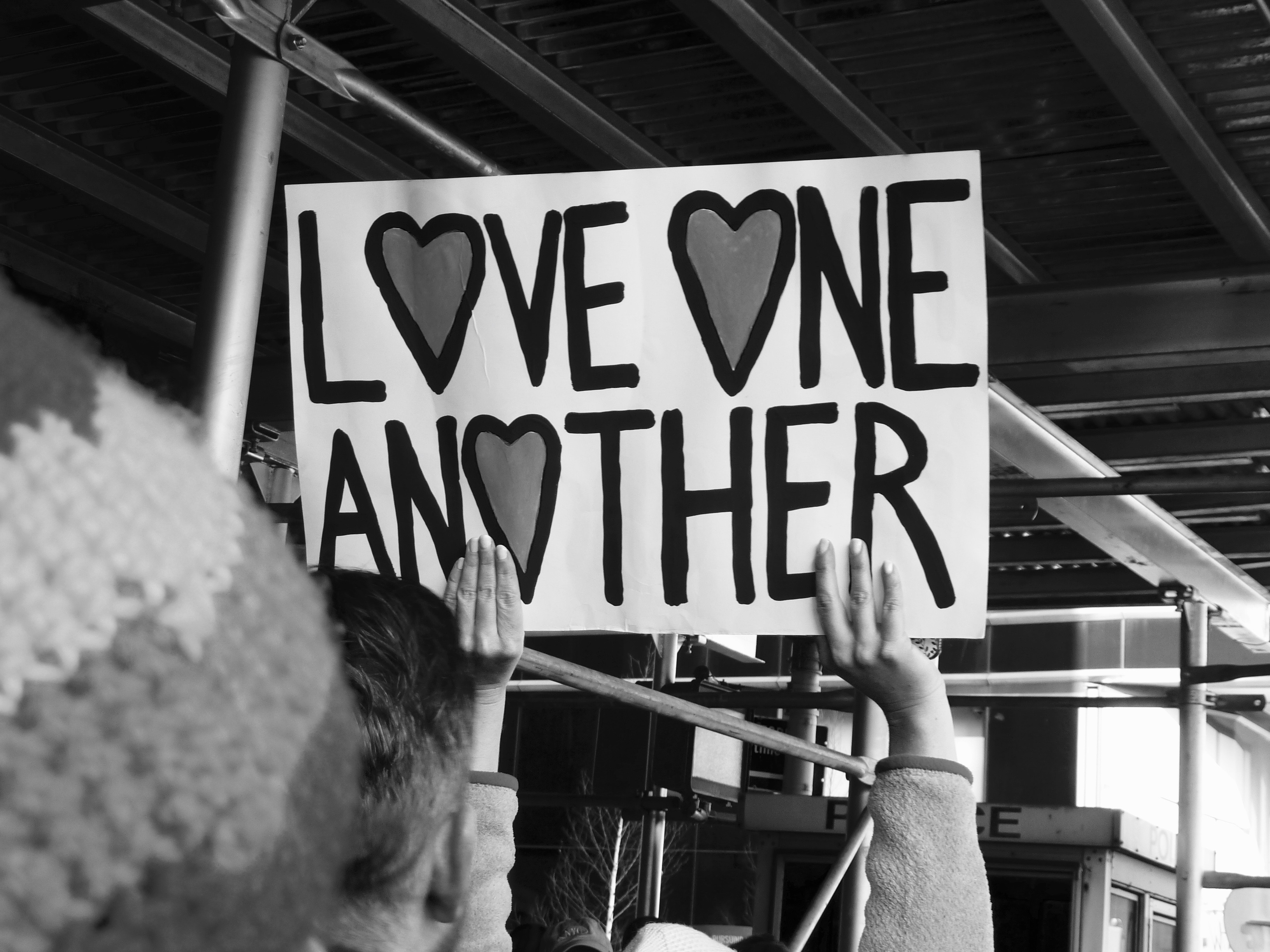
New York City Women’s March – January 2017

Acting Means Doing

The purpose of this post is not to chronicle the protests taking place across the United States and, in response, the rest of the world.

The purpose of this post is not an outcry against society or systems. It’s not a tirade against power and authority.

This is a post about love.

I’m rereading Erich Fromm’s The Art of Loving, a remarkably rich and very short book on what it means to love in all of its forms. Today I read the following:

The most fundamental kind of love, which underlies all types of love, is brotherly love. By this I means the sense of responsibility, care, respect, knowledge of any other human being, the wish to further his life. . . . If I have developed the capacity for love, then I cannot help loving my brothers. In brotherly love there is the experience of union with all men, of human solidarity, of human at-onement. Brotherly love is based on the experience that we all are one. The differences in talents, intelligence, knowledge are negligible in comparison with the identity of the human core common to all men.

Towards the end of the paragraph, Fromm quotes Simone Weil, whose writing is incredibly vibrant and actually quite apt for this current point in time. In his quotation she writes:

The same words [e.g. a man says to his wife, “I love you”] can be commonplace or extraordinary according to the manner in which they are spoken. And this manner depends on the depth of the region in a man’s being from which they proceed without the will being able to do anything. And by a marvelous agreement they reach the same region in him who hears them. Thus the hearer can discern, if he has any power of discernment, what is the value of the words.

Love is a verb. Verbs are actions. Love that is truly meant on the basis of our humanity and interdependence then requires us to act.

This post is a call to action, a call to doing something beyond what is immediately visible.

Participating in the Women’s March in New York City following the US election of 2016 was an eye-opening moment for me. I watched similar marches around the world. I watched as we were all swept up in solidarity and excitement and a sense that this was our time.

And then I watched as everything continued more or less as usual.

And I asked why. I had raised my voice in an outcry and continued to do so, but with the growing awareness that an outcry is only that. What is needed is action.

Thank you to those standing up for justice. Please do more than stand up. Please act in ways that may not be visible but play into the systems you’re trying to dismantle. If history tells us anything it is that protests are easy to organize, easy to join, and easy to let go. Although perhaps not electrifying, there are far more concrete ways to stand up and actually make the difference you believe in.

There are organizations that need your support to take cases to trial. There are organizations that need your support to provide meals, transportation, shelter, job training, clothing to those who need it. There are organizations that need your support to make laws. There are organizations that need your support to keep the doors to their clinics and offices open so that they can run campaigns to change the balance of power. And on. And on.

Yes, attend a peaceful protest and raise your voice.

And then act on what you say.

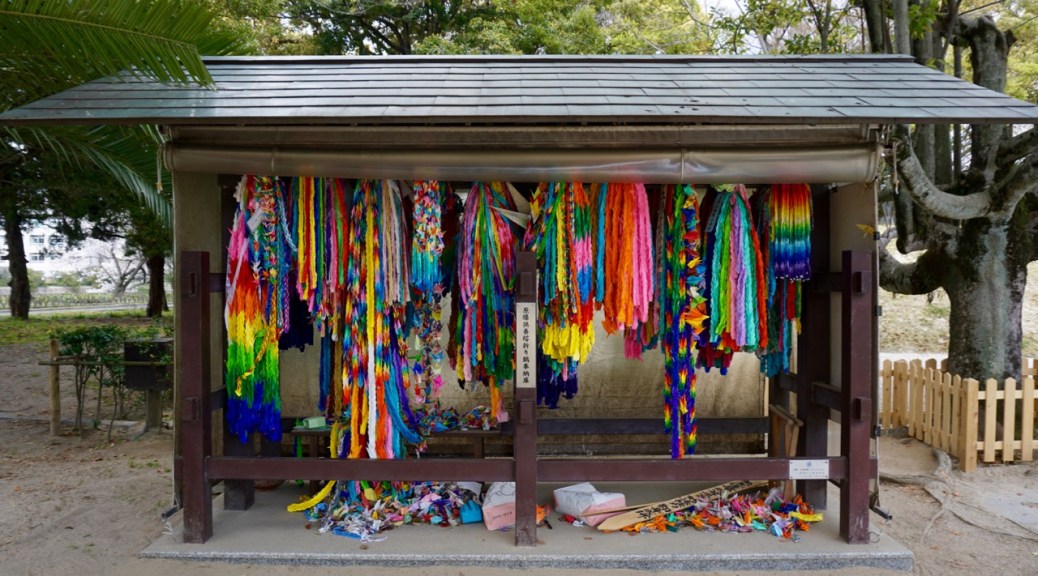
Hiroshima Peace Memorial Park – April 2019

Why I Went to Work on International Women’s Day

I didn’t intend to write this post.

And then my eighth graders asked some questions and I realized I was missing an opportunity to explore the complexity of what it means to be a woman and educator in today’s world.

As my students noticed, I did not participate in A Day Without a Woman on Wednesday, March 8. I did not participate in the demonstrations in New York City. Instead, I went to work.

This lack of participation is a sharp contrast to my activism in the Women’s March back in January, and my students were curious about it. Many of my eighth graders read this blog (and ask me about it in class when they’re supposed to be working on other things) so this post is for and because of them.

p1080681
My favorite sign from the Women’s March in January

The Question
A number of my students come from households that talk politics. Some of them come to class echoing their parents’ conservative or liberal views, others come with questions, and still others want to be involved in the conversation but don’t know where to start. I  don’t openly discuss my political views with my students, but I’m also not completely closed off when political questions intersect with deeply held personal views.

On Thursday, March 9, the day after International Women’s Day, two young women who usually present very different political narratives quietly and separately asked me, “Why were you here yesterday? I was expecting you’d be at a protest.”

I was surprised because I hadn’t even considered skipping school to demonstrate or protest. My identity as an educator is such that I feel a sense of moral responsibility in being there for my students to guide their learning. That is what I tried to convey in my answer to both of those young women on Thursday.

The Answer

That’s a really good question. The way I see it, my job is to make sure that you’re learning. I know that I can best do that when I am here helping you learn and guiding you along. When I’m not here, I have to leave that task to someone else. Yes, someone else can do it, but I know what my goals are for you and I know what I’m doing to help you reach those goals. My not being here is potentially harmful to your learning. So, to be the best teacher I can be, it’s important to me to be here with you.

I understand why some women made the choice to protest. I understand why it’s important to show the country what happens when women are silenced and shoved aside. But I think that an alternative way to demonstrate that is to be here with you and talk about it. So I support those women who didn’t go to work. I support their decision to make their absence felt. It just doesn’t fit with my job right now. I have a different agenda, which is to do what’s right for you.

The girls nodded. Both expressed their surprise and understanding. One of them told me she respected that decision.

In truth, the more I think about it, it’s far more complicated than that.

The Challenge
The challenge for me is to “talk the talk and walk the walk”. It’s all well and good to say that I support women who took time off work, either paid or unpaid, to stand in solidarity with other women on Wednesday. However, I did not take time off work. I did not physically stand in solidarity with women. Do my actions speak louder than my words? If so, do my words of support still count?

If I want to be a role model for my students and do what is right, am I obligated to stand up on behalf of women and join them in protest? Or is sticking to my beliefs about education modeling in itself?

I’m not sure.

I could be giving myself far too much credit as essential to my students’ learning. I know they could have gotten through a day without me and that the day would not have been a loss. So maybe I’m not as important as I think I am, and maybe I could have had a greater impact missing school and joining a protest.

Similarly, there are definitely things I could have done in class on Wednesday to draw attention to A Day Without a Woman. I could have addressed it explicitly and discussed the history of women’s protest with my students. I could have asked if they knew anyone participating. I could have pulled opinion pieces and even footage of protests and demonstrations and we could have had a class discussion on the purpose and effectiveness of protests.

Picking a Side
In truth, I didn’t think about it. Perhaps I should have. Perhaps this was a lost opportunity and my students and I all missed a valuable learning experience. Perhaps this was not simply a matter of another day at school.

Unfortunately, I think that’s all too common in schools. I think we often miss valuable learning experiences because we’re tied to other priorities, whether those are selected for us or by us. I don’t know if I made the right choice in going to work. I don’t know if I made the right choice in spending the day on “normal curriculum” instead of digging into protest in America or wage inequality or women’s issues around the world.

I do know that I’m walking a line between political and personal identities and I’m having trouble finding a bridge. I feel like I’m coming from two almost opposing camps and I don’t always know where they should intersect.

On Wednesday, I chose to go to work and do my job because I felt like it was the best thing I could do for the young people under my care. Yes, there are others who care for them. But I can only control what I do and the messages that I send. It was more important for me to stand by my promise to be present with my students than it was to embrace my role as a woman and skip school that day. At this point, all I can do is recognize that choice for what it is and perhaps consider what other options I might have in the future.

Eighth graders, you ask good questions. Keep doing that.