Tag Archives: Religion

Travel Guide: Jerusalem

I recently had the pleasure of chaperoning a two-week trip to Israel with the eighth grade class at my school. The purpose of the trip was to develop strong cultural connections with Judaism and the land of Israel, celebrate their B’nai Mitzvah together as a grade, and form new and better friendships with their classmates. Based on the reflection that the guides led on final night, I’d say that mission was accomplished.

Many organized trips to Israel like ours cover the three regions of the country; the north, the south, and the central region, which includes Jerusalem and its surroundings. We spent the first four and last three days of our trip in and around Jerusalem, and that’s what I’ll walk you through in this post. Stay tuned for the others!

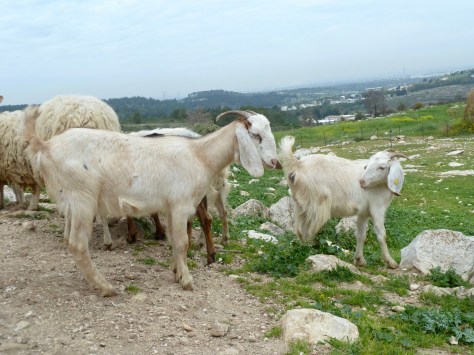
We hit the ground running after a 12-hour flight that landed at Ben Gurion International Airport at 6:30am! Despite kids’ pleas to go to bed, we headed to Neot Kedumim, a biblical garden and land reserve that highlights animals, plants, and plant products mentioned in the Old Testament.


Highlights included herding sheep . . .
P1080870

. . . and planting trees, a vital part of every first trip to Israel as a way of “giving back” to the land and contributing to its continued prosperity.

P1080881

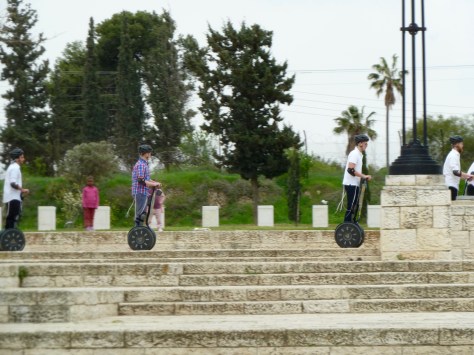
It was the first trip to Israel for many of our students and we spent some time singing and celebrating on the Talpiyot Promenade that overlooks the Old City.

P1080886

This was also a perfect location to experience some of Israel’s idiosyncratic juxtapositions of religious and modern life.
P1080893

We spent most of the following morning at the City of David, the archaeological sites that date back to the Second Temple period (about 530 BCE-70 CE). Attractions included a walk through Hezekiah’s Water Tunnel, an underground tunnel built in the 8th century to protect Jerusalem’s water from Assyrian invaders. As it was a bit chilly that day, I opted to wait outside and take pictures overlooking the Old City, but my students said it was a lot of fun.


We also visited the Davidson Center, which is a museum dedicated to the ongoing archaeological excavations around the Temple Mount area of the Old City.


No visit to Jerusalem, at least for Jews, is complete without a visit to the Kotel, or Western Wall, part of the ancient retaining wall of the Second Temple. Most of the wall is reserved for men and therefore all of my pictures come from the women’s section. The segregation irritated me more this time than it has in past visits to Israel. There’s something truly fundamentally wrong with separating men and women because of invented notions of purity.


We walked back through the Old City as the sun was setting. It was beautiful.

P1080985

The next day we visited Beit Guvrin, an active archaeological dig that is a lot of fun no matter how many times I’ve done it. There are so many artifacts yet to find! Spelunking there is great, too, because some of the completed excavations are best experienced in the darkness by candlelight. This time, we visited a columbarium dating back to 200BCE! And the park itself is beautiful.


After celebrating Shabbat together in Jerusalem, we went to the famed Ben Yehuda Street to eat and shop. I bought some gifts and had a delicious and overpriced falafel – my gift to myself!


We returned to Jerusalem for the final two nights of our trip after traveling through the country. Our first stop when we got back was to Latet, an organization that aims to reduce poverty and create a better, more just society in Israel. We volunteered by sorting boxes of food for delivery to needy families for Passover. The kids received very little instruction, someone hooked up an iPod full of Israeli folk songs, and suddenly everyone had organized themselves into groups sorting different food products. In moments, without talking about it at all, everyone knew who was packing boxes of canned vegetables, grape juice, matzah, chocolate spread, and others. There was so much excitement and energy in the room, cheering as boxes filled, laughter as we threw food products to one another (until we smashed a wine bottle and had to clean that up . . . and then promptly continued), and genuine joy in the work we were doing. We participated in two service projects on our trip and I absolutely loved both of them. Doing service work with students is high on the list of my favorite things.

The same day, we visited Yad Vashem, Israel’s Holocaust memorial and museum. Our visit started in the Avenue of the Righteous Among the Nations, the area of Yad Vashem that honors non-Jews who saved Jews during the Holocaust. Remembering that there were people, however few and far between, who risked their own lives to save others is the only way to go through the rest of the memorial without losing all hope.

The museum itself is designed to mirror the darkness of Hitler’s rise to power – you are literally underground in a close, constrained environment. Yad Vashem does not allow visitors to freely walk from one room to the next. Instead, all must pass through each room in turn, zigzagging across a long hallway the way Hitler’s persecuted people had no choice of where to go or how to get there. By the time the war ends, visitors are at ground level and the museum opens to a beautiful view of the world outside. Unsurprisingly, most students were especially moved by the Children’s Memorial. The fact that it even exists is enough to say about it.

But two days later, we visited Yad LaKashish, a beautiful contrast to the Holocaust. Yad LaKashish is an organization that teaches the elderly different types of crafts, like metalworking, bookbinding, jewelry making, and silkscreening. The artwork is then sold in the gift shop to finance the whole program. The artists love visitors, especially young people, and they make truly beautiful things. I was not alone in wishing aloud that I had any artistic ability whatsoever. Clearly it’s never to late to learn!


That afternoon, to bring the story of Zionism to a conclusion, we visited the Herzl Museum and reviewed much of what we’d learned in social studies class (a nod to my department – we done good!) prior to the trip about the Dreyfus Affair, Theodor Herzl, and the origins of the idea of a Jewish state.

Our final evening was spent reflecting on what we’d learned and experienced, thanking all of those who had been part of the trip, and enjoying one another’s company before heading to the airport in the wee hours of the morning.


I love Israel because it feels like home. This was my third time there but that feeling was present within me from the first moment I landed at Ben Gurion International Airport back in 2007. There’s an unspoken understanding among Jews in Israel, and this is most certainly a sign of privileged status in the country, that you’re welcome to visit, to explore, to ask questions, and to call Israel home. I did a lot of exploring this time around. I asked a lot of questions, specifically about the relationship between being religiously Jewish and culturally Jewish. Israel answered a lot of the questions I’d been asking before the trip and as always, I left wanting more.

Stay tuned for my posts on our time in the south, my favorite part of the country, the much greener but equally beautiful north, and the vibrant city of Tel Aviv.

Travel Guide: New Orleans, LA

Prior to leaving on this long weekend with my mum (the first time we’ve traveled somewhere together!), I had the following conversation with more than a few friends and colleagues:

Curious person: Oh cool, New Orleans! Are you going for Mardi Gras?
Me: No, that’s not until next week.
Curious person: Oh right, of course.

To all of you who asked such a good question, I owe you an apology. I was completely wrong and you seemed to believe what I said without question (likely because I go a lot of places and do a lot of things and usually sound pretty confident when I speak, the latter of which is largely smoke and mirrors anyway). Mea culpa. Lessons learned: Factually, trust no one (as aptly phrased by a friend) and always, always research.

The Mardi Gras season, as the extremely friendly and hospitable New Orleanians (I may have made up that word) told me, runs from Epiphany in January to actual Mardi Gras day (Fat Tuesday). As the locals explained it, Mardi Gras is an excuse to do as much sinning as possible for 5+ weeks in order to have something to atone for over Lent.

So yes, I was in New Orleans for part of Mardi Gras. And it was amazing. There were parades everywhere at all times of the day and night. Most of these photos are from the Krewe of Cork parade in the French Quarter:

My mum and I thoroughly enjoyed collecting as many beads as we could and ogling in astonishment at the parades, costumes, and general debauchery, especially on Bourbon Street. There are no open container laws in New Orleans, which was a lot of fun and probably explains much of what we saw:

More importantly, we learned a lot about the rich history and culture of New Orleans, which has been Spanish, French, and American throughout its history, creating Creole and Cajun cultures that give the city a flavor and a pulse unlike anything I’ve ever experienced. The food is darn good, too, and this is coming from a vegetarian. If I was impressed, omnivores will be even more so.

I have to admit, however, that I still don’t like doughnuts. It was a lot of fun to eat beignets and drink café au lait while walking down the street, but I just don’t like doughnuts. That said, I’d still recommend a visit to Café du Monde, if for no other reason than to say you did. We got there around 8:15am on Saturday morning and beat the lines by about a minute. And the café au lait was truly delicious.

img_3242

Mum and I really love wandering along streets and in and out of shops and galleries wherever we are, which is how we spent most of our time. We explored the French Quarter and French Market on our own and also took a French Quarter walking tour to actually learn a thing or two about how New Orleans came to be. We were amazed at the beauty of the streets and buildings, and delighted with the art and music that were everywhere:

Another really excellent walking tour took us through Lafayette Cemetery and the Garden District. There were some incredible homes in the Garden District, with a remarkable diversity of architecture based on sheer whim of the wealthy homeowners.We learned about the burial laws of New Orleans (as long as you wait a year and a day, you can open a tomb and shove another body inside) and some of the history of the city’s wealth from trade. The first burial in Lafayette Cemetery took place in the 1840s and the cemetery is still active, which is really neat:

We also spent one evening on Frenchmen Street where there was jazz everywhere, as well as an art market. The hard part was picking a bar to visit (we chose The Spotted Cat based on several recommendations) and a place to eat afterwards! And then we were interrupted by the Krewe of Chewbacchus parade in Marginy, which was so much fun. Unfortunately, I’m a rather petite person and couldn’t get close enough to the police barrier to take any decent photos of the parade itself. But here’s Frenchmen Street:

On our last night in the city, we took a ghost tour to learn about the haunted history of New Orleans. I’m glad that we did the French Quarter tour first because the histories are obviously intertwined, but I don’t know that I’d seek out another ghost tour. I enjoyed hearing the stories and visiting a possibly haunted bar that doesn’t have electricity, but I got a lot more out of the daytime walking tours. That’s probably not surprising, considering the supernatural is questionable at best.

I’ve always admired the “doors of” posters of various cities that are often on the walls in waiting rooms, so I decided New Orleans was a good opportunity to work on my own collection of “doors of” photos. My favorites, including one set of mailboxes:

The most surprising aspect of New Orleans was the culture of the city and the genuinely open, receptive, and free spirits of all the people I encountered, from the man in the suit to the young couple in togas to the woman wearing only glitter. People playing music on the streets seemed genuinely excited to be doing it and artists hung their work anywhere they could and worked wherever they were standing. Palm and tarot readings were readily available and the voodoo shop we visited could not have been more welcoming; they even suggested a different shop when we couldn’t find what we wanted!

(Full disclosure here: Friends have read my tarot cards twice and palm once, and while I don’t know if I “believe” any of what they said, it sure was telling. And, in hindsight, frighteningly accurate.)

Maybe it was Mardi Gras or Southern hospitality, but there’s something truly wonderful about a place where what is normally considered “subculture” is just everyday being.

img_3374

Building Peace by Waging War

Disclaimer: I attended a Jewish day school from kindergarten through grade eight and then went to public high school. I grew up celebrating Jewish holidays and going to synagogue Saturday mornings. My siblings and I had to negotiate pretty hard to miss a Friday night Shabbat dinner at my parents’ house and I spent nearly every Friday night at Hillel throughout college. I attended Hebrew School on Sundays throughout high school to keep my Hebrew in reasonable shape and taught a grade eleven Hebrew School seminar on the Arab-Israeli conflict for two years after college. I am currently teaching at a K-12 Jewish day school. The following post reflects my personal beliefs and not necessarily the views of my school and governing bodies, our curriculum, or Conservative Judaism.

An alumnus came to speak to the eighth grade students at school last week. After graduation, he had moved to Israel and joined the IDF, the Israeli Defense Forces. He spoke briefly about the experiences traveling in Israel that led to his decision but most of his talk centered around cool drone technology for gathering intelligence. The kids were understandably impressed and excited. They asked all sorts of questions about the mechanics and uses of the plane. The speaker showed photos of his army unit and explained the challenges of basic training.

I listened to the presentation with my mind racing. I was very aware of the conflicting narratives running through my head. Over the summer, I wrote about the search for congruence in my personal life. Over the course of the presentation, I realized that my views on Israel have historically been highly incongruent with my current conception of the necessity of peace for the sustainability of the planet and humanity.

The following is an attempt to trace my views of Israel and how they have changed over time. These ideas are very much in flux and I’m writing this post to demonstrate that – the changing nature of ideas we hold dear as new evidence and experiences force reevaluation.

High School
When I was a senior in high school, I took a contemporary issues class in which we spent each week investigating an ongoing global conflict in preparation for a discussion, debate, or Socratic Seminar at the end of the week. I remember being really excited when the Arab-Israeli conflict appeared on the docket because I had visited Israel for the first time over the most recent summer break.

During our weekly computer lab session I was sitting next to the boy I’d just started dating. I don’t remember the conversation we had at the time, but I do remember that he later told me, “The look in your eyes when you were talking about what Israel means to you – I couldn’t decide if it was beautiful or terrible.”

Likely, it was both. I felt a deep sense of ahavat yisrael, love of Israel. I was certain that Israel was the place where the Jewish people belonged. To my thinking then, it was the place that had been promised in biblical times and therefore had to be defended at any cost.

For the eight and a half years our relationship lasted, that boy in the computer lab and I managed only a few conversations about Israel without arguing. This is mostly my fault. Israel was usually a topic I would either refuse to discuss, or would only entertain under very limited and specific circumstances. Those were few and far between and largely occurred after an attack in the region made global headlines.

Though I am very much a promoter of dialogue, I was concerned that if I showed anything less than complete devotion to Israel, that would leave room for him and all non-Jews to question the validity of all of Israel’s land claims. Underlying this was the fear that people I knew and loved would not rally behind Israel’s right to exist.

College
The university I attended had a sizeable Jewish minority, which played a huge factor in my initial decision to apply. However, it was during my time in college that I encountered real opposition to Israel and Israeli policies.

My nine years of Jewish education, four years of Hebrew School, and lifetime of synagogue participation had not prepared me to respond to any criticism at all. As I had been taught, Israel was the Jewish homeland. Everything anybody did to defend Israel was good. Everything anybody did to suggest that Israel was misguided in some way, either in policy, laws, or land claims, was bad. All of my experiences with and about Israel had not prepared me to fact check myself and those around me, nor was I able to satisfactorily articulate my personal beliefs on Israel because I’d never engaged in real dialogue about it. I had always shut off those conversations and did not know how to respond when turning away was not an option.

I started to do a lot more reading and a lot more questioning. Everyone I encountered had a lot to say. As the adage goes, “Two Jews, three opinions.” The narrative among my Jewish friends, though varied, was limited. We collectively felt responsible for defending Israel around non-Jews and weren’t entirely comfortable with criticism among ourselves. If we didn’t steadfastly support Israel, who would? And of course, it is very difficult to be the member of a tight-knit group with a specific cultural narrative who starts questioning the narrative.

Hebrew School
Two years after college, while I was both a graduate student and a teacher, I was asked to teach the required grade eleven seminar at my synagogue’s Hebrew School. The Hebrew School model had evolved since I was a student, so this was not a class I had taken. Sure, I figured, how hard could it be?

Topic: Arab-Israeli Conflict
Goal: Explore the Arab-Israeli conflict in context with primary sources and evidence from both sides to help students think critically about Israel in order to deepen their understanding of and connection to it.  
Curriculum: The David Project

According to The David Project’s website, in the new curriculum that I was teaching:

Issues, especially those in the Historical Dimension, are addressed in a more chronological fashion, as opposed to reacting to common allegations or claims against Israel. We hope that this method will allow students to trace the evolution of the conflict and gain a wider perspective of key events.

There are no direct advocacy elements in this curriculum. While we believe Israel advocacy to be a worthwhile enterprise, the goal of this product is to engage students in thoughtful exploration of the conflict and to encourage future study and involvement.

The history of the Palestinian national movement is interwoven with the Israeli history and that of the conflict in general. While we do not take political positions, no study of the conflict could be complete without examining the Palestinian component and gaining a deeper understanding about how Palestinian identity, politics and terrorism, have shaped the conflict with Israel.

There is a greater emphasis on interactive learning, with each unit containing several suggestions for classroom activities that go beyond discussion questions. These activities are designed to produce a more experiential environment and one where students have to engage with the material on a more individual level and at a greater depth.

I learned along with my students. Almost every lesson I prepared involved a learning curve. Throughout the course, we encountered Israel’s founding documents; maps of the Middle East throughout history; statistics about Israeli settlements; political struggles in Gaza and the West Bank; legal documentation of the development of the Palestinian Liberation Organization (PLO); position statements on one-state, two-state, and three-state solutions; academic texts about the refugee problem; and the moral dilemmas of Israeli policy that exist today.

This is what I had been missing throughout my own school years. I am confident that after completing the course my students were better prepared to articulate and defend their personal beliefs about Israel than I was at their age.

Back to Israel
I visited Israel for the second time over the summer of 2013, six years after my first visit. I had grown a lot and learned a lot, and had a completely different experience as a result. Israel had changed, too. There was more government-supported cooperation with Palestinians and Arab-Israelis, but also an increased number of controversial Israeli settlements. Our guide (who I cannot say enough good things about) constantly emphasized the need for multiple perspectives, multiple narratives, and the necessity of seeing all people as simply people who are trying to make a living and a life. Humanity is often forgotten in a fight for the right to exist. Most people, if given the option, would choose peace in order to live their lives and raise their families.

It is one thing to love Israel because of its history, culture, beauty, and people, which I do. It is quite another to agree blindly with every government decision. I had started to understand that in my first year teaching Hebrew School and grew to believe it during that summer.

I grew to love and understand the nuances of Israel far better than I had previously. And it’s really impossible not to love a place that looks like this:

Hebrew School Again
When I taught my Hebrew School course for the second time to a new group of grade eleven students, I had the background of the first year of the course as well as a foundation that came from my discussions with our guide, Ilan, over the summer. I’d spoken to him about my personal struggles to understand various elements of Israeli policy that did not match the narrative I had been taught during my own school days, in which there were no questions and no moral dilemmas.

By the end of the second year of the course, I thought I knew where I stood on questions about security barriers, settlements, and refugees. I did not agree with every decision the Israeli government made, but when do I ever agree with every decision any person, body, institution, or government makes?

Now
As all of my recent writing on peace should suggest, I am very concerned with the state of our world. I am concerned with the lack of discussion given to peace not only in social studies classrooms, but in our contemporary and historical narratives. We are inundated with news reports and media glorification of violence, aggression, and war. We have not developed school curricula that emphasize peaceful dialogue, interactions, relationships, or cooperative efforts towards compromise.

When we talk about Israel, we focus on defense. How are we trying to protect Israel’s right and ability to exist when surrounded by neighbors who have sworn to annihilate it? How are we trying to maintain a distinctly Jewish identity in the tumultuousness of the Middle East? How are we honoring the legacy of those who fought and died so that Israel could exist?

While those conversations should take place, it is the glorification of the fight itself, the wars for independence and existence, that dominate the narrative. The speaker who presented to the eighth grade class at my school last week did not once explain what Israel is fighting for, or who, or why. There was an implicit message that fighting is the only choice, the only option, the only reality simply because it has always been that way. There was absolutely no context for why there’s war in the region or the need for continuous military intelligence. This is due to a prevailing view that Israel needs to fight to literally stay on the map.

While there certainly is ongoing conflict in and around Israel, we need to rewrite the narrative that only emphasizes war. We need to expose today’s students to context. We need to talk about why and who and how, as well as explore peaceful solutions to the conflict. One of my favorite examples is Seeds of Peace, which operates all over the world and has special programs that bring Israeli and Palestinian teens together. These initiatives need to be part of the conversation, too.

Discussions of peace must be far more nuanced than a simple lack of violence. At the moment, the narrative does not go that far. We absolutely need to emphasize peace as an attitude and state of mind if we are going to build a world where sustainable well-being for all is attainable.

Conclusion
I have attempted to convey the evolution of my views about Israel, particularly in relation to my goal of building a better, more peaceful world that is sustainable for all. Likely, these ideas are still in transition and will develop further as I continue to read and learn.

As explained above, the vast majority of my learning began when I was ready to see the other side and wanted to understand perspectives inherently different from my own. All I know for sure at this moment is that dialogue and honest conversation were integral to the expansion of my ideas about Israel and what it means to support Israel in today’s world.

I firmly believe Israel’s fight is worth fighting. If cessation of violence were presently a viable option, the Israelis would stop fighting tomorrow. Since it isn’t, however, they fight to protect their families and lives against those who have sworn that Israel will be destroyed at whatever cost to innocent human life. Ironically, this is the more peaceful option. Protecting human lives and promoting peace in Israel means fighting Hamas and its supporters, who use children as human shields and launch attacks from schools and hospitals.

I believe that Israel’s fight is necessary because it emphasizes that human life has value. If we lose that perspective, we have lost humanity. We can’t build a world that increases sustainable well-being by destroying human life in the process.

Supporting Israel means valuing and protecting the innocent person’s right to live.

Our world is struggling to cope with increasingly advanced AI, increasingly devastating climate change, and a variety of global issues that are far bigger than the conflict in one region. If any nation at all wants to survive, priorities around the globe have to change. We have to decide that innocent human lives are worth protecting and worth a reevaluation of our time, energy, and efforts. Israel is fighting to do that within its borders. This fight to protect humanity needs to be part of the way we discuss Israel’s history, politics, and efforts at conflict resolution.

For me, dreaming is simply being pragmatic. – Shimon Peres