Tag Archives: Sky

Climbing the Zugspitze

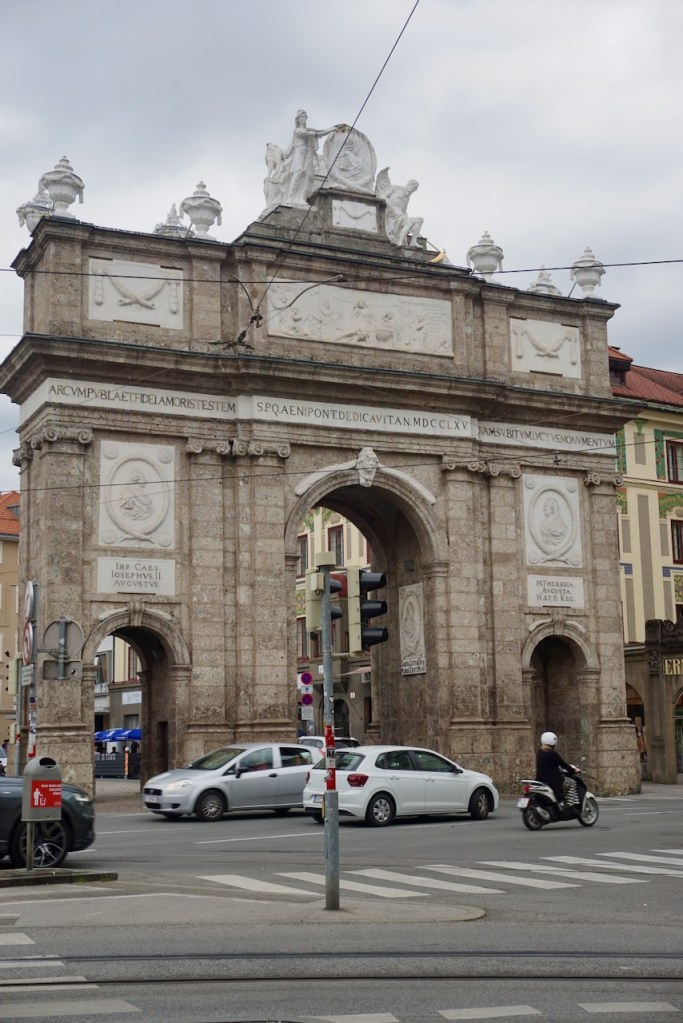
Memories of our first alpine tour still fresh in our minds, my partner and I left Slovenia just as cooler air was moving in. We arrived in Innsbruck glad that we had jeans and raincoats, and spent a couple hours browsing the plethora of sporting goods stores and walking through the beautiful old town. With mountains visible from everywhere, painted buildings, and a vibe of loving adventure, Innsbruck is the type of place I could easily imagine living . . . or at least visiting again.
We spent the night a little ways outside of town to facilitate our drive the following morning. Past Garmisch-Partenkirchen, not far from the German border, we were surprised to hear a radio show host speaking English and realized we were not far from a US military base.

We parked and looked up at our destination: Zugspitze, Germany’s tallest mountain. From where we were standing, it was only slightly visible, hidden behind mountains that seemed much more imposing, much more daunting. Knowing that they weren’t, knowing what awaited us on the route ahead, filled me with a sense of wonder. We were actually here. And we were ready. Our backpacks included easily-accessible energy bars, our essentials for a night in the hut (toiletries, sleeping bag liner, towel, change of clothes, extra layers that turned out to be unnecessary), and the necessary gear: climbing harness, carabiners, slings, helmet, via ferrata set (Klettersteig in German, details to follow), rope, ice axe, crampons, trekking poles. Showtime.

But first we had an easy day to warm up. We followed the trail markers along the river to the Höllentalklamm, the gorge that we’d pass through on our way to Höllentalangerhütte, the alpine hut where we’d spend the night.

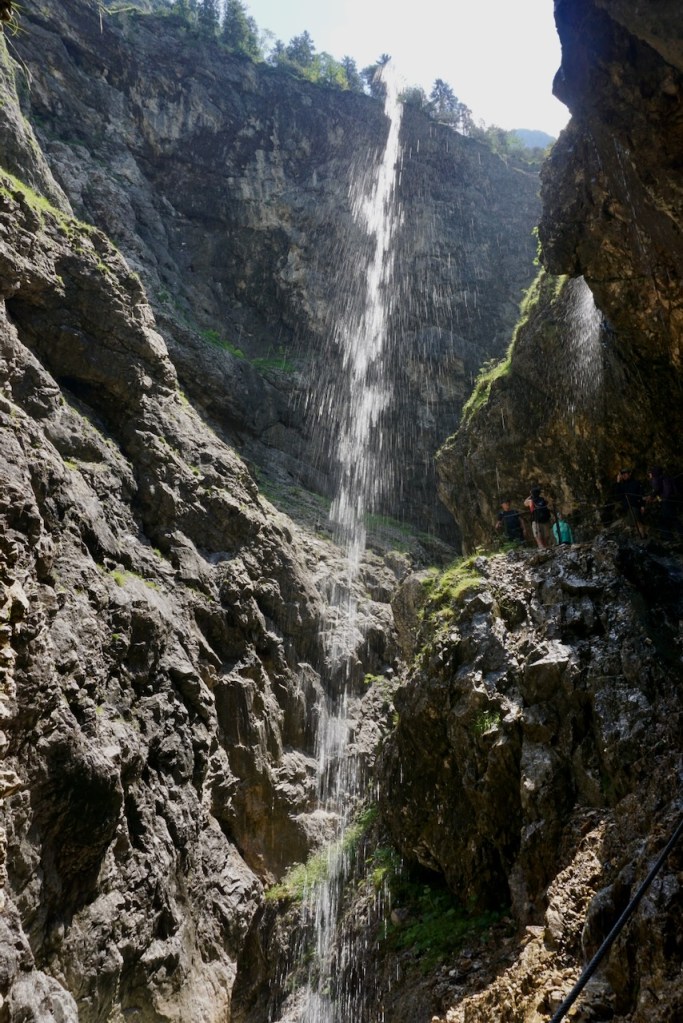
The gorge itself was dark and cool, the spraying water a much-needed relief from the heat. We walked carefully along narrow, slippery bridges and stones through the canyon, carved deep into the earth. The ancients were right to honour water as one of the four elements.

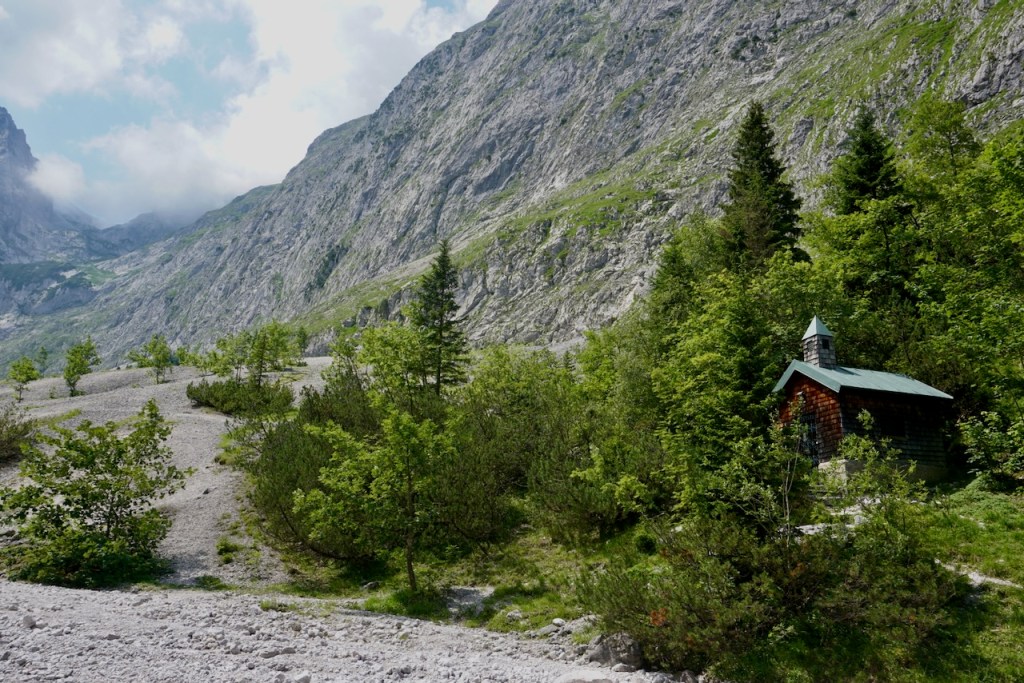
Subsequently, the path grew steeper, rockier. The mountains grew larger as we approached, and the trees began to recede. We had ascended 700 meters and could see the end of the tree line past the point where we would end our walk for the day. The air around us glimmered and my senses tingled.

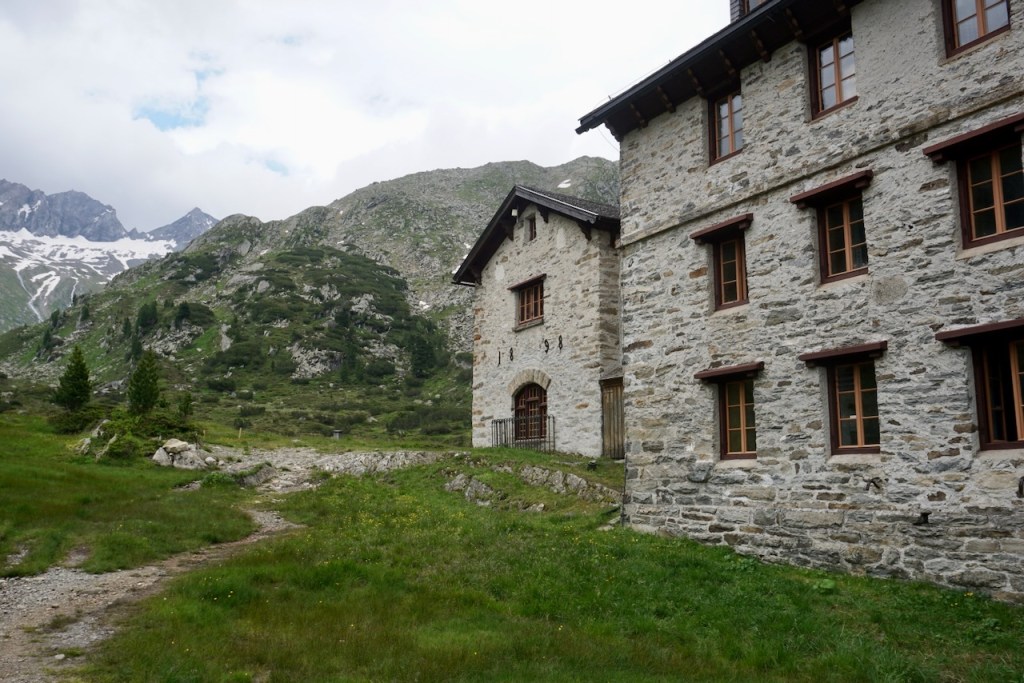
We reached Höllentalangerhütte in high spirits with the sort of jitteriness that comes at the end of a long wait. It brought to mind the last day of school, or one’s birthday, or a favourite holiday. One more sleep.

After a shower and a snack, we meandered across fields of stone away from the hut and took a good look at what we could see of our path for the next day.

The way markers designated six hours. In the end, the climb took us exactly six hours.

We began promptly at 6am, joining most of those who had shared our 35-bed dorm room for breakfast at 5:30. The mountains glowed that morning in welcome. To be in such a place, and to be able to take on the task we were taking on, is an incredible privilege. We couldn’t stop smiling.
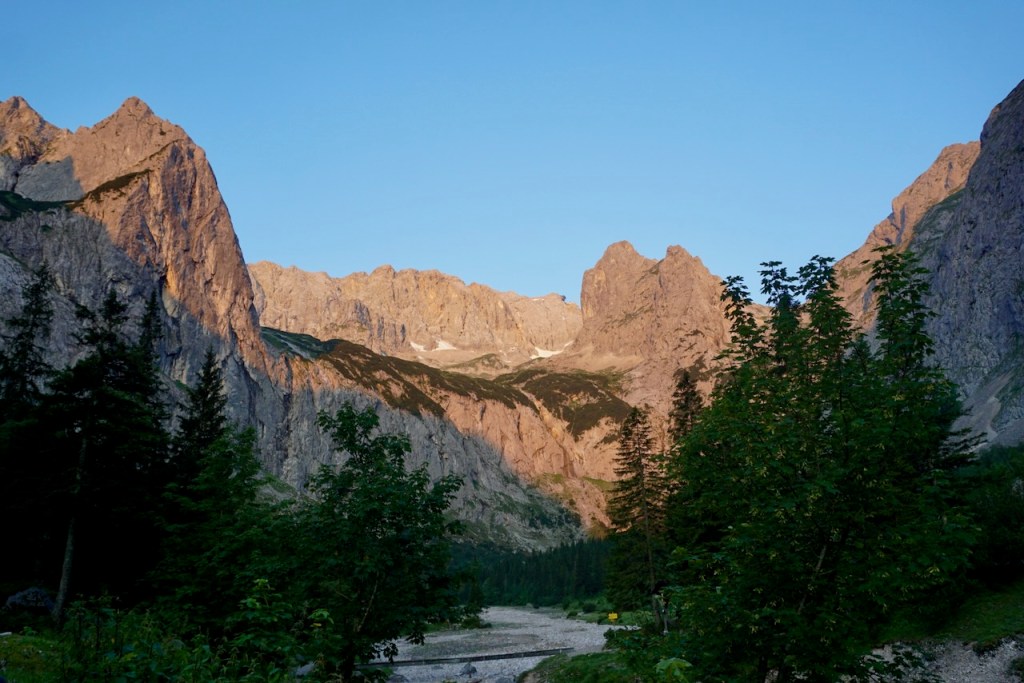
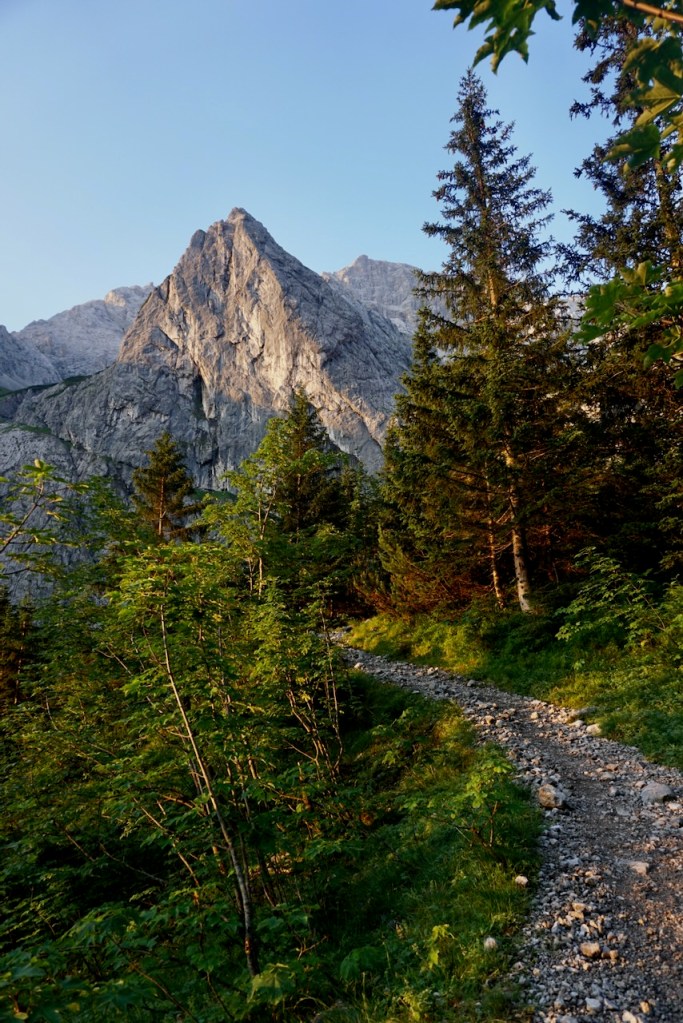
The Zugspitze is steep, just over five kilometers with an elevation gain of 1,390 meters. This was easily the most demanding mental and physical experience I’ve had in the mountains. The physical challenge, the ceaseless gaining in elevation along difficult terrain, tired the body and that tired the mind. A tired mind is then an unfocused mind, and that can be dangerous. The mental challenge then, is remaining alert and aware, moving simultaneously with confidence and caution.

In addition to the steepness of the terrain, the Zugspitze is also a technical climb with multiple sections of via ferrata, or Klettersteig. This is a sort of aided climbing using fixed cables that allows access to sides of mountains that would be too risky to attempt otherwise. That being said, you don’t want to fall because a via ferrata set is basically one-time use. The set is comprised of two large carabiners attached to lanyards, which are attached to a longer lanyard snugly packed inside a little bag that will only extend if you fall (and then you can’t stuff the lanyard back into its bag in alignment with safety ratings, so that’s that). The entire set is attached to your climbing harness. A helmet is required and I find durable, fingerless gloves designed for the thick cables to be essential. We also use an additional safety sling because again, you don’t want to fall. There were two sections of Klettersteig on the Zugspitze, both relatively easy grades but hard enough once we got into altitude. The first one made for a nice warm-up for what was to come.

The sections of the route that were not part of the Klettersteig were rock scrambles, generally easy climbing that requires all four limbs. Mountaineering is serious work, but there was so much play alongside the intensity.

As we climbed higher however, I was breathing too quickly. My pulse was racing and head spinning from the altitude. We continued moving as my partner demonstrated breathing slowly and deeply to bring everything down. And then I carefully counted breaths, letting my body acclimate. In just a few moments, my head cleared and my pulse returned to normal. It is easier to keep going, slowly, under such circumstances than stopping for a rest; the body needs to adjust, not to stop, and the breath controls the body. To reset mentally, it was enough to look around. The strength that comes from being wrapped in nature, the edges of the mountain growing more jagged as we crossed them, left me with feet planted firmly on the ground and a strengthened resolve.
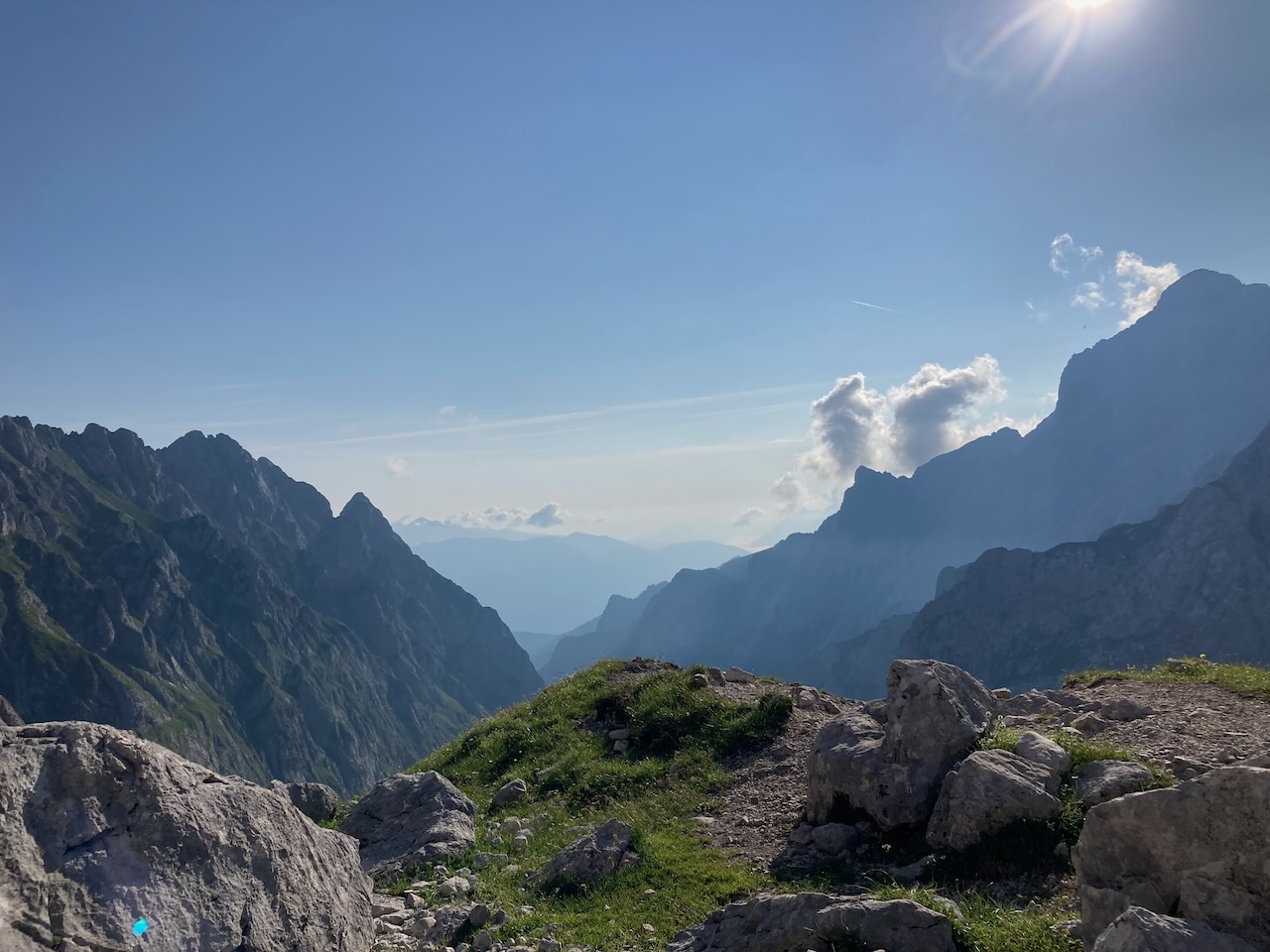
What I found unique about this climb is that it never let up and, therefore, neither did we. It was continuously hard, continuously driving me to the edge of what I thought I could do. I kept moving long after I would have liked to have stopped and long after it hurt. I knew I had blisters forming on the backs of my heels, but I also had carabiners in both hands to clip onto cables, rocks to scramble over, and a sheer drop visible to my left that kept my feet moving with precision. The nearly instantaneous benefits of energy bars have never been more apparent.

We had made very good time when we reached the glacier, a very special aspect of climbing the Zugspitze. Excited to get into snow, we unpacked our crampons and rope, which we had prepared in advance with figure-eight knots for us to clip into and butterfly knots as stopper knots for the unlikely event that one of us fell into a crevasse. As we had practiced, we wrapped the ends of the rope around our bodies, securing them with one more knot. My partner readied his ice axe and I adjusted one trekking pole. Our free hands would be used to guide the rope as we walked.

Photo by TM

Due to the potential consequences of falling, a glacier crossing should not be done alone, but rather in pairs or groups, everyone attached to a rope. It is the leader’s job to make the way, to form the tracks. It is the leader’s job, when necessary, to use the ice axe to arrest a fall. The follower’s job is to manoeuvre the rope and to keep the right amount of slack between the leader and follower. Knowing the terrain where we were, an ice axe for the follower was unnecessary, but there are bigger, more dangerous glaciers where this would not have been the case. A trekking pole with a snow plate was sufficient for stability and support. Crossing the glacier as a team with my partner, our safety quite literally tied together, sent jitters up my spine as we got ready. And then, with the first steps, the romantic moment vanished into one of sheer focus.

A combination of steepness and rope management made the glacier tiring work. We followed tracks that had been made throughout the season, lamenting that the snow was rather mushy, a sign that it was much warmer for this time of year than it should have been. As grateful as we were to have the way tamped down, the steepness remained a challenge. Our toes did most of the work, the spikes cutting sharply into the snow and holding fast.

Arriving at the end of the glacier and getting ready to clip back into the Klettersteig, we shed our jackets immediately. It is absolutely no joke that glaciers are the way to see climate change in action. We looked down at the edge of the glacier and stepped quickly and carefully, not wanting to linger. And then we looked up at the way ahead, following the cables with our eyes until we could no longer see them, the summit hidden but closer than it had been.

Photo by TM

The second Klettersteig took us the remaining two and a half hours of the climb. When we looked down, we could see the zig-zag tracks that we had followed across the glacier, essential in steep terrain. Although it hadn’t felt that way, the glacier looked vast. Focused on whatever needed my attention in any given moment, we had climbed a lot farther than I had realized.

It was easy to lose track of time not just because of how hard we were working, but also because of how much fun the climb was. And it really was, which struck me over and over. I knew that I was pushing all of my body’s limits and that I was absolutely in the range of what I could do even if I hadn’t done it before. I knew I had a range of aches and pains and bruises, but I had ceased to feel them. I knew I was tired and thirsty and hungry, that I hadn’t eaten enough at our second snack break, that everything should have been uncomfortable, but somehow it wasn’t. There was laughter ready to bubble up at any moment, a smile every time my partner and I called to each other, an electricity throughout my body that propelled me along. For six hours, there was nothing but us and the Zugspitze.

Photo by TM

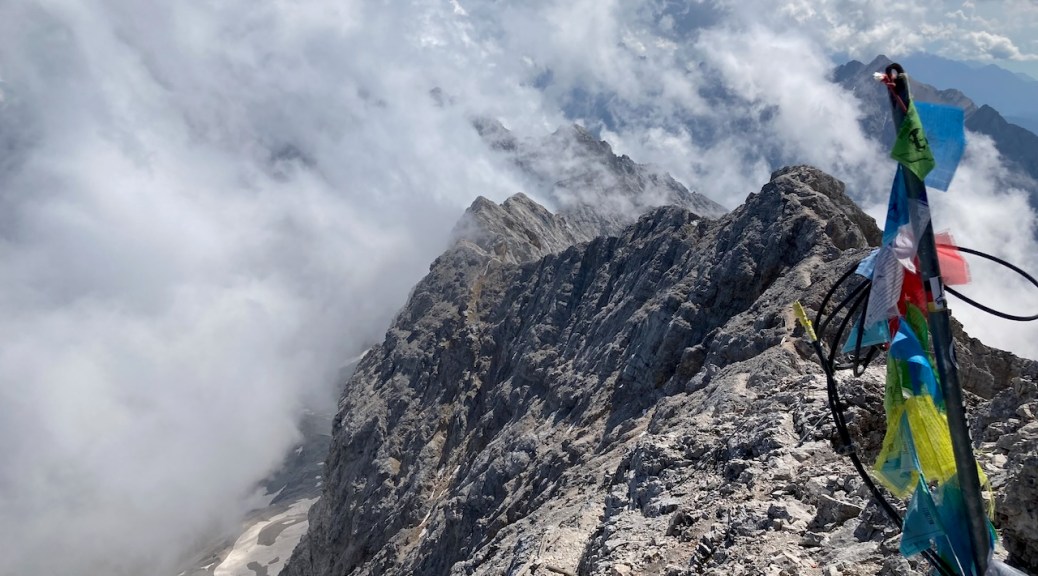
More than once, we thought we were just around the corner from the summit. More than once, we thought we were right there only to lose sight of it again. The clouds began to roll in behind us and my partner, whose photos are below, paused above me to watch. Suddenly, the world we had come from disappeared and there was only the world of the rock under our hands and the mountain who allowed us to hold on. My heart hammered in my chest in both exertion and a profound swelling of gratitude and respect for what we were doing.

About 40 minutes later, the Klettersteig cables disappeared. We climbed the last few meters unassisted, the exhaustion of the previous hours vanishing in the waves of excitement that began to build, and we were there.

At 2,962 meters, we had summited Germany’s tallest mountain in exactly six hours, mind and body fully engaged the whole time, laughing throughout in exuberance as reality hit us. The Zugspitze is not only Germany’s tallest mountain but also one of its hardest mountaineering tours, and we had done it. Together.


We ate and drank, gratefully took the train back to where we’d parked the car, ate and drank again, and then drove the five hours home, stopping for yet more food. Words failing us and hearts full of the day, we talked mostly about other things or not at all. Periodically, one of us would utter something like “Wow” prompting a response akin to “Yeah” from the other one. Slowly, we were able to talk about the experience, our different thoughts and feelings along the way, the areas where we’d each encountered challenges, or how much fun a certain section had been. Gradually, as we told others about the Hochtour and shared our photos, it became real that we’d stood at Germany’s highest point and that we’d made the way there together.

There were, however, serious conversations before planning this trip about whether we wanted to attempt it, whether my fledgling mountaineering skills were up to the task. There were moments before committing where we were uncertain about whether this was the right thing to do together. Mountaineering is a risky sport and the consequences are unthinkable, which is precisely the reason they must be thought about. And discussed. Openly and honestly, which can be stressful.

Once we decided to do it, the preparation took weeks. My partner took responsibility for learning the route and briefing me on it while I practiced different techniques of walking in new boots and read up on crossing glaciers and how to respond in a sudden thunderstorm. We watched videos and practiced knots together, made packing lists, prepared backpacks, went for a local hike completely kitted out, made adjustments. We talked about weather and feeling comfortable and knowing what it meant to decide to turn back. We did not take this climb lightly and I do not want to make light of what it took to get there.

As a result, there was no point on the Zugspitze where we were in any doubt about what we were doing, but also no point at which we took the mountain and our being there for granted. Nature allows you to be where you are, or it doesn’t. Nature welcomes your presence, or it doesn’t. Nature speaks and we have to listen, to respect. We are guests in nature.

And it was an honour to be there.
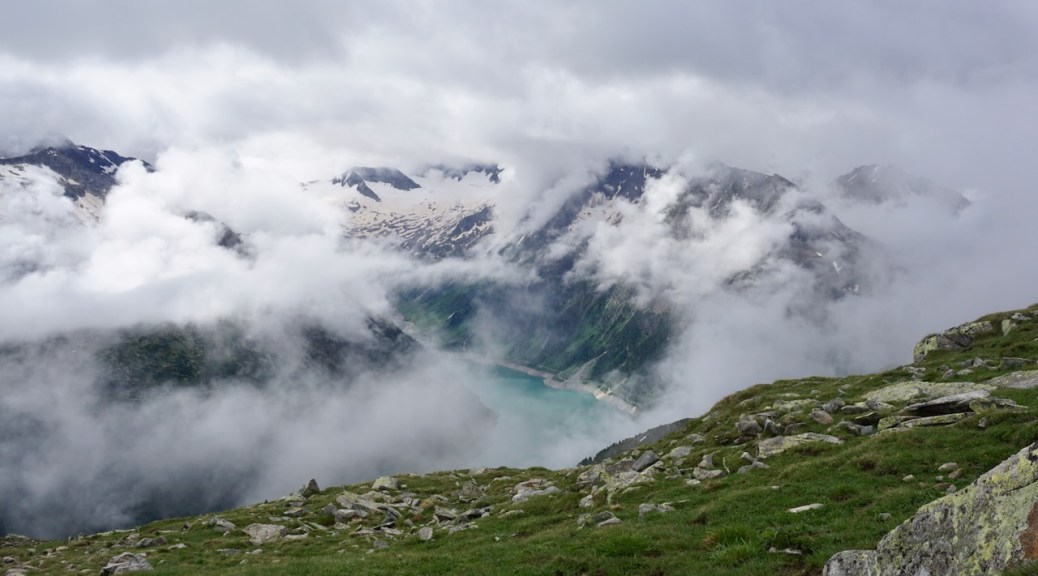
In the Alps: Berliner Höhenweg

The German word “Hochtour” literally translates to “high tour” and the term is used to describe a trek through the Alps that passes through snow or over a glacier. As it’s been in Europe where I’ve become involved in mountaineering, I don’t know if there’s a single English word for this concept. I also don’t know how trekking through the Alps compares to multi-day trekking in North America, where I’m from. But I do know that my first Hochtour, accompanied by my partner and two girlfriends, left me hungry for more.

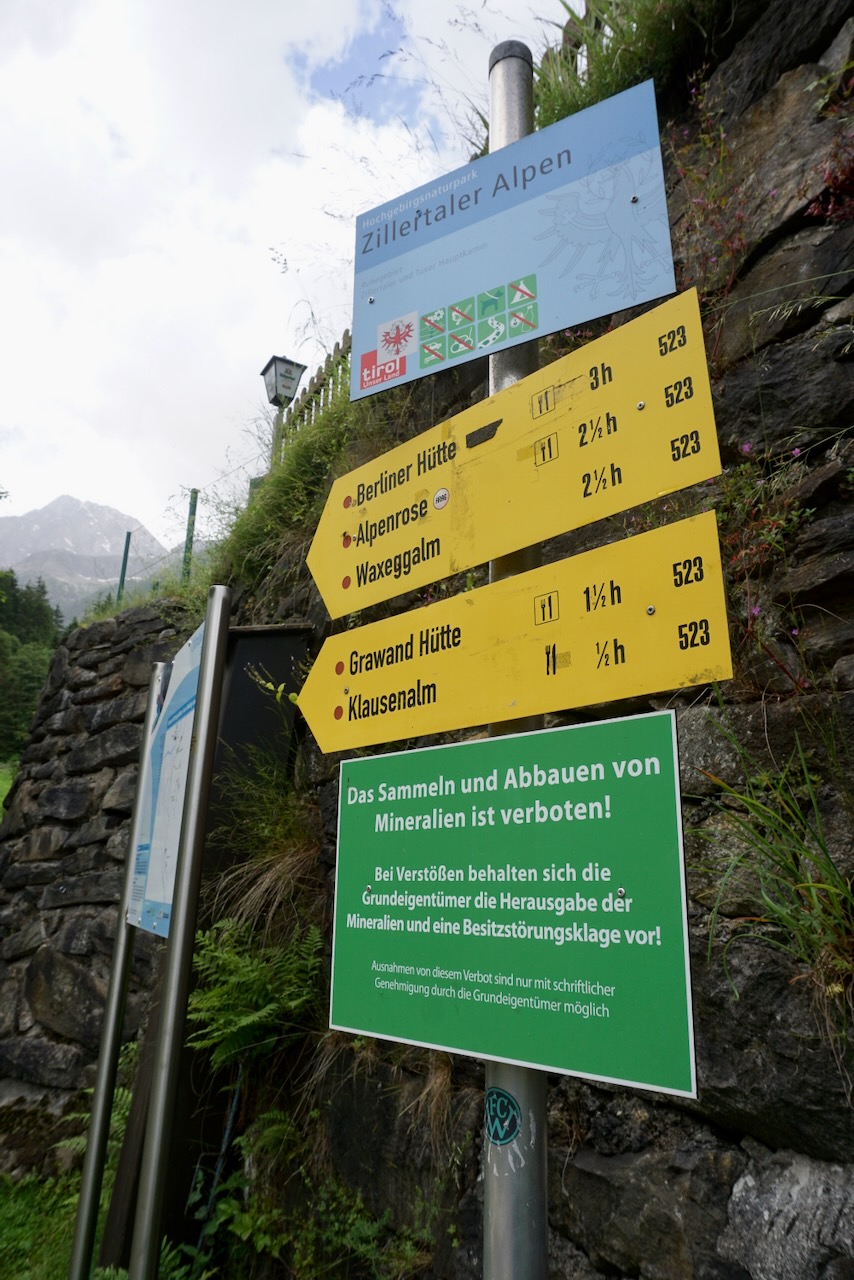
Based on available time and building in a buffer for the weather (summer is thunderstorm season in the Alps), we decided on a four-day trek along the Berliner Höhenweg, a famous nine-day route in the Zillertal Alps in Austria. Based on a weather report from friends who were in the area at the beginning of June, we changed some of our packing to include essentials for snow, which had come late and heavy. We added an ice axe, crampons, trekking poles, climbing harnesses, carabiners, and a rope; all of these items are needed to cross a glacier (stay tuned for a blog post!) and all could be helpful in snow. In the best case, we wouldn’t need anything but the crampons and trekking poles, but preparation is key.

Day 1: Breitlahner to Berliner Hütte

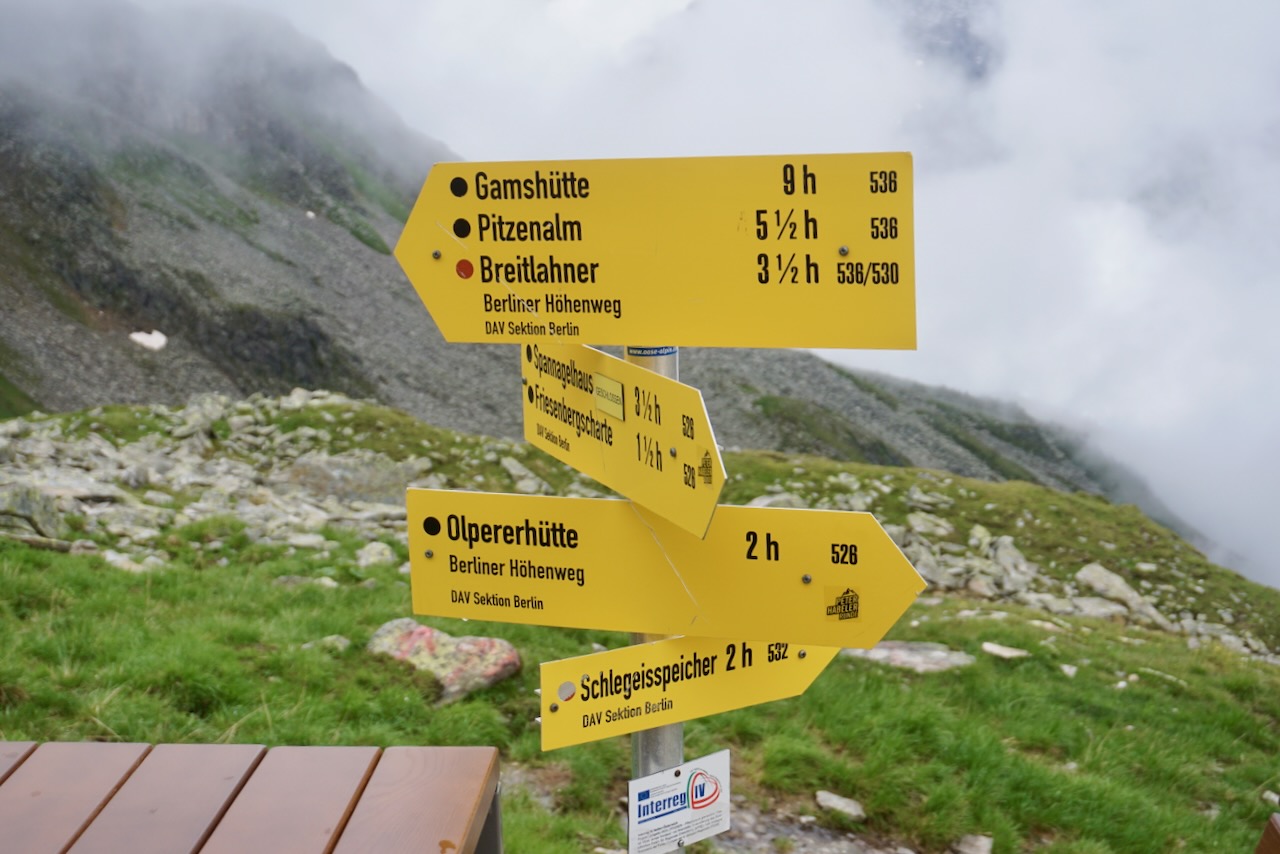
Our Hochtour began with a warm-up hike from the long-term parking lot at the Breitlahner restaurant and guesthouse to the Berliner Hütte, the first of the guesthouses (“Hütte” means “hut” but that has a different connotation in English) to be built in the Zillertal Alps. We ascended 780 meters in just over 9 kilometers, arriving shortly before the rain.

As we would quickly learn, we moved rather more slowly than the posted time estimates. This was likely due to inexperience within our group, but we also suspected that the estimated times described perfect conditions without backpacks. (Or so we told ourselves.)

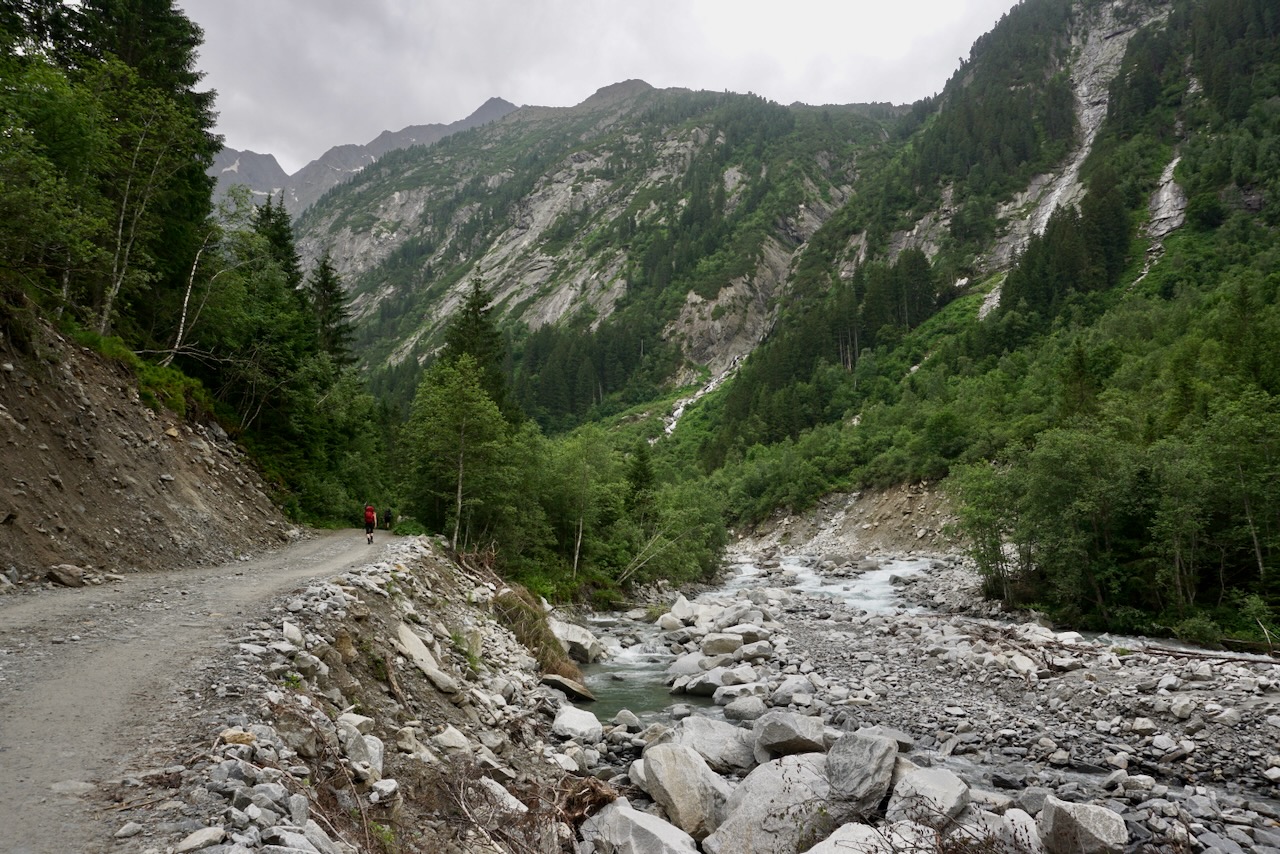
The way led us past rivers and waterfalls . . .

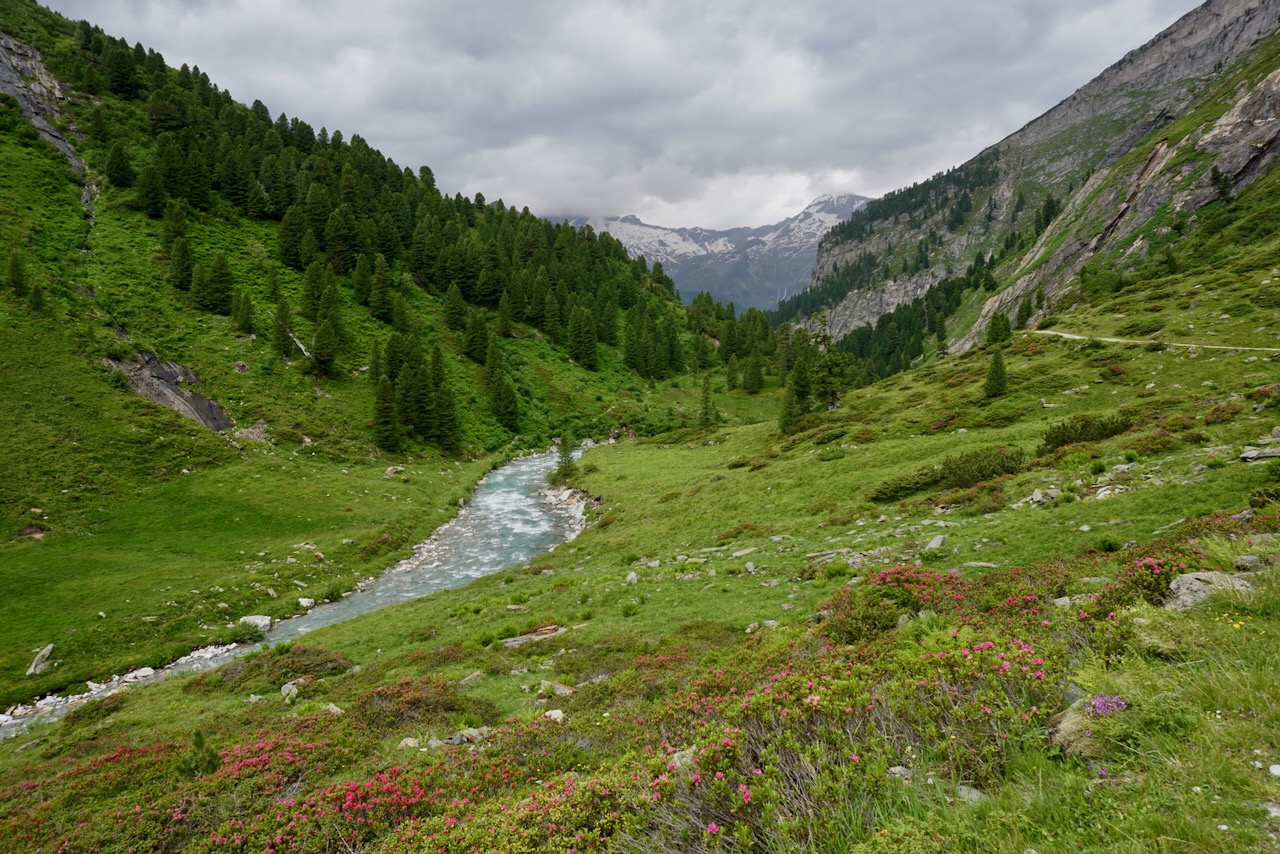
. . . through fields of flowers, including our only wild edelweiss right at the Berliner Hütte . . .

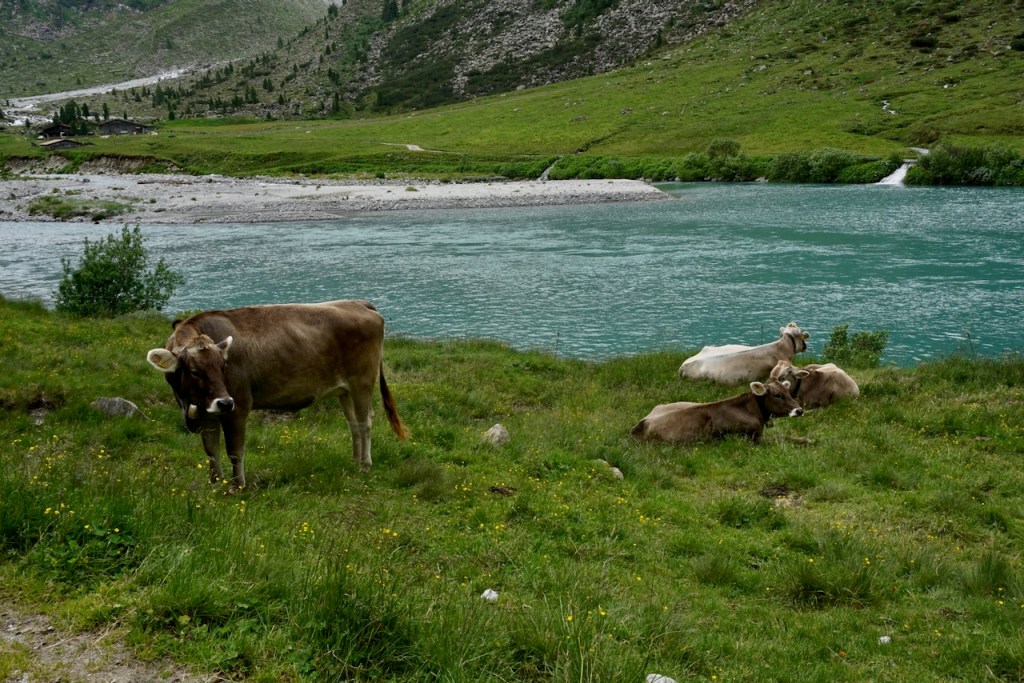
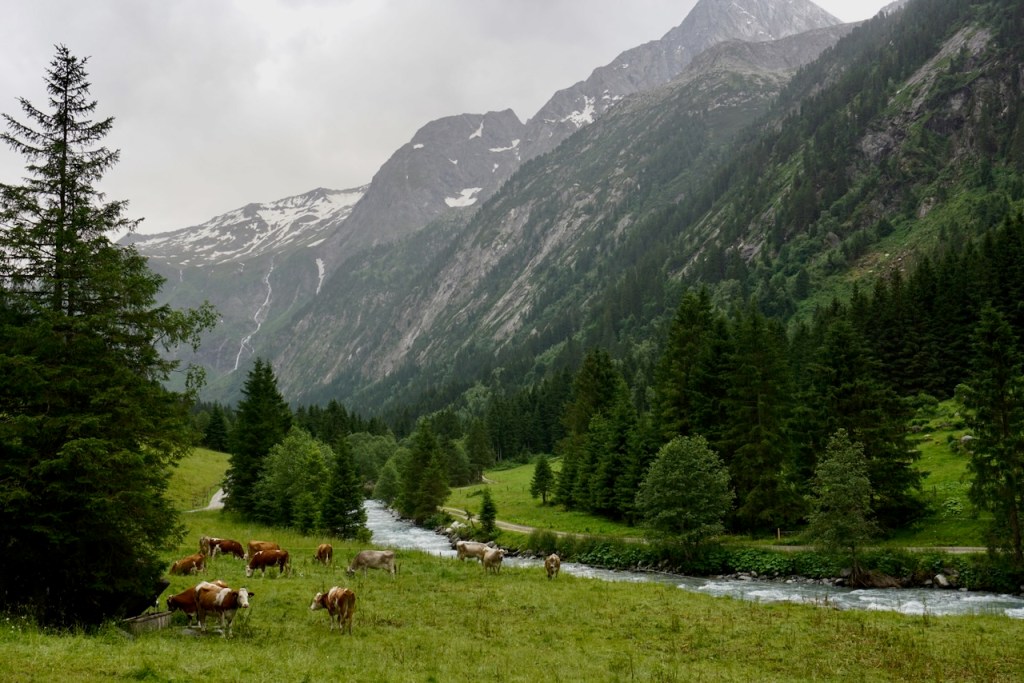
. . . and alongside grazing cattle, whose gently tinkling bells accompanied us long before and after the cattle themselves were in view . . .

We were, of course, surrounded the whole time by mountains . . .

. . . and passed a World War I memorial on the way dedicated to the alpine club members who had died in the war.

This was the first of many memorials that we passed along our route, constant reminders that the mountains are not a playground.

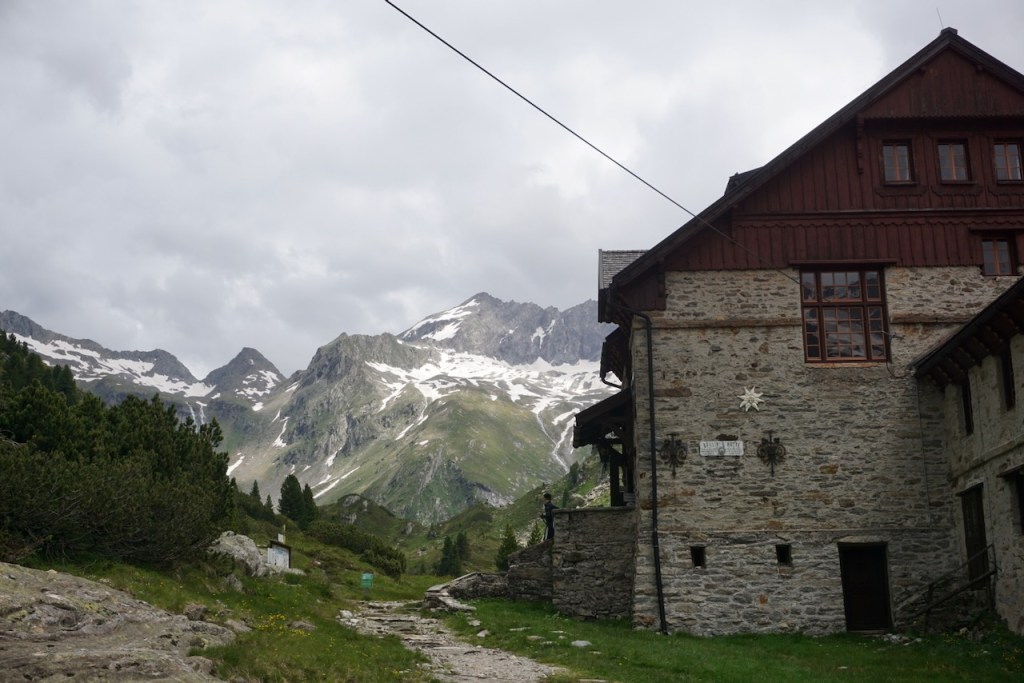
Ready for a celebratory radler, a mixture of beer and lemonade known in the UK as a shandy, and a shot of Zirbe, a liquor made from a type of pine found in the Alps region, we reached the Berliner Hütte at 2,042 meters.

From here we could see where we’d be going next. We turned in early after a hearty dinner and a few rounds of cards; the following day would be a big one.

Day 2: Berliner Hütte – Furtschaglhaus

We woke to rain that came in waves over the course of the day, during which we would ascend 1,060 meters, descend 810 meters, and cover close to 9 kilometers.

For a variety of reasons, the way took us much too long. We were lucky that the original forecast calling for thunderstorms had changed, but the rain that blew in instead was nasty enough, and it was there that I realized I needed a new rain coat.

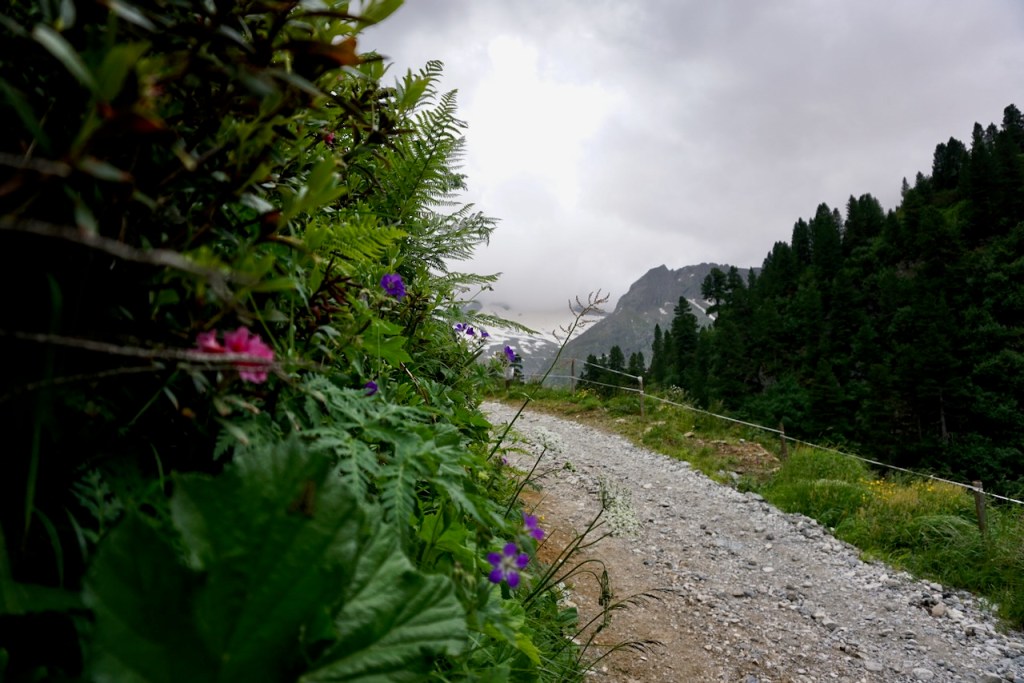
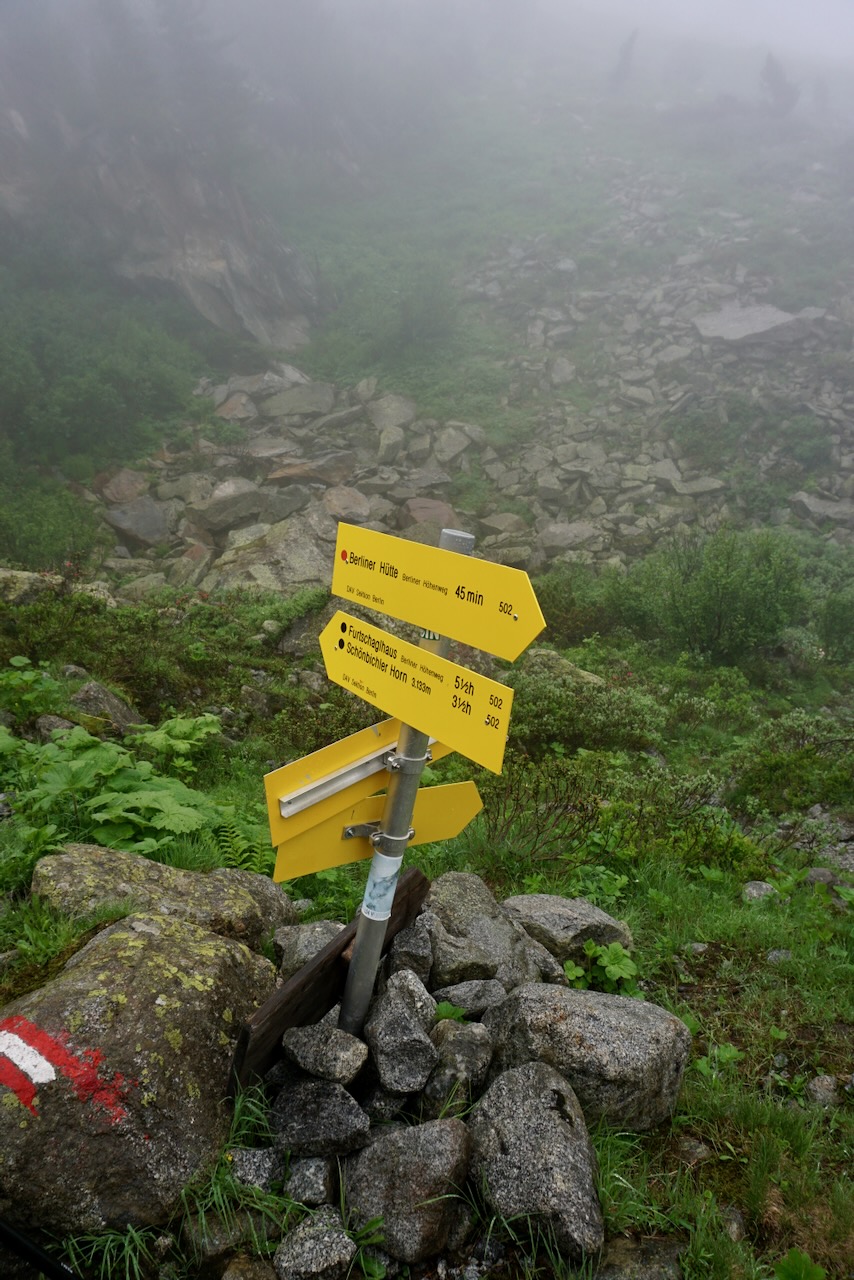
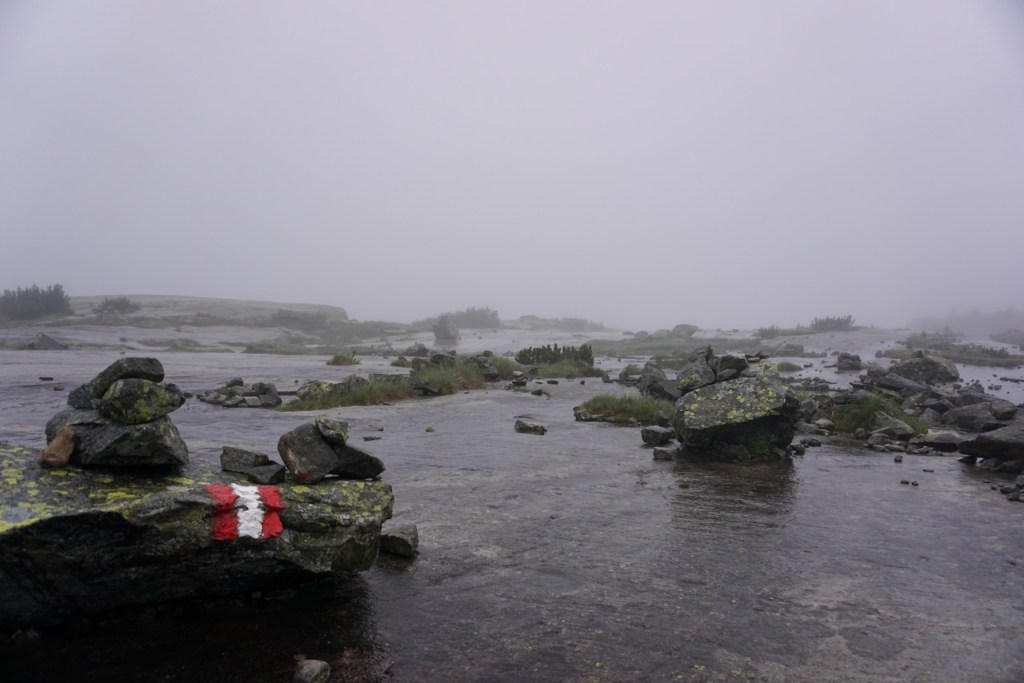
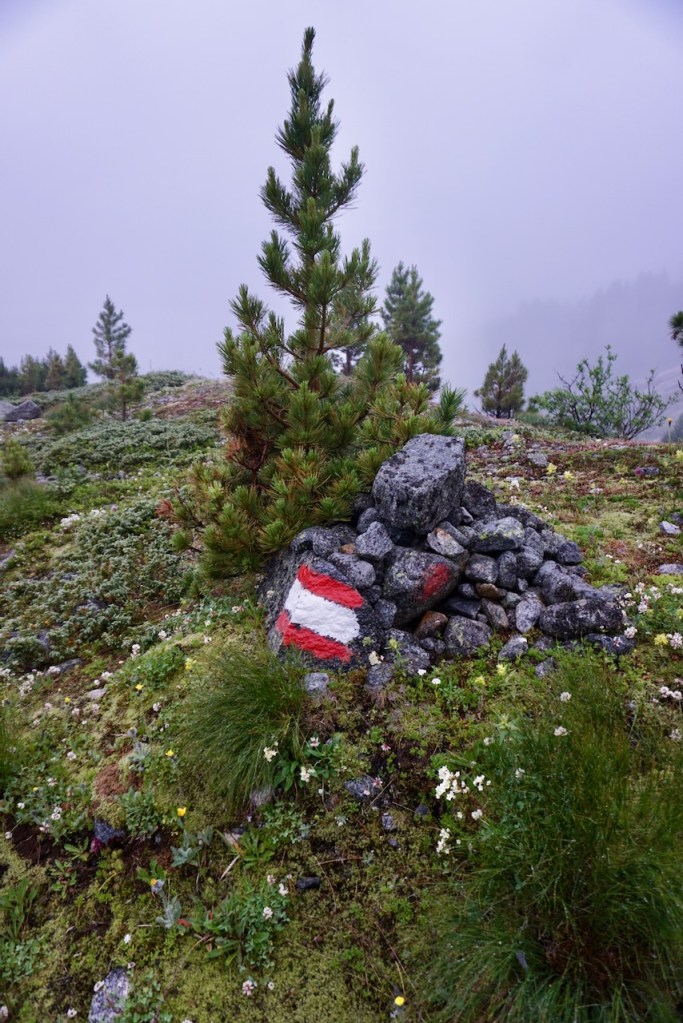
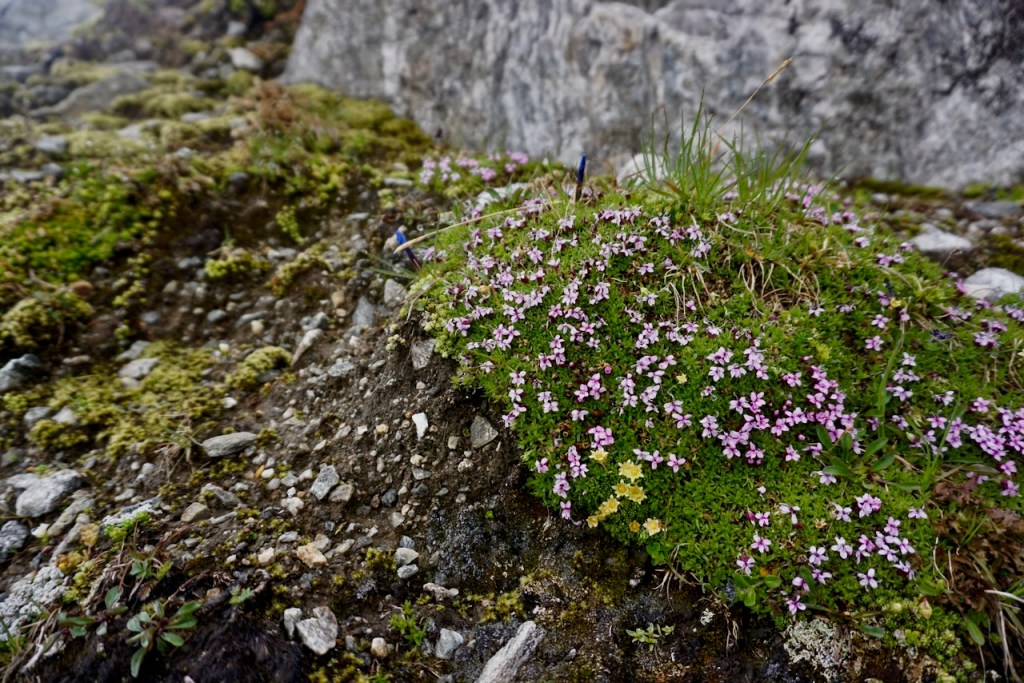
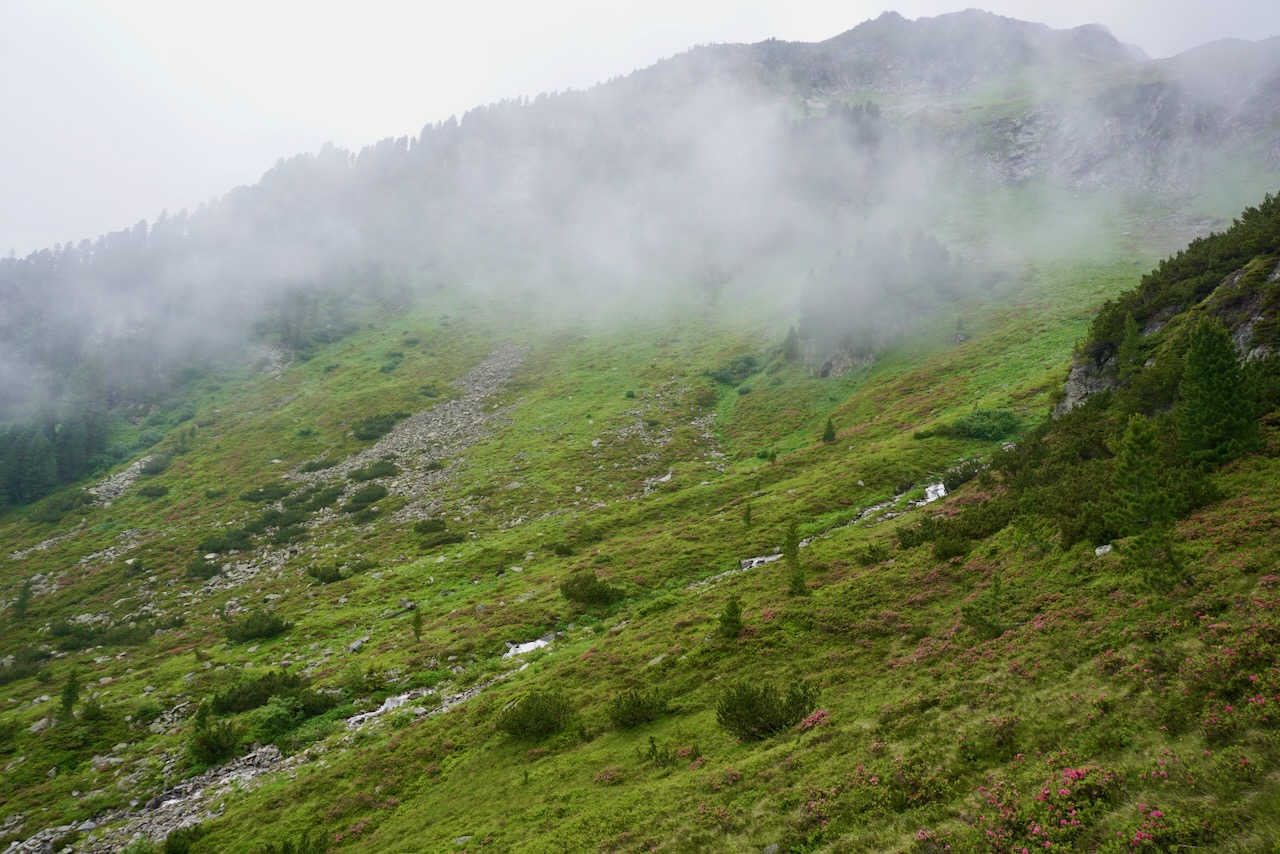
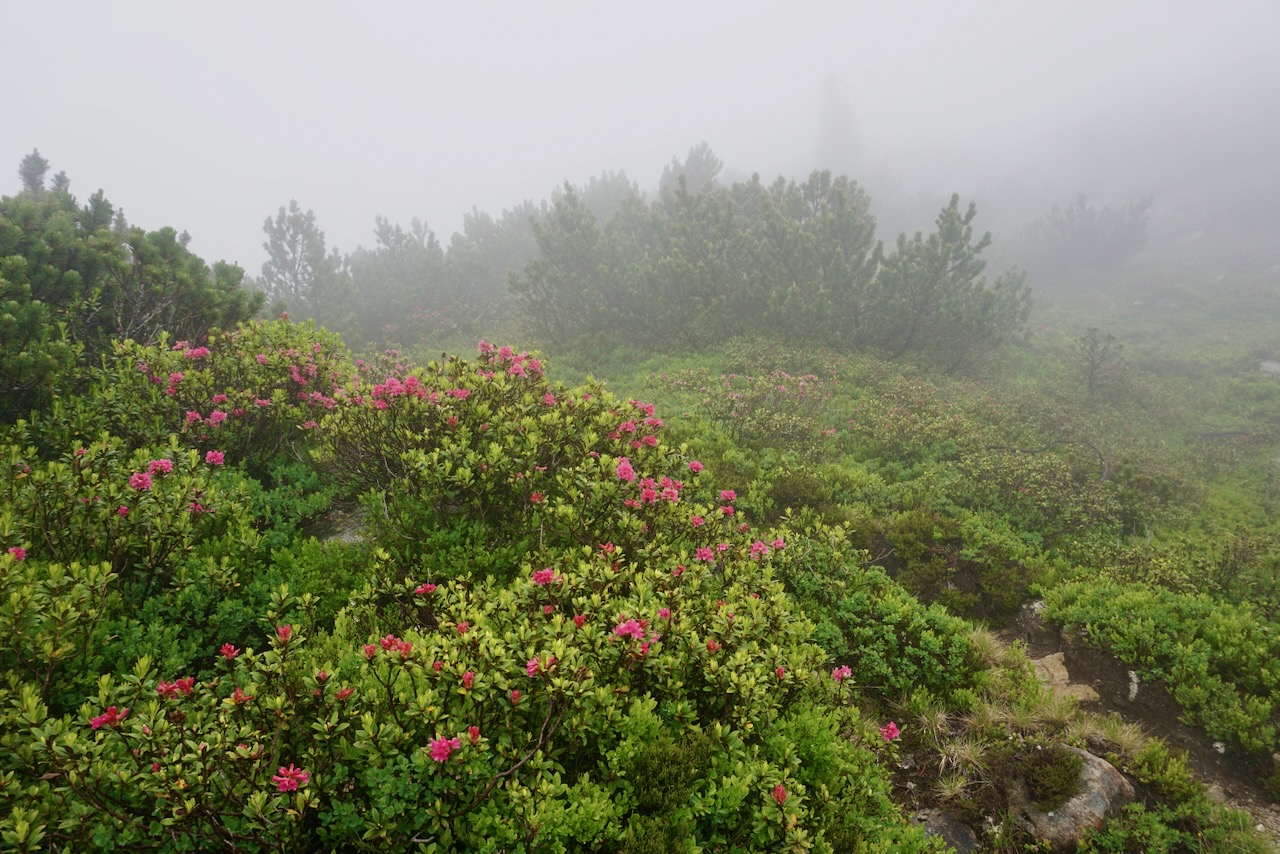
We began following the trail markers over sheets of rock that gave way to a trail that wound through scrubby trees and bushes marking the end of the tree line. The tiny alpine flowers provided pops of colour through the fog.

It wasn’t long before we needed to cross a river, one that is not always as high as it was when we were there. We looked for the most accessible points in the direction of the bridge that we very much needed.
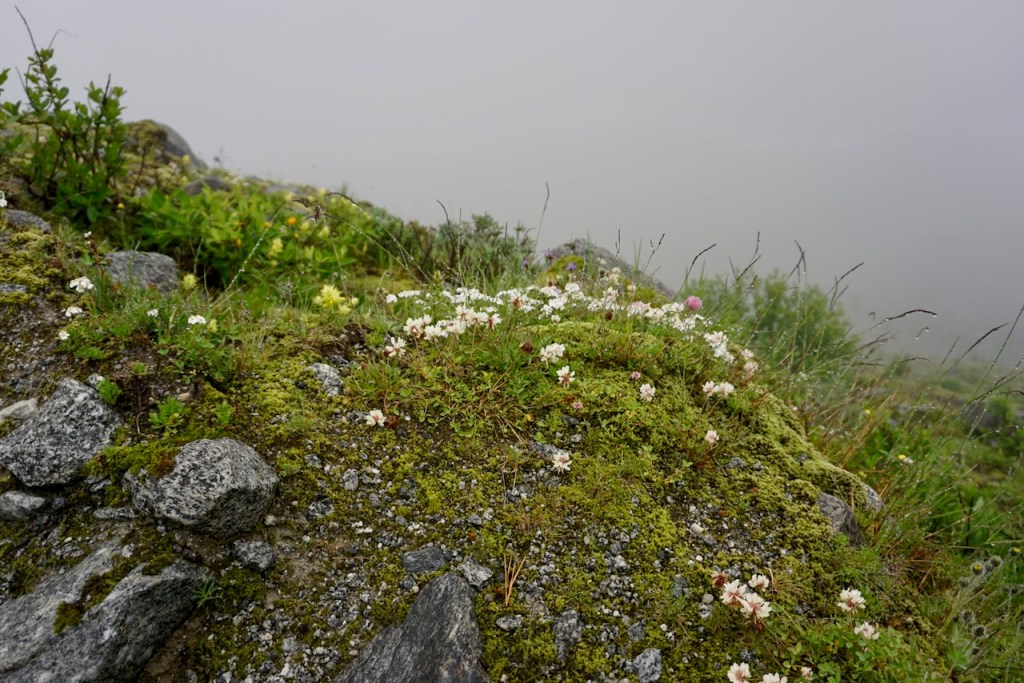
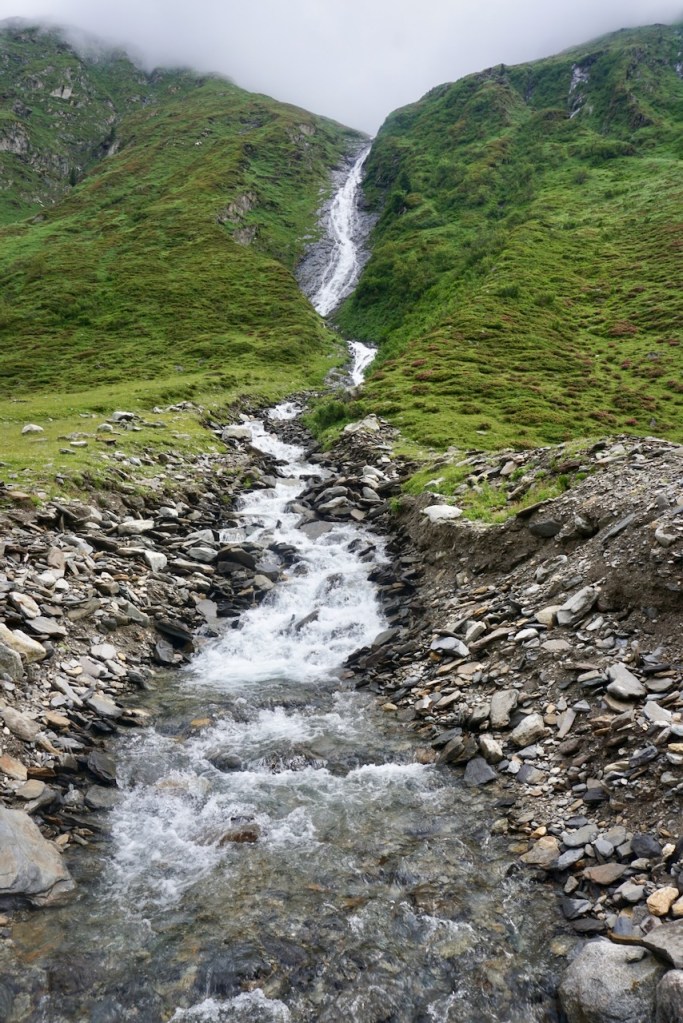
Shortly thereafter, the rain cleared and we were greeted first by waterfalls, mystical as the clouds pulled away to reveal mountains . . .

. . . and then by goats sharing our path.

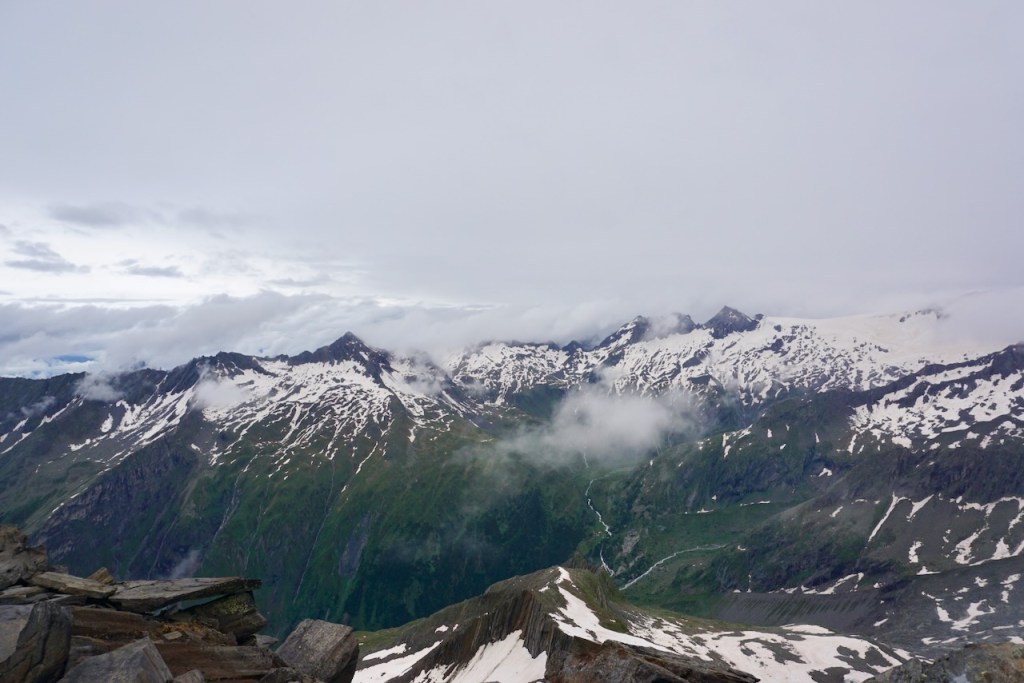
The mountains grew even more imposing . . .

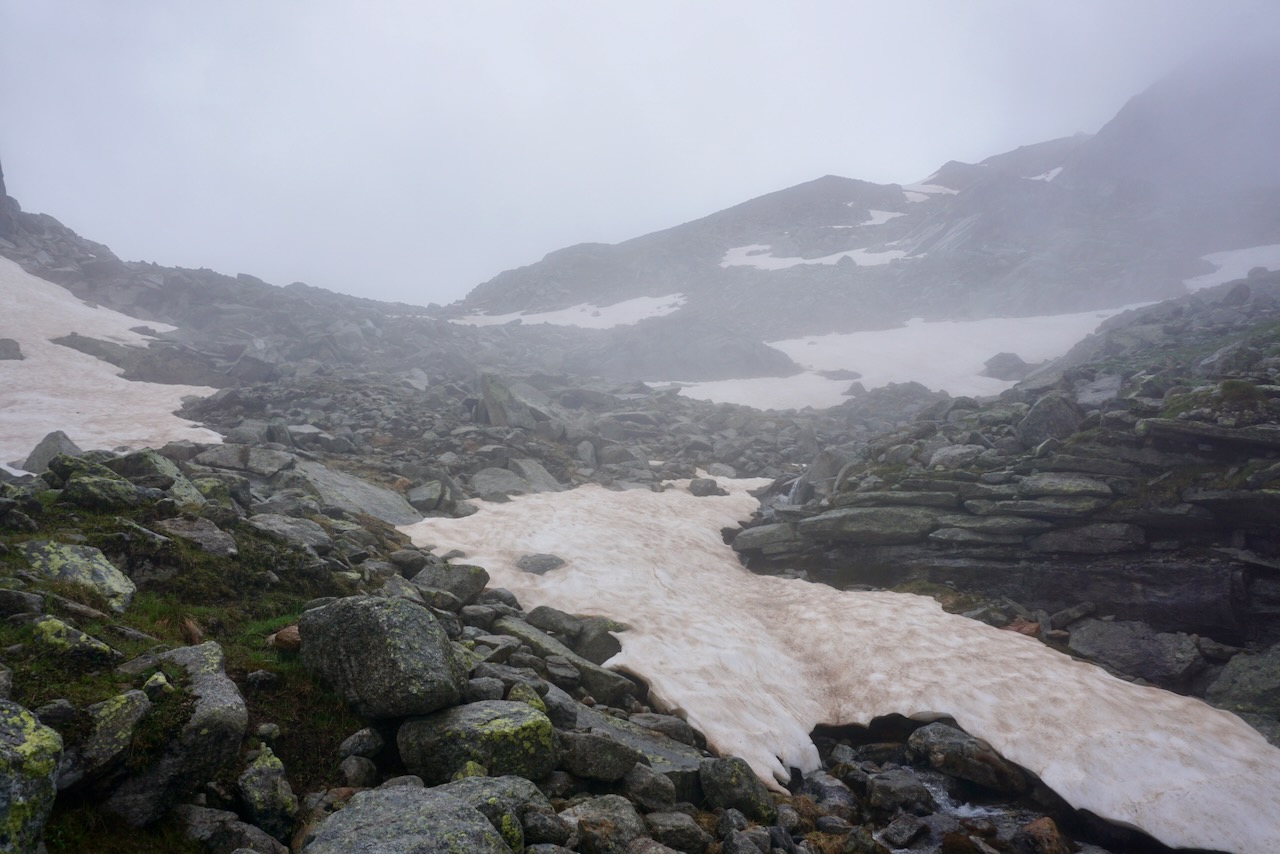
. . . and we soon encountered the conditions that would be with us for the coming hours. We continued over rocks and boulders as the clouds came and went . . .

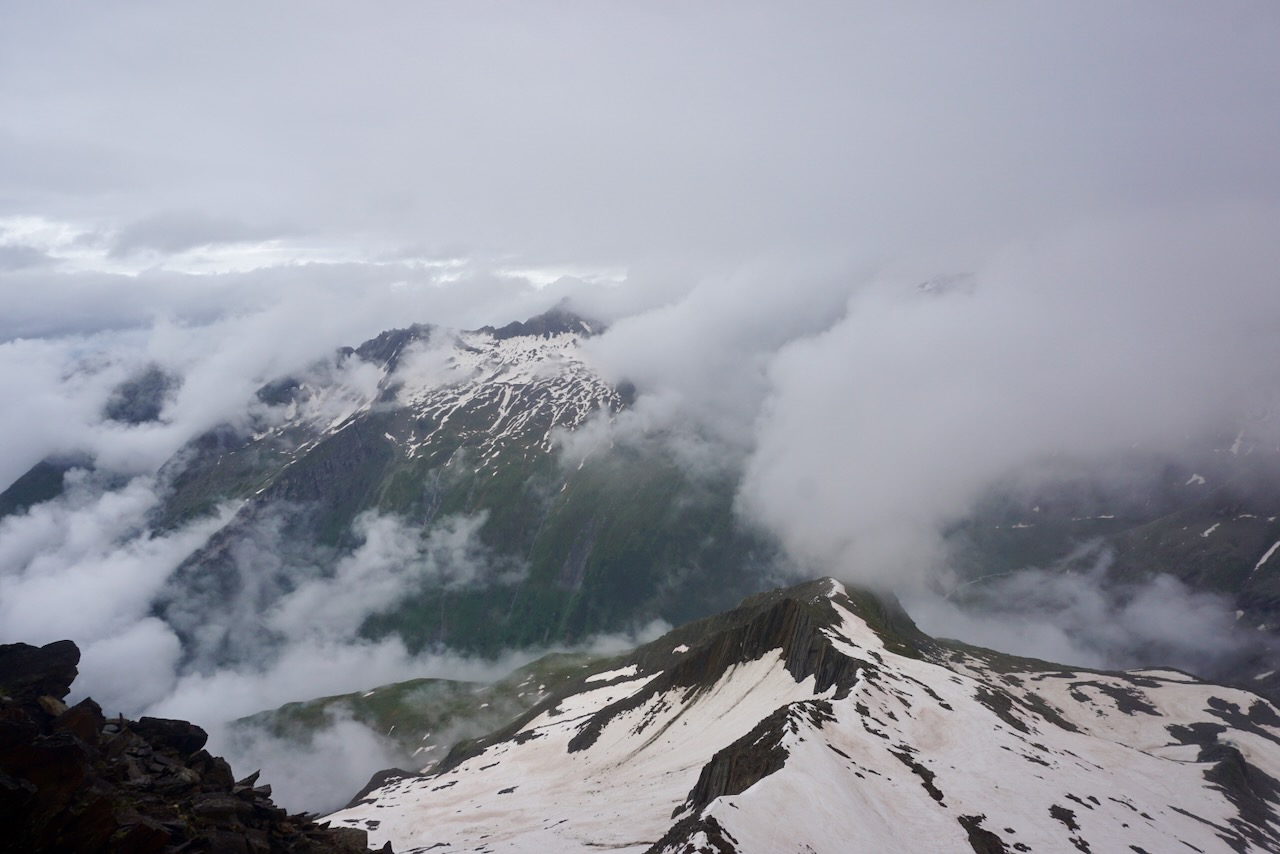
. . . and reached the first of the patches of snow that we would cross, all of which were larger and deeper than usual at this time of year. As we continued and the conditions became more technically challenging, crampons and trekking poles would prove their worth many times over. The winter child in me was delighted.

It started to rain again when we exited the largest of the snow fields so far and began the scramble in the direction of our planned summit. Unable to see or feel my fingers as I scrambled alone over jagged and unpredictable rock, voices of my friends somewhere below me, I had a moment of panic unlike anything I’d experienced before. It was neither graceful nor collected, but I continued to move until I reached a point where I didn’t know how to go further. A friend reached me and, feeling immediately better for not being alone, we pressed on together. This experience stayed with me for the rest of our trip and I handled myself much better on a different mountain later on (stay tuned!). There is a first time for everything and I know why I got scared. I also know why, in retrospect, I didn’t need to be. The key, at least for me, is working with the mountain rather than fighting against it. And this is something I had to learn.

The rain was kind enough to stop for a while as we reached the summit of Schönbichler Horn at 3,133 meters. Exhausted from the efforts of the previous hours, which had us well behind schedule but clearly past the threat of thunderstorms, we did not linger long, aware of how much farther we had to go.

We would find ourselves in snow multiple times over the next several hours, using crampons only when absolutely required in an effort to save time. We were cold and tired, the rain became relentless, and the difficulties within the group became more apparent.

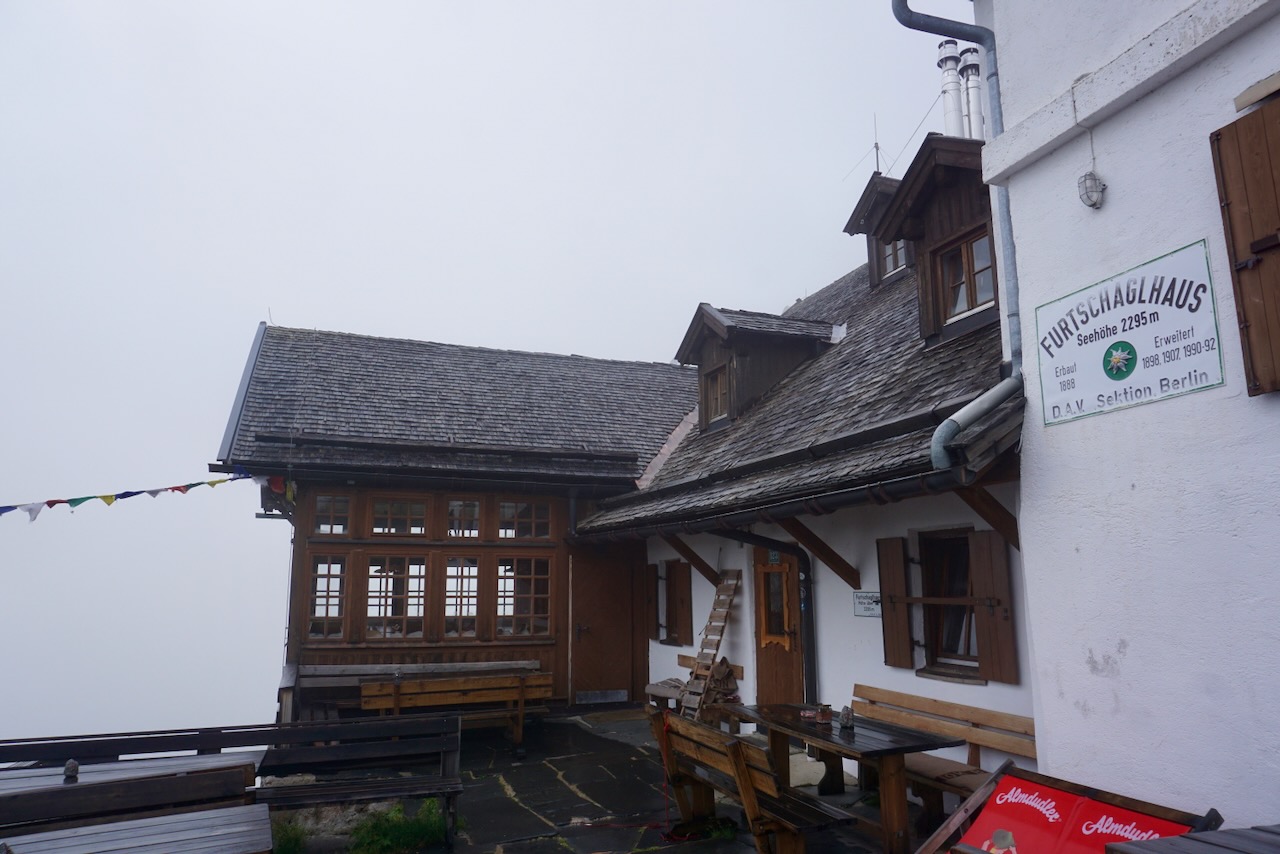
Descending to Furtschaglhaus at 2,295 meters took much longer than it should have and I have never been more grateful for a hot shower. Those three glorious minutes were our longest shower of the trip and worth every cent.

Day 3: Furtschaglhaus to Olpererhütte

In comparison to the previous day, our path to the Olpererhütte was far less physically demanding. At over 10.5 kilometers, this was our longest day yet, but with only a 510 meter descent and 610 meter ascent. The five flat kilometers in the middle of the route followed the Schlegeis Reservoir, and we were looking forward to a little break.

Although we hadn’t had the energy to notice, the landscape had changed during our descent the day before. We were out of fields of snow and jagged stone and back to grass, gentle rocks, flowers, and waterfalls.

As when we first began, we passed grazing cattle as we made our way down to the Schlegeis Reservoir.

The route is beloved for day hikes as well as being part of the Berliner Höhenweg, and I can understand why. The bright flowers and the reservoir in bright blue with the mountains all around are rather photogenic.

However, the change of landscape came in stark contrast to the challenging solitude of being deep in the mountains. After some time on a gravel path with a heavy backpack, passing day hikers in sneakers and sandals, I was looking forward to being back “up there” with people who understood what we were doing and why we were doing it.

The ascent to the Olpererhütte, while full of pretty views . . .

. . . comprised of a clear path that zig-zagged along the side of the mountain. There was no way-finding using markers, no need to stop and think before putting one foot in front of the other. And because of its straightforwardness, it was busy and crowded. While not a path that I’d recommend doing in sandals, there were plenty of hikers doing just that. Choosing strategic points to get by them was about as challenging as it got, and we reached the Olpererhütte rather uninspired.

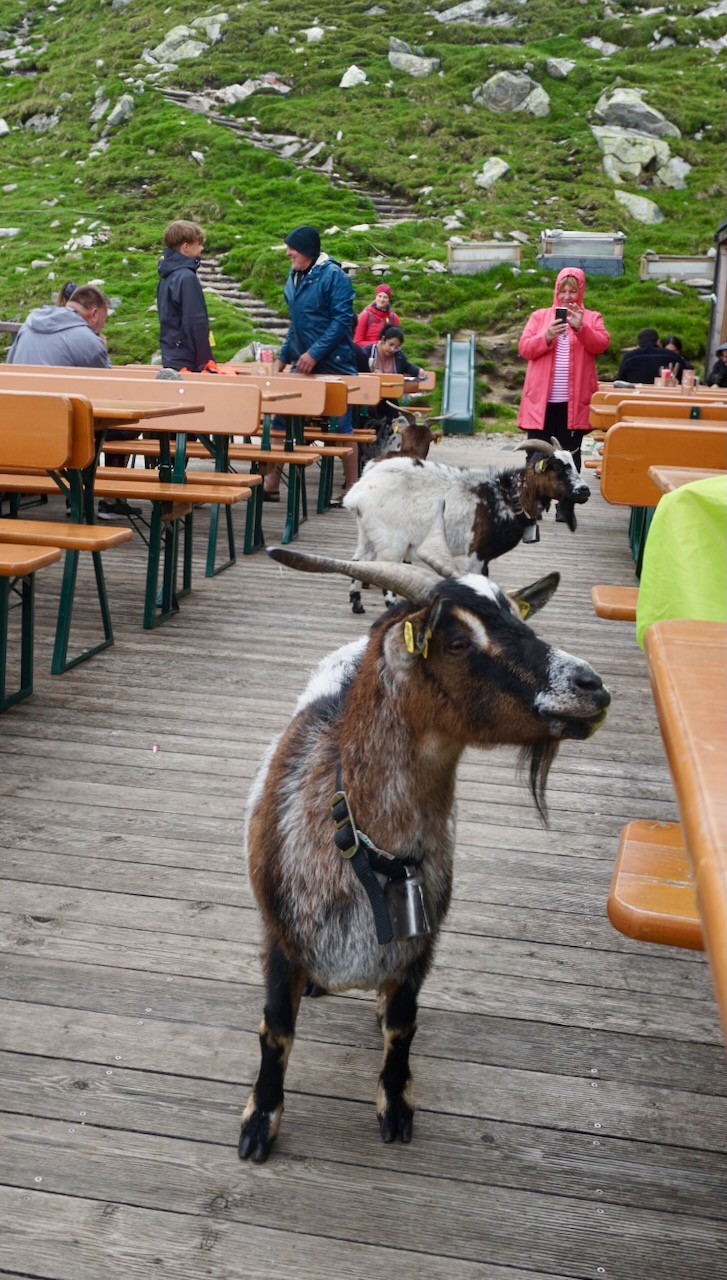
But being greeted by the resident animals was charming and it was comfortable to sit outside bundled up after the steep walk up to 2,389 meters.

The atmosphere of the hut changed after the day hikers left and the rest of us settled down to dinner, drinks, and cards. Feeling refreshed after our easy day, we spent our last night in the mountains in laughter.

Day 4: Olpererhütte to Breitlahner

We had planned our route so that we could walk back down to where we’d parked without the need for buses or trains. At slightly over 10.5 kilometers, this meant a 270 meter ascent and then a huge descent of 1,390 meters. Once again, we were very grateful for the trekking poles. We would pass another hut, Friesenberghaus, on the way.

The day started scrambling over boulders and small snow fields, aspects of a Hochtour to which we had become accustomed and that I really enjoyed. There’s an element of playfulness amidst the need to be sure-footed and deliberate.

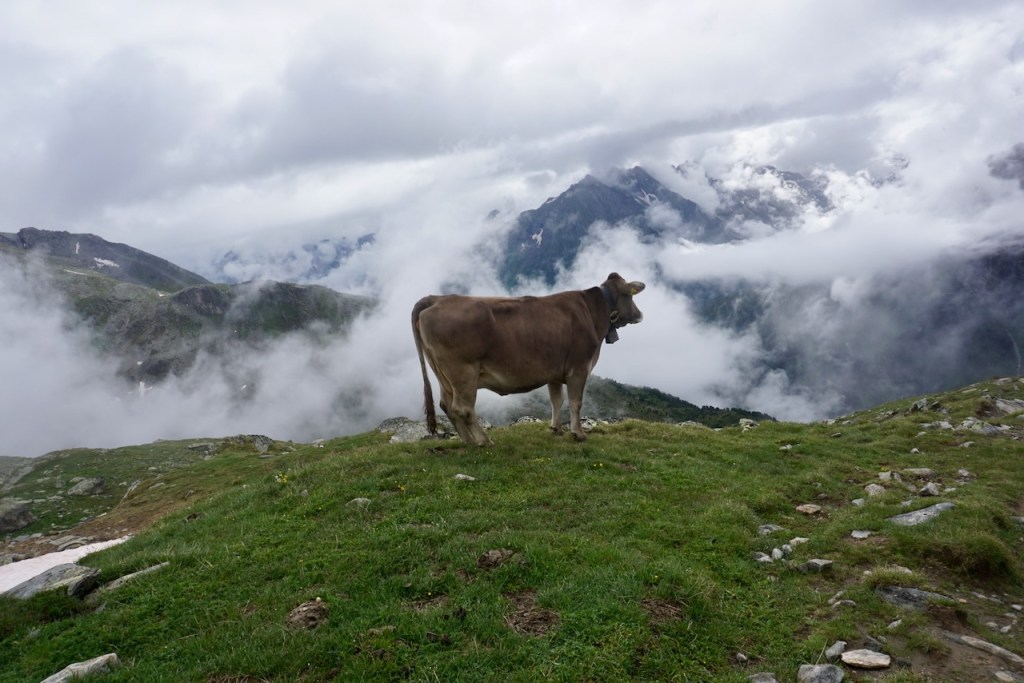
As usual, we were greeted by cows. This time, though, they seemed to enjoy the sweeping vistas as much as we did. Perhaps it is not only humans who feel tiny and inconsequential when finding themselves in so much mighty, majestic nature.

After a round of steep snow fields, the landscape began to change yet again and alpine flowers appeared.

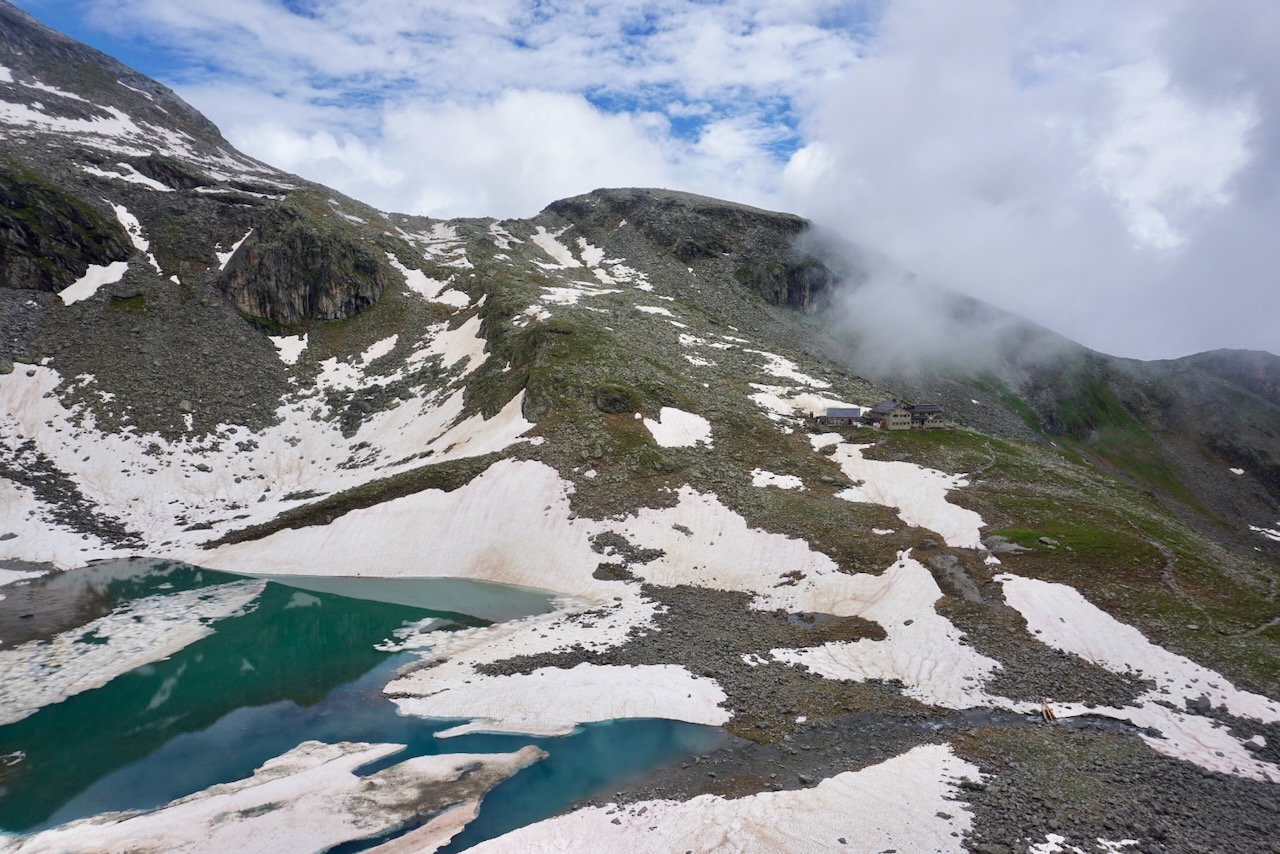
We saw Friesenberghaus before we reached it, picking our way down through particularly steep sections of snow, several of which had us first ascending, which was rather easier.

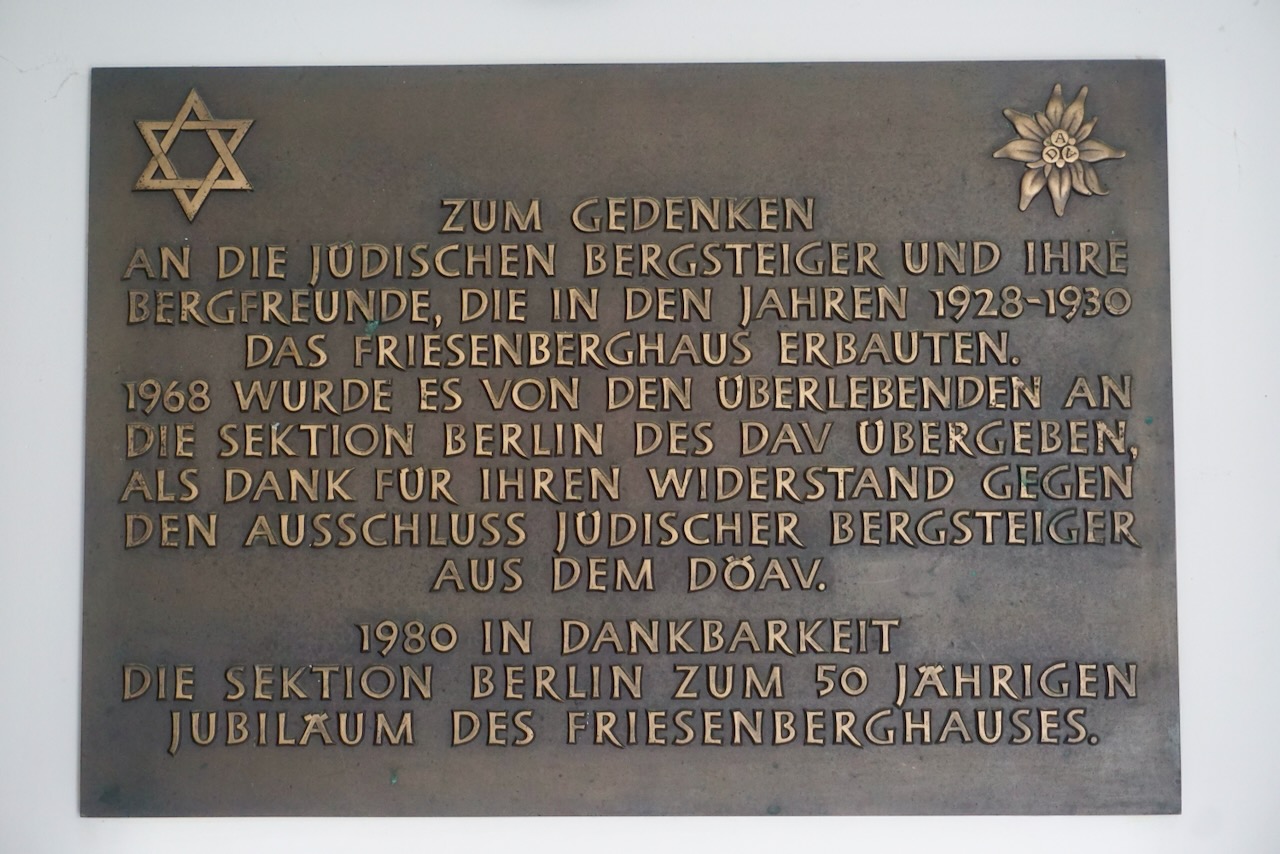
We stopped for a bowl of soup to get out of the rain that had picked up. It was interesting to note the bit of history on the wall, thanking the members of the Berlin section of the alpine club for their resistance against the exclusion of Jewish members from the German and Austrian alpine clubs. There is little place for exclusion in the mountains.

I also appreciated the sense of humour at Frisenberghaus in which a stuffed animal was employed as a weather station.

When Joachim . . .
Dry – Sun
Cries – Rain
White – Snow
Dances – Wind
Invisible – Fog
Hops – Earthquake

Doubles – Alcohol
Speaks – LSD

Checking our watches, we left before the rain stopped. We weren’t the quickest and had a ways to go.

The way continued to grow grassier as it wandered over rocks and streams. Flowers continued to appear and then scrubby bushes and trees. The air grew more humid and the clouds floated upward.

The final descent was long and we knew we were nearly there when our way headed directly through the trees. The mountains were above us again and we were too far from where we’d started to see where we’d been. Our trekking poles showed good signs of wear by now.


We spent one more night together to recover. We cooked a carbohydrate-heavy meal, drank wine, showered for free without looking at the time. We laughed and shared photos and congratulated one another.

We had been in the mountains, had experienced the rhythms of weather, the physical and emotional cycles of a body under strain, the atmosphere of a guesthouse filled with people who love mountaineering. We had been in the mountains, swept away, taken in, and in awe. Mountains are truly the most beautiful place.

And as glad as I was for a real bed in a room shared with only one person, I missed it immediately.

“The mountains are calling and I must go.” -John Muir

Travel Guide: Arizona Road Trip (and a Moment in Nevada)

We’d been in Arizona since early afternoon, had seen sights, eaten at a diner where we heard a local band, and were getting ready to call it a day when we realized that we’d crossed, hours earlier, into a different time zone.

Source: https://en.wikipedia.org/wiki/File:US-Timezones.svg#/media/File:US-Timezones.svg

The shaded parts of Arizona and Nevada on the above map do not observe Daylight Saving Time, remaining instead on Mountain time. This means that Arizona follows Pacific time in the summer. The parts of Arizona that are not shaded are Navajo territory, where they do observe Daylight Saving Time. (Thanks to Wikipedia for helping us out once we noticed that our phones and my wristwatch were keeping different time. Figuring out how to change the time on the GPS took us another day.)

Our drive from southeastern Utah took us through Kaibab National Forest where we saw the effects of forest fire, sometimes stopped only by the road itself. We didn’t know when the fires were, or how many there had been. There were patches where tree trunks were fully blackened, leaves burned away, and patches where black tree trunks were topped with fresh green leaves. We had already seen warnings of fire risk in each of the national parks we visited, and this theme only became more prominent as we drove deeper into the desert.

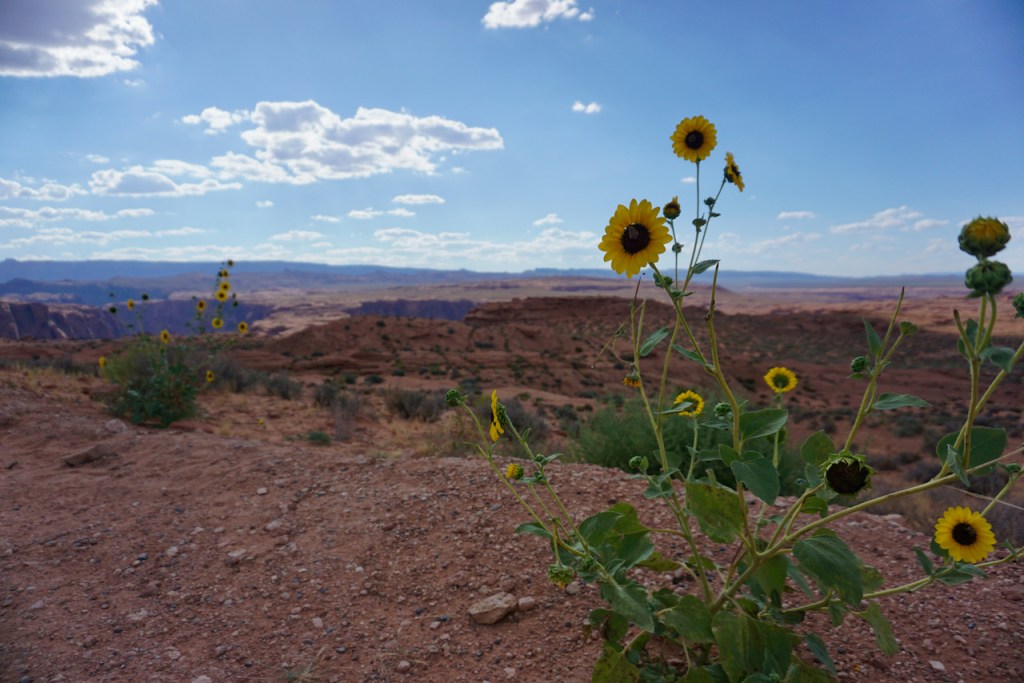
What is desert? Desert is yellow sand, red and purple rock, vast blue sky, and the straightest roads I’ve ever seen. Roads that stretched beyond the horizon, already impossibly far away, and further than that. The lazy tumbleweeds of the movies actually exist, as do dust devils that you can see in the air long before you reach them, assuming a sudden shift in atmosphere doesn’t blown them away by then. We spent many hours driving through a desert of nowhere, of now here.

It was extraordinary to watch the flatness of this scrubby landscape, populated with yellow grasses and green shrubs, suddenly sprout canyon walls and huge red mesas that stayed with us along the road.

Several times a day, as we passed sign of human activity ranging from clusters of trailers to tiny towns built along the oases created by rivers, my partner commented, “You’re on a journey looking for a new place to live, and you stop here and you look around and you say, ‘Yep, looks great. We’ll stay.’ There’s nothing here. How do people live here?” My contributing comment in response: “And why do they still live here?”

Knowing what I know about the history of American treatment of Native people, it’s entirely plausible that living here was never a choice. And that means it’s also possible that the people who have stayed are here for reasons beyond eking out an income. The reasons the Navajo consider this land holy ground were all around us.

We stopped at Horseshoe Bend in the late afternoon, just outside of Page, Arizona, where we would spend the night. We looked down at the mighty Colorado River, which we had encountered multiple times on our journey, and we watched the clouds move and the sky change.

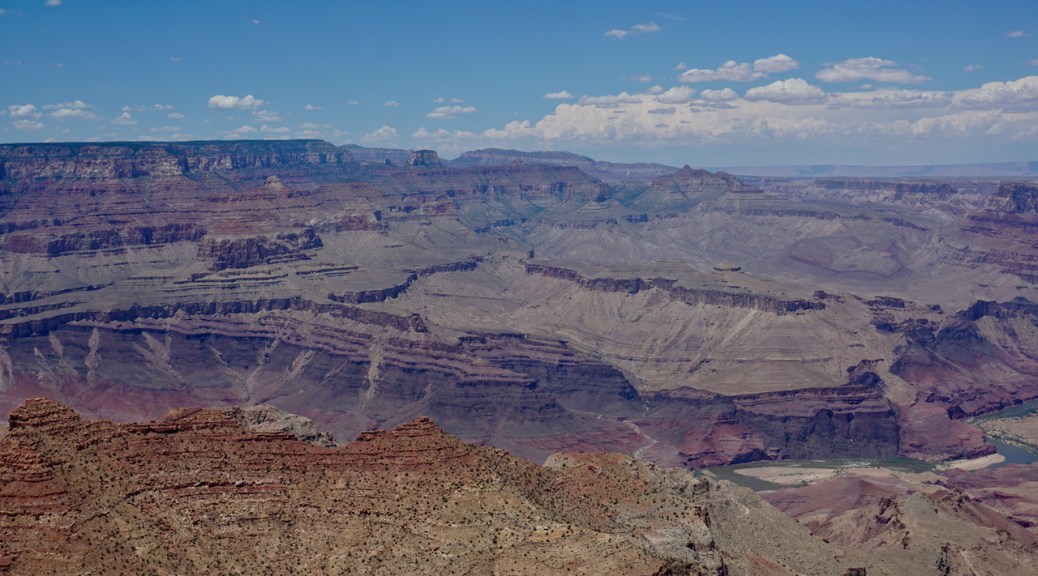
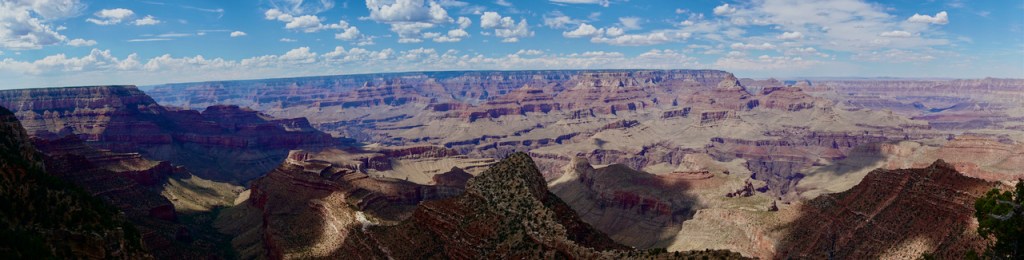
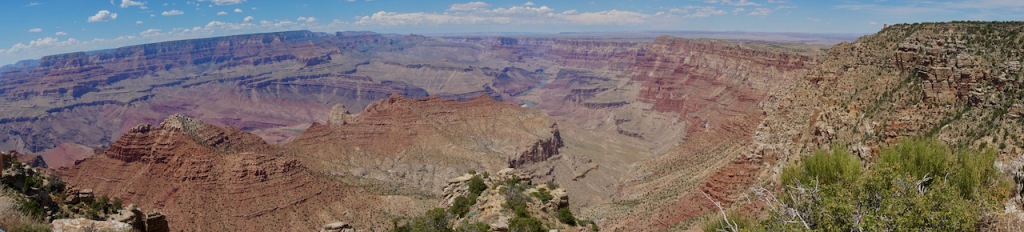
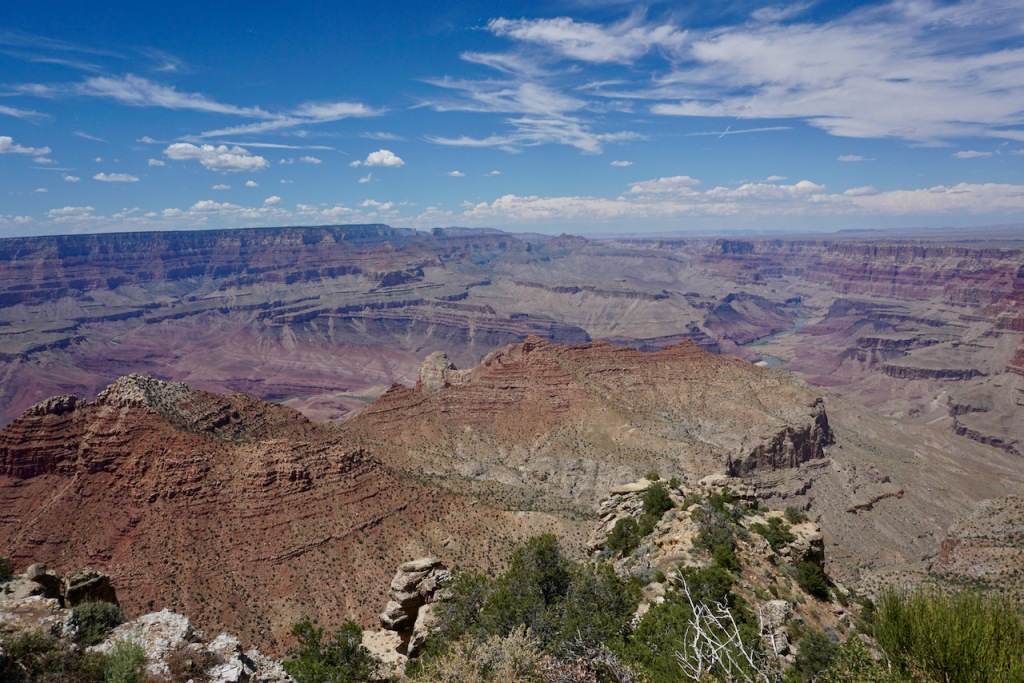
Although there is a great deal of beauty around Page, we didn’t linger. Instead, we drove in the direction of the Grand Canyon, which is indeed a sight to behold. It is so massive, so huge, and stretches to somewhere very far away. It is unfathomably deep, cavernous, and abutted by mountains in one direction and forest in the other. At lookout after lookout, we exclaimed over the scale, the vastness, and the majesty of sand, wind, water, and time, this wonder called nature.

After a while I stopped taking photos and just looked. There was really nothing to say, no words that could capture the privilege of being there.

Late in the afternoon, following our trip motto of, “Always take the scenic route,” we turned off the main highway to follow:

On Route 66 we found the town of Seligman, with preserved shades of former glory and local people used to welcoming tourists. My partner’s dream of being called “sweetheart” by a diner server was fulfilled, I finally had a veggie burger, and the man in the kitsch/second-hand/antique store gave us markers to sign the wall, like many hundreds of travellers before us. Liebe Grüße aus Weimar!

It took us fully by surprise that the diner where we ate was German-themed, the walls full of license plates, stickers, and other memorabilia. In addition to typical diner offerings (refillable coffee, breakfast all day, pie in a glass fridge by the door) bratwurst was on the menu at Westside Lilo’s Cafe. Based on the reactions of people who walked in the doors, we were the only ones who had just stumbled in, but not the only ones who could read the German and English newspaper clippings on the walls.

After a night in Kingman, Arizona, we drove to the other side of the Grand Canyon to experience the skywalk, which I really wanted to do despite having already paid once for access to nature. But, as with Horseshoe Bend, this was the way in. Here was our opportunity, picture-taking prohibition notwithstanding, to be high up on the rock and look down. Also enjoyable was the obligatory bus stop at another lookout where we scrambled up rocks to the highest point. The sheer size of the Grand Canyon was awesome, in the original sense of the word.

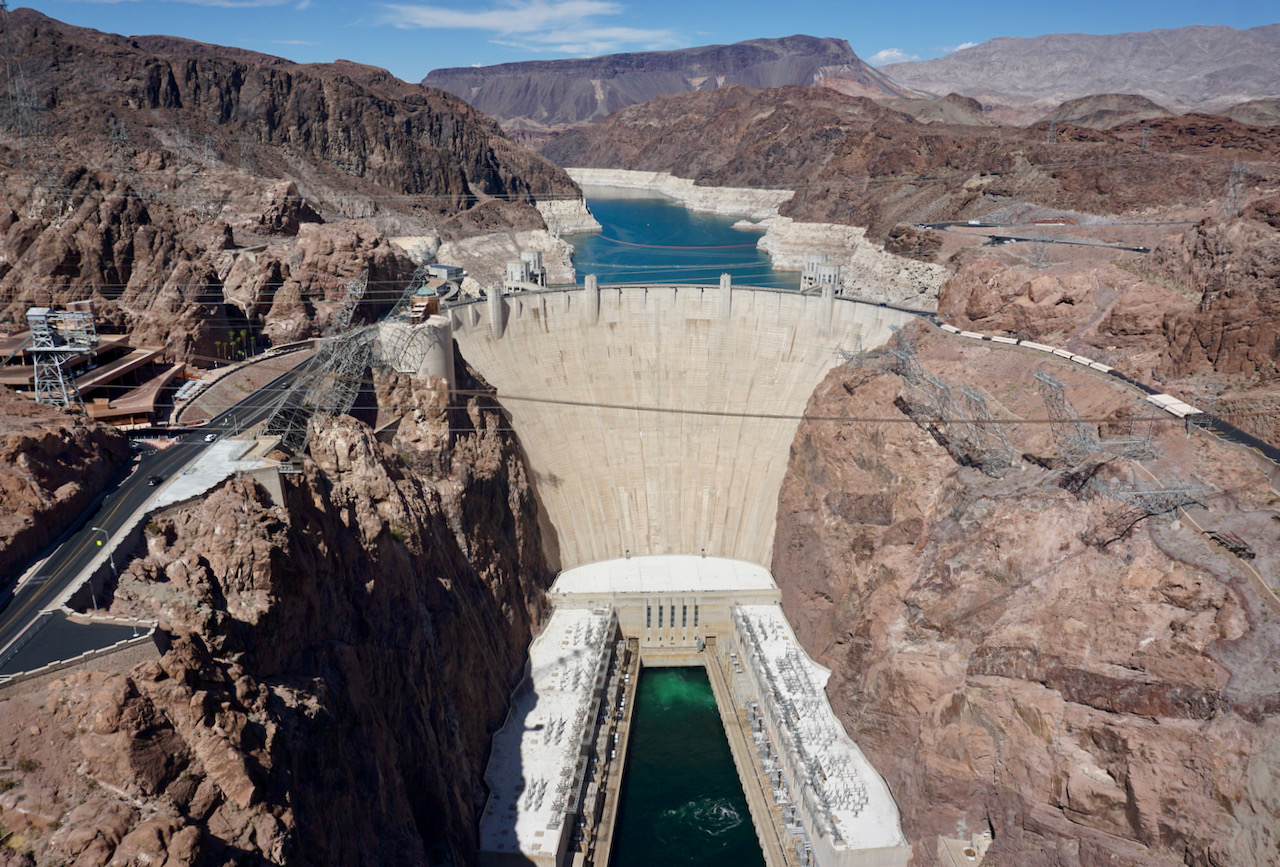
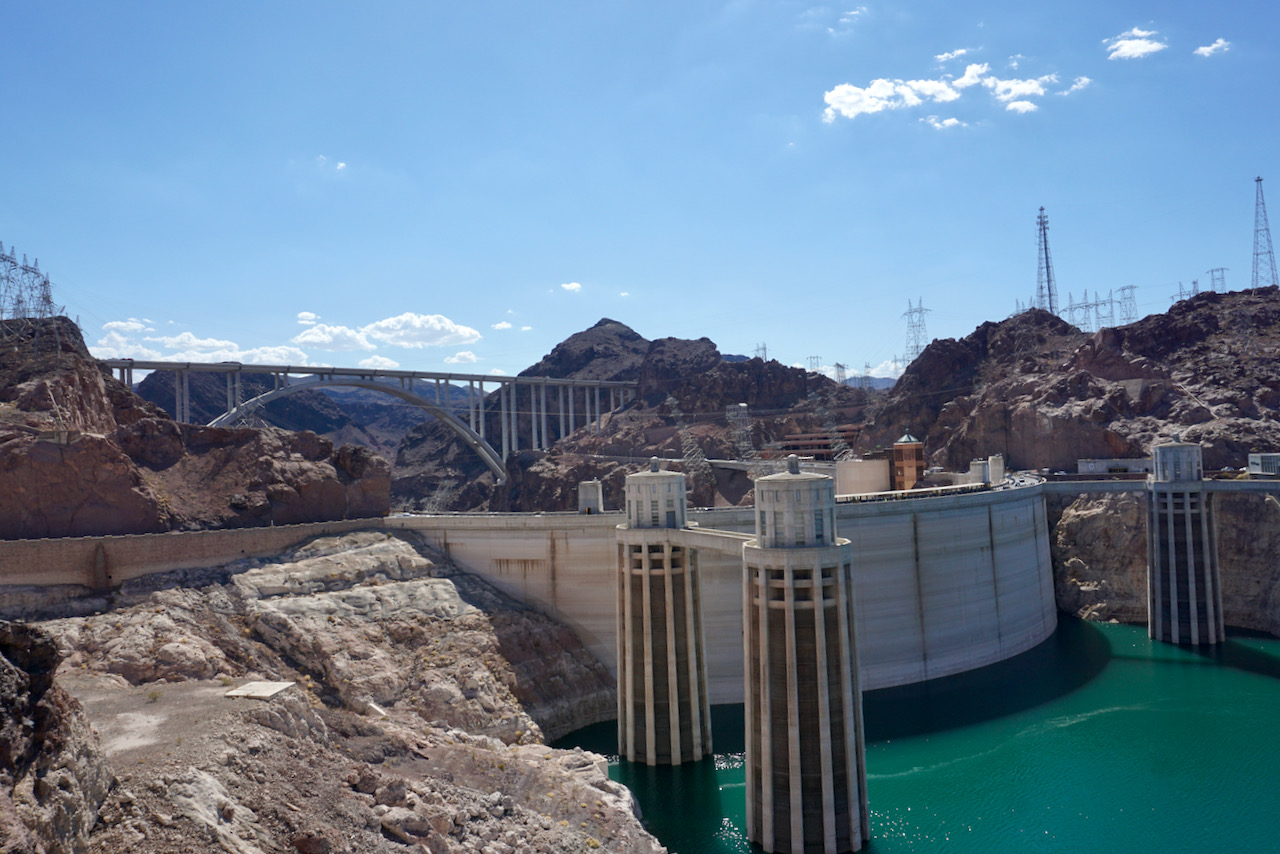
Our next overnight stop was Las Vegas, Nevada, and on the border between Arizona and Nevada, where our car registered 122°F (50°C), we pulled over to walk across the bridge at the Hoover Dam. Not interested in the engineering feat, I was mostly in shock at the heat against the backs of my legs and the fact that my greenstone necklace burned against my skin. No one needs to live in a place that is that hot.

And why people do so is the question we asked ourselves, and later the friend who hosted us in Vegas, as we continued our drive.

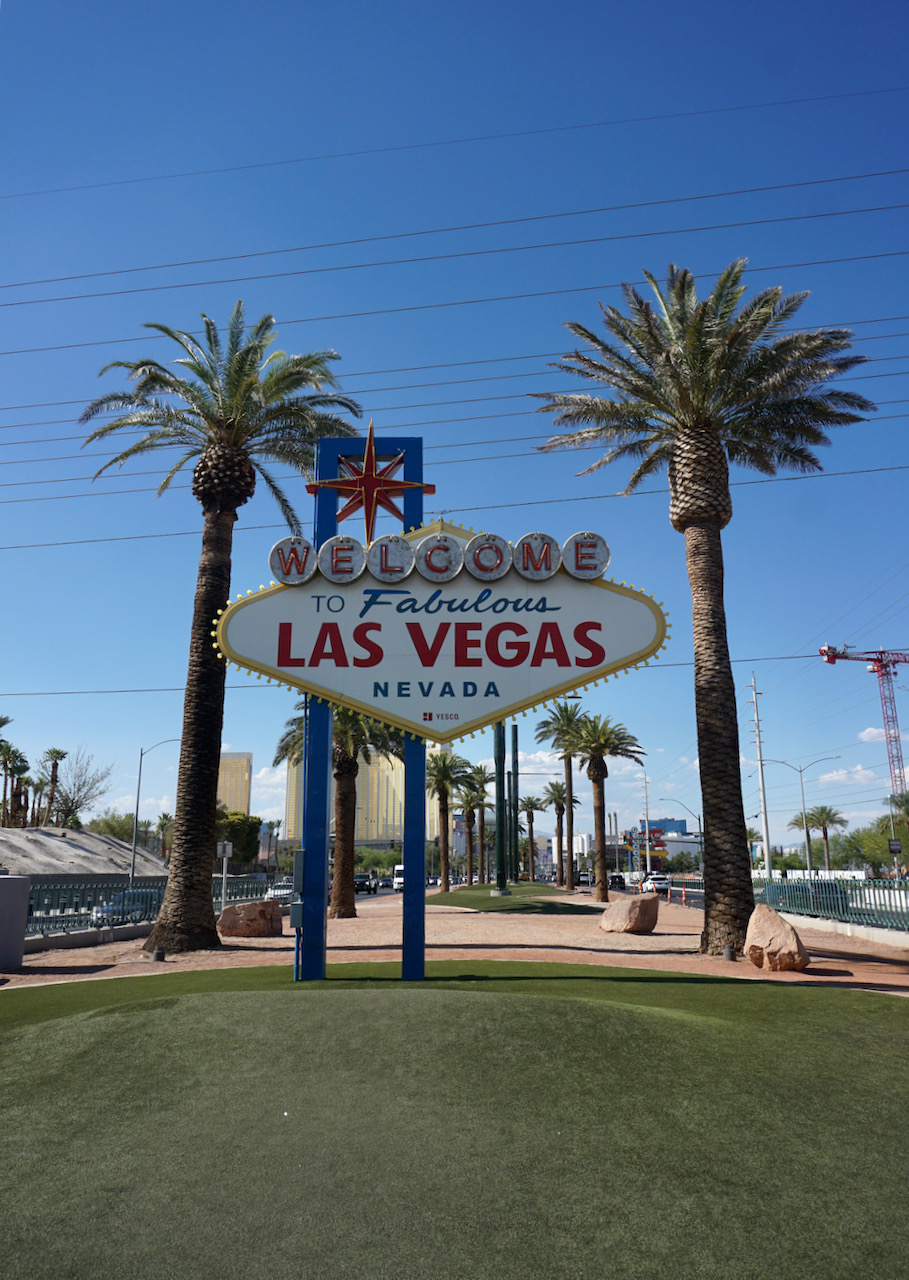
I never had any intention of visiting Vegas, but there we were, and having a local tour guide was a lovely experience. We visited the Strip in the afternoon to gawk at the buildings and the people, and returned at night to see the lights and a show, continue gawking at buildings and people, lose a gambling budget of $50 in under two minutes, and take a drive to the “old Vegas” of Freemont Street, glitzy yet cozy under even more lights.

There was so much to look at and it was impossible to stop looking. I’ve lived in big cities and have plenty of experience with glitz, glam, and mazes of shopping malls. After a week of the relative solitude of the desert and intense contact with nature, however, we found the scope and scale of it all a little stressful and overwhelming. I was glad to get back on the road and looking forward to the final part of our trip – California. Coming soon!