Tag Archives: Travel

There and Back Again

Well, I did it.

I left my home and family and friends and got on a plane that took me back to Malaysia. The biggest challenge in returning is leaving people who love and care about me. I’m not saying I don’t have friends here; I do, and they’re amazing people who I trust, love, and have enriched my life in countless ways. But, to use a cliché as I did in my last post, there’s no place like home.

Readjusting to the routine that I have in Malaysia is probably going to take about a week. When I got back from Spain in January, I called my dad crying at 2am when I couldn’t sleep because of jet lag, depression at having returned at all, and a deep sense of loss. My dad told me that I was not, under any circumstances, allowed to make any important decisions for a week. He told me that it’s completely normal to feel sad and out of sorts after a vacation and that exhaustion didn’t help. He told me to get myself through the week by focusing on school, working out, and spending as much time with others as possible. (I don’t do well alone; I ruminate on everything and talk myself in circles.)

My dad was right. By the time the weekend rolled around, I was back into the groove of daily life, over my jet lag, and feeling much better. So I decided to keep at it in Malaysia rather than book a flight home, which is what I wanted to do when I called at 2am.

This time, I managed to make it until 6:00 this morning before getting in touch with my parents. I’d already been awake for over an hour when I finally gave up and gave in to what I knew would make me feel better. Hearing the voices of loved ones generally has an uplifting effect on me. This morning, however, I was simultaneously comforted that it’s so easy to keep in touch with home, and also sad because I had a fresh reminder of everything I was missing. As I knew it would, though, the brief talk cheered me up and gave me the strength to start my day. Even though I felt alone, I wasn’t. Home is simply a phone call away, and I needed to make that phone call to remember that.

The next few months are going to be my last in Malaysia. I don’t know what’s coming next, but I will make the most of my remaining time here. I made the decision to move here and to return (twice!) and it would be a shame to waste the opportunity I asked for.

Travel Guide: Hong Kong

Recently, Mitch and I met up with our friend Lucas in Hong Kong. Lucas has been a best friend for years; we met as freshmen in high school, went to college together, and have kept in very close touch since he moved away to California not too long before I moved to Malaysia. Lucas has a very cool job that lets him do things like travel the world. About six months ago, Lucas told us that he was going to be travelling to Hong Kong sometime in November or December. Along the way, that turned into March. The knowledge that one of my best friends was going to be a four-hour plane ride from me acted like a tonic; whenever I considered throwing in the towel and heading home after returning to Malaysia from Spain after Christmas, I remembered that Lucas was coming. And then March showed up and the three of us spent a fantastic weekend together exploring Hong Kong.

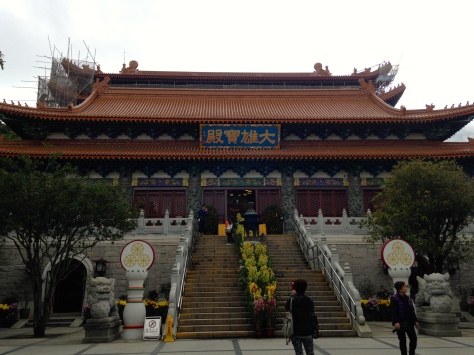
Our first destination was the Po Lin Monastery, located on the island of Lantau. It’s a bit of a trek to get there from where we were staying on Kowloon. Taking public transit took just under 2 hours. It would have been quicker had we been able to take the cable car upon arriving on the island, but it was under repair so we took a bus up windy, twisty roads. That is always a potential recipe for disaster, but we pulled through. Monasteries seem to always be built in beautiful places, and it’s no surprise why. Look around and there’s some sort of breathtaking moment or view or setting that causes one to think of higher powers that could have created such an image.

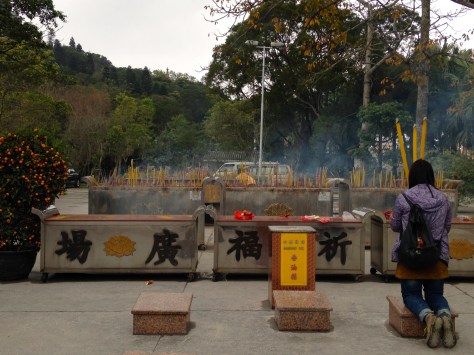
I’ve really enjoyed visiting Buddhist sites around Southeast Asia because they are so different from the types of religious sites to which I am accustomed. I particularly like seeing worshippers, also because their religious practices are unfamiliar to me. As a social studies teacher, I can list Buddhist principles and the history of Buddhism in my sleep, but seeing devotees practice is always eye-opening.

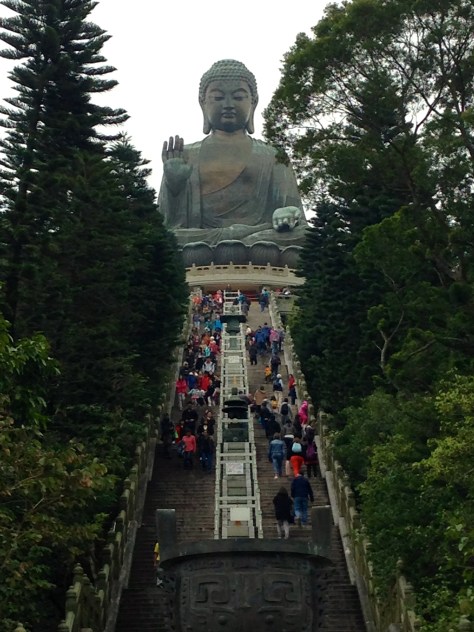
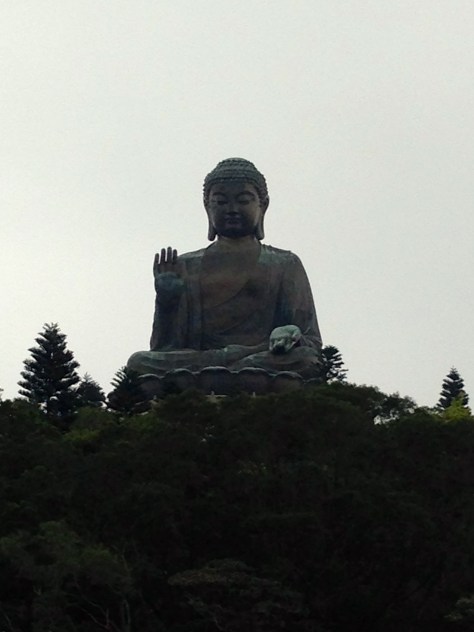
One of the main attractions at the monastery is the Tian Tan Buddha, also referred to as Big Buddha on the signs. We climbed a whole lot of steps and were enthralled with what we saw. This monastery is home to a bone relic from Siddhartha Gautama, The Buddha with a capital T. (And a capital B, I guess.) Big Buddha sits on top of the temple containing this relic. It’s so small that the only way to see it is on a video screen that has a photo of the bone under a microscope.

It was from Big Buddha that we were able to see the valley that Po Lin Monastery calls home.

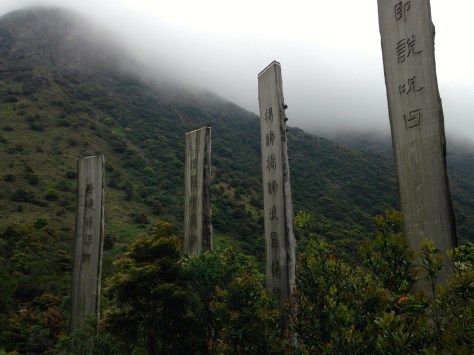
There also walking and hiking trails around the monastery, which we decided to visit. We found ourselves in clearing of unexplained trees carved with Chinese characters. Mitch said he expected druids to come out any minute, which is probably the best way to describe it.

That evening, we went to Temple Street Night Market to show Lucas what night markets are and also to eat cheap local food. In my mind, the market was notable for its vegetable satay and the prevalence of stands selling very naughty lingerie next to stands selling key chains. Something for everyone. We also ventured to the Goldfish Market the next day, which is not an experience I plan to repeat. We’d been warned and now that I’ve seen it with my own eyes, I can assure that it is no place for anyone even remotely concerned with animal welfare. The entire street was lined with pet shops and all of the animals were in tiny cages and being poked and prodded by buyers and people who simply seemed to enjoy the novelty. We looked around, walked up and down half the street, and called it quits. There are some cultural barriers that are too high to breach.

The next day, we wandered through Hong Kong Central, basically following the crowds. We made our way down windy streets where antique stores sold porn along with very old coins. (My personal favorites were the holographic cards that show a voluptuous clothed woman and a voluptuous naked woman, depending on which way they’re twisted. Fascinating stuff.) We went through streets of grocers’ markets and found multiple stands full of fish that had probably been caught that morning. Personally, I preferred the smells coming from the spice shops.

Spices
The only items in the market I could stand in front of long enough to get a picture
More spices
How old are oranges before the peel is considered old? What color is the peel if it’s considered oranger?

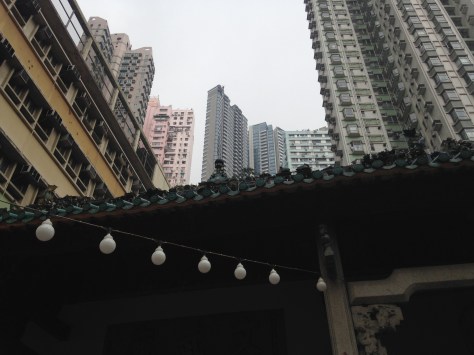
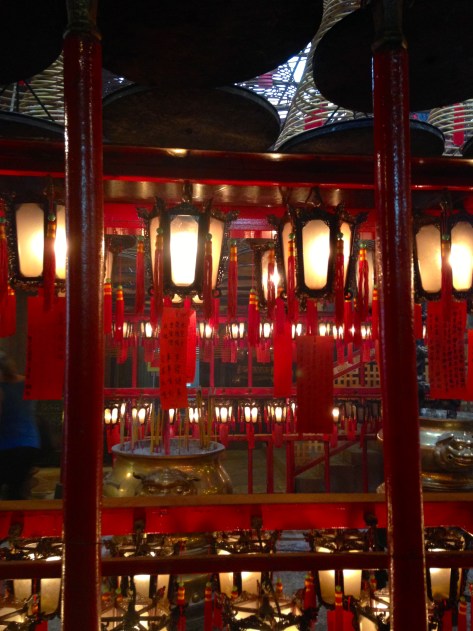
                                                                                                                                                                                                                                                                                                                                                One of the things I love about Southeast Asia are temples located in the middle of big, bustling cities. Hong Kong’s oldest temple, Man Mo Temple, dates to 1847. It sits next door to massive high-rises and crowded with Buddhists lighting incense and praying. The smoke was so thick inside that it was hard to breathe, even more difficult than in the rest of Hong Kong. (The fire alarm in our hostel went off early one morning because of the smog.)

We went to A Symphony of Lights at Tsim Sha Tsui Waterfront on Kowloon, which is the island where we were staying. The symphony wasn’t much to speak of, but it was neat to see the skyline lit up. I also really loved the ferry we took from Kowloon to Central in the dark.
Hong Kong at Night

Probably my favorite aspect of travelling is experiencing life as locals do. I love unique signs and shops and neighborhoods that would never be found in guide books because of their normalcy in everyday life. From the outside looking in, however, these are what make people and places real and liveable.

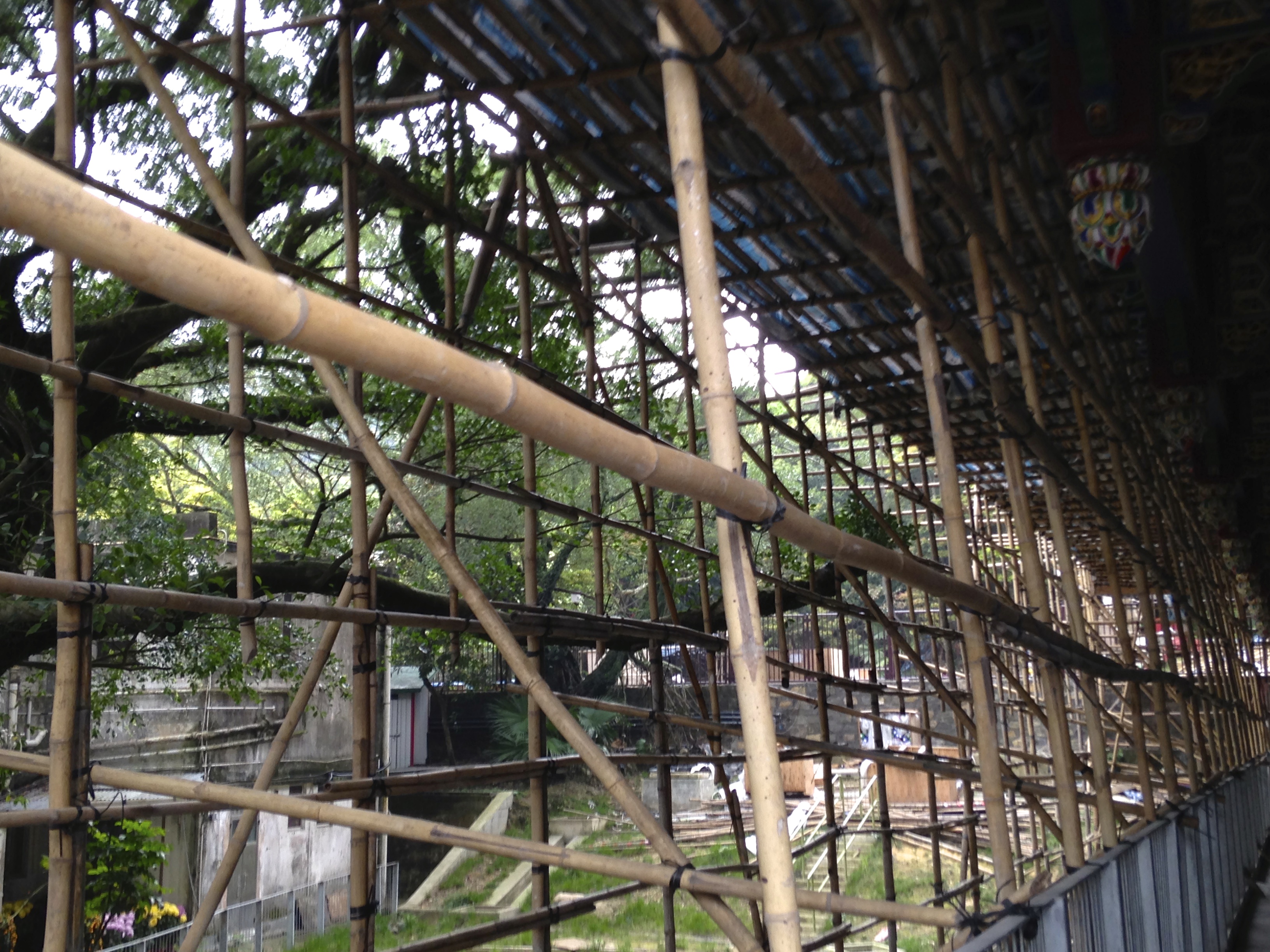
Like building techniques . . .

Scaffolding
Bamboo scaffolding – They’ve probably been using it for thousands of years and see no need to stop. If it ain’t broke, don’t fix it.
Scaffolding
Yes, this was at Po Lin Monastery but we saw scaffolding like this all over Hong Kong. It made quite the contrast against concrete!

                                                                                                                                                                                                                                                                                                                             nightlife culture . . .

Nothing beats telling it like it is!
One of the many trendy and expensive bar streets in Central
Had we known Operation Leprechaun was on, we would have come prepared

                                                                                                                                                                                                                                                                                                                     home decor . . .

We found these mugs in a store window selling Taiwanese products. The whole area was full of high-end desginerly home goods - made me want to buy lots of things when I grow up!
We found these mugs in a store window selling Taiwanese products. The whole area was full of high-end desginerly home goods – made me want to buy lots of things when I grow up!

and a very important aspect of Hong Kong life . . . subway etiquette!

HK subway sign
Thank you, helpful sign. The best part is that “do do do” is exactly how one would describe that specific sound
HK subway sign 2
I also like that these helpful signs are color-coded

Safe travels and remember to keep your ears pricked for “ding-dong!”

Longing for a List

The irritating, understanding, omniscient they claim that experience is the best teacher.

Newsflash: They’re right.

I’m embarrassed to admit that I have a weak spot for lists of ideas, books, movies, sayings, and experiences that will purportedly change my life. You’ve seen them: 100 Places to Visit Before You Die, 50 Ways to Beat Stress, 20 Things You Wish Your Mother Had Told You, etc. Real Simple magazine, which I love dearly for its, well, simplicity, provided a list of 50 Books That Will Change Your Life that is tacked above my desk. I’ve been working my way through them and they’re excellent.
But that’s not the point.

The point is that I wish someone had shoved a list of Things to Know Before Leaving Your Home to Teach Abroad under my nose and forced me to read it. But deep down, I know that even if they had, there’s no guarantee I would have listened. If you’ve been following my blog for any time at all, you’ve probably gathered that I’m ambitious and adventurous and that I’m bad at risk assessment. (No, I don’t jump off cliffs. I’m adventurous, not stupid.) I am, however, a dreamer and I like to test myself. I get ideas into my head and can be rather single-minded in instances when I should talk less, listen more, and think before I act. If I had put together a list of what I was told and how I was warned before moving to Malaysia, I would have had my very own list of Things to Know Before Leaving Your Home to Teach Abroad. I wish I’d done that. Instead, I turned what I heard on its head and heard what I wanted to hear.

I heard, but I didn’t listen; I thought, but I didn’t consider.

It’s hiring season now for international schools around the world. Most hiring fairs will be over by the end of February. This is shockingly early in comparison to the US, when talking about “next year” generally waits until after April Break. In light of the 2015 hiring season, a recent Facebook post from a friend considering teaching abroad, and my own reflection of 6 months (6 months!!!!!) worth of experiences, I bring you . . .

12 Things to Know Before Leaving Your Home to Teach Abroad*
*I take no responsibility for personal happiness, self-fulfilment, or the quality of advice provided. This list is meant to be purely informational based on my (relatively limited) experience, career path, and personal situation. You can’t sue me because you made a poor, uniformed decision tough choice and are unhappy. Capisce?

1. You are not an objective thinker. My friends have always told me that I give good advice because I look at situations from all sides. When you yourself are involved in making a huge decision, you will lose all objectivity. No one considering a career change or huge move is completely impartial.

2. Considering the above, listen to what others have to say. There is a difference between hearing and listening. I heard a lot of people say things like, “Wow, that’s really . . . wow” and “The only way you’ll regret this is if you die.” (Real statement from a real person.) Neither of those are ringing endorsements for the idea of giving up an apartment lease, selling a car and possessions, packing everything else into boxes, quitting a job, saying goodbye to everyone, and moving 12 time zones away.

3. Relatedly, ask people who know you well for advice. Mitch and I asked literally everyone we knew for advice. Those who knew us were much more cautious and concerned when saying what they had to say. The others, the ones who we listened to, ironically, heard words like “travel” and “experience” and told us to go for it. Most of those friends spend about 50% of their waking hours drunk or high; we would never listen to them under normal circumstances, but we made the mistake of listening because they told us what we wanted to hear.

4. If you don’t want a career change, don’t change careers. I really wanted a job in Europe teaching social studies, which is what I taught back in the US (and love teaching and miss teaching). I ended up with a job teaching elementary school in Malaysia. Journalists don’t end up working for NBC, CNN, or anything we’ve ever heard of right out of school; they write weekly columns for local papers about upcoming yard sales, but that’s still journalism. I should have waited for a social studies job. I miss social studies and secondary students every single day and what I’ve found here wasn’t worth changing educational areas.

5. Look for concrete evidence. The school where I teach is brand spanking new. It opened far too early with no resources. The school has a lot of plans and that’s what they advertise. There are no real photos on the website because nothing looks the way management have imagined it to look. Promises are everywhere but evidence is lacking.

6. Pay the $30 membership fee for access to International Schools Review. ISR publishes anonymous reviews of hundreds of schools around the world and even includes a guide of what to look for to make sure the reviewer is telling the truth. Treat this like you would review on Amazon – not everyone has the same preferences and not everyone looks for the same things, but the information is valuable.

7. Buy a guidebook and read it. A quick Google search of the city where I live told me that there’s a Starbucks here, loads of restaurants, and 14 sights on TripAdvisor. I assumed that meant this was a “real place,” by which I meant a place like home where I can walk around, explore different neighborhoods, and have things to do over the weekend. I didn’t learn enough about Malaysia before arriving to know that cities are poorly planned, rarely include sidewalks, traffic is horrendous because roads are narrow, shopping malls are in every city and full of chain restaurants and popular Western stores, and temples listed on TripAdvisor are places of worship, not places to visit. All of the above accurately describes where I live; a description of other places in Malaysia would be very different. I didn’t know enough about where we were going. A quick glance at a Lonely Planet guidebook would have told me exactly what I needed to know – “nothing to detain you here.”

8. Learn about local history and culture and know a few words in the local language before arrival. This is something Mitch honestly did quite well. I didn’t, so thank goodness for him! Knowing the political history of Malaysia helped us make sense of what we saw when we got here and what we have seen in our travels. It also helped us understand what to say, what not to say, and a little bit about the shared histories of different groups of people.

9. Don’t rush into a contract. International school contracts are not exactly binding. Breaking contract is really common and really easy. Mid-year hiring occurs when teachers go home for Christmas and don’t come back. International school contracts are also complicated, because sometimes they’re company contracts and not your typical teaching contract. Read carefully and get everything in writing.

10. Unfortunately, we’ve learned over and over don’t trust anyone. I can count on one hand the number of promises that have been fulfilled when and as expected – 1. That was my flight here. Everything else that we were promised has either been brushed aside, changed, altered, or pushed back . . . even though it’s in writing.

11. Watch the signs. The person who hired me and was supposed to be my boss quit, our moving date was changed because the apartments weren’t ready, the school calendar wasn’t finalized until after arrival, and the school couldn’t provide photos of the building’s interior in July when it was supposed to open in September. I should have known.

12. If you still decide to go, travel. I hate living where I’m living, I hate the school and people I work for, I spent four months in a hotel, I’m still working illegally, I have no passion for teaching elementary school, I desperately miss Mitch and my friends and family. However, the travel opportunities and life experiences that we’ve had and the amazing people that we’ve met make me feel that choosing to come out here has not been an utter failure.

Before I left the US, my parents tried on numerous occasions to convince me to stay home, work for another year at my previous school, and take another year to look for social studies jobs in places where I wanted to be. I told my dad that I had to see this fail before I would get teaching abroad out of my system. I don’t want to be here anymore, but I’m not 100% sure I’m ready to go home. Some days, I’m this close to looking at flights. Other days, I just want it all to work.