When I was flying back from Siem Reap, Cambodia in March I read an article in JetStar’s inflight magazine about vegetarian hawker food in Singapore. My go-to at the hawker is mixed rice because you just point to the dishes you want, grab a pair of chopsticks, and enjoy. Eating at a vegetarian hawker, however, would open up a whole world of culinary flavors that I have been unable to try here!
Lucky for me, I have kind and adventurous friends who have actively responded to my pledge to make every day count as I wrap up my time here in the Little Red Dot (sob!).
With that JetStar article as a guide, Josh and I headed out to the Aljunied MRT, where we were promised delicious bowls of laksa at the oldest vegetarian eatery in Singapore. One restaurant near where I lived in Malaysia served delicious vegetarian laksa and I miss it. I also miss my bowl of hot, spicy curry mee at 10am for morning break at school!
Mmmm food. My palate has expanded in the most delightful ways.
We knew we were getting close to our destination when we passed multiple shops that smelled of incense and sold Buddhist artifacts and books. Kwan Inn Vegetarian Food turned out to be a hawker stand serving mixed rice, made-to-order dishes, and several soups.
For our first course, Josh and I each ordered a bowl of laksa in a fantastic, fragrant coconut broth. I picked out a few items from the mixed rice counter for us to share – spicy fake fish (this used to be school lunch sometimes at school in Malaysia), tofu and green beans (a classic), and two kinds of mushrooms. We have the best mushrooms in Asia. Lime juice was our beverage of choice.
Total cost: $10.80. Eating can be cheap in Singapore if you know where to go!
Of course, with so many opportunities to experience real Peranakan food, we had to get more! Josh ordered peanut fritters (normally prawn fritters) and spinach noodles (yes, actually green). These were served with two types of tofu, mushrooms, and sprouts. Normally the meat is char siew, which is pork, and the noodles are plain egg noodles. We tucked in before I could get a picture, but I promise it was all delicious!
Thank you to Josh for a really fun meal and thank you to JetStar for its inspiration!
This week-long adventure was different from any I have ever experienced. This was my first time in Cambodia and my first traveling internationally with students. I visited Battambang with the entire grade 10 class of my school (about 90 students) along with the seven other teachers. Upon arrival, we joined JUMP!, a very wonderful experiential education social enterprise with which school is currently working to plan the annual field studies trips for all secondary school students. I am in awe of what JUMP! planned and how their plans came to fruition.
But I’m getting ahead of myself.
The focus of the grade 10 week in Battambang, Cambodia’s second largest city, was to get students thinking about community development, both as communities of advisories (groups of about 15 students that meet daily) and global communities. We spent the week learning from and working with different social enterprises that aim to make Cambodia a better place. All the restaurants where we ate were social enterprises, as well. As part of the program, we explored privilege, voluntourism, sustainable development, Cambodia’s history, and how to bring about positive social change. Throughout the week, I saw my students’ hearts and minds open up, not only to these ideas but also to each other as individuals and as friends. I can say without a doubt that every student returned to Singapore wiser, humbled, empowered, and with new friends.
This post will chronicle my week in Battambang as best as I can based on the photos that I can share. Most of my photos for the week were of and with students, and there are a variety of reasons (i.e. privacy, confidentiality, just plain propriety) why I won’t share them in an unprotected online space. Heartfelt thanks both to JUMP! for their incredible work and to John, the extraordinary JUMP! facilitator assigned to my advisory for the week.
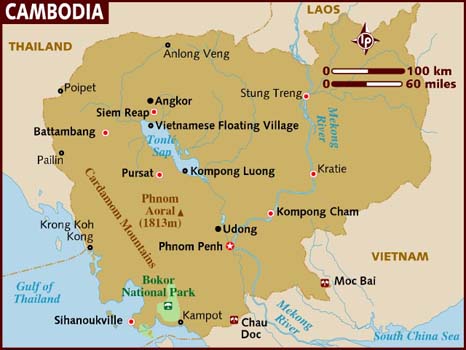
To get oriented, here is a very helpful map from Lonely Planet:
We flew into Siem Reap on Saturday and drove the 3+ hours to Battambang the next morning
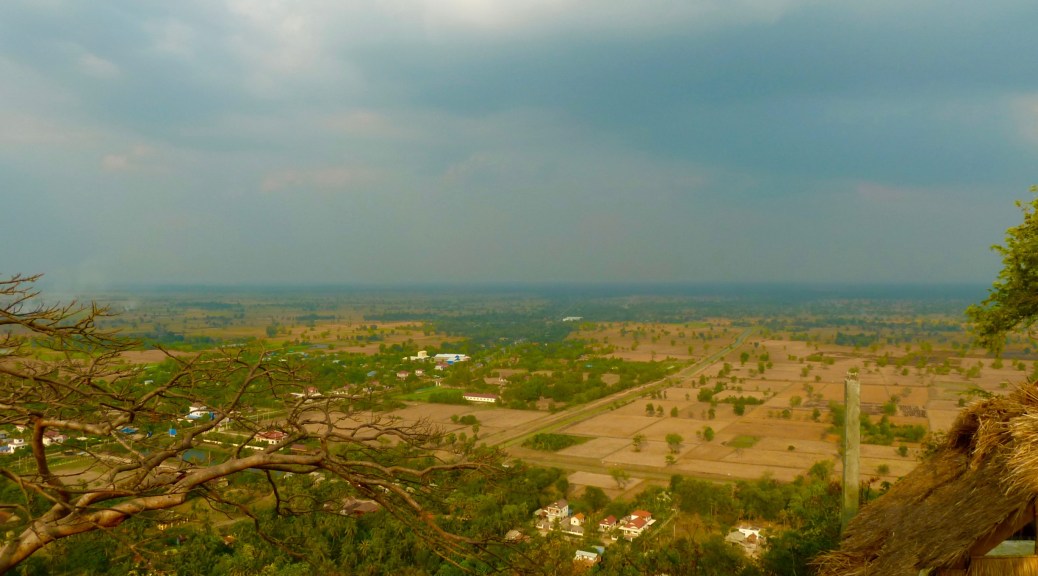
One of our first activities was a tuk tuk ride to visit Phnom Sampow. We took a difficult climb up a steep hill, pausing along the way to see Buddhist temples and learn about Cambodian agriculture from our guide. We could see farms for miles from various lookout points.
The temples were exquisite, as well. I have a few Buddhist students who stopped to pray along the way.
We also encountered a number of monkeys and actually had to alter our route at one point to get away from them. Monkeys are vicious and will grab any food item or even backpack in site. My favorite monkey was this one:
The highlight of this trip, though not photographed because I felt weird about that, was the killing caves, a site of Khmer Rouge slaughter. The caves contained a memorial to victims, including skulls of those who died there and a Buddha statue for those who wished to pay respects.
Probably my favorite morning of the trip started with a trip to a local market to pick up ingredients for the Cambodian lunch we would learn to prepare! The market was wonderful (and sold more than vegetables, though my photos might have you believe otherwise) and the cooking school was incredibly accommodating to my vegetarian needs. Even better: We received cookbooks to take home!
Another really transformative experience was our visit to COMPED, a social enterprise that collects organic material, turns it into compost, sells it to farmers for fertilizer, and uses the money to run enrichment programs for children. To learn about what they do, we visited a market, collected rotten produce, and shoveled it onto the compost pile at a local dump. While there, we also learned that the families who live on the dump are paid more than they would be in other jobs. Despite health risks from being around burning trash, they choose this life to feed their children.
Dump site
Like many social enterprises, COMPED receives support from another foundation, this time in Germany. This partnership is because COMPED’s founder used to be a waste management engineer in Germany before returning to his home in Cambodia.
This child lives at the dump and wandered over to the sifter just as I was taking a picture
New organic material on the right, four months into the composting process in the center.
Another social enterprise, Coconut Water Foundation, also runs after school and summer enrichment programs for students. We joined them at a school for about an hour one morning to play games with some of the students. Rather than sharing pictures of children, here are a few artsy shots:
Our last full day found my group on a bike ride with Soksabike, a social enterprise that pays families to produce traditional products, therefore putting money into the economy, and brings tourists to see these products. Soksabike’s tour guides are local university students who are working to enhance their English skills as they do their jobs.
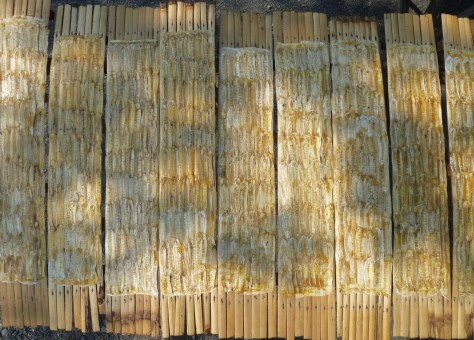
Among other things, we learned how rice paper is made . . .
. . . and sampled some delicious dried and fried bananas.
The final stop on the tour was a very moving memorial to another killing fields site across the street from a Buddhist temple that the Khmer Rouge turned into a prison and interrogation facility. I didn’t have the heart to take pictures of the memorial, mostly because it broke my heart. The 1970s weren’t that long ago, and the Khmer Rouge existed in Battambang until 1991. 25 years ago is not very many years. The detachment with which Cambodians speak about the Khmer Rouge genocide is painful to witness.
I don’t have photos to share, but other social enterprises that we visited and worked with were Phare, FEDA, and Cambodian Children’s Trust. All of these organizations work with and for community development, specifically targeted at children. CCT was the most moving for me because they taught us about orphanages and orphanage tourism. We learned that 80% of children in Cambodian orphanages have living family and are in orphanages (and often exploited and abused as a result) because their families were tricked into thinking their children would have better lives and a better chance at education.
It was a week of growth, that’s for sure. I’ll be back in Cambodia in March to spend a weekend in Siem Reap to visit Angkor Wat. I’m so grateful for the opportunity to travel with my students to Battambang to learn how real Cambodians live. The trip we took and experiences we had would not have been possible for me to orchestrate. JUMP!, thank you for opening my eyes to this beautiful country and its proud, hopeful citizens.
I don’t have a photo for tonight’s dinner, unfortunately. While a picture might be worth 1,000 words, it doesn’t do much about taste. These recipes, on the other hand, will more than make up for the lack of photos in this post.
Halloumi salad became part of my mother’s culinary repertoire in the summer of 2007, when we travelled to Israel for the first time. We encountered halloumi cheese served with grilled vegetables while there and couldn’t get enough of it. Upon learning that our local grocery store, the one and only Wegmans, carried halloumi, this salad because a regular part of our summertime meals. It’s best when you can get fresh mint and eat outside.
Grilled Vegetables Salad with Halloumi
What you’ll need:
Olive oil
Halloumi cheese
Your favorite vegetables (I used eggplant, green zucchini, and red pepper because I like all the colors together)
Fresh mint, chopped
What to do:
1. Slice all vegetables into moderately thin slices
2. Slice halloumi into strips about 1/4-inch thick, set aside
3. Heat grill pan on medium-high heat
4. Toss all vegetables in olive oil (I add the eggplant last and sometimes on its own because it will absorb all the oil)
5. Lay vegetables flat on grill pan in batches, flipping once when char marks appear (level of char is up to you)
6. Once all vegetables are ready, grill the halloumi, flipping once when char marks appear (this will happen much more quickly than it did for the vegetables)
7. Toss halloumi and vegetables together in a bowl
8. Add mint
9. Enjoy while warm or at room temperature
I made the halloumi salad as a side for my favorite salmon, the recipe for which follows. I could honestly just eat the halloumi salad and be a very happy person, but eating a block of cheese for dinner is far from healthy. This is probably the easiest way I’ve ever prepared salmon, and it’s also the most delicious.
Lemon-Sugar Salmon
What you’ll need:
4 salmon filets
1 tbsp sugar
1 tbsp lemon zest
Salt
Pepper
What to do:
1. Preheat over to 450°
2. Combine sugar, lemon zest, salt, and pepper into a dry rub
3. Rub on both sides of salmon
4. Place salmon into lightly greased baking dish
5. Cover and refrigerate for 30 minutes
6. Bake for 10-12 minutes until salmon flakes easily with a fork
Bon appétit!
Photos, travels, musings, and ideas on education by someone trying to make the world a better and more peaceful place





 By Rebecca Michelle