
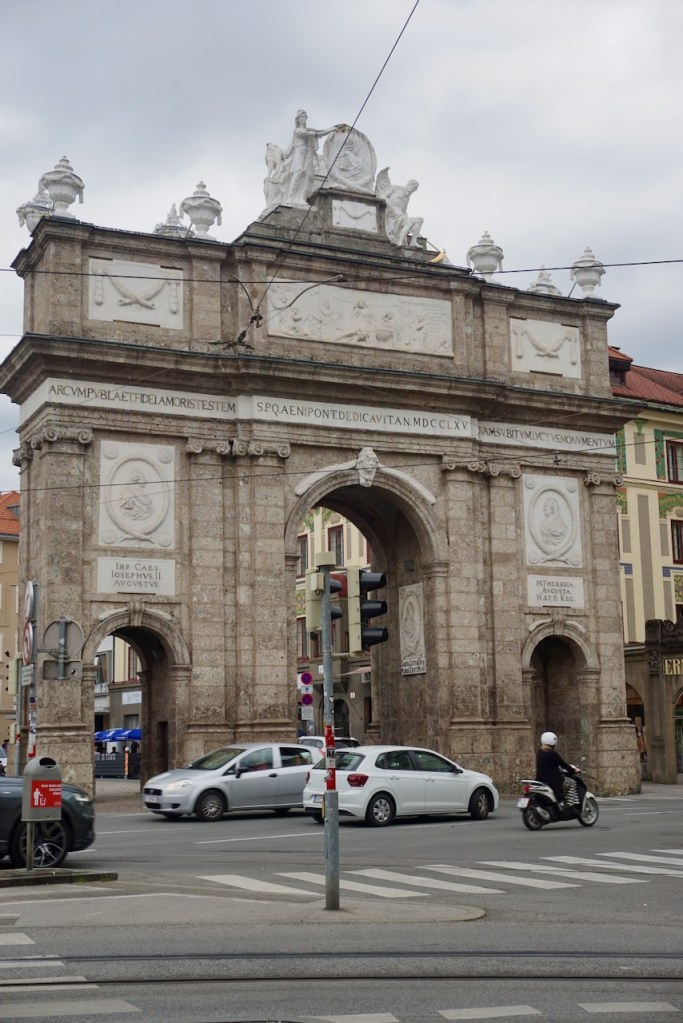
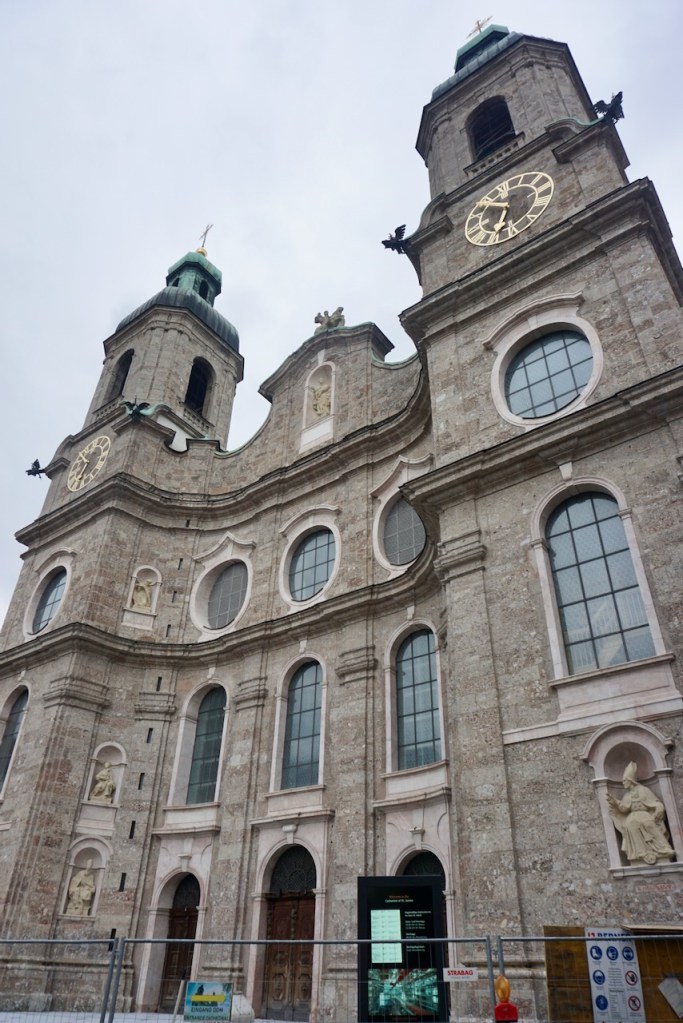
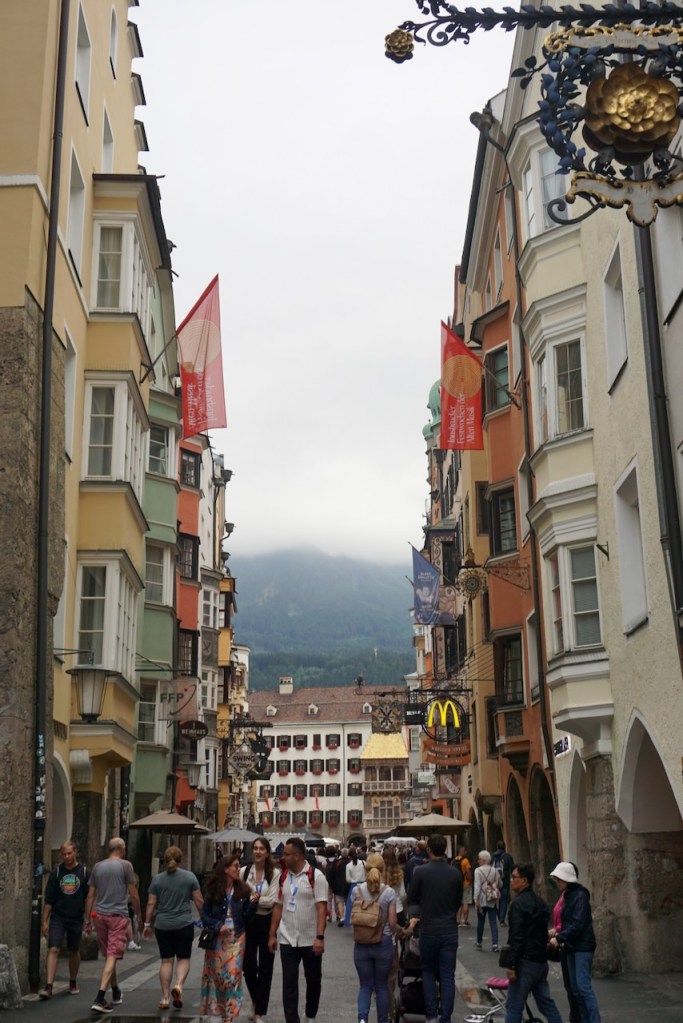
Memories of our first alpine tour still fresh in our minds, my partner and I left Slovenia just as cooler air was moving in. We arrived in Innsbruck glad that we had jeans and raincoats, and spent a couple hours browsing the plethora of sporting goods stores and walking through the beautiful old town. With mountains visible from everywhere, painted buildings, and a vibe of loving adventure, Innsbruck is the type of place I could easily imagine living . . . or at least visiting again.




We spent the night a little ways outside of town to facilitate our drive the following morning. Past Garmisch-Partenkirchen, not far from the German border, we were surprised to hear a radio show host speaking English and realized we were not far from a US military base.
We parked and looked up at our destination: Zugspitze, Germany’s tallest mountain. From where we were standing, it was only slightly visible, hidden behind mountains that seemed much more imposing, much more daunting. Knowing that they weren’t, knowing what awaited us on the route ahead, filled me with a sense of wonder. We were actually here. And we were ready. Our backpacks included easily-accessible energy bars, our essentials for a night in the hut (toiletries, sleeping bag liner, towel, change of clothes, extra layers that turned out to be unnecessary), and the necessary gear: climbing harness, carabiners, slings, helmet, via ferrata set (Klettersteig in German, details to follow), rope, ice axe, crampons, trekking poles. Showtime.
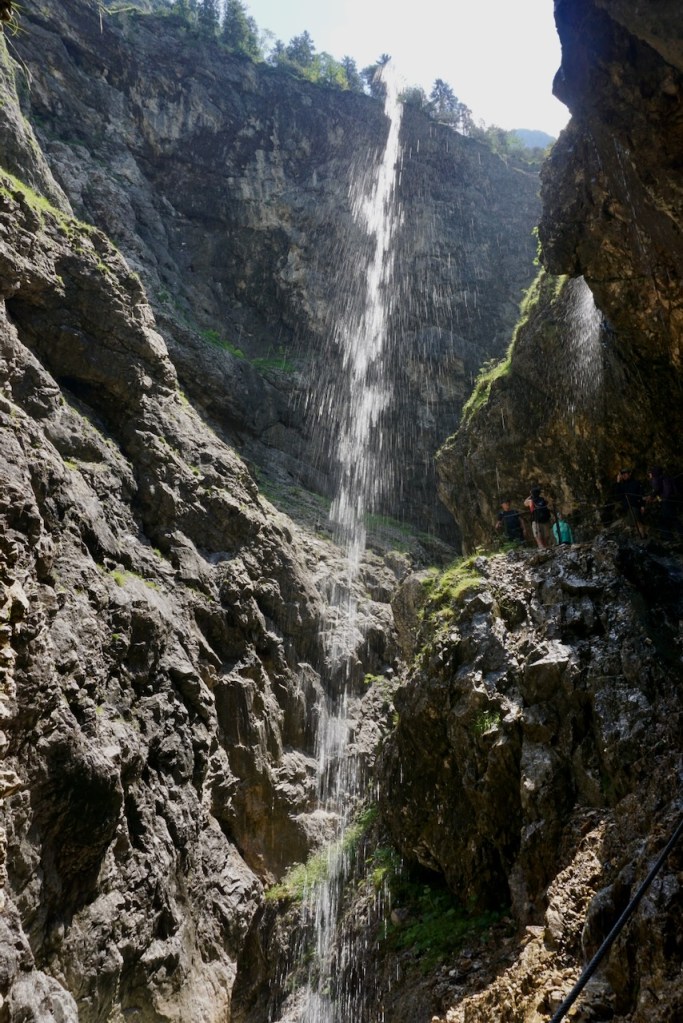
But first we had an easy day to warm up. We followed the trail markers along the river to the Höllentalklamm, the gorge that we’d pass through on our way to Höllentalangerhütte, the alpine hut where we’d spend the night.


The gorge itself was dark and cool, the spraying water a much-needed relief from the heat. We walked carefully along narrow, slippery bridges and stones through the canyon, carved deep into the earth. The ancients were right to honour water as one of the four elements.




Subsequently, the path grew steeper, rockier. The mountains grew larger as we approached, and the trees began to recede. We had ascended 700 meters and could see the end of the tree line past the point where we would end our walk for the day. The air around us glimmered and my senses tingled.


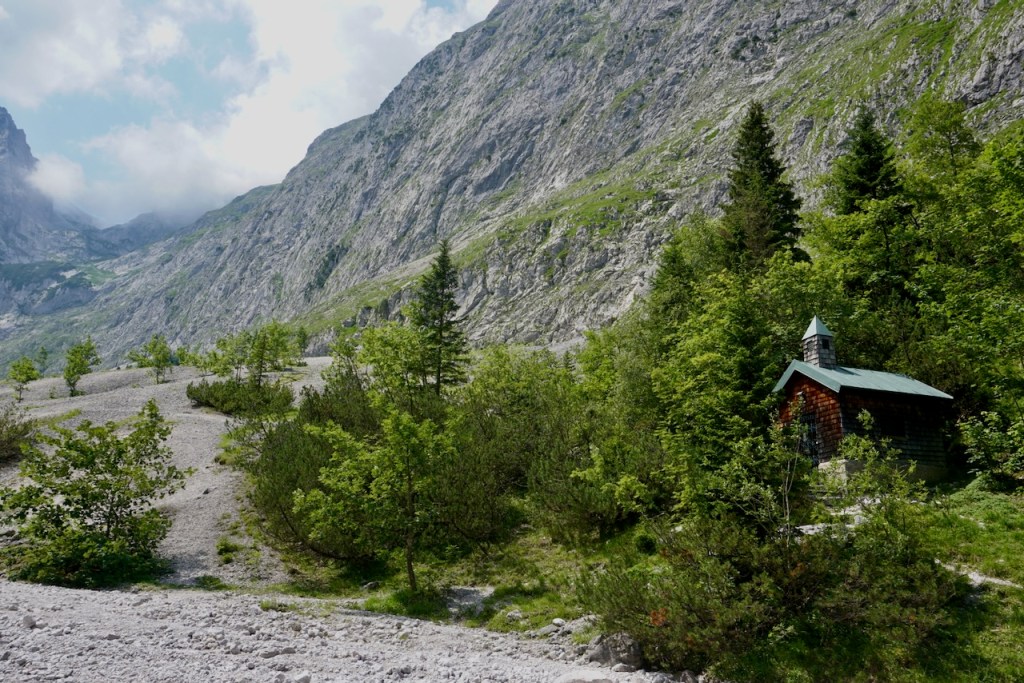
We reached Höllentalangerhütte in high spirits with the sort of jitteriness that comes at the end of a long wait. It brought to mind the last day of school, or one’s birthday, or a favourite holiday. One more sleep.


After a shower and a snack, we meandered across fields of stone away from the hut and took a good look at what we could see of our path for the next day.


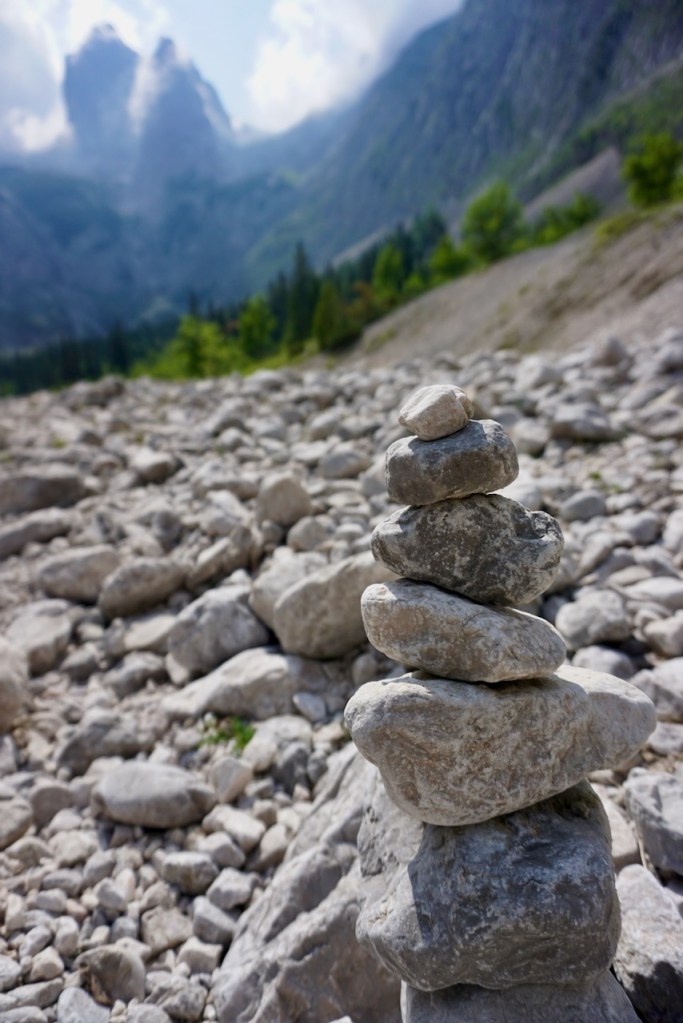
The way markers designated six hours. In the end, the climb took us exactly six hours.

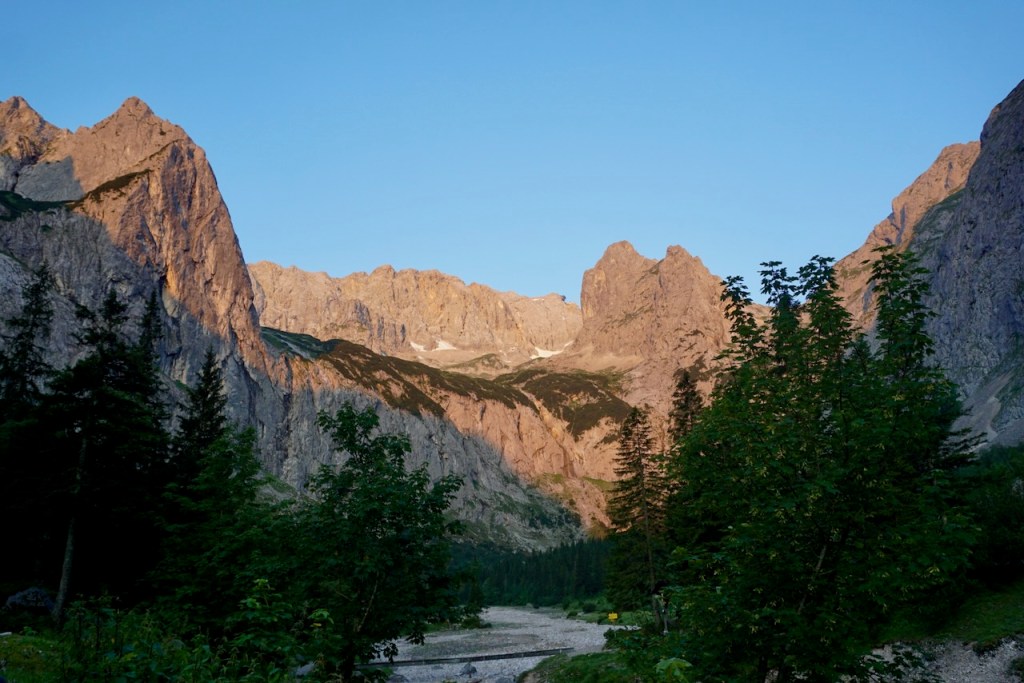
We began promptly at 6am, joining most of those who had shared our 35-bed dorm room for breakfast at 5:30. The mountains glowed that morning in welcome. To be in such a place, and to be able to take on the task we were taking on, is an incredible privilege. We couldn’t stop smiling.
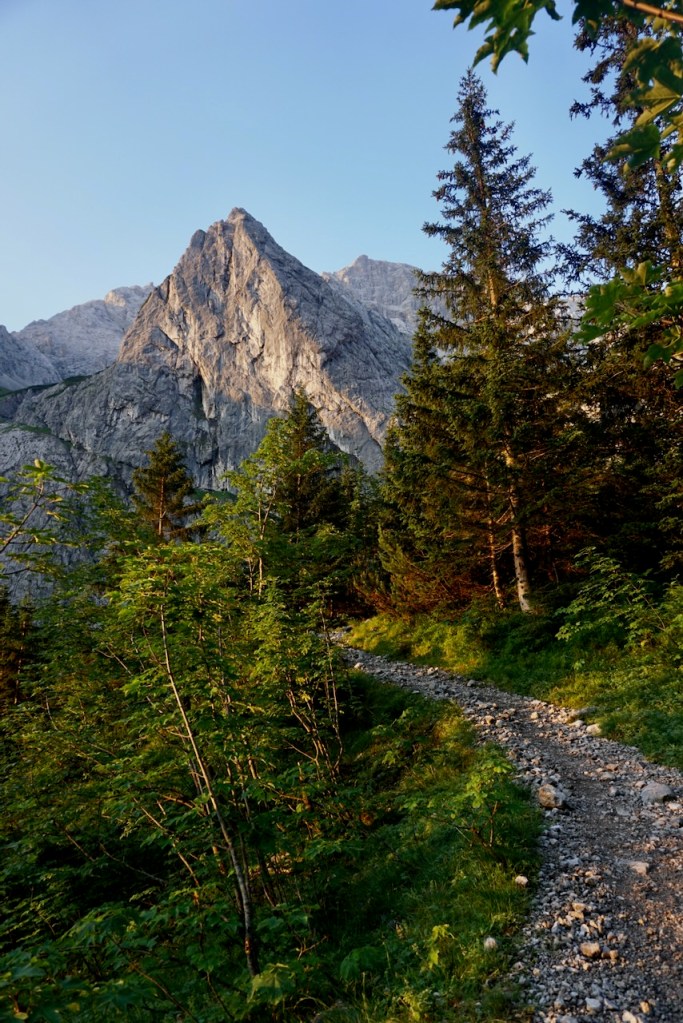

The Zugspitze is steep, just over five kilometers with an elevation gain of 1,390 meters. This was easily the most demanding mental and physical experience I’ve had in the mountains. The physical challenge, the ceaseless gaining in elevation along difficult terrain, tired the body and that tired the mind. A tired mind is then an unfocused mind, and that can be dangerous. The mental challenge then, is remaining alert and aware, moving simultaneously with confidence and caution.
In addition to the steepness of the terrain, the Zugspitze is also a technical climb with multiple sections of via ferrata, or Klettersteig. This is a sort of aided climbing using fixed cables that allows access to sides of mountains that would be too risky to attempt otherwise. That being said, you don’t want to fall because a via ferrata set is basically one-time use. The set is comprised of two large carabiners attached to lanyards, which are attached to a longer lanyard snugly packed inside a little bag that will only extend if you fall (and then you can’t stuff the lanyard back into its bag in alignment with safety ratings, so that’s that). The entire set is attached to your climbing harness. A helmet is required and I find durable, fingerless gloves designed for the thick cables to be essential. We also use an additional safety sling because again, you don’t want to fall. There were two sections of Klettersteig on the Zugspitze, both relatively easy grades but hard enough once we got into altitude. The first one made for a nice warm-up for what was to come.


The sections of the route that were not part of the Klettersteig were rock scrambles, generally easy climbing that requires all four limbs. Mountaineering is serious work, but there was so much play alongside the intensity.
As we climbed higher however, I was breathing too quickly. My pulse was racing and head spinning from the altitude. We continued moving as my partner demonstrated breathing slowly and deeply to bring everything down. And then I carefully counted breaths, letting my body acclimate. In just a few moments, my head cleared and my pulse returned to normal. It is easier to keep going, slowly, under such circumstances than stopping for a rest; the body needs to adjust, not to stop, and the breath controls the body. To reset mentally, it was enough to look around. The strength that comes from being wrapped in nature, the edges of the mountain growing more jagged as we crossed them, left me with feet planted firmly on the ground and a strengthened resolve.
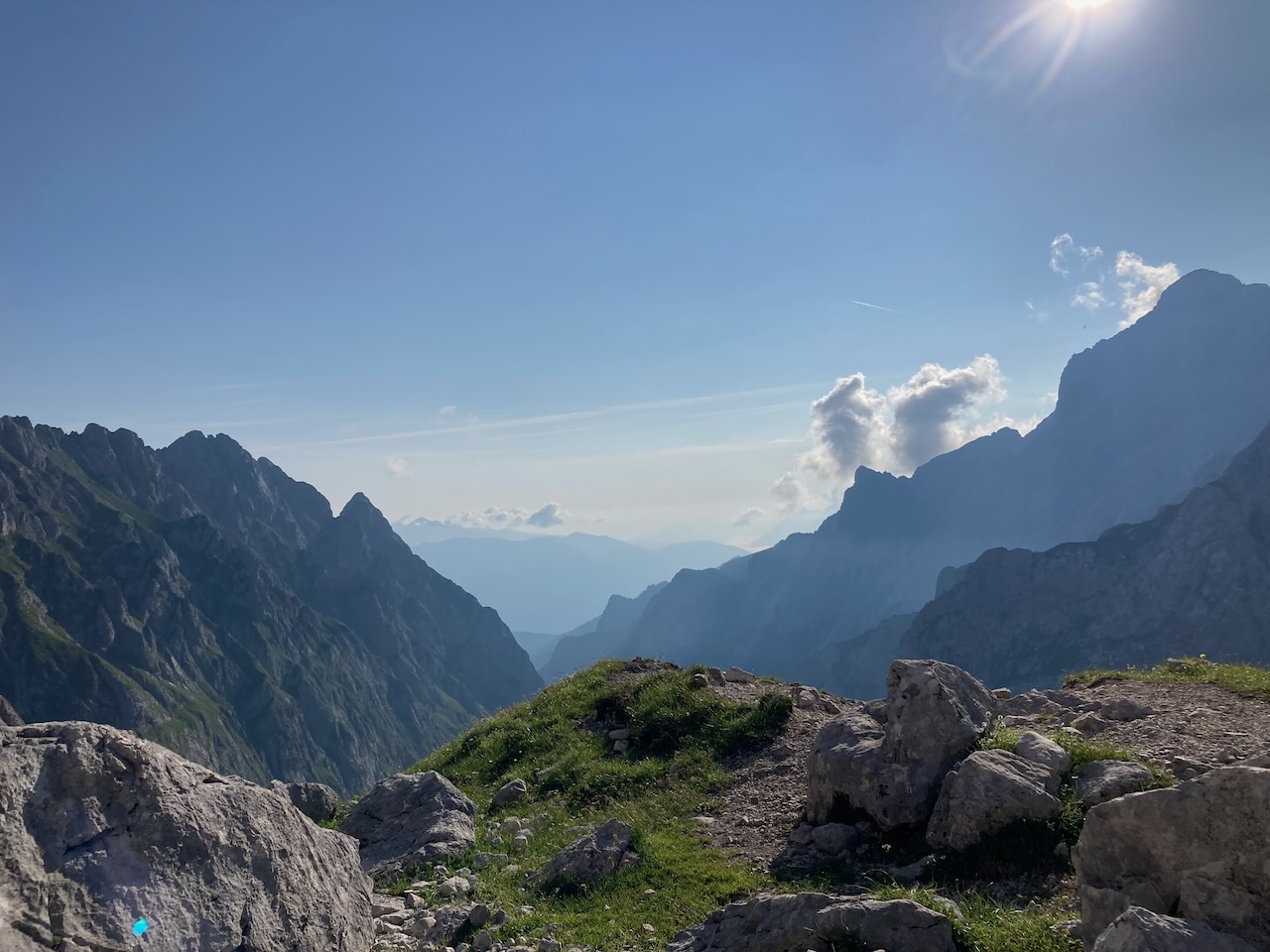
What I found unique about this climb is that it never let up and, therefore, neither did we. It was continuously hard, continuously driving me to the edge of what I thought I could do. I kept moving long after I would have liked to have stopped and long after it hurt. I knew I had blisters forming on the backs of my heels, but I also had carabiners in both hands to clip onto cables, rocks to scramble over, and a sheer drop visible to my left that kept my feet moving with precision. The nearly instantaneous benefits of energy bars have never been more apparent.
We had made very good time when we reached the glacier, a very special aspect of climbing the Zugspitze. Excited to get into snow, we unpacked our crampons and rope, which we had prepared in advance with figure-eight knots for us to clip into and butterfly knots as stopper knots for the unlikely event that one of us fell into a crevasse. As we had practiced, we wrapped the ends of the rope around our bodies, securing them with one more knot. My partner readied his ice axe and I adjusted one trekking pole. Our free hands would be used to guide the rope as we walked.

Due to the potential consequences of falling, a glacier crossing should not be done alone, but rather in pairs or groups, everyone attached to a rope. It is the leader’s job to make the way, to form the tracks. It is the leader’s job, when necessary, to use the ice axe to arrest a fall. The follower’s job is to manoeuvre the rope and to keep the right amount of slack between the leader and follower. Knowing the terrain where we were, an ice axe for the follower was unnecessary, but there are bigger, more dangerous glaciers where this would not have been the case. A trekking pole with a snow plate was sufficient for stability and support. Crossing the glacier as a team with my partner, our safety quite literally tied together, sent jitters up my spine as we got ready. And then, with the first steps, the romantic moment vanished into one of sheer focus.
A combination of steepness and rope management made the glacier tiring work. We followed tracks that had been made throughout the season, lamenting that the snow was rather mushy, a sign that it was much warmer for this time of year than it should have been. As grateful as we were to have the way tamped down, the steepness remained a challenge. Our toes did most of the work, the spikes cutting sharply into the snow and holding fast.

Arriving at the end of the glacier and getting ready to clip back into the Klettersteig, we shed our jackets immediately. It is absolutely no joke that glaciers are the way to see climate change in action. We looked down at the edge of the glacier and stepped quickly and carefully, not wanting to linger. And then we looked up at the way ahead, following the cables with our eyes until we could no longer see them, the summit hidden but closer than it had been.

The second Klettersteig took us the remaining two and a half hours of the climb. When we looked down, we could see the zig-zag tracks that we had followed across the glacier, essential in steep terrain. Although it hadn’t felt that way, the glacier looked vast. Focused on whatever needed my attention in any given moment, we had climbed a lot farther than I had realized.
It was easy to lose track of time not just because of how hard we were working, but also because of how much fun the climb was. And it really was, which struck me over and over. I knew that I was pushing all of my body’s limits and that I was absolutely in the range of what I could do even if I hadn’t done it before. I knew I had a range of aches and pains and bruises, but I had ceased to feel them. I knew I was tired and thirsty and hungry, that I hadn’t eaten enough at our second snack break, that everything should have been uncomfortable, but somehow it wasn’t. There was laughter ready to bubble up at any moment, a smile every time my partner and I called to each other, an electricity throughout my body that propelled me along. For six hours, there was nothing but us and the Zugspitze.

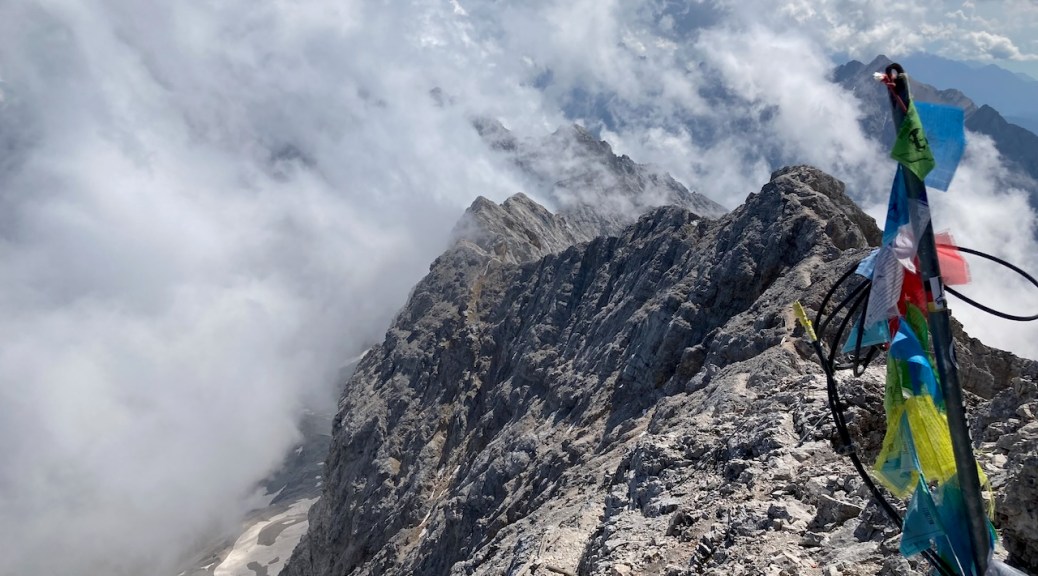
More than once, we thought we were just around the corner from the summit. More than once, we thought we were right there only to lose sight of it again. The clouds began to roll in behind us and my partner, whose photos are below, paused above me to watch. Suddenly, the world we had come from disappeared and there was only the world of the rock under our hands and the mountain who allowed us to hold on. My heart hammered in my chest in both exertion and a profound swelling of gratitude and respect for what we were doing.


About 40 minutes later, the Klettersteig cables disappeared. We climbed the last few meters unassisted, the exhaustion of the previous hours vanishing in the waves of excitement that began to build, and we were there.


At 2,962 meters, we had summited Germany’s tallest mountain in exactly six hours, mind and body fully engaged the whole time, laughing throughout in exuberance as reality hit us. The Zugspitze is not only Germany’s tallest mountain but also one of its hardest mountaineering tours, and we had done it. Together.
We ate and drank, gratefully took the train back to where we’d parked the car, ate and drank again, and then drove the five hours home, stopping for yet more food. Words failing us and hearts full of the day, we talked mostly about other things or not at all. Periodically, one of us would utter something like “Wow” prompting a response akin to “Yeah” from the other one. Slowly, we were able to talk about the experience, our different thoughts and feelings along the way, the areas where we’d each encountered challenges, or how much fun a certain section had been. Gradually, as we told others about the Hochtour and shared our photos, it became real that we’d stood at Germany’s highest point and that we’d made the way there together.
There were, however, serious conversations before planning this trip about whether we wanted to attempt it, whether my fledgling mountaineering skills were up to the task. There were moments before committing where we were uncertain about whether this was the right thing to do together. Mountaineering is a risky sport and the consequences are unthinkable, which is precisely the reason they must be thought about. And discussed. Openly and honestly, which can be stressful.
Once we decided to do it, the preparation took weeks. My partner took responsibility for learning the route and briefing me on it while I practiced different techniques of walking in new boots and read up on crossing glaciers and how to respond in a sudden thunderstorm. We watched videos and practiced knots together, made packing lists, prepared backpacks, went for a local hike completely kitted out, made adjustments. We talked about weather and feeling comfortable and knowing what it meant to decide to turn back. We did not take this climb lightly and I do not want to make light of what it took to get there.
As a result, there was no point on the Zugspitze where we were in any doubt about what we were doing, but also no point at which we took the mountain and our being there for granted. Nature allows you to be where you are, or it doesn’t. Nature welcomes your presence, or it doesn’t. Nature speaks and we have to listen, to respect. We are guests in nature.
And it was an honour to be there.





































 By Rebecca Michelle