Back in 2020, I read a New York Times article about a crowdsourced, online project to digitize records with the Arolsen Archives, the keepers of the world’s largest archive on victims and survivors of National Socialism (Nazism). The goal of the #everynamecounts initiative is to create a digital memorial with records accessible to all.
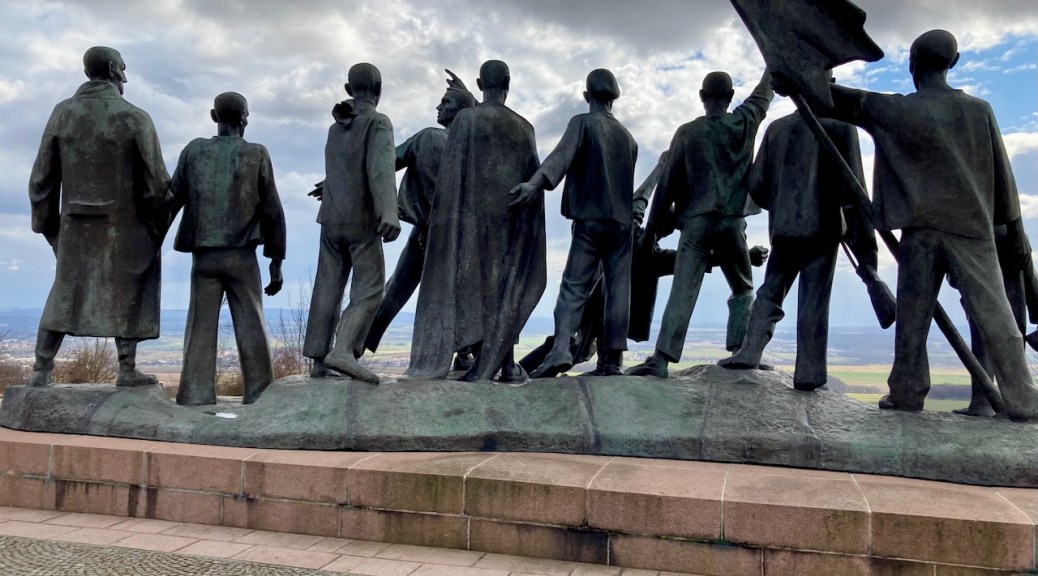
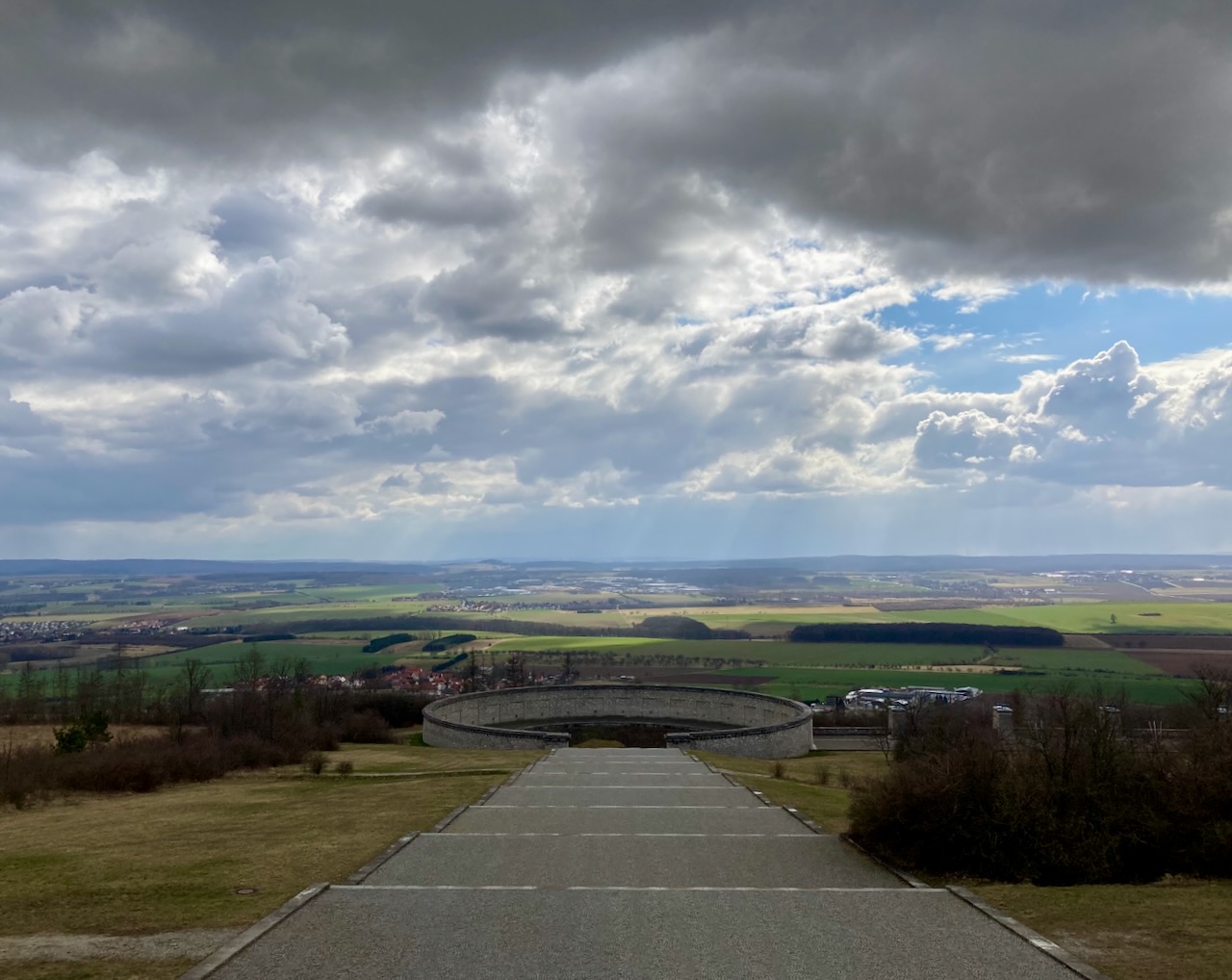
With thousands of volunteers around the world, I type whatever information there is. Sometimes I’m familiar with the names because of the community I grew up in and where I live now. Sometimes I recognize locations. One project involved documenting records of prisoners held in the concentration camp Buchenwald. I live within cycling distance of Buchenwald and have been up there more than a handful of times.
I most enjoy working on records of displaced people. These are the survivors, the young children with huge names, the defiant elders, the unbreakable adults. The documents indicate where they came from, and where they were sent to, and when. People were living in DP facilities until the early 1950s. Sailed to New York. Flight to London.
I wonder about the workers who took down these records, the handwriting of people all over the world, the very human touch of both condemning and saving a life. There is handwriting that loops and weaves, handwriting that took the time, handwriting that scratched and scrawled. Name. Marital status. Birthplace. Last address. Location. There are typed records, too, an indication that all of this happened in a world different from ours, yet not so long ago.
As I record lives lost and lives saved, I think about the internationalism of these records. Europe in ruins, its condemned minorities and those unlucky enough to have a non-conformist opinion collected and shipped off. To somewhere. Europe’s ravaged population surviving wherever they ended up, many so far from home.
And the internationalism of 175,000 volunteers around the world who painstakingly transcribe documents holding the stories of 17.5 million people. To guard against mistakes, each document is read by several volunteers. Any areas that cannot be read according to the usual guidelines are then checked by a member of the Arolsen Archives team. Seventeen and a half million individuals and their stories are too precious for error.
Two weeks ago, quite by accident, we drove past the town where the International Centre on Nazi Persecution, home of the Arolsen Archives, is located. I transcribed a few more documents the next day.
It wasn’t the size or the scale or the beauty of the view, the changing leaves, the sun peeking out behind the grey clouds. It wasn’t the stones placed on memorials or the signs explaining what we were meant to remember. It was, rather, the order, the organization, the efficiency and thought that had gone into creating an industrial process that, as intended, exterminated thousands of souls.
Souls that were exterminated because they were no longer thought of as souls, as individuals, as humans.
In an industrial process devoid of humanity to enable the process to function.
In a place that was beautiful, with forest growing on the mountaintop, with sunlight streaming through trees, where the wind must have been extraordinary when it came.
And what got me, too, was the way that nature could entirely take over if we let it. The soil had regenerated from the burned remains of buildings overloaded beyond expectations. The trees had grown tall inside what had once been structures meant to contain, to suppress, to separate. The paths were almost overgrown, almost hard to distinguish from the leaves strewn across the ground.
It was autumn in the beech forest. Autumn in Buchenwald.
If we let it, nature could obliterate the remains of what we were there to remember. Nature thrives despite of humanity, against humanity, and here we have fought nature back to remember. Letting this place become, once more, simply a beautiful place would mean that we risk forgetting, risk allowing the lessons of the past go unlearned.
And so the paths were almost hidden. Almost, but not quite. Intentionally the paths were designed and intentionally they remained.
It is not enough to remember; rather, there is a responsibility to act. And this means putting up the markers, placing the stones, taming the trees. This means being there, being at Buchenwald, and acknowledging the lives taken and ended there. This means continuing to tell the stories, to say the names, to walk where thousands walked, and to share the experience so as to keep it as present as we can into the future.
Because it is not enough to say that we remember.
We must always take sides. Neutrality helps the oppressor, never the victim. Silence encourages the tormentor, never the tormented. – Elie Wiesel
Sometimes I like to escape my usual world for a while, just to feel my feet under me again. A beautiful way to do this is out in nature, literally just outside the door, and I do this often. But sometimes I like to go exploring in a different way, the way that reaffirms my confidence in walking independently through the world. I’m not a city girl, as much as I’ve tried to be (much more of a kopi at the hawker girl, a friend aptly said), but I like spending time in cities. I like watching people, I like getting lost, and I like the anonymity that comes with crowded spaces.
And this is how I ended up in Dresden last weekend.
I arrived in the rain and was delighted when the sun came out and kept the rain at bay for the remainder of my visit. My first impressions were everything that comes out of story books. Stone buildings, castles and churches, graceful bridges.
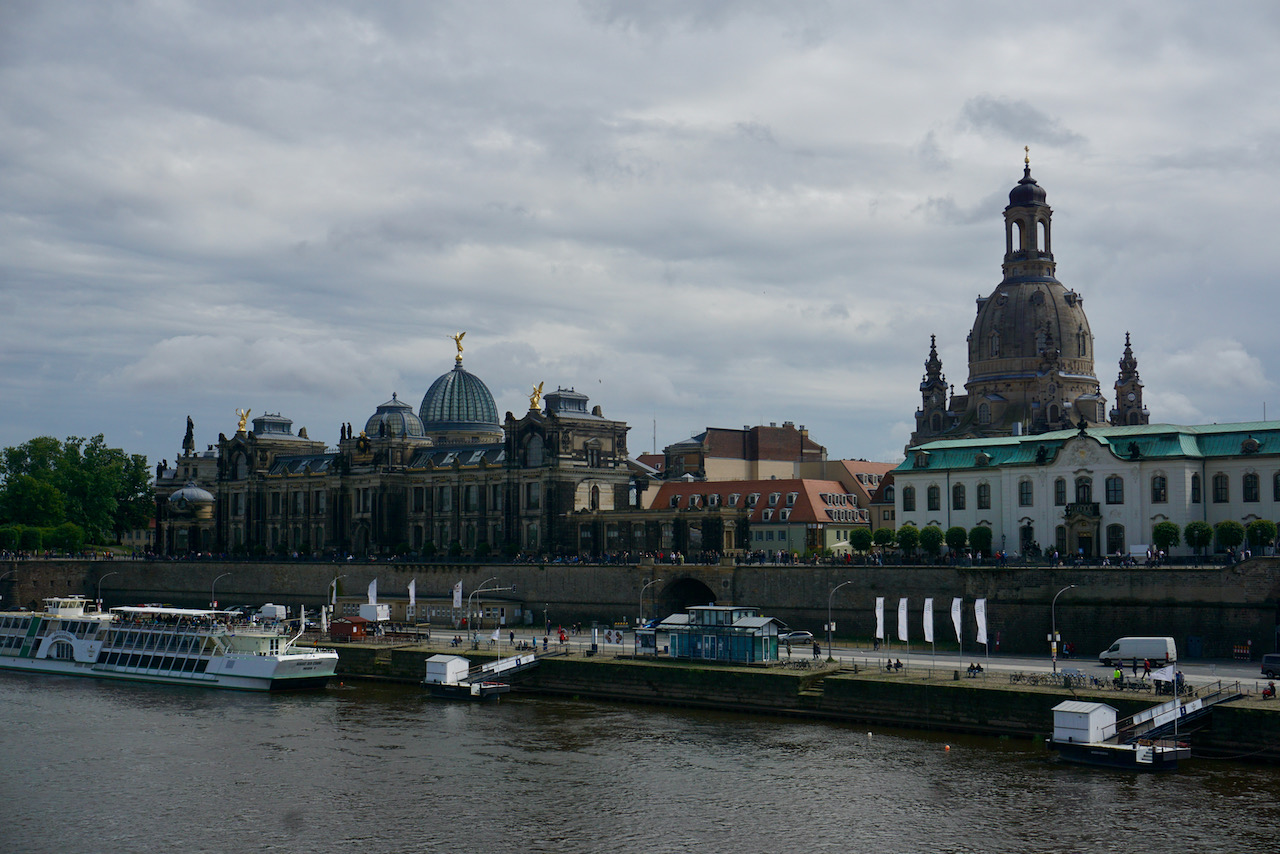
An extraordinary thing about Dresden is that everything has been rebuilt since firebombs destroyed the city in February 1945. This tells us something about what is meaningful to people and, I think, it tells us something about the power of place. These ideas stayed with me as I stopped on Brühlsche Terrasse (Brühl’s Terrace) to look back at the city.
View of Brühlsche Terrasse from across the Elbe
From there I headed for Neustadt, a neighbourhood located across the Elbe from Dresden’s Altstadt, or old town. First, I took a brief walk through Neustädter Markthalle where the vendors sell a variety of local, handmade, and interesting products. Unsurprisingly, the book exchange shelf, a mark of communities everywhere, was my favourite part.
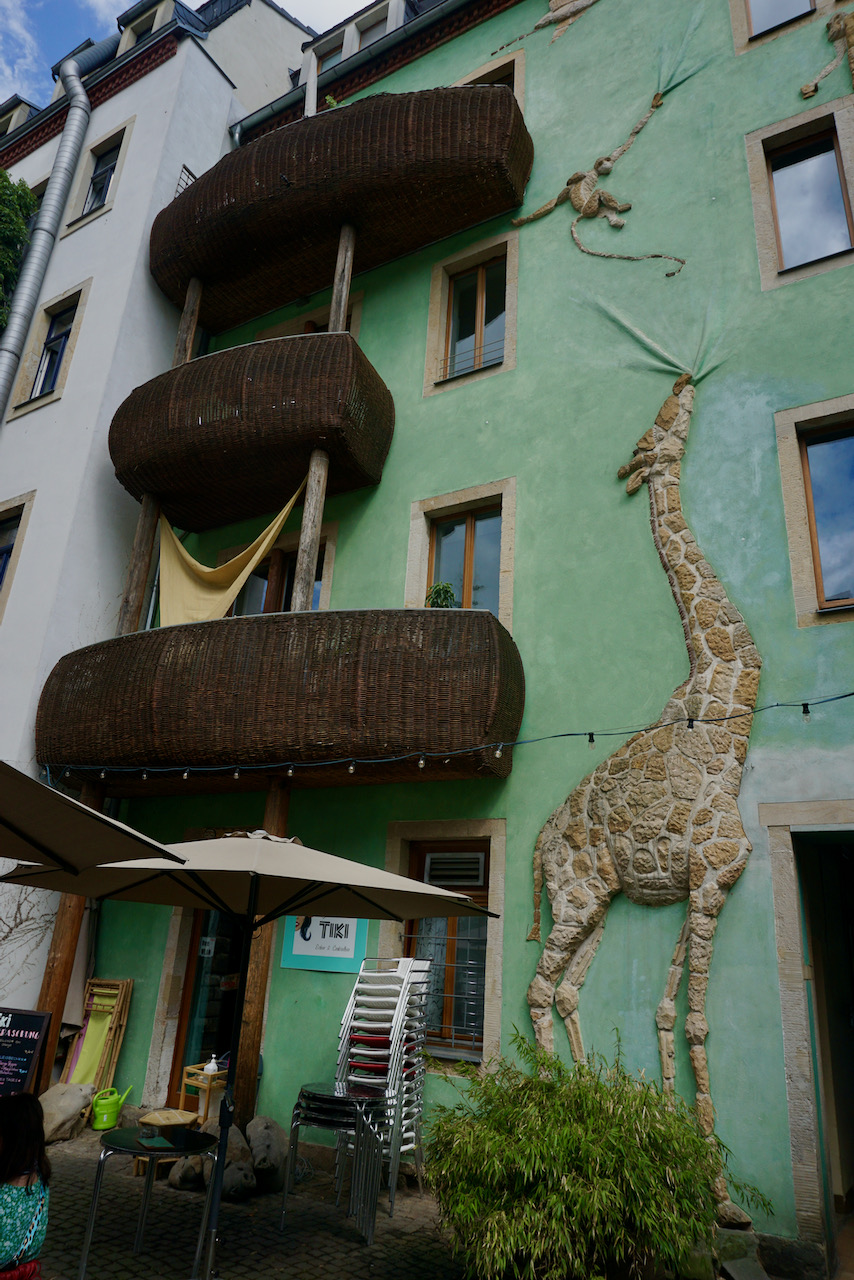
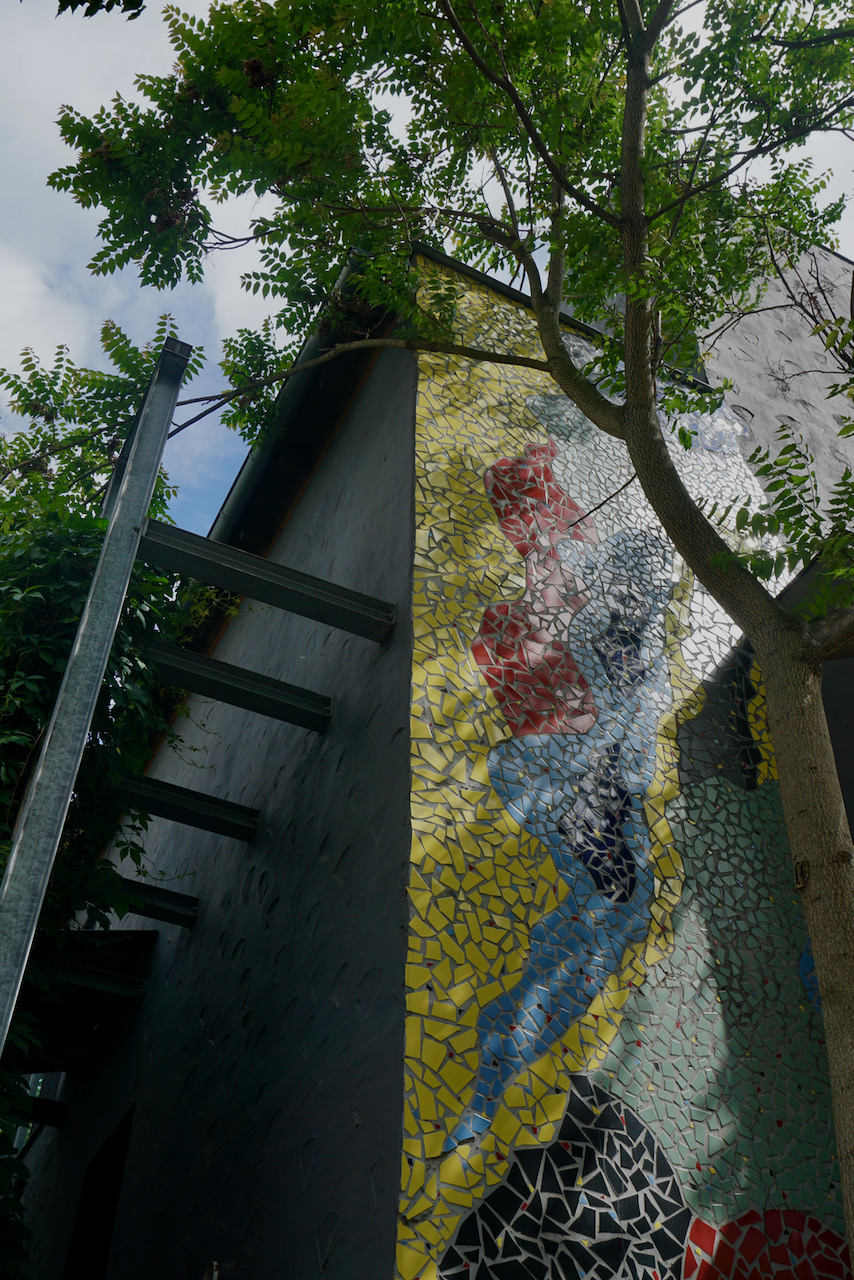
Just around the corner is the Kunsthofpassage, a series of painted courtyards and art galleries dedicated to different themes. I walked into many of the galleries just for a look around and would have loved a seat outside at one of the many cafés, but I was far from the only one with that idea.
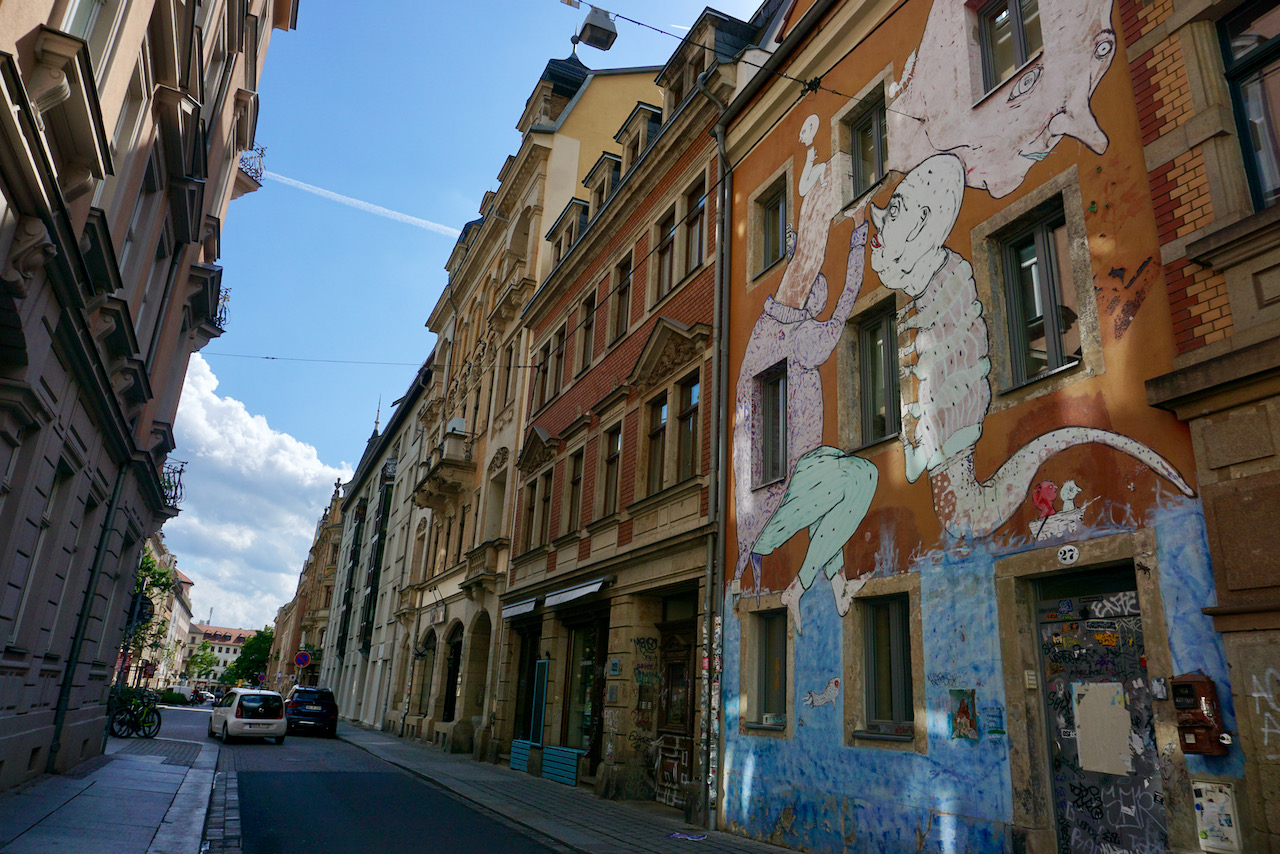
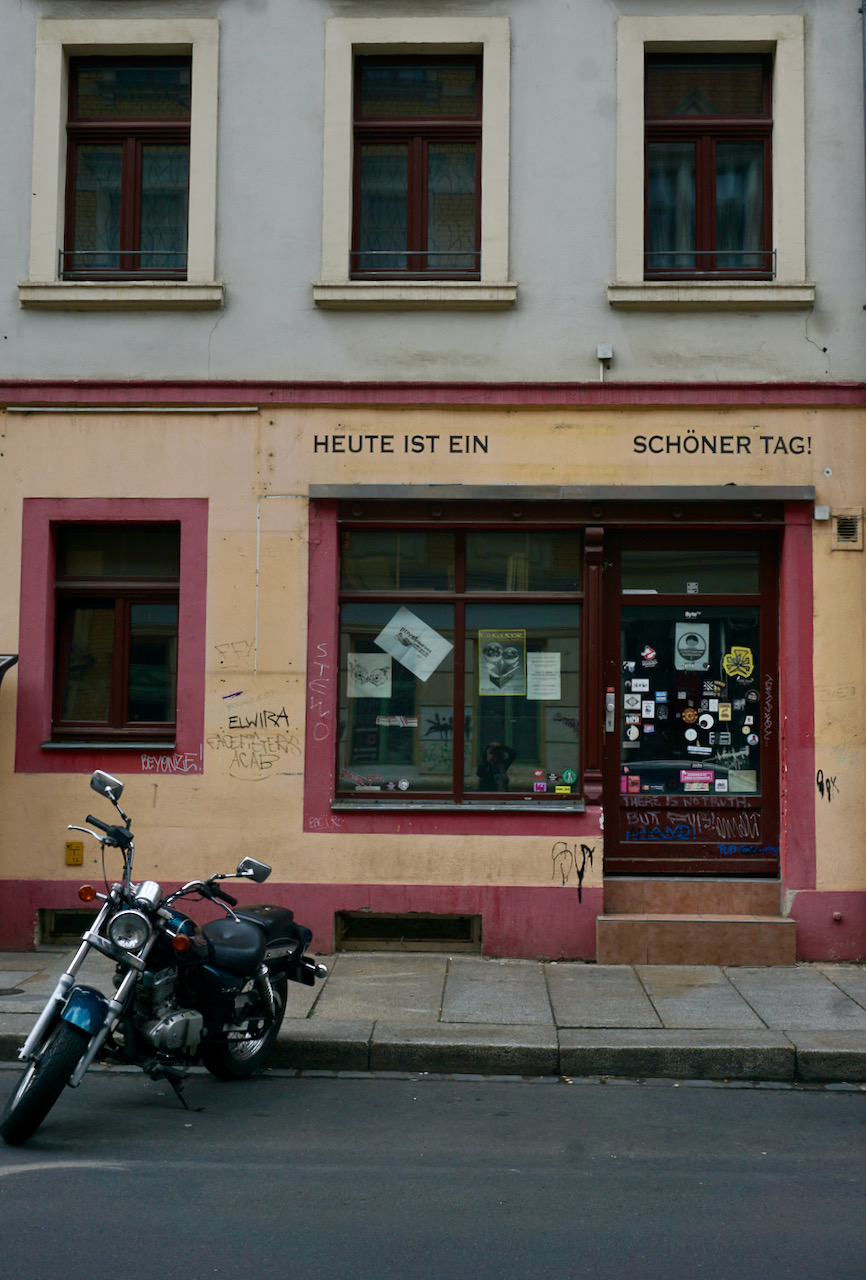
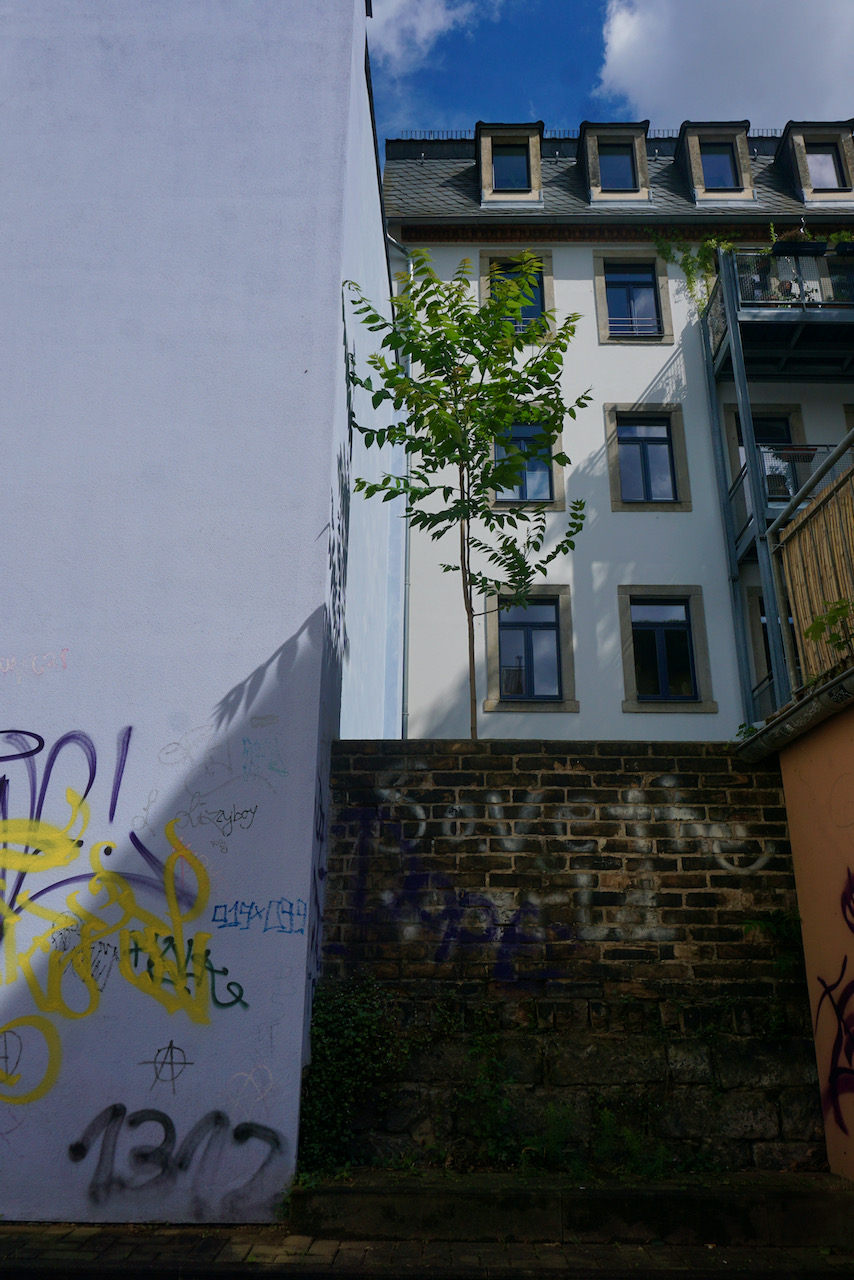
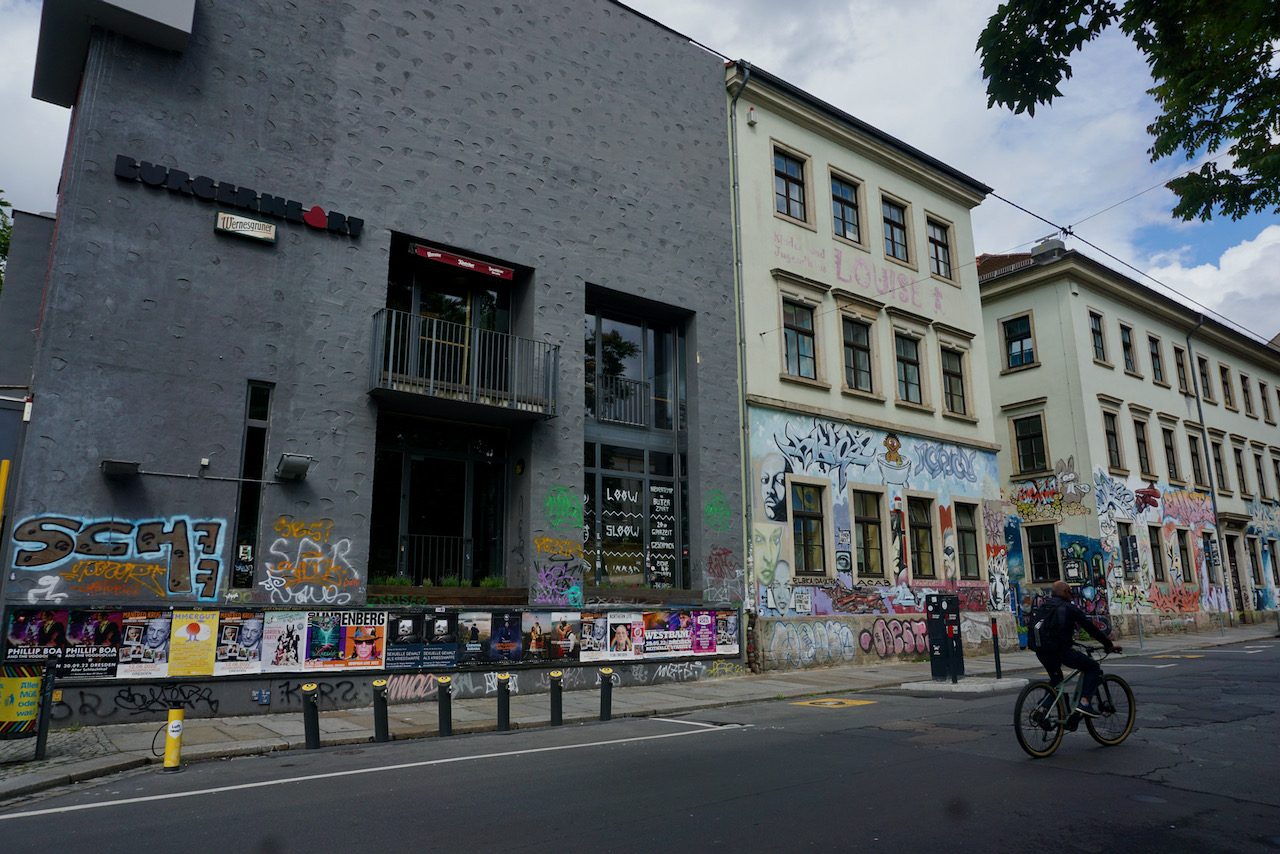
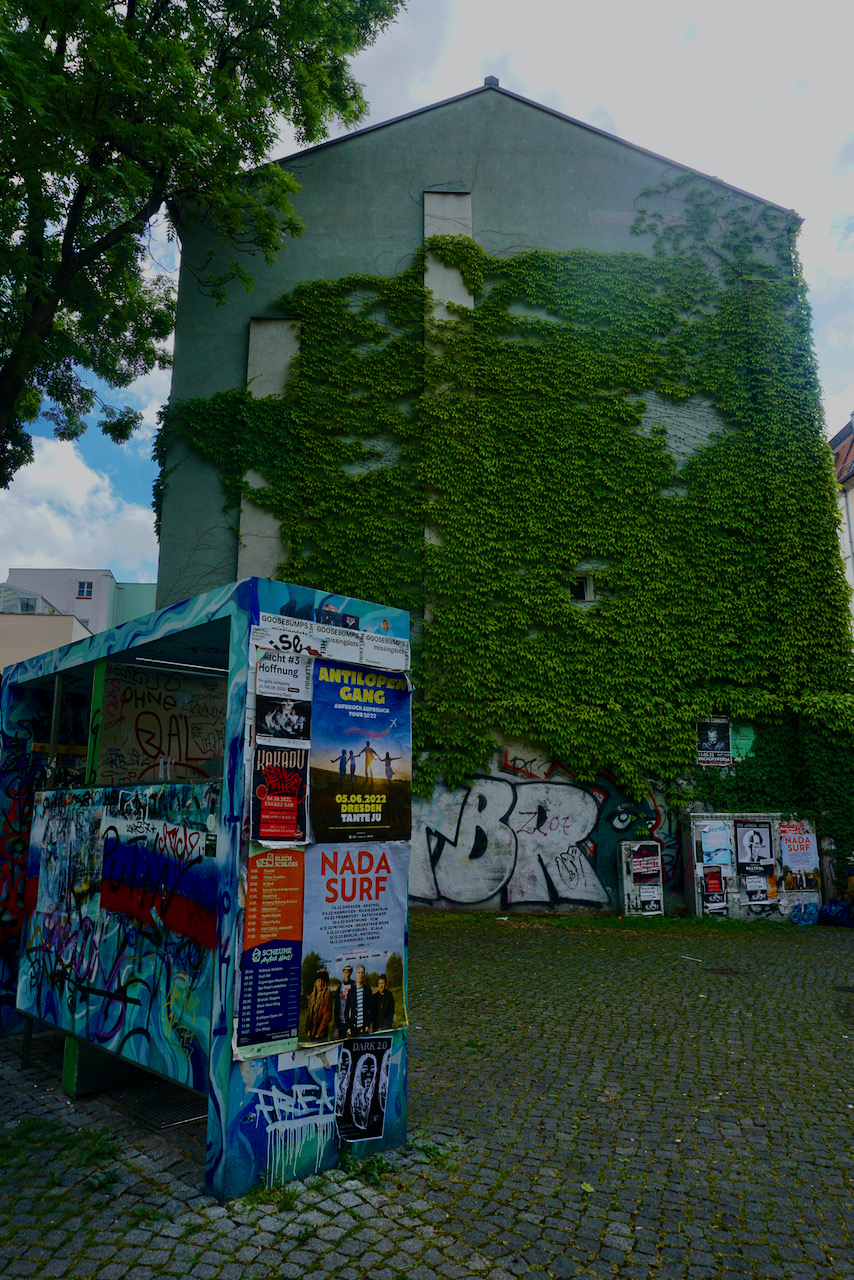
The rest of my afternoon walking through Neustadt was pleasant and the temperature slowly climbed, keeping me wandering down neighborhood streets that grew slowly more lively.
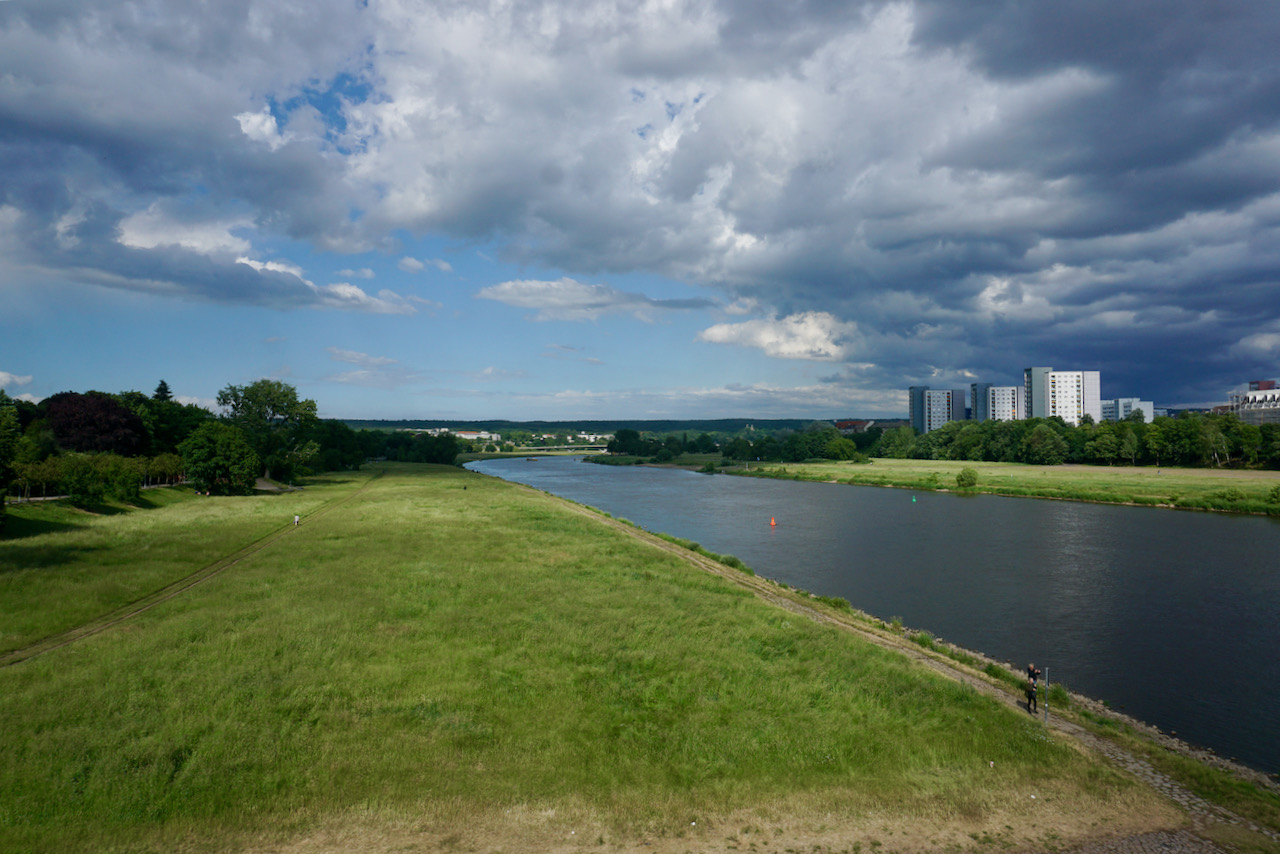
I spent the early evening sitting at a beer garden on the Elbe watching the sun, the water, and people enjoying their time outside. It seemed to me that the river is the soul of Dresden. This is where people play and gather and this, in my eyes, is what makes a place a home.
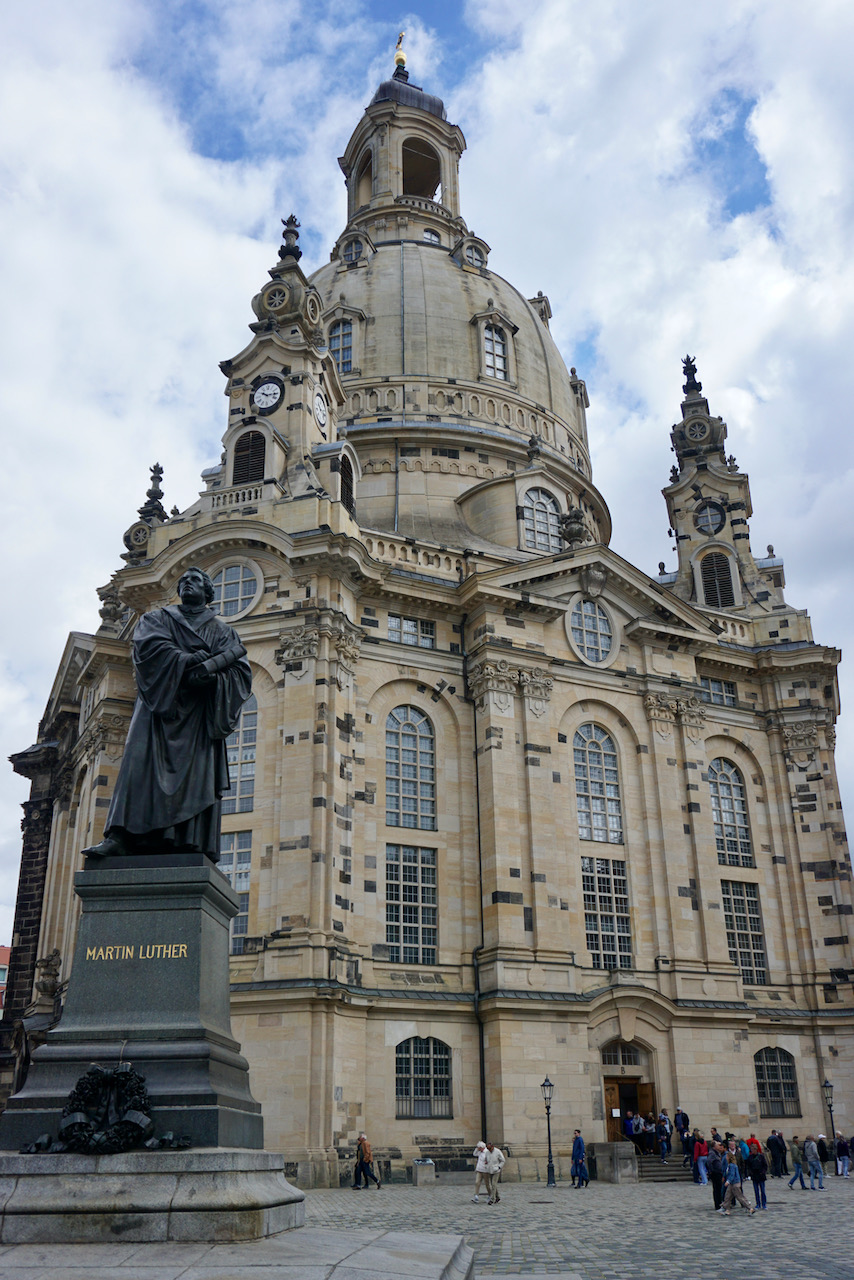
The following morning I stayed on the Altstadt side of the river and joined a walking tour to learn about the history of Dresden. We covered the time period from the Holy Roman Empire through present day, and I was again struck by how old Europe is. I am still tickled by this. Notable stops on the tour included the famous Frauenkirche, which was rebuilt using some of the recovered stone that had been part of a memorial after World War II . . .
. . . and the Fürstenzug, a porcelain tile mural first created in the 1870s that depicts the leaders of Dresden from 1127 until 1904 (the later part was an addition). Interestingly, the tour guide explained, the Fürstenzug survived the war with minimal damage because porcelain is heated to extreme temperatures during its production. As a result, the firebombing that destroyed the city did little damage here. I was intrigued to hear this, as well as to see the rather large club of bearded men (no joke) who were also there for a visit.
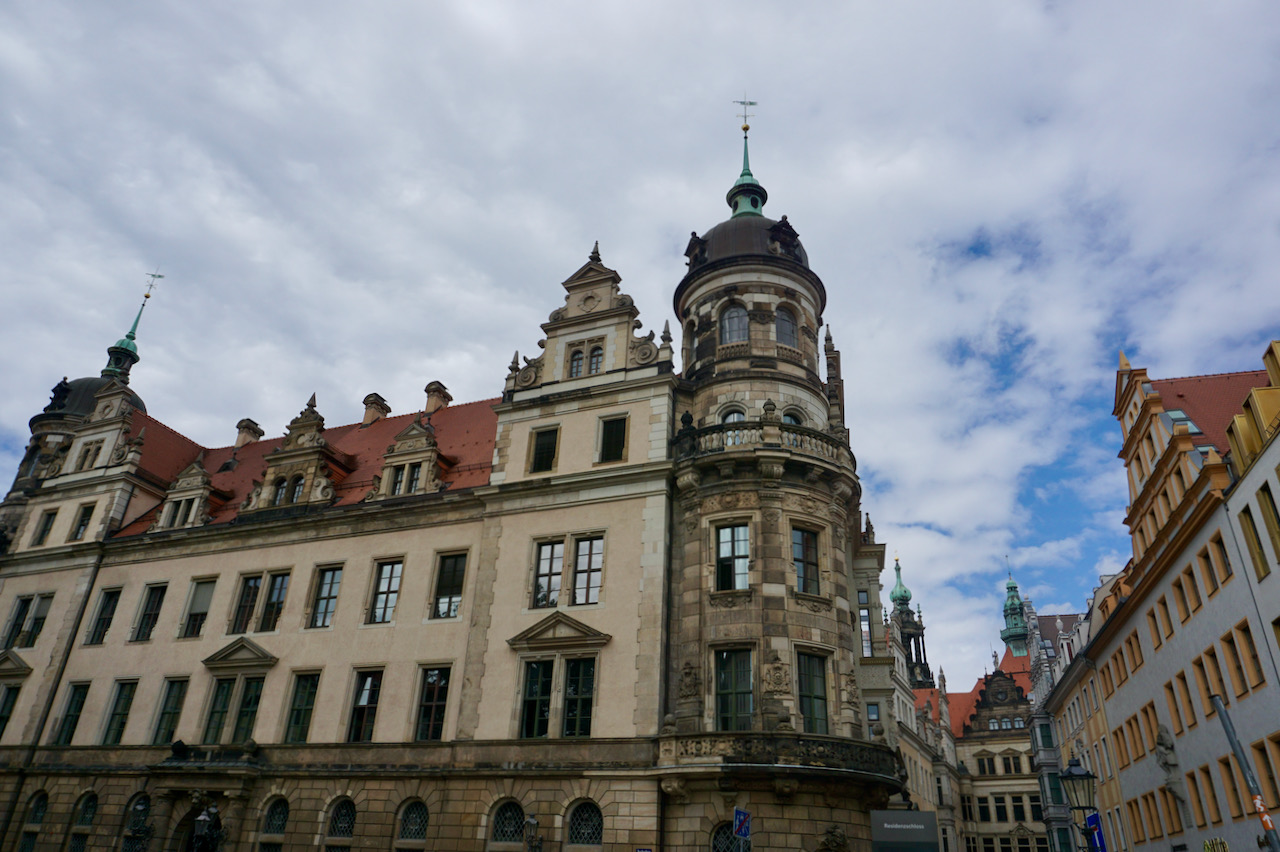
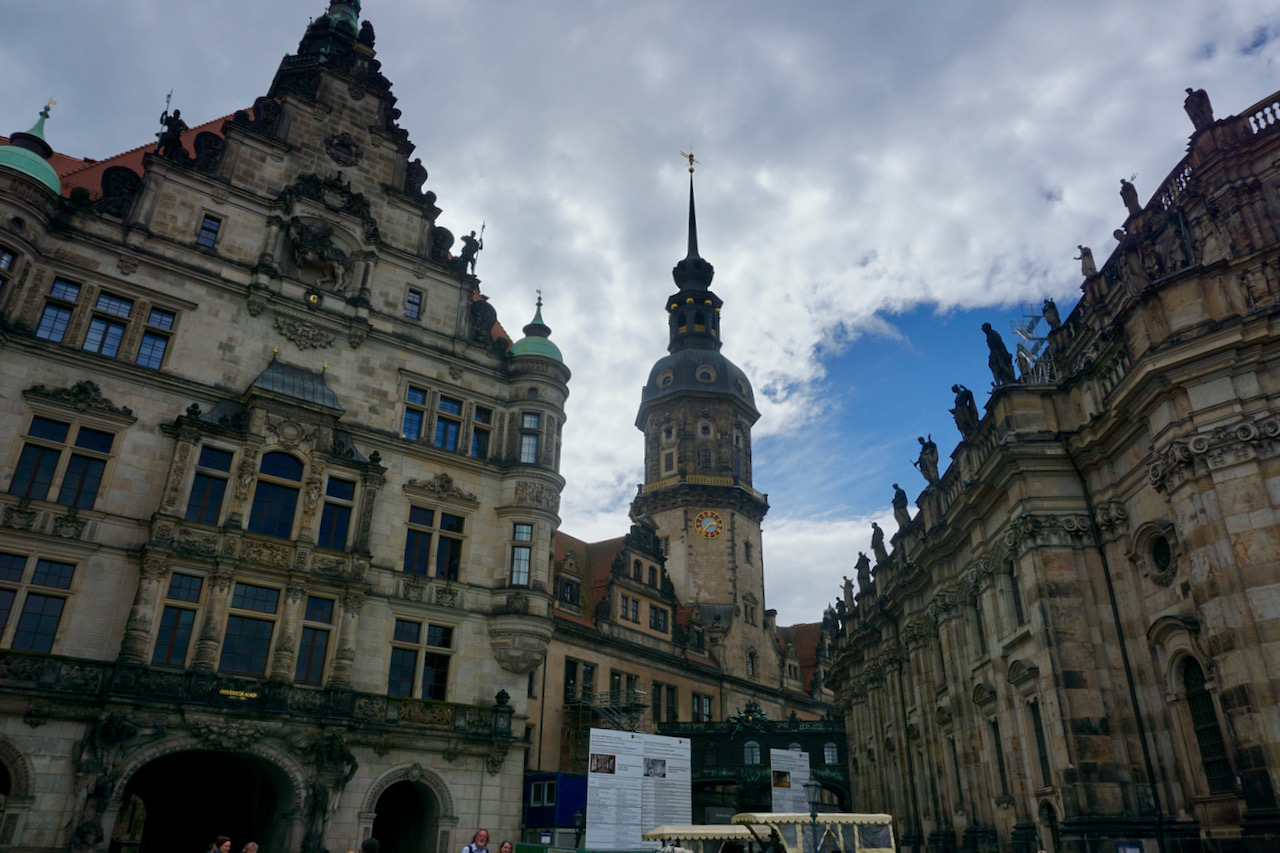
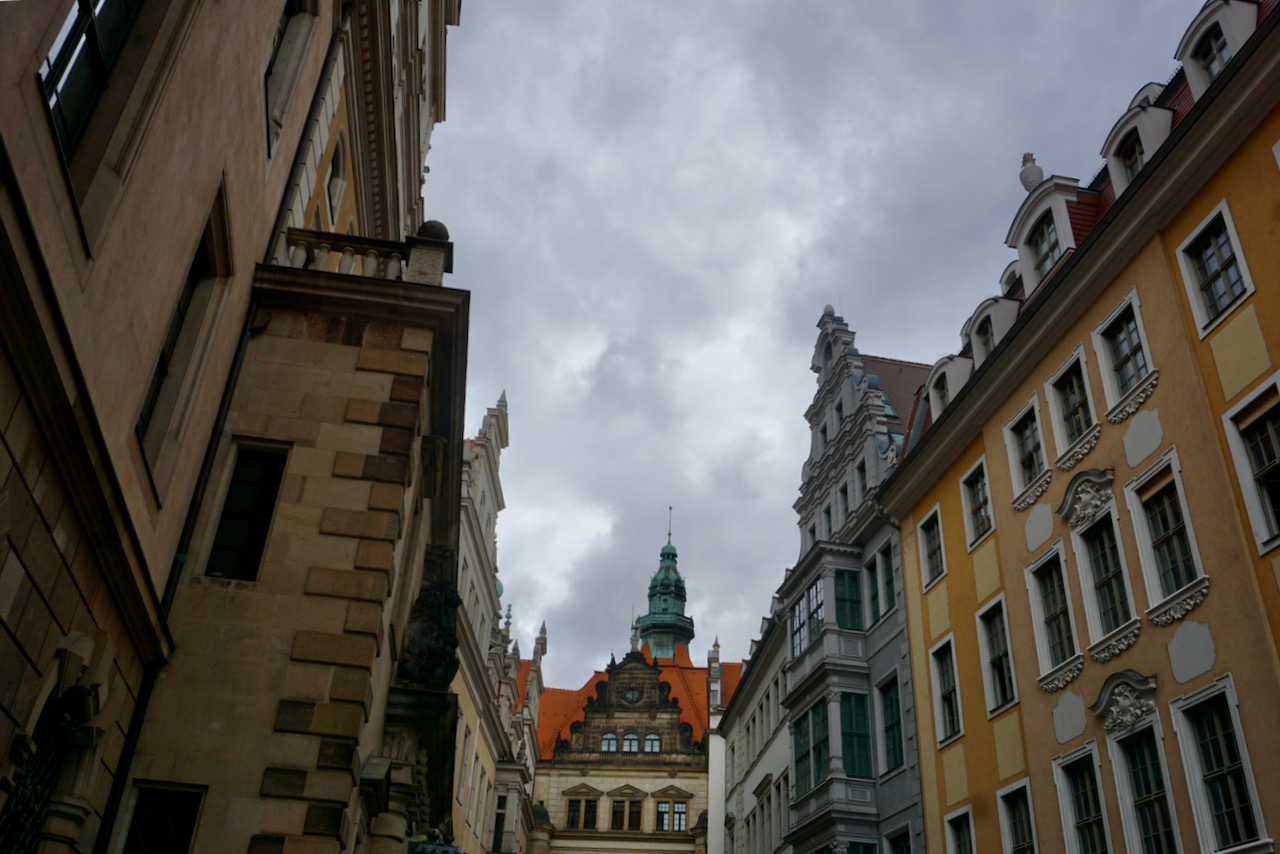
Our guide also took us through the inner courtyard of the Residenzschloss (residence castle) . . .
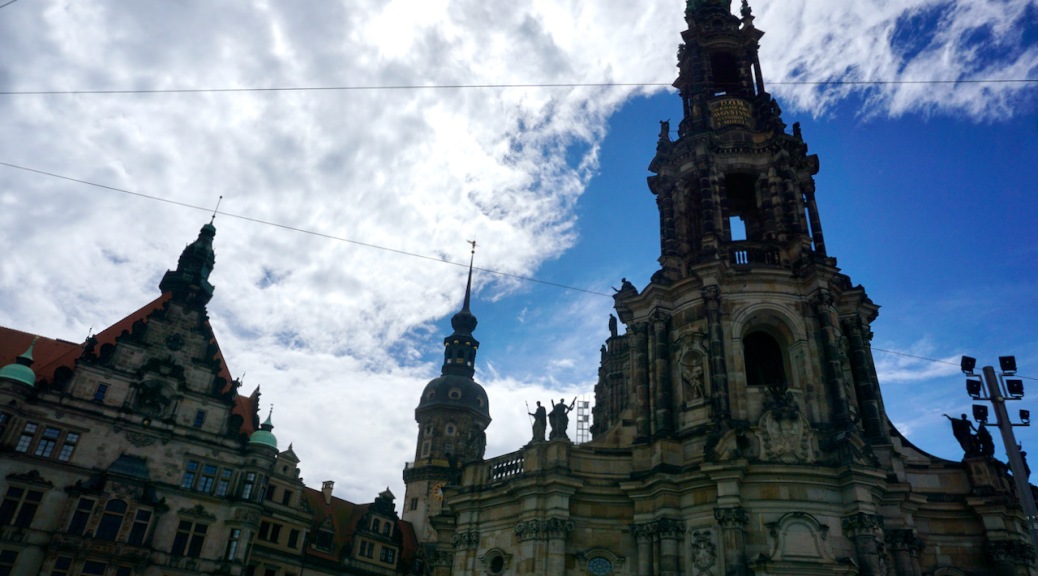
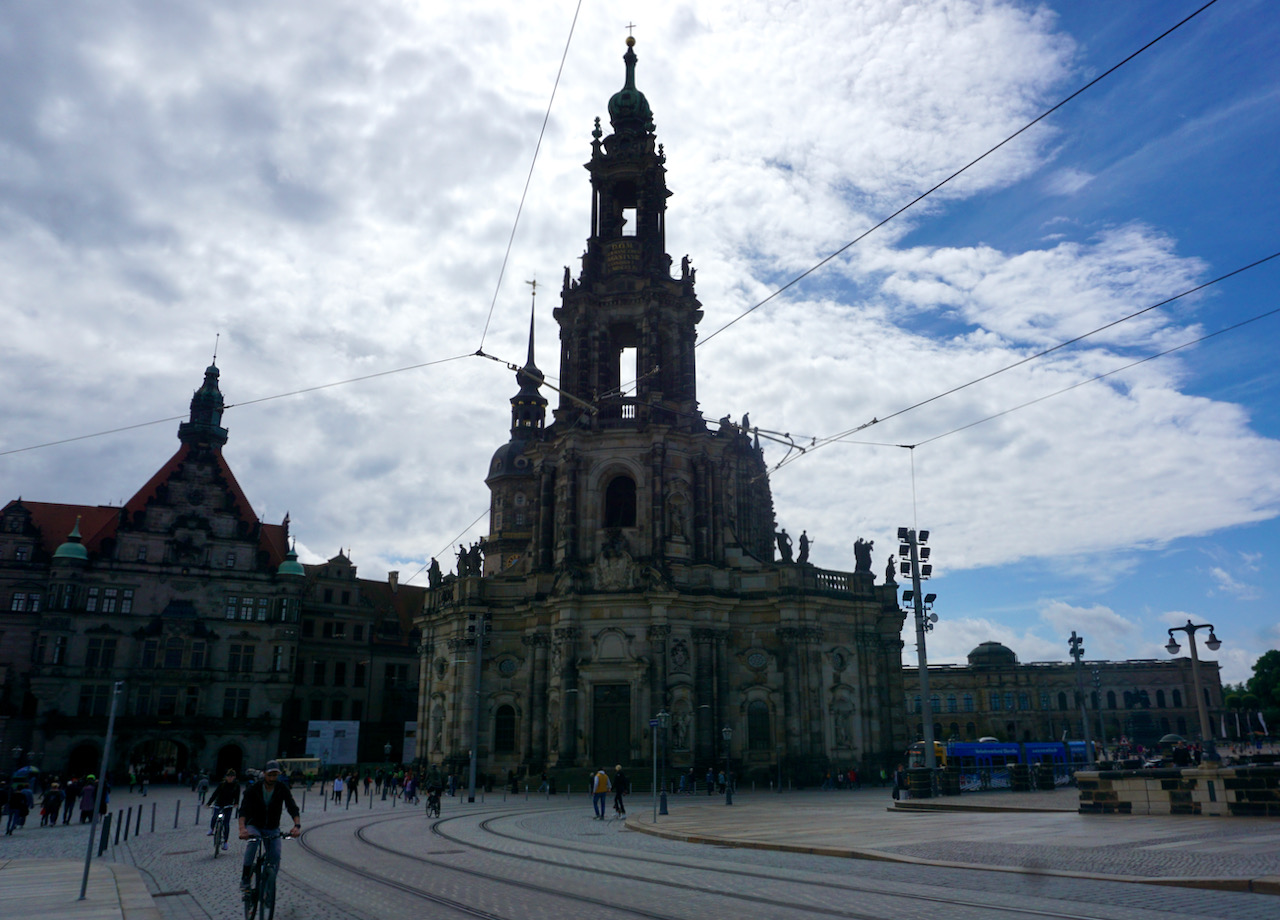
. . . past the Catholic church built by Polish king Augustus the Strong during his role as Elector of Saxony . . .
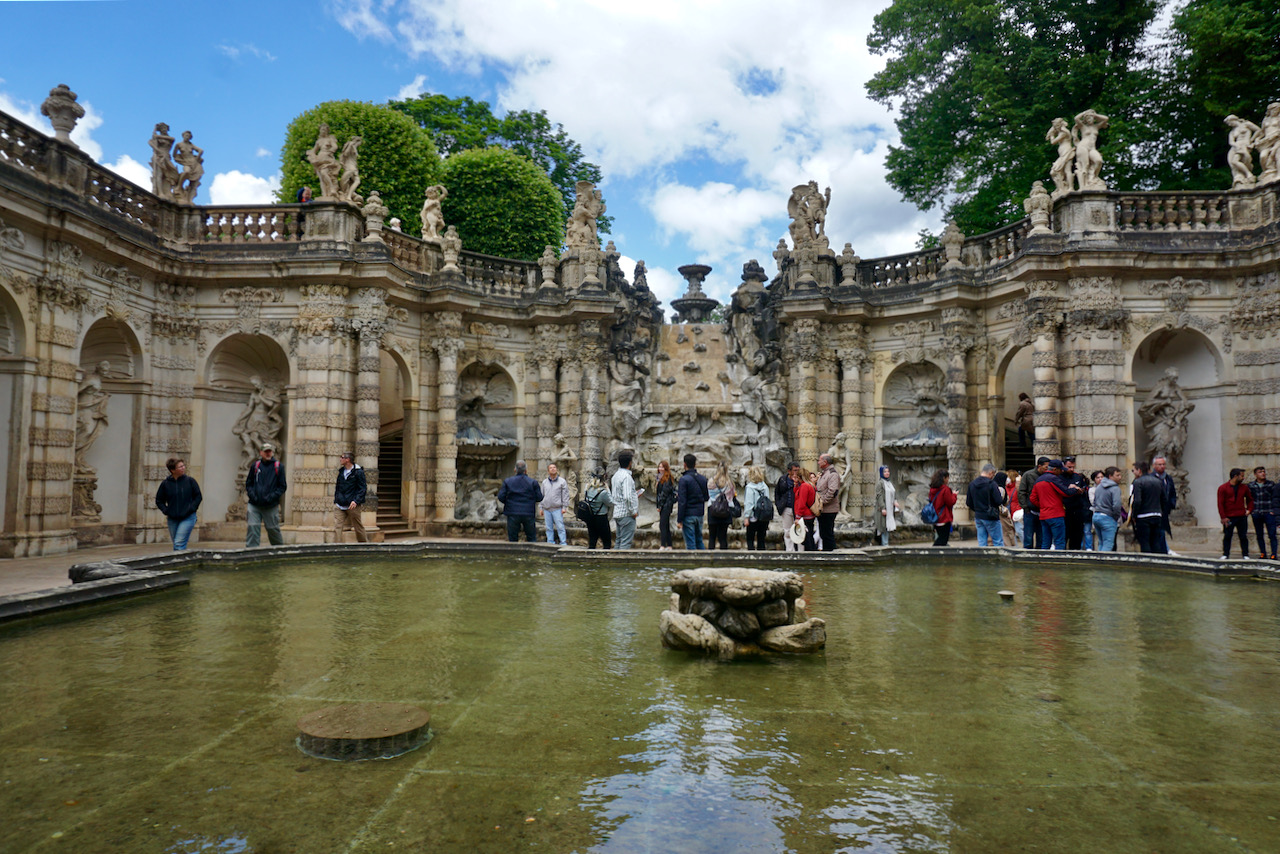
. . . the Zwinger Palace, also built by Augustus the Strong following a visit to Versailles . . .
. . . the Semperoper, Dresden’s opera house . . .
. . . and a mural celebrating life under communism that functioned as a wonderful piece of propaganda during its time.
As usual, there’s a great deal else to find in an old city with architecture that makes me wonder about the people who crafted it. These are stories I would like to hear.
To get out of the high winds that afternoon, I visited the Staatliche Kunstsammlungen Dresden (State Art Collection), which is particularly known for the Grünes Gewölbe, or Green Vault. There is a historic Green Vault and a new Green Vault, which contains stunning treasures housed in a normal museum (which happens to be the Residenzschloss) rather than in a literal historic green vault. I’ve been to many art museums, but never one with such whimsical works from centuries ago. Intricate carvings on everything ranging from a cherry seed to coconut shell, for example, as well as works of porcelain, glass, and ivory. I was also particularly interested in an exhibit on Ottoman military tents, which should give you a sense of the range of treasures this museum has to offer.
The following morning I visited the Stadtmuseum (City Museum), which utilizes a collection of artifacts to told the story of Dresden from its founding through the fall of the Berlin Wall. It was especially interesting to see repurposed military items from the Deutsche Demokratische Republik (German Democratic Republic, or East Germany), such as a bomb casing turned into a stove. The Stadtmuseum also highlighted Dresden’s Jewish history with the open question of how to reckon with history, a question that applies in so many societies in our world today.
By the time I needed to catch a train, I felt content with my solitude and comfortable enough with my surroundings to no longer feel lost. And by the time I returned, remembering my pounding heart as I arrived by train almost a year ago, I was fully glad to be back. It’s nice to go away for a while, and part of going away means coming home.
Photos, travels, musings, and ideas on education by someone trying to make the world a better and more peaceful place






















 By Rebecca Michelle