
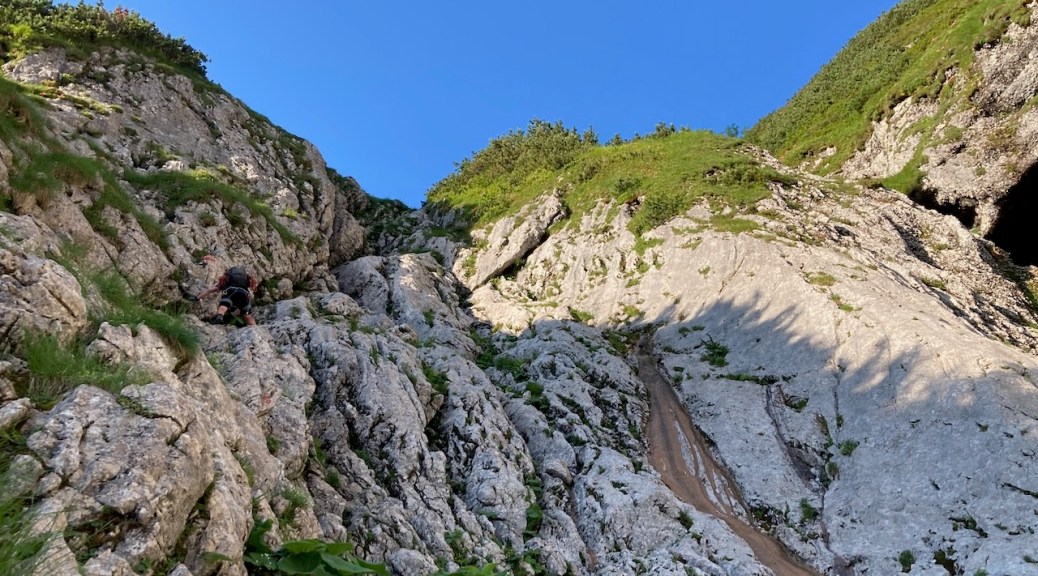
The weather has been unfortunately uncooperative for outdoor climbing this spring. Our nearest climbing area is in a forest and it really needs to be dry the day before an outing in order to get on the rocks safely. You can’t grip clammy stone. So we were delighted last weekend to have the opportunity to spend two days climbing outdoors, only our second time out this year.
It was quickly apparent, and completely expected, that we’re unused to the endurance and challenge of outdoor climbing. It was also very hot, which softens the hands, presenting an additional challenge. Outdoor climbing is part sport and part meditation, in that one tries to feel the rock, to understand it, to work with its nuances and quirks. There’s no bright colours telling you where the next move is; rather, you need to be attentive, responsive, creative, and flexible. You need to look for texture in the rock, which is often not there at first glance, and figure out what to do with it. It takes a few days outdoors each year to return to that feeling and to grow comfortable doing outside what we so easily do inside.
In the middle of the afternoon, we set a top rope on a route far too hard for any of us to lead, but one that looked possible when one remained secure the whole time, removing the fear and potential hazard of numerous expected falls. And fall I did, until I decided it wasn’t worth it anymore. My hands hurt, I swung out of the line and had to repeat each sequence to make any progress, and my belay partner was doing at least half the work by pulling me up past tricky areas that I couldn’t manage. And the route wasn’t even fun. After yet one more try, I called down to my belay partner to lower me. There’s no role for heroism in climbing.
Rather, climbing is about being part of nature, not fighting against it. Climbing is about listening to oneself, knowing when to push and when to back off. Climbing is about a healthy respect for fear, knowing the difference between fear that is manageable and fear that will overpower. The joy of of climbing is to reach beyond oneself and follow the rock.
We climbed long and hard that day, and I felt it in my fingers, hands, and throughout my body the following morning. A friend who is a much more skilled climber led a hard route as a warm-up and I fought my way up it, again on top rope, just for the experience.
And then the body had had it. I looked up at a route that was within my capacity but not easy, and then at another that was as close to a stroll as I would get that day. And then I ignored the difficulty grading in the guidebook and took the easy route. There’s no role for heroism in climbing.
As climbers, we celebrate falls. A fall means you’ve tried, you’ve taken a deep breath, you’ve pushed beyond the survival instinct that tells you not to fall. Amateur climbers often fear falling (it’s how the human species has survived) and that’s why we sometimes decide to practice. Falling happens so fast that you often don’t feel it at all. It’s the fear of falling, or the thought of falling, that can be debilitating if you let it. But then there are other circumstances where a climber would rather not fall, situations where the fall line could hurt. Risk-taking is part of climbing, but in a way that is managed. Things can, after all, go devastatingly wrong.
And so I listened to my body and climbed what I knew I could. We were on rocks that were brittle, rocks that were a little bit creakier than we would have liked. Sometimes, climbing can just be a lot of fun. It doesn’t always have to hurt.

 By Rebecca Michelle
Thank g-d. you have a head on your shoulders and you know when to stop. Please take care..Love Bubbie. ❣️
LikeLike