All posts by Rebecca Michelle

Educator, traveler, reader, blogger. Loves learning, black coffee, and friendly people.

“Who lives, who dies, who tells your story?”

This is our last week of school and it’s hard. Saying goodbye is difficult and it’s not something I’m good at. I hold on for too long. I reach out for too long. I grow nostalgic before it’s even time to say goodbye and I let myself feel all the things I’ll miss before it’s time to miss them.

I’ve said goodbye enough times to know which stories will stick, which memories will make me smile and which will strike a chord that hurts a little bit. I’m lucky to have taught students who ask real questions, seek out real answers, and report back what they’ve learned. I’m lucky to have worked with truly good people who welcomed me with open arms and saved me from my darkest thoughts. I will miss them all.

This year was my sixth year in the classroom and the first year I considered seeking out avenues outside the classroom to satisfy my need to make an impact on the world. I’ve got a few more things I want to do in the classroom and we’ll see after that.

This is also the first year I let myself entertain the possibility of all kinds of change because this is year that nothing went as planned.

So I’m saying goodbye to good people, a good place, and the path I was following when I co-signed a lease for a New York City apartment a year ago. I’m thinking about the life I want to live going forward so that I can be satisfied when I look back in 100 years or so. What will I have done? What will I be proud of? What will I wish I’d known?

As my therapist says, “What does your 95-year-old self say to your current self?”

I needed this year because I needed time alone to think, to take a step back, and to make the decisions that make the most sense to me rather than the decisions that I thought others wanted me to make. I needed this year to prove to myself that I am capable of making those decisions and don’t need to rely on the opinions of others. Being happy is okay. Making changes to be happy is also okay. Putting oneself first is okay, too.

My 95-year-old self wants to look around and know that she’s touched lives in positive ways. She wants to see family and friends who are global citizens, who believe in the possibility of improvement for all, who work to help those around them realize a better, more peaceful, sustainable world. She wants to have taught students who are good people, who help others, and who harness their interests and skills to have a positive, meaningful, lasting impact on the world around them. She wants the people around her to know that they are loved, supported, and affirmed as members of a community. She wants nature alive and well, ecosystems thriving. My 95-year-old self wants clean air and clean energy; she wants peace, prosperity, and good health for all.

So what does this mean for me as I am now?

It means that I will continue to learn, read, write, and communicate my aspirations and ideas. It means that I will continue to educate because I believe that the next generation of leaders needs more than they are getting in schools today and I want to give that to them. It means that I am looking to surround myself with people who believe that we can build a world that is better, more peaceful, and environmentally sustainable as compared with today’s world. I want to be around people who push me to ask questions, find answers, and be the best person that I can be.

Change does not happen overnight and it does not happen without allies. Change requires teams with a shared vision and I want to be part of a team making a real impact. That’s what I’m working towards.

“Who lives, who dies, who tells your story?” –Hamilton

I hope to live my story and I hope to find people who want to live it with me. If that’s you, post a comment below or send me a message through the contact page. I can’t wait to meet you.
P1090037

Visiting Roosevelt Island

Getting to Roosevelt Island requires nothing more than a MetroCard swipe. Just another New York neighborhood, right?

Wrong!

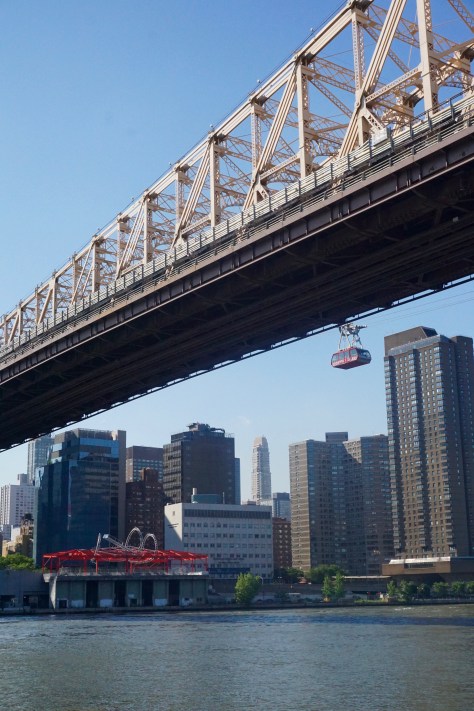
Roosevelt Island feels like a completely different world. It’s located in the East River between Manhattan and Queens and you can get there either by taking the F train or by taking the Roosevelt Island tram, which was a quick little ride. It’s a lot of fun to see New York’s streets from a couple hundred feet in the air.

DSC00294
You can access the Roosevelt Island tramway from its only station on 59th and 2nd.

The first thing I noticed is that Roosevelt Island is quiet. You can see all of Manhattan’s traffic on FDR Drive but can’t hear any of it. Roosevelt Island is only two miles long and you can walk the entire thing without needing to stop for a car to pass. About 12,000 people live in this strange little city of its own, with the helpful amenities of Duane Reade, a fruitcart seller, three restaurants, and a library and school.

What Roosevelt Island also has in abundance, however, is a lot of outdoor recreation space. This also made it feel like a completely different world. Manhattan does an excellent job of creating these spaces, but the number of parks, athletic fields, playgrounds, and pools on the island was really surprising. It even has a community garden with separate plots so you can have your own garden within a garden!


Once on Roosevelt Island, my friend and I stopped first at The Octagon, a fancy apartment building that used to be the main entrance to the New York City Lunatic Asylum:

People were taking wedding photos in front of it, which I can understand because the stone is beautiful. But I couldn’t help but think of Shutter Island and the sorrow of that story. What lives were lived here? What lives were lost? What stories were never told, or told and disbelieved?

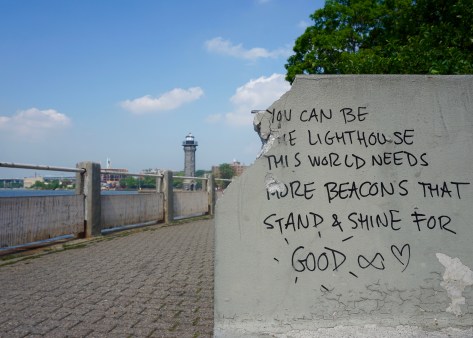
The spooky, eerie feeling of Roosevelt Island remained with me despite the heat and bright sunlight. Our conversation turned to other psychological thrillers and horror movies as we walked to the lighthouse at the northern tip of the island.

DSC00264DSC00267DSC00265

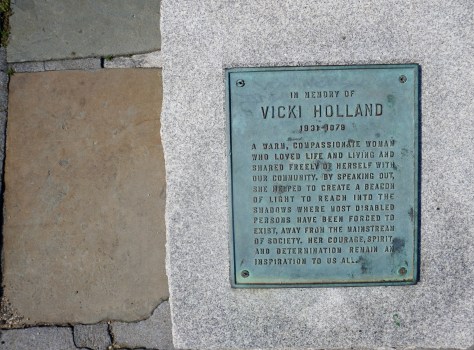
There’s clearly a legacy of advocacy on Roosevelt Island. The island is currently home to a K-12 school for students with disabilities, as well, so it was nice to see activism as a continuing conversation. Likewise, it was disturbing to think that such a calm, quiet oasis had been used as a place to remove individuals from society. (Kind of like Australia’s history as a British penal colony.)

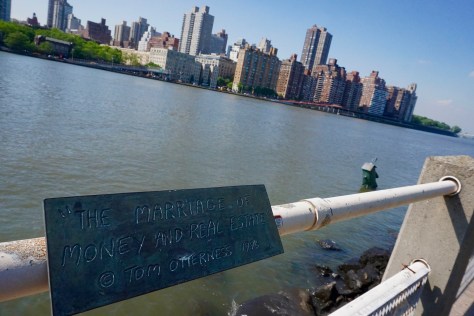
From the lighthouse, we walked south, passing by a modern art commentary on what Roosevelt Island and New York City often represent:

DSC00271DSC00274

Clever, right?

As we walked south, we also passed Blackwell House, which dates from 1796. It changed hands a number of times and often housed the administrators of several Roosevelt Island institutions. You can read about it (and about Roosevelt Island’s five other Landmark buildings) here.

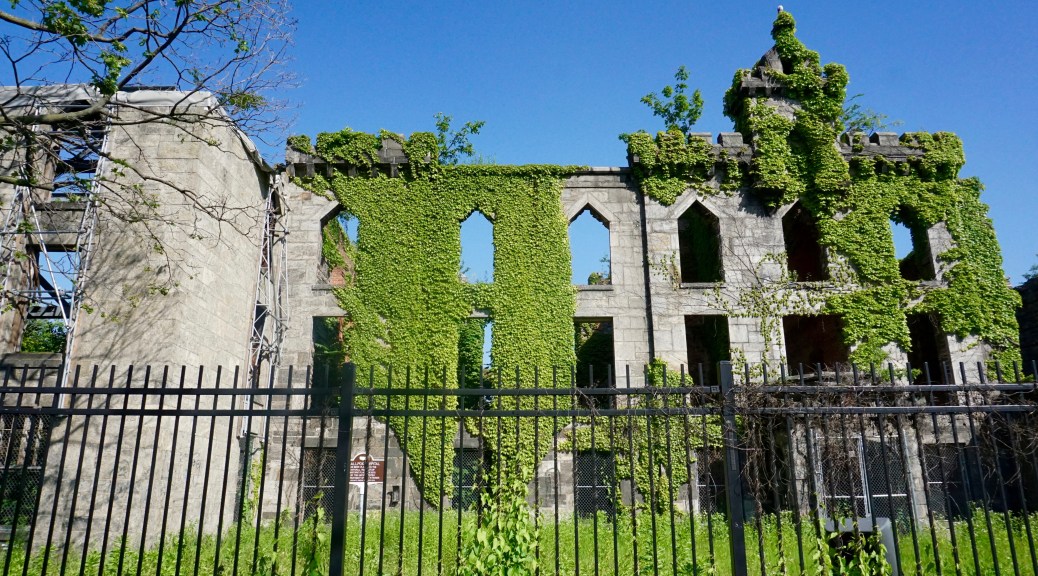
On the southern tip of Roosevelt Island lies perhaps its most interesting attraction: an abandoned smallpox hospital! The building was protected by a fence but the shell that remained, slicing straight through the sky, gave me chills:

At one time, those rooms were full. The walls closed in on the patients and on themselves. The ivy covering the building, blowing gently in the light wind, gave it a lifelike quality that juxtaposed sharply with the empty tree branches. Something’s wrong here.

People were quiet as they approached, looked around, took photos, and continued walking south to the park, concert venue, and memorial to President Franklin D. Roosevelt that occupies the remainder of the island. I won’t say that I believe in ghosts but if I did, I’d be certain that this island is haunted.

And that’s reason in itself to go visit! Happy exploring!

DSC00262


The Day After the Worst Day

Recently, a friend mentioned seeing a segment from reality TV show in which participants discussed the worst day of their lives. I immediately cast my brain around to unpleasant areas and two days came to mind, though not in the way I expected.

I thought first of the night when my dad looked at my sister, brother, and me sitting around the kitchen table and said, “Mummy and Daddy won’t be living together any longer.” And then he started to cry. So did we.

I thought next of the morning when my now ex-boyfriend and I ended a relationship that had lasted eight and a half years. Calmly, in a fog, I looked at him and said, “Okay.” I did a lot of writing that day.

There’s a lot that I remember and still viscerally feel about those moments. I remember tone of voice and facial expression and it still makes me ache. As I write this, my breathing has constricted and my stomach has clenched. My hands are shaking over the keyboard and my chest hurts. I remember the feeling that came later: anguish, despair, and the sense of falling into thick, dark, unforgiving blackness.

But what I can’t remember at all is the day after each of those events. I can’t remember the day I got out of bed after what must have been a sleepless night and had to cope with a reality that, mere hours earlier, had been unimaginable. The day I had to begin relearning how to live because the way I’d been living no longer existed. The day the nightmare inside my head grew louder as time passed instead of fading.

I can’t remember the day after. I can only guess as to what happened.

This is probably a neural defense mechanism. My brain has probably suppressed the memories of the day that followed my parents’ separation and my breakup because they’re painful, harmful, and detrimental to my daily functioning.

The brain’s purpose is to keep you alive and the way that happens is fascinating. During a traumatic episode, the flight-or-fight response activates, leaving a sketch of what happened but relatively few details. The brain and body need to focus exclusively on getting you out of a dangerous situation. Both adrenaline and noradrenaline are released to allow you to respond quickly and to fight or flee as needed. Adrenaline blocks out non-essential information to focus on the essential (the quick response) and noradrenaline destroy’s the brain’s ability to store memories. Basically, the brain focuses on getting you physically out of a dangerous situation or mentally through a traumatic one and it streamlines its neural processes in order to do that. (Useful reading: Why Can’t Accident Victims Remember What Happened to Them?)

I’m willing to guess that this is what happened in the aftermath of my worst days. I have flashbulb memories of the specific events themselves (truly, neither of them fall in to the trauma category, which I’m inclined to reserve for real disasters, death, violence, sexual assault, etc.) but it seems that my brain’s neural processes interfered with my ability to remember the day after in order to keep me putting one foot in front of the other.

Since my hypothesis is based on one anecdotal example, I’m wondering about others’ experiences. Can you remember the day after a traumatic event? If so, is there something specific about that day that you remember? By contrast, is there a gap in time that you don’t remember? Have something else to say or a different idea entirely? Post a comment or send a message through the contact page. Thanks in advance!