The new school year begins tomorrow and I would normally cap off the summer holidays with a dinner out with my family or friends. However, this is a year of great change and I’m alone tonight. I didn’t want to go out alone, though that’s something I am more than used to doing because of traveling. I did want to do something out of the ordinary, however, so I made pizza.
I don’t write recipe posts nearly as often as I should for the amount that I cook, but I figured I’d write this one because it’s a super easy recipe that a typical working person might actually attempt. (I’m also a bit sad at being alone and writing gives me something to do.)
What You Need
Precooked pizza crust (I normally aim for whole wheat but couldn’t find whole wheat pizza crust in either of the two stores where I do most of my shopping)
1 clove garlic
About 10 oz fresh spinach
Sundried tomatos in oil, sliced into julienne strips with 2 tbsp oil reserved
Kalamata olives, halved
Feta cheese
Red pepper flakes
What To Do
1. Preheat oven to 450ºF
2. In a frying pan on low heat, warm 2 tbsps of oil from the sundried tomatoes
3. Add garlic and sauté for 1 minute
4. Slice spinach leaves into strips and add to pan; sauté for 1 minute
5. Top pizza crust with spinach mixture and as many sundried tomatoes and olives as you’d like
6. Scatter as much feta cheese as you’d like on top
7. Bake for 8-10 minutes until crust is browned to your liking
8. Finish with a sprinkle red pepper flakes for added heat
And that’s it! There’s obviously a lot of choice and personal preference here and let’s face it, it’s pizza. Pizza can literally be anything and it’s almost always tasty.
My new teacher orientation finally starts on Thursday. I’m teaching grades 6 and 8, which are both new to me. Teaching, however, is not new. This will be my sixth year as a teacher and each year has gone faster than its predecessor. By the end of this year, I will have taught every grade that my 5-12 social studies certification allows and I’m pretty excited about that.
I wanted to put together a short post on the difference between fairness and equality. The ideas reflected here are also found elsewhere on my blog, but I hope to clarify why I find this distinction so important in the classroom. Many of my personal beliefs on this topic stem from my Master’s program in inclusive education and my experiences teaching at two international schools where students speak literally dozens of languages.
What follows is an explanation of the difference between fairness and equality, how I encourage student discussion on the topic, and why I feel differentiation and conversation about it are necessary.
Background
We spend a lot of time discussing fairness with young children. We teach them about taking turns, about sharing, and about making sure each child has the same number of cookies. We might call it fairness, but we are actually promoting equality, which is not the same thing. Equality means treating everyone the same way. It means providing each child with the same number of turns on the swings, the same number of carrots, and the same choices between which two books to read.
As children grow older, they begin to realize that they are not treated the same way as their siblings or classmates. They cry out, “That’s not fair!” when parents or teachers treat different children differently. (In my parents’ house, my dad’s stock response was, “Tough” while my mum preferred a calmer but equally devastating, “Life’s not fair”.)
What children mean is that what they are seeing is not equal. It is likely, however, completely fair.
From an educational perspective, fairness means providing each student with what he or she needs in order to be successful. Different students need different supports to achieve a desired outcome. As parents and teachers know, fairness means approaching each child differently based on different needs. Treating everyone equally, as though the are the same, is counterproductive to the goal of success.
Discussing Fairness in the Classroom
I like to discuss the difference between fairness and equality with my students. It leads to really interesting discussions about students’ individual needs, backgrounds, experiences, and goals. Most importantly, openly discussing fairness helps students realize the danger of assuming that a single way of helping others will work for everyone who needs help. It also helps them understand why so many people struggle in so many different ways.
Generally, I start the discussion of fairness and equality by showing students one of my favorite educational cartoons and asking for initial reactions:
The cartoon usually gets a laugh and responses like, “That’s stupid” and “Fish can’t climb trees” and “Obviously the monkey will win”.
This, I assure my students, is precisely the point. The next question I ask is whether they have had this experience in their own lives, particularly in school.
Students are usually quiet for a few moments. Inevitably, one student will volunteer to share a time when he or she was unprepared for a test because of switching schools, missing class time, difficulty understanding material, language barriers, struggles at home, etc. Once one student begins to talk, the rest of the class draws similar conclusions. (Pedagogical note: I am a huge fan of think-pair-share activities during discussion.)
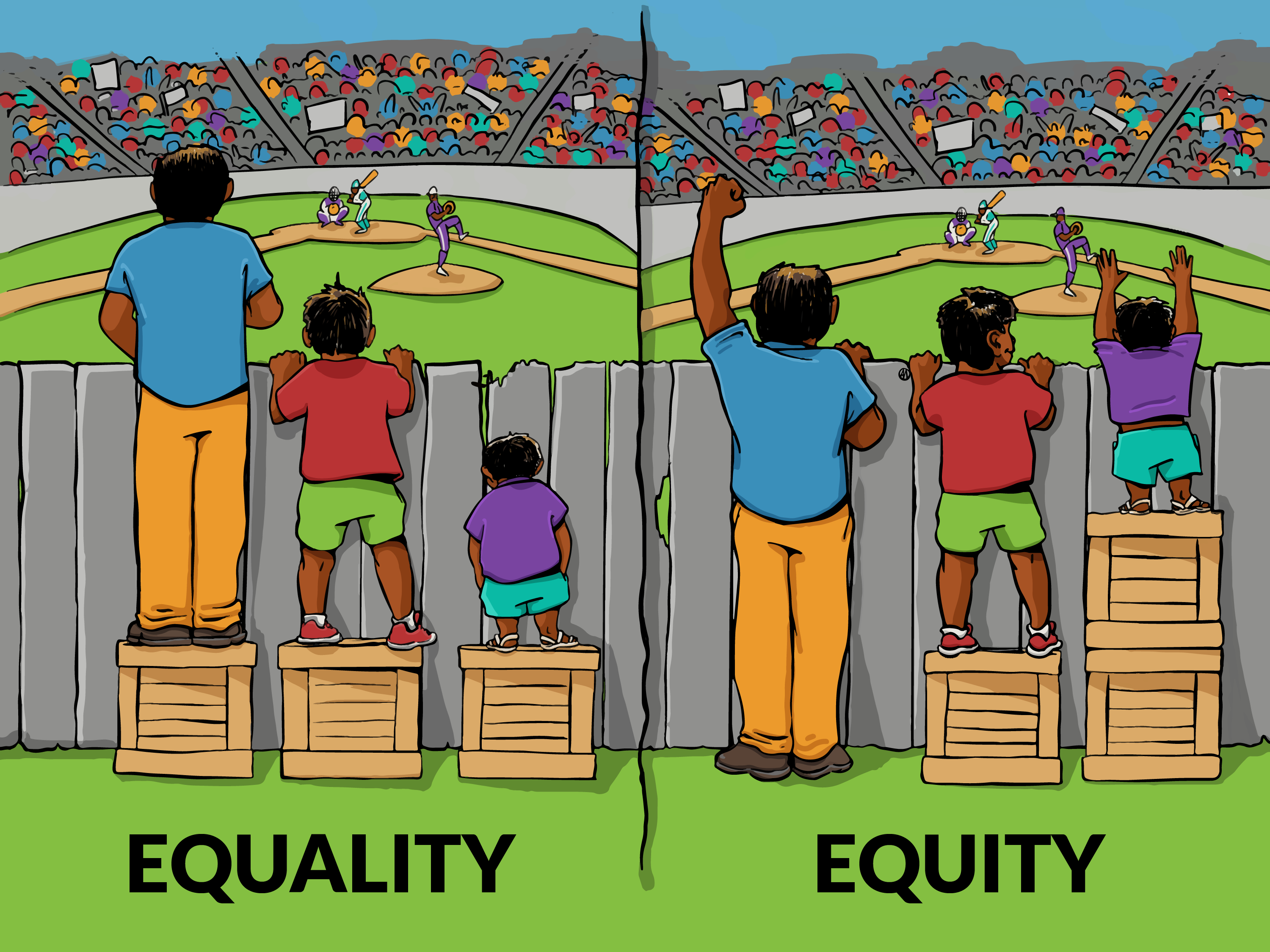
This image above acts as our example of equality for the discussion that follows. All the animals in the image are being treated equally, by simple fact of definition. They are being treated the same way.
I can usually count on a student to point out, “Yeah, but that’s not fair.”
Once that happens, I know my students are ready for the second image:
This is the first time many students will interact with the word equity, so we discuss it in context of fairness, a word they already know. We discuss the situation students would prefer to be in. I ask whether or not they believe that it is okay for the people on the right to have extra support.
When I then ask students to reflect on where they see this in their personal lives, many of them draw on relationships with their siblings. They talk about times when they weren’t necessarily treated equally (i.e. being responsible for different chores) but they do understand how they were being treated fairly (i.e. everyone had a chore, but you can’t expect the youngest sibling to walk the dog alone).
Students also talk about their school experiences, often using each other as examples. One of my English language learners last year pointed to his best friend and said, “I think Daryl is super lucky because he can use a translator for the test but I’m really the one with an advantage because my English ability is better than his. If Daryl didn’t have the translator, the test wouldn’t actually show what he knows about the topic. It would just be another language test.”
That’s precisely the point.
Students are very, very practiced at seeing the differences between themselves and their peers. They miss relatively little. Giving students the words to talk about what they’re seeing allows them to understand why there are differences in the ways teachers approach different members of the class. It also helps them understand the purpose and necessity of government policies that provide aid to certain groups of people in a variety of contexts.
Addressing Opposing Arguments
I have always had students who argue that giving each student in the room the same test is the only way to truly be objective and unbiased in finding out who knows the most. (In case you were unsure, I am against everything that resembles a traditional sit-silently-and-race-the-clock model of filling in bubbles to find out what students know.)
Since I work really hard to cultivate students’ individual voices in the classroom, I can usually rely on other students to challenge this position and provide evidence that helps the rest of the class develop more nuanced understandings of fair and equal. Depending on the age level of the students and the political bent of the school (unfortunately, this is actually important to be aware of) I may choose to segue this discussion into politics and economic policies, specifically addressing facts and myths surrounding public assistance.
However, in school environments where educators’ academic freedom is more limited or with younger students, it is generally more productive to pose a version of the following question: How can we find out what students know in ways that are fair rather than equal?
I have found that reframing the conversation around fairness, rather than letting students get hung up on their understanding of objectivity, is the more useful discussion. It challenges students to focus on what different individuals need to be successful, while also providing them with an opportunity to talk about formative and summative assessments that think best allow them to demonstrate their knowledge.
Why It Matters
Each student brings a unique background, perspective, set of circumstances, hopes, dreams, and experiences to the classroom. Assuming that an individual student needs exactly what his or her classmates need is harmful not only to the student, but to the rest of the class, as well. Some students need breakfast before we can expect them to learn, while others need additional learning activities to reinforce what they did in class that day. Still others need more difficult questions to consider that help them understand information in a more complex way.
Considering all of these student needs and coming up with one set of activities, one set of questions, one homework assignment, and one assessment might mean that we are treating all students equally.
But in doing so, we would not be treating them fairly.
I am not saying that we need a different lesson plan for every student. What I am saying is that we need to carefully consider what our students need to be successful, and we need to adjust accordingly. We need to take into account who our students are and where they come from. Ignoring all of this and assuming a tabula rasa model of the mind does a disservice to students’ individuality and diversity.
Conclusion
Differentiation takes time, practice, and collaboration with colleagues. It means preparing multiple modes of exploring and interacting with new ideas and concepts. It also means providing variety or choice in assessment of knowledge and learning.
The more differentiation students see in the classroom, the easier time they will have discussing and exploring the difference between fairness and equality.
I believe this is an important conversation to have with students because it draws on their experiences in and outside of the classroom and will prompt them to look around at their world. Students will begin to see circumstances in which fair does not mean equal and circumstances in which equal is actually harmful.
Encouraging students to question what they see is a key part of working to make the world a better place for all. Change is certainly possible, but not if we don’t point out what needs to change. We need to encourage the questions, help students evaluate solutions, and take into account what differences exist and why. Being open to these discussions is necessary for developing a better, more peaceful world
And speaking of being open to discussion . . . If you’ve had similar conversations with students, I’d love to hear about them. Other ideas on differentiation or fairness in the classroom? Comment below!
This has been a week of a lot of change. Change is always hard, whether it goes as planned or not. This has been a week of new situations, new decisions, and new choices. None of this is easy. New things are rarely easy.
But things get better.
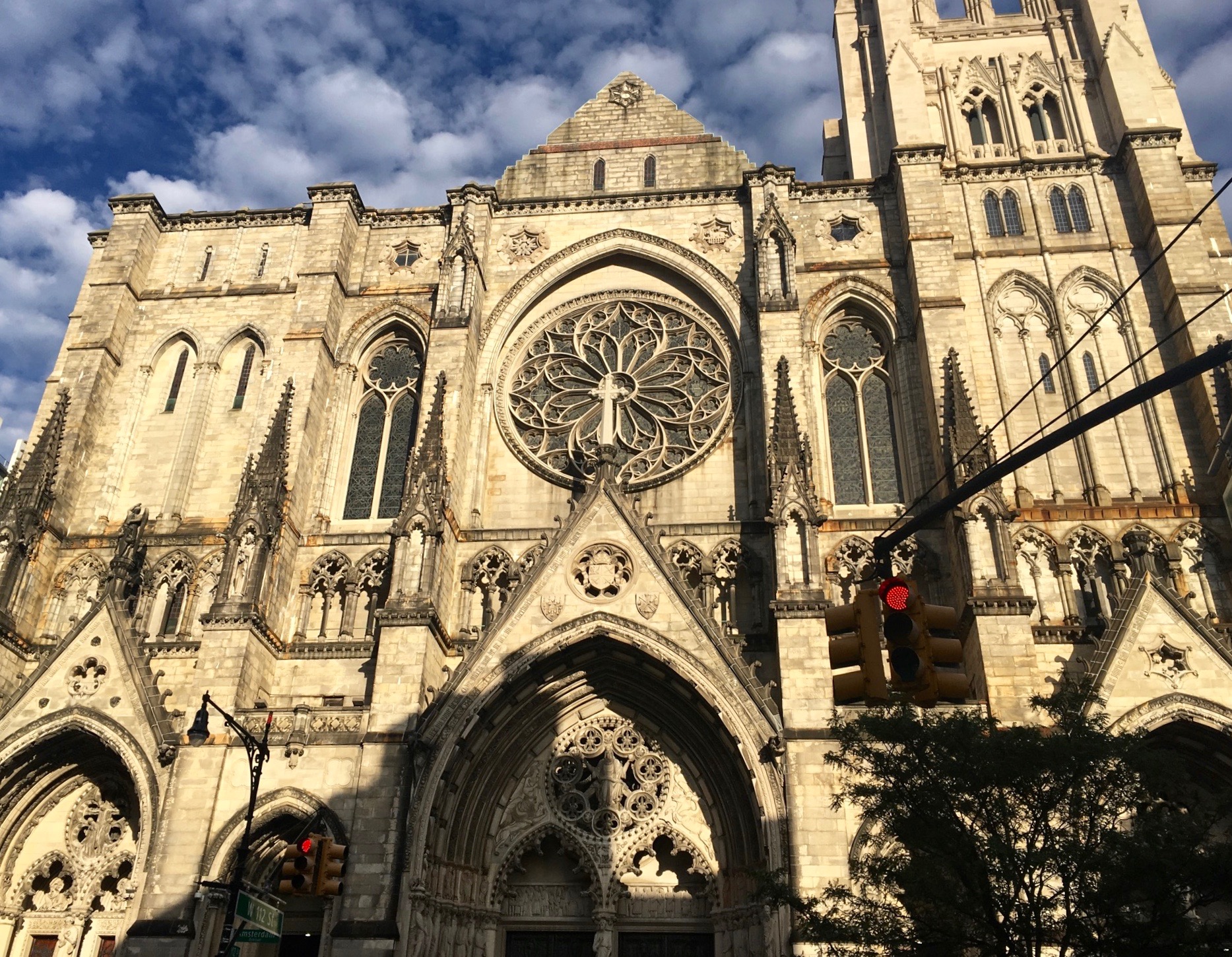
I’m beginning to like New York, which has surprised me. I didn’t know if I would. New York might be big, loud, and fast, but it also has a lot of beauty to offer. I wasn’t expecting that. For example:
Cathedral of Saint John the Divine
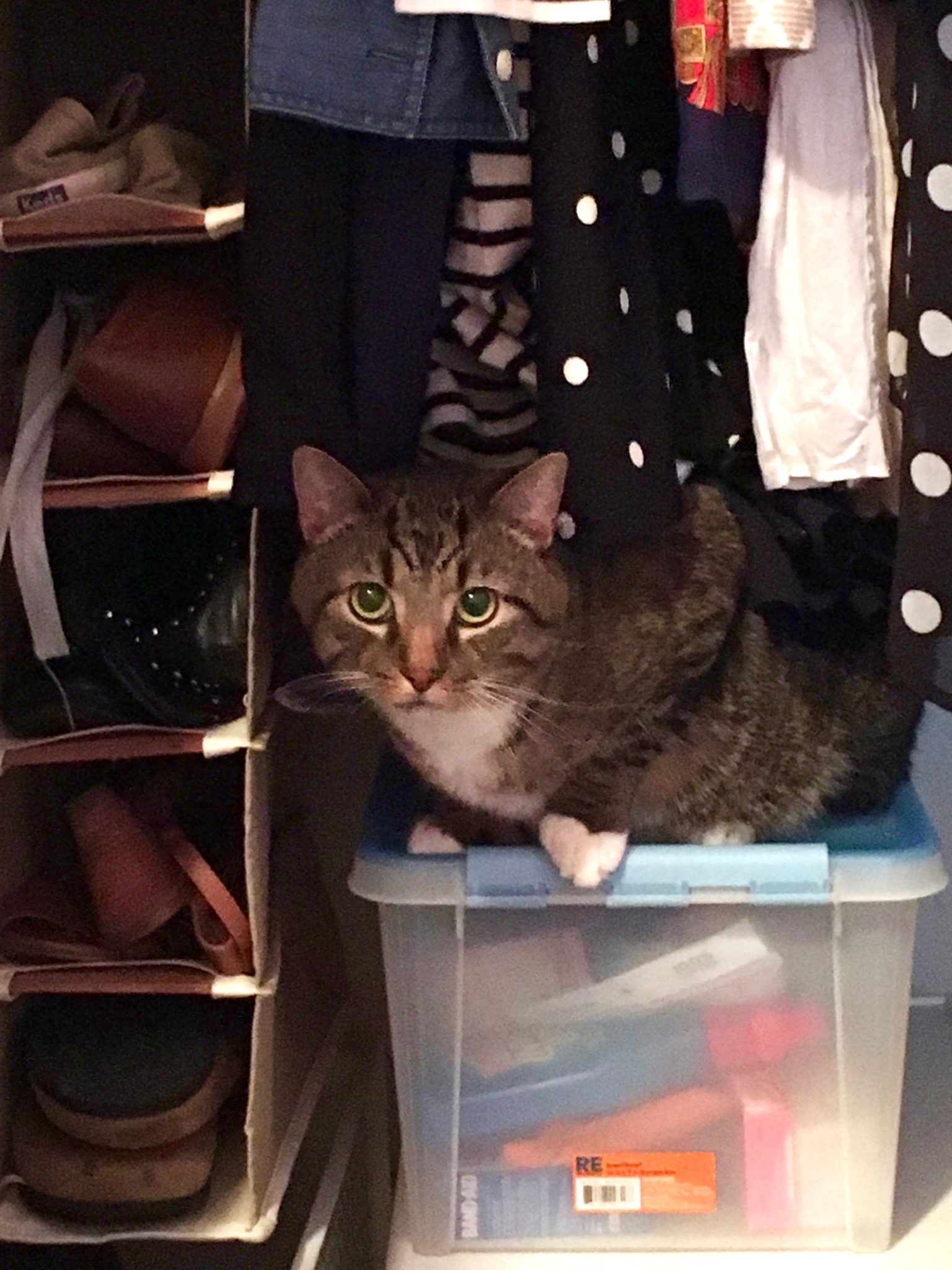
The unexpected has been a welcome distraction. So has this cat, who I met when helping a friend move into her new apartment:
Moments of laughter have been a relief.
As hard as I’m trying to put one foot in front of the other, I have fallen more than once. It’s times like this that leave me overwhelmed with gratitude for friends all over the world. This week has reminded me that it’s okay to hurt, cry, and feel. It’s okay to be afraid and to reach out to those who love me.
I am not in this alone. This I know.
There have been moments that have taken my breath away in both positive and negative ways. Here was a good moment and I wasn’t the only one taking pictures:
View of the Chrysler Building from 15th Street
Change is a process. It’s about taking life one step at a time and one day at a time. It’s about balancing each task as it arises so as not to be overwhelmed by the big picture.
This journey is not about looking backwards. It’s about acknowledging the past for what it is and moving forwards to be better each day. It’s about learning from the past and growing better for the future. I have a lot of figuring out to do, which is scary. I’m grateful to those who have promised to hold my hand along the way.
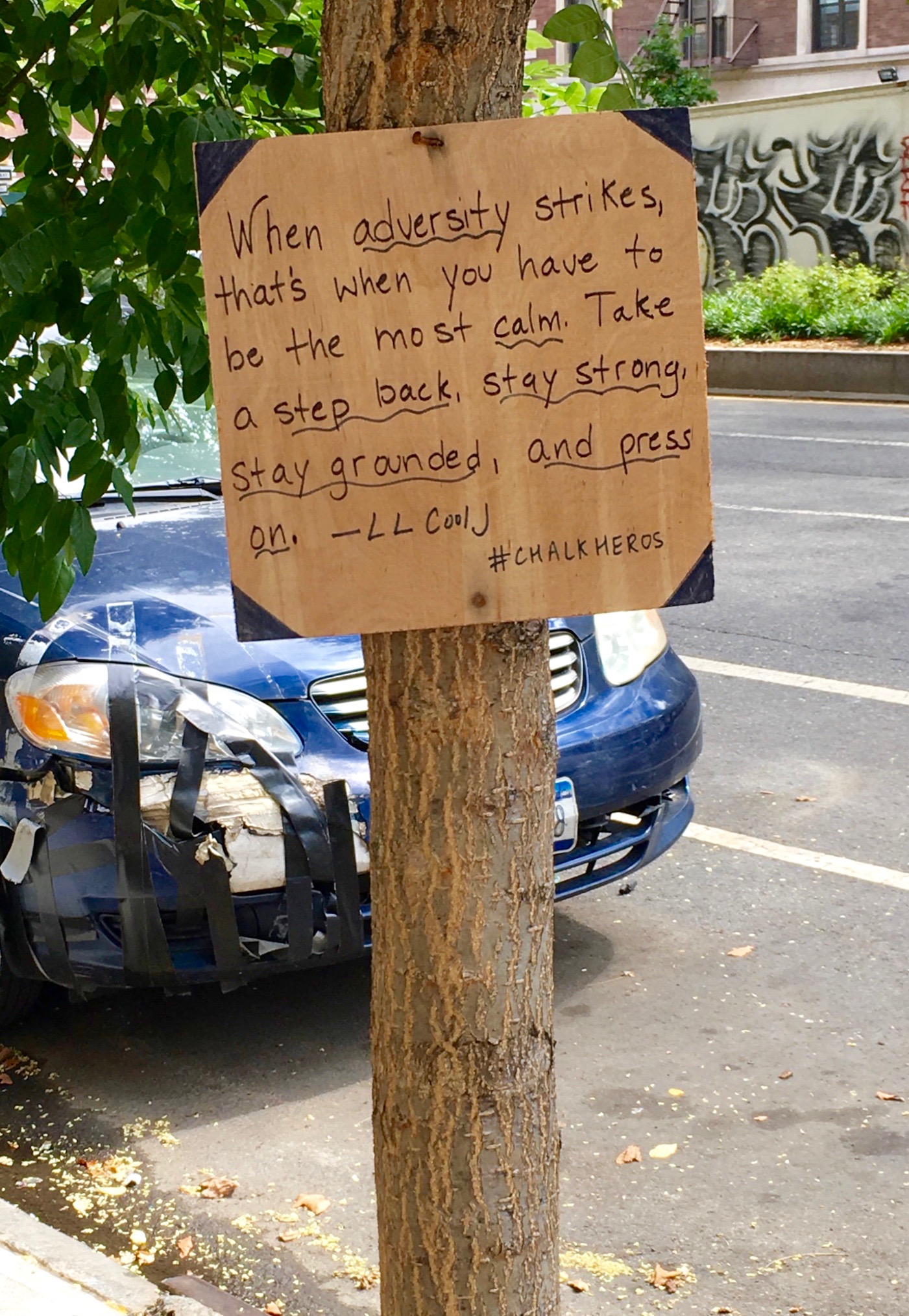
Inspirational signs line 110th Street on the Upper West Side
I’m telling myself that it’s okay to move slowly in the fastest place I’ve ever been. It’s okay to be uncertain. Today was one day and tomorrow will be another. Days will pass. Change will get easier.
This I know.
Photos, travels, musings, and ideas on education by someone trying to make the world a better and more peaceful place





 By Rebecca Michelle