About ten years ago, I went through a difficult period in which I couldn’t see a future; I couldn’t dream. I tried to imagine one, five, ten years into the distance and saw blackness, absence, nothing. It wasn’t that bad things were happening, but that I couldn’t see anything at all.
I tried the same with friends of mine and could see a future for each one of them. I concluded that nothing was wrong with my imagination, but that something was wrong with my own thoughts about myself.
This is why I will always tell people that therapy changed my life. Go see a therapist – they are good people.
One of the things on my mind back then was one day, eventually, starting a family. Ten years has gone by faster than I ever would have thought and when I consider myself and two friends around me at that time, I can only throw back my head and laugh.
At the time, all of us were unsuccessfully dating. Now, we are engaged, partnered, married. None of us were ready for the children we all hoped would be somewhere in the future. Now, we are all preparing for babies who will arrive this year.
Ten years ago, I saw these futures for my friends though I couldn’t see one for myself. Today, I am holding hands with these friends across time and space; the future couldn’t look more different.
I recently started my time in Mutterschutz, the period from six weeks before my due date until eight weeks after the baby’s birth in which I am not supposed to work but receive my full salary, paid partially by health insurance. This time of “mother protection” is there to help avoid physical or mental strain, which increases risks for both mama and baby, and to allow a heavily pregnant woman to step back from certain aspects of daily life in order to prepare for what is to come. As I’ve been writing my to-do list, I’ve kept this time firmly in mind, which is what had me starting on task one, wash all baby clothes, first thing Saturday morning.
After a day of hanging in the living room to dry, everything was ready to be folded. We’ve received some baby clothes as gifts, but mostly been given gently used items from friends, meaning we are entirely lacking an overview of what we have. My partner and I looked at each other helplessly.
“How do you fold something so small?” “I dunno.” “Like this?” “But now we can’t see what it is. Like this?” “What is it?” “This one has feet.” “Oh okay. This one has arms but no feet.” “Oh. Okay so start a new pile.” “Which pile does this go in?” “I dunno. Is that a onesie or does that go over a onesie?” “How should I know? How do we even put this on? It has no snaps.” “Do we need a pile for things without snaps?” “These two things are different but neither has snaps.” “I am not dressing her in anything without snaps.” “Okay, put it here.” “What’s the name of this pile?” “Should we write signs?” “Where does this go?” “I’m serious about the signs.” “This is so tiny.” “There’s only one thing in this pile.” “So combine it with this pile.” “Oh wait, no, these are different. Fold the arms out so we can see that there are arms. Long arms.” “We got this.” “This is so tiny.” “The next round is socks. How do we even dry socks?”
Savour everything now, they say. This time will never come again, they say.
To that end, we bought a new board game and borrowed one from friends. We started going out for dinner once a week and lie in bed weekend mornings until hunger drives us into the day. Alongside the ease with which we are living right now, there’s extensive paperwork to complete (welcome to Germany), a hospital bag to pack, bottles and pump to sanitize, a photo album to start. There’s a life to get ready for.
But there’s also the relationship between the two people who decided to be a family before there was a third member involved. Although no one has said so, maybe one idea behind Mutterschutz is to put relationships, rather than work, at the forefront in order to protect them at a time of great change. I would imagine that the stronger and more centered we are together, the easier the transition into a new phase of our lives.
Time will tell about that. In the meantime, the socks are drying on the radiator.
A friend recently sent me a bracelet in the mail – no card, no note. Instead, the gift was accompanied by an explanatory text introducing the the bracelet as one for expectant mothers and informing me that the three stones on a thin cord were rose quartz and hematite. According to the text, rose quartz is meant to provide protection and emotional support for mother and child, while hematite is one of the oldest protective stones and believed to help maintain balance in body, spirit, and soul.
I felt a peace spreading through my body when I held the bracelet in my hands. It’s the type of jewelry that I’d like to wear without taking off, but I’ve decided to remove it at night for the sake of longevity. For many years I wore red string bracelets, believed by cultures around the world to protect the wearer from harm. In the tradition that I know, a loved one clasps the bracelet around the wearer’s left wrist where it should remain until it falls off on its own. I often found mine tangled in my sheets upon waking, and I’d like to prevent my newest protective bracelet from meeting the same fate.
I admit to being somewhat superstitious in certain contexts, having a baby being one of them, as well as fully persuaded by the existence of unexplained spiritual forces in the universe. I hadn’t known that I was holding any negative emotions until I put on the rose quartz and hematite bracelet and felt lighter, safer, more confident. I am not one to shy away from incorporeal practices of the ages.
My partner and I joke about how we found each other in the world – mostly by travelling through enough countries in the same year that we eventually landed in the same place. We are both happy to accept a spiritual explanation for that.
That a friend from halfway around the world sent me just thing that I didn’t know I needed has, to my way of thinking, similar spiritual overtones).
And any force of nature that people have believed in for thousands of years, especially at a time when I draw strength from all of evolutionary history, is a powerful one indeed.
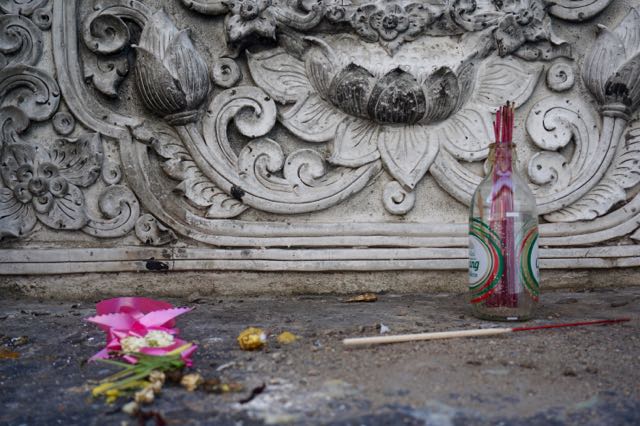
Chiang Mai, Thailand – January 2018
Photos, travels, musings, and ideas on education by someone trying to make the world a better and more peaceful place



 By Rebecca Michelle