
All posts by Rebecca Michelle

Educator, traveler, reader, blogger. Loves learning, black coffee, and friendly people.

Herbst/Fall/Autumn

There has been more than a little space between blog posts recently, and it’s not for lack of what to say. Rather, it’s due to time spent being in the world where, I am grateful to say, I have found myself in good company and laughing.
Playing, I said.
Living, came the response.

And in this moment, quite so.

Where I pause, however, is when I stop to consider the gulf between my small corner of the sky and the big, wide world around me. That’s when it’s hard to laugh, hard to remain positive, hard to stomach what I read in the news with my students every day. We’ve had beautiful sunshine lately and that affects my mood, too. Fall can be a quiet, contemplative time but lately it hasn’t been. It has been lively and full and it’s easy to get swept away in that. I need to remind myself to take stock, to take a step back. I am so lucky to be here.

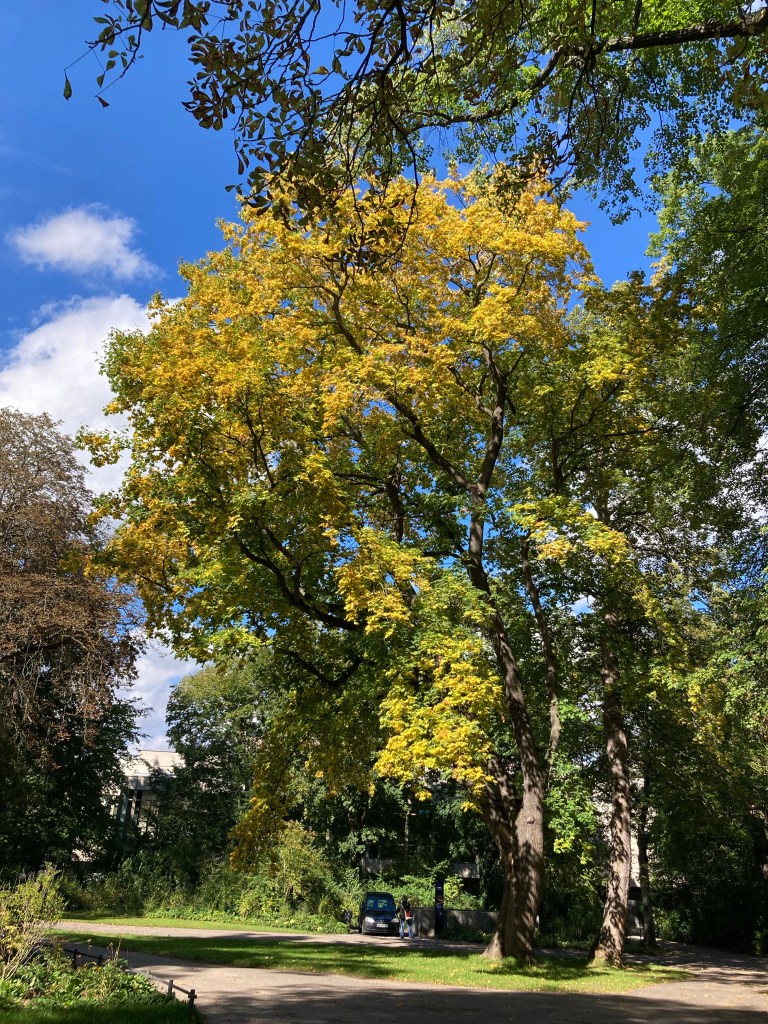
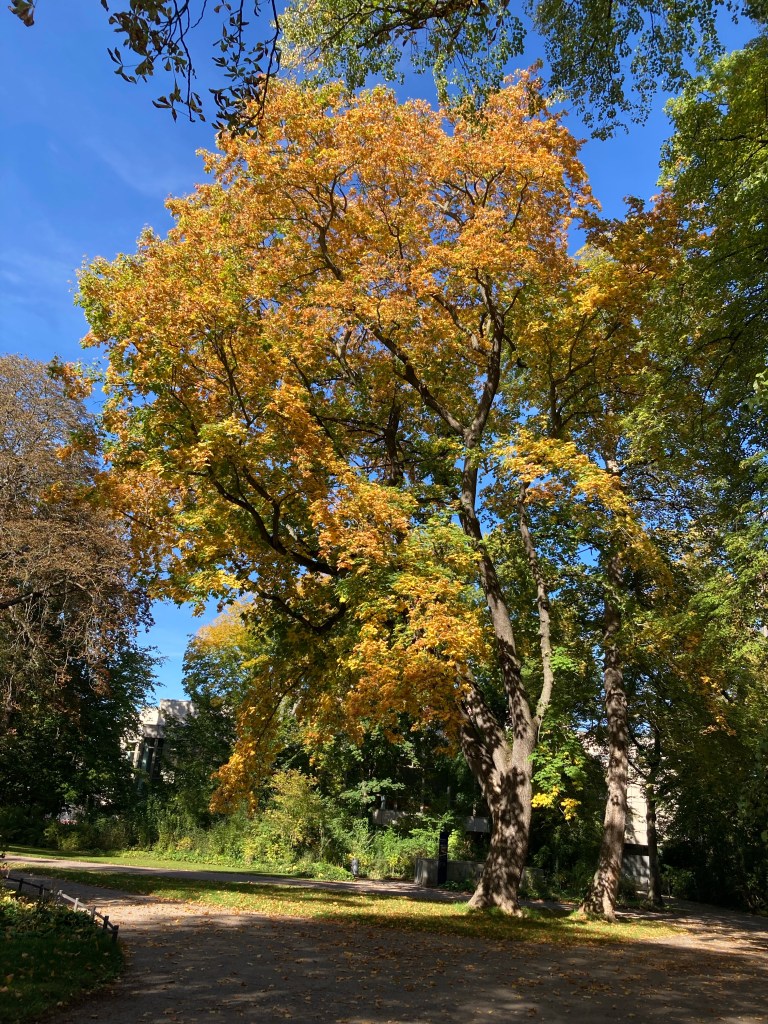
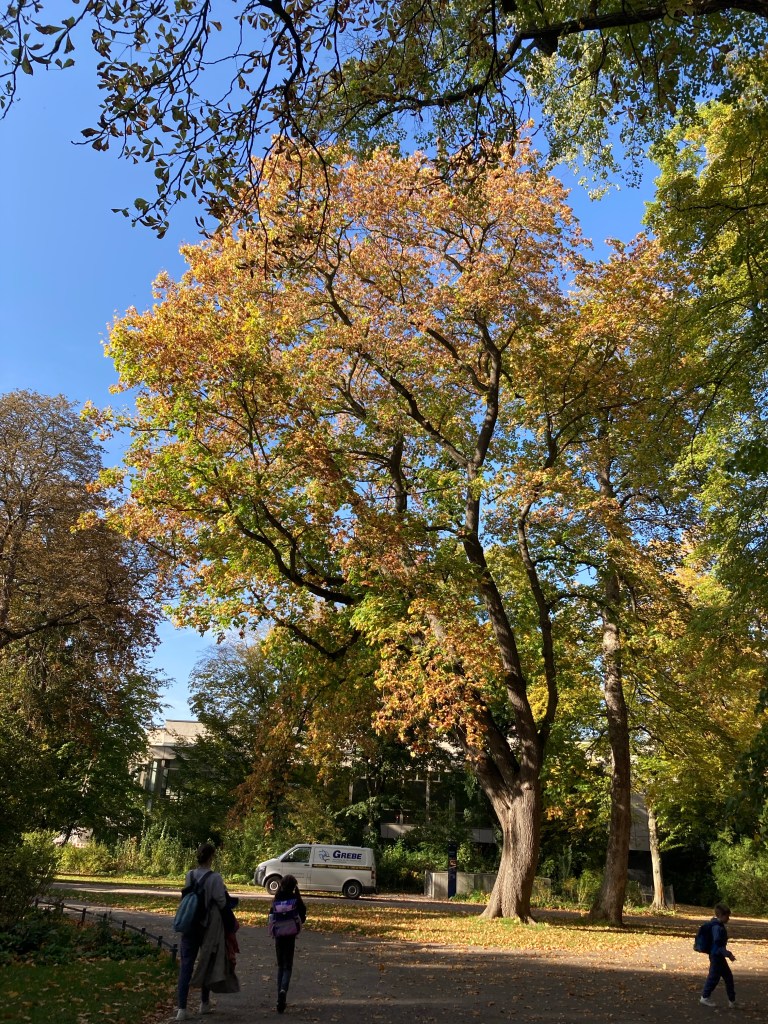
A year ago we started watching this tree as the leaves changed, as the days grew colder and the nights crisper. We watch nature because we are at home in it, because it’s beautiful, because it quite literally soothes the soul. And we spend as much time out in nature as we can because we know that pleasant temperatures don’t last forever.
Lately I’ve been laughing a lot, despite what’s in the news and what we expect for winter in Europe. I cannot change the world’s geopolitics but can put into the world what I believe should be part of it. To this end, I’ve been laughing with someone who reminds me to slow down, to take it easy, to take time away in order to be present with what is there.

Here now in autumn, leaves change. Colours change. The way that we approach one another during times that many of us, to varying degrees, find profoundly unsettling, can also change. We can choose to be a little kinder, a little more open, a little more honest. We can look for reasons to laugh, to play, to live.

And in the world that I believe should be, we stand up together and support one another because that creates “us” and when there’s just “us” rather than “us and them”, that creates peace. We all laugh, after all, and peace means finding commonalities and making them count.
So I’ve been out in nature and laughing. And I hope this post, and my wish for the world, inspire you to get out there, as well.

Professional Development

Every time I’ve interviewed for a teaching job, we’ve discussed the question of professional development: What does professional development look like at the school? What is provided for and expected of teachers? What PD opportunities have had an impact on my practice and what can I bring to the school from these opportunities?

Professional development, or PD in the alphabet soup of education, is how teachers get better at teaching. It’s how we learn about new research and best practices, look outside of what our own schools are doing, make connections with other schools and teachers, and grow as professionals. I can think of a professional development opportunity that fundamentally changed the way I approach my students as learners, and a second that changed my approach to teaching content. I have been a better teacher since and my students have benefitted from my opportunities to learn.

Unfortunately, a comment I hear often on PD days is, “Well, I didn’t learn anything, but it was nice to have the time to work.”

Let me start by saying that it is absolutely nice to have the time to work. Teachers are increasingly (and often overwhelmingly) expected to do more big-picture collaboration work with colleagues across departments that simply do not fit into the school day. The rare time that teachers have together during the day, when it exists, is usually spent on much more pressing concerns, like a plan for the next unit, editing an assessment task, or going over a recent student work. Having the time to work with colleagues with whom we do not otherwise have a chance to work is critical for the cohesive educational programs that we know help students learn. Additionally, there is often work for school evaluation visits that requires collecting materials, filling out questionnaires, and documenting school programs. Collaborative work time is necessary for all of this to take place, and I have never been in a school where teachers have enough time. So yes, we need the time to work.

However, collaborative work time is not professional development. Collaborative work time might stem from PD (we are always looking for new ideas) or benefit from PD (trying to integrate better technology in the classroom might require teachers to be trained on said technology, for example), but it is not the same as PD.

Although I am as grateful for work time as anyone else (and we really are!) I also want to learn. I want the professional development days on the calendar to be about professional development, to help me get better at my job, which is helping students learn. If I walk away from a PD session with one idea that I can try with one student tomorrow, that is a good day. If I walk away from one of our scheduled PD days without having had the opportunity to learn something new, I’m disappointed.

Of course, professional development can come in many forms. I once taught at a school in which a different teacher at each faculty meeting was invited to share something that they were trying in class. Often, these ideas came from working with the curriculum coordinator or attending PD trainings outside of school. Teachers were asked in advance, presentations took no more than 10 or 15 minutes, and we walked away from those meetings with new ideas.

If we want teachers to be independent, creative professionals, we need to give them opportunities to learn and opportunities to put into practice what they have learned. A PD day on a calendar should mean professional development; if the intention is for collaborative work, it should be called as such. The frustration is when collaborative work is confused for PD, and teachers who have been promised PD do not receive it. We cannot expect teachers to more effectively work with students if they do not have the opportunities to learn how to do so.

Sleight of Hand

Magic shows are magic either because we believe them to be or because we let them be. They are magic because we want them to be or because we let our guard down and appreciate what we’re shown. Magic shows captivate children because they have not yet learned to be jaded, because they are willing to imagine, because the laws of physics are not more compelling than handkerchiefs that appear and disappear or cards slyly revealed. Children believe because they have not yet learned not to, and therefore they are not disappointed.

I watched a magic show last week and caught myself looking for the tricks, looking for supports hidden in the darkness, or trapdoors, or poorly hidden props. I don’t remember when magic shows ceased to be magical and instead became an opportunity to call out magicians for precisely their specialty – sleight of hand. If we wanted to be swept away, to be amazed, we would stop looking for the gaps in the tricks, stop looking for the wires or behind the curtain. Do we always have to know better?

Sometimes, the answer is yes. We cannot expect magic to sweep us off our feet if we’re just sitting on the couch waiting for it to come along. We cannot expect something to change just because we want it to change without taking action in this direction. But we can let go of what we cannot control and let the universe unravel itself, which it always does, though often in ways that force us to abandon our plans and change course. We won’t find what we’re looking for if we don’t go out there to look for it. We won’t learn if we’re not curious, won’t see beautiful things if we walk only with heads down. Once we know that magic is there, we need to let it find us and be willing to accept it when it comes.

You could argue, that’s not magic. That’s not special or sparkly, and it doesn’t come with glitter. No, perhaps not. Perhaps there’s a lot of trust involved in letting magic happen, a lot of putting pieces into place only to then step back and just see what happens. To let what is going to happen simply . . . happen. Without looking for the reasons, without searching for complications, without poking holes in something beautiful. Sometimes, it can just be beautiful.

Children love magic shows because they let magic happen. And while watching that magic show last week, I tried to turn off the part of my brain that insisted on figuring out what was hidden and where. This is when I saw magic happen, too. And why not? It’s a far more compelling way to watch a show, and a far more peaceful way to walk in the world.

And above all, watch with glittering eyes the whole world around you because the greatest secrets are always hidden in the most unlikely places. Those who don’t believe in magic will never find it. – Roald Dahl

Adirondacks, New York – July 2022