All posts by Rebecca Michelle

Educator, traveler, reader, blogger. Loves learning, black coffee, and friendly people.

Travel Guide: Santorini

One of the perks of being an international educator is the time and opportunity to travel. This October break, we scooted off to Greece! (Literally – Scoot is the name of the budget airline that provided an eleven-and-a-half-hour direct flight with food, water, blankets, or entertainment not provided but available to purchase. But it got us to and from Greece for under SGD550, so I’m not complaining.) Upon landing in Athens, my girlfriends and I switched terminals and then boarded our 45-minute flight to Santorini. (Olympic Air is a budget airline so we got those little cleansing towelettes and two snacks – Greek hospitality is just so lovely.) We were staying in Oia,  the town you probably picture of when you hear “Greece”. It is simply stunning.

Oia is pretty at night, too . . .

. . . and it has a fantastic bookstore, Atlantis Books, which we visited and purchased from twice. The exterior should give you a hint at the wonder of the interior. Books in all languages stacked floor to ceiling, hidden behind the staircase, and available to borrow and trade on the upstairs patio. Small signs and notes with suggestions from the bookstore employees. Just the best.

Watching the sunset is a popular activity in Oia, and considering how crowded the western part of town grew in October, I can’t even imagine how it would be during peak tourist season. It was cloudy every night, though only once during the day, so many of our fellow viewers were disappointed but I thought the clouds made for some really beautiful pictures. And just being there with good friends was easily the best part.

We took a few adventures from our first base in Oia. On our first full day, we spent five hours on a very fancy catamaran with a delightful crew, unlimited beverages, and delicious lunch. The weather was bright and sunny but slightly chilly so they even made us coffee!

We stopped at the hot springs, where I actually got into the very chilly water . . .

. . . the Red Beach . . .
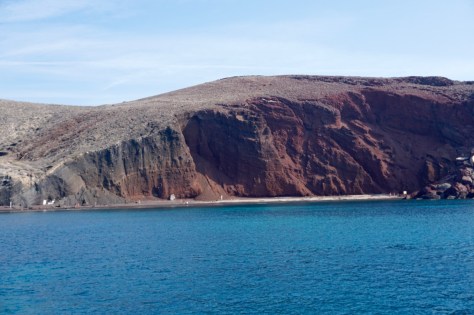
DSC05193

. . . and the White Beach. Snorkeling was an option but it was cold! And I was perfectly happy to bask in the sunshine and chat with the crew. I miss being on boats.

The next day, we walked down the steps of Oia, from the top of the volcano to the water, to check out the seafood restaurants at Ammoudi Bay and go on our next adventure. I’m a vegetarian but one of my friends was really excited about the sun-drying octopus and booked us a seat for dinner at a restaurant that turned out to be delicious.

We waited at Ammoudi Bay for a ferry to take us across to Thirasia, another of Santorini’s islands. My brother recommended that we go and it was really cool to be able to share travel experiences and advice with him. He told us to walk up all the stairs . . .

DSC05344

. . . and eat at the restaurant at the top where an elderly man greeted us, singing and grilling fresh fish. So we did!

And then we wandered around town, which was eerily empty. It felt like a combination of an abandoned film set and a ghost town. In addition to the people running the restaurant, we saw three construction workers, one elderly woman, and another woman running the town’s only other restaurant (it was actually called Different Restaurant because it’s obviously not the one, but the different one). My pictures are a little weird and grainy, which accurately reflects the strangeness of the town but is actually because I mistakenly used the wrong setting.

The part of the town near the water was more like a boardwalk of restaurants and again, this was low tourist season. Empty.

Our last full day in Oia was probably my favorite day of the whole trip and that’s because it was the greatest adventure. It’s pretty common for travelers to hike the path between Fira, Santorini’s largest city on the eat side of the island, to Oia on the west. We’d read that the path is mostly downhill, not terribly strenuous, and difficult to lose. Great!

But not so when you go the other way! Of course, we learned this hiking the other way, from Oia to Fira, and it was challenging in parts, a little scary when we found ourselves on the side of a cliff in gusts of wind, and a little more scary when someone we couldn’t see started hunting birds. But we made it!

We left Oia at 7am, which is before the sun rises and before anything is open. It was so cool seeing the streets dark and empty, lit by streetlights.

There were some signs along the 10.5km route . . .

. . . but also a critical point that was difficult to navigate coming from Oia. Turns out we did have to go behind the desalination plant on the edge of the cliff. Found that out after realizing we were on a road curving the wrong way and had to hike up a hill behind a hotel to reorient ourselves. And then, under a menacing sky and loud gusts of wind, we traversed the beautiful, sometimes desolate wilderness that is the edge of the caldera.

No matter how tiny or empty the landscape, though, Greece has many churches . ..

. . . and their frequency increased as the hike became more urban. . . .

At times, the hike took us through resorts and villas, which was a little strange, but it was also comforting to see people. After a stop for breakfast and about four hours, we were delighted when we finally reached Fira!

Once in Fira, we found a taxi to take us a little further to Santorini Brewing Company, the only brewery in Santorini. They brew five beers and offer free tastings of three, which we enjoyed very much. And because I wanted to be able to say I’d had all of them, we bought bottles of the remaining two and sat outside the brewery (because it doesn’t have a liquor license) to drink them.

Afterwards, hungry from our hike and having made the acquaintance of the adorable kid on staff at the brewery, we asked for recommendations for lunch. He suggested Artemis Karamolegos Winery, a 5-minute walk down the road. The winery is beautiful, staff delightful, and food absolutely excellent. Best meal I’ve had in recent memory and the most full I’ve been in recent memory. And then they turned up with desserts and a digestif, which happened throughout our time in Greece. Truly an amazing country with wonderful people.

Finally, we decided it was time to return to Oia. Hiking the four hours back would have lost me two friends so we took the local bus first into Fira and then onto Oia. Forty minutes and keeping my friendships instead of four hours and losing them seemed worth it.

All in all, we loved our time in Santorini (and in Athens and Delphi). The people were wonderful, the food superb, and the wine plentiful. And it’s just gorgeous.

Antisemitism Among the Internationally Minded

“How much is a taxi to the airport? I have to pay it myself. My school doesn’t give me a per diem.”
“Oh that’s too bad. Why not?”
“It’s a Jewish school so they’re stingy.”
“Hey!”
“Well that’s how they make all their money.”

And then we made eye contact and she looked away.

My only contribution to this conversation was the interjection, “Hey!”. I’m not sure whether it was enough. I’m never sure.


I’ve spent the last three days at an IB professional development workshop for the DP Psychology course that I teach. People came from all over – Singapore, Indonesia, China, Nepal, India, New Zealand, Hong Kong, and Abu Dhabi were represented among 24 psychology teachers. And that’s just where they teach now; where they’re from is a completely different list.

Context is important here. What I like most about the IB, and what gives me legs to stand on when discussing controversial topics, is its mission:

The International Baccalaureate aims to develop inquiring, knowledgeable and caring young people who help to create a better and more peaceful world through intercultural understanding and respect. . . .
These programmes encourage students across the world to become active, compassionate and lifelong learners who understand that other people, with their differences, can also be right. (emphasis added)

To this end, the IB highlights international-mindedness throughout its programs, though the way this actually looks is heavily discussed and debated. The point, however, is that this is who we’re supposed to be as an IB community. We’re supposed to be internationally minded, emphasize intercultural understanding and respect, and accept difference.

I’ve seen antisemitism all over the world and it no longer surprises me. But I was taken aback to see it in a woman about my age, also a traveler, who teaches a psychology course that includes a sociocultural unit. She’s obviously frustrated at having to pay for what was likely a required workshop, so I’m not questioning that. Frustration is why she made the claim – we blame others when things that we don’t like happen to us. My question is why the claim was antisemitic in the first place.

Since she teaches at a Jewish school, she knows more than nothing about Judaism and she knows Jewish people. She likely has Jewish friends, even if they’re friends just at work. This means that I can’t use ignorance as an explanation, which is usually the excuse that I give people. Ignorance is lack of knowledge or lack of information and that’s clearly not the case.

As a teacher of psychology, she is familiar with Henri Tajfel’s work on social identity theory, which, ironically enough, stems from his experiences of persecution during the Holocaust. In short, we compare ourselves to others and categorize ourselves into groups in order to boost our self-esteem. “We” are the in-group and “they” are the out-group. “They” are this and “we” are not. “We” do this and “they” do not. Etc.

Much of our group categorization is unconscious. We are not necessarily aware when this happens because the brain naturally categorizes things in order to simplify and streamline our thinking. As a teacher of psychology, she knows about cognitive biases, which are mental shortcuts that the brain uses to make sense of the world around us. We’d never be able to make any sort of decision if the brain first had to process every possible option.

Stereotypes are also linked to implicit associations, generalizations that the brain makes based on patterns. Again, we don’t realize this is happening. Harvard University’s Implicit Association Test, which I do with my students, can be enlightening. Sometimes these associations, or biases, have little impact on our interactions with others but sometimes they can be quite significant. As I discuss with my students, having implicit biases is normal. Checking yourself when you come to a snap judgement is what it means to be mindful before acting.


To summarize, it is troubling to me that a psychology teacher in a global program with a mission to value international-mindedness, intercultural understanding and respect, and acceptance of difference made an antisemitic comment. I don’t have an explanation for this teacher. She should know and teach everything I’ve just described. And if she hasn’t been doing that, we just spent three days discussing it. She should understand this in her own life and adjust accordingly. And maybe she will.

So why the antisemitic comment? The nagging voice in my head says that some people are just antisemitic. Some people are just racist, biased, discriminatory, prejudicial, xenophobic even when they know better. Sometimes this comes from fear or uncertainty. Sometimes this comes from prior negative experience. (As one of my friends would say, “Sounds like textbook human.”)

Haven’t an explanation doesn’t rectify or excuse the behavior, but perhaps it can suggest ways that allow us to respond constructively. And perhaps, since this woman didn’t check herself but was ultimately checked, this particular comment can be a learning experience.

It is heartening that no one else in the room engaged with her comment at all. The conversation moved on immediately, which is a perfectly appropriate response once someone speaks out and the other backs down. It seems plausible that most people in the room recognized the bias, prejudice, and stereotype behind this comment and knew it to be wrong. In light of that, maybe we’re doing okay at building a better, more peaceful world.

But in light of that, we cannot pretend the work is over.

Courage is the price that life exacts for granting peace. – Amelia Earhart

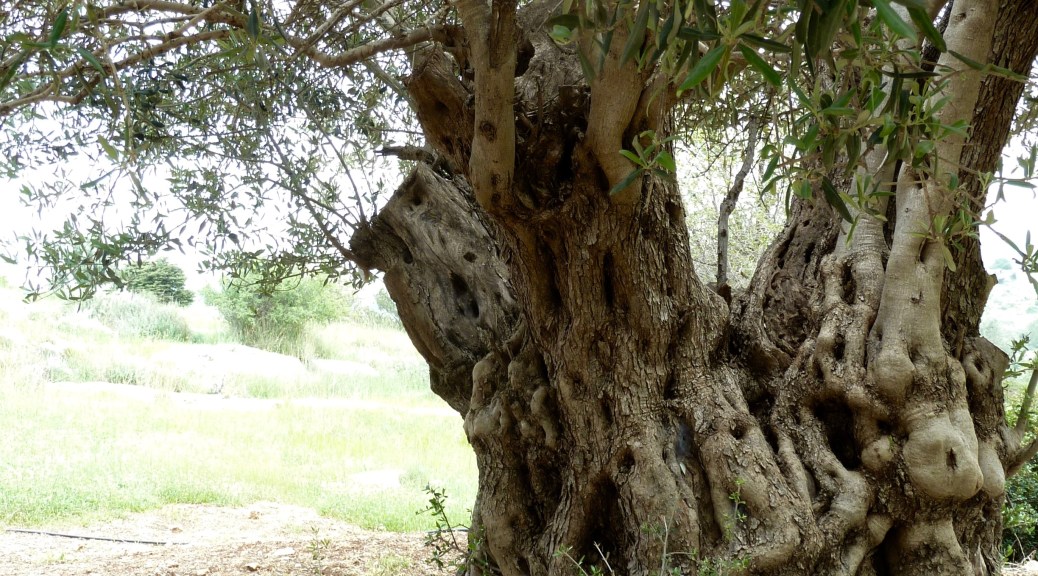
P1080876
An olive tree in Neot Kedumim, Israel – March 2017

Learning to Meditate

One
The unpleasant feeling of being lonely hit me really hard kind of out of nowhere when I was walking home from the MRT. And then I thought about Sam Harris’s meditation lesson from yesterday: “That which is aware of sadness is not sad. That which is aware of fear is not afraid.” As soon as I thought about that, and each time I went back to it in between episodes of masochism resulting from loneliness, the feeling went away. For a fleeting moment, but it went away.

And that amazed me because that, I think, is what it means to let the ego dissolve. Sadness is a sensation but I am not sad because there’s no I. Interesting.

Two
Tonight’s meditation about emotion, day twelve, came at a good time. Sam prompted recall of a situation that was unpleasant – something to leave you sad or anxious or upset in some way. Following his cues, the point was to notice first the thought itself and then where that unpleasant feeling lies in the body, giving rise to the emotion that we’d started with.

Sam went through the exercise three times, twice with situations that bring about negative emotions and once with a situation bringing about positive emotions. He then talked about emotions as just “patterns of energy” and about how powerful it is to recognize emotions in this way. Just energy in the body, like any other feeling. Sam used knee pain as an example and I’ll follow suit because it worked. It seems the idea is to see “the feeling of sadness” in the same way as “my knee is sore” but not let the self become the sadness anymore than the self becomes the sore knee, which is not at all.

During tonight’s meditation, as always, I felt the negative emotions in my chest. When I’m anxious, afraid, or sad, my chest tightens and it’s difficult to breathe. At least once during the meditation exercise I gasped and opened my eyes, certain I was going to cry. But when Sam prompted thinking about something positive, I felt the same clench in my chest. And it rose into my throat just like tears do, but this time the feeling manifested as what I usually call “a bubble of joy”. It was so interesting to observe the same sensation and label it with a different emotion.

At the same time, though, I also started to wonder what a person becomes without deep feelings. But it’s not a lack of deep feelings, is it? It’s a lack of attachment to them during a full experience of them. The purpose of meditation is to notice whatever it is I’m actually noticing. I realize this now, writing, but at the time I worried a little, worried just for a fleeting moment, about becoming an empty shell, something not quite human.

But now, reflecting, I realize that’s not it at all. Instead it’s being able to recognize what’s there with an open mind instead of judgement and have the experience instead of letting it pass by.

Three
With tonight’s meditation experience, I thought in a different light about an earlier conversation with a friend that really upset me. I was talking about how frustrating it is to want something that has eluded me and my friend asked if I ever meditated on letting go or living without. My immediate response internally was defensive outrage, but tonight it struck me that perhaps I can separate the feeling of wanting from that which is I. And if the feeling is just a feeling and the conscious mind is what processes the feeling, there’s no need to attach any of it to I at all. Because I is just a construction of the mind. But the point is, “I can walk away from the feeling because the feeling isn’t me.”

I’m not there yet. But I think that’s the point.

Four
I’ve been finding it helpful to focus on sound. Sound comes in and out of conscious awareness and there’s nothing we do to make that happen. It’s just there and then it isn’t.

It’s the same for thoughts, though harder to grasp because I don’t find myself beginning to have a thought; rather, I find myself when I’m already lost in them. But it’s the same thing. Thoughts just appear. Like sounds. We notice them and then they’re gone, too, and we don’t notice them anymore.

Five
Watching my emotions change over the last week has been really interesting. As best as I can, I’ve tried to step outside of myself and observe what I’m feeling rather than just letting it swallow me.

I went to the climbing gym twice this weekend because I disappear when climbing. As a friend explained once, “There’s no room for ego up there.” It’s easy to lose myself in my own head when I’m running but not so easy at dance or doing yoga or on the climbing wall. I’ve been trying to engage in ways that let me spend less time lost in thought, an experiment to see what happens.

And so far, I’m not too sure.

Six
I had a conversation today that indicated ego is alive and well. Frustration for other reasons bubbled up and got the better of me and I was defensive instead of open-minded. As I teach my psychology students, we are cognitive misers and it’s less taxing to rely on emotion than reason. Knowing the traps doesn’t mean immunity from falling into them.

I didn’t realize this conversation was still bothering me when I sat down to meditate tonight, day nineteen. But as soon as I turned my attention to the breath, I noticed an elevated heart rate even though I was breathing deeply without effort. For several minutes, I couldn’t slow my heart down even though I guessed its cause. So I observed that and tried not to judge it.

While I’ve been familiar with loving-kindness meditation for a while, Sam’s inclusion of it tonight was most welcome. In its full form, you begin thinking about someone close to you and wishing them well and then expanding the well-wishing, over the course of several stages, to the whole world. Tonight’s meditation centered on just one person.

I thought about a very dear friend. And that’s when I felt my heart rate slow down. I felt better turning my focus towards another person and wishing happiness, which really means sending pure love.

May you be happy.
May you be healthy.
May you be peaceful.

Mindfulness is a journey to travel, a journey without signposts and without end. But even as a novice along the journey, I’ve had moments of utter simplicity where I’m left stunned by what is sometimes so easy and other times so challenging.

To be mindful is to be aware. Aware of what we see, hear, and think. It is to experience. It is to look outward and take in with an awareness of what we’re doing instead of just letting it happen. It sounds like doing nothing. But as I’m learning, it’s actually doing quite a lot.

Newport Beach
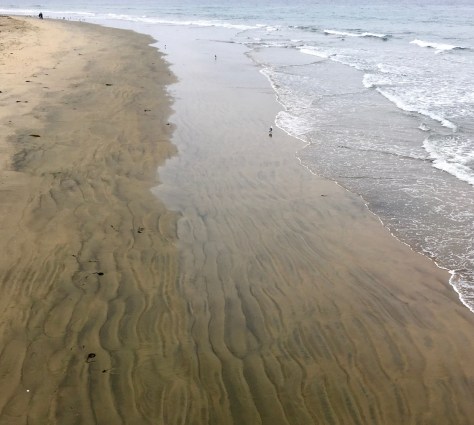
Newport Beach, California – December 2016