
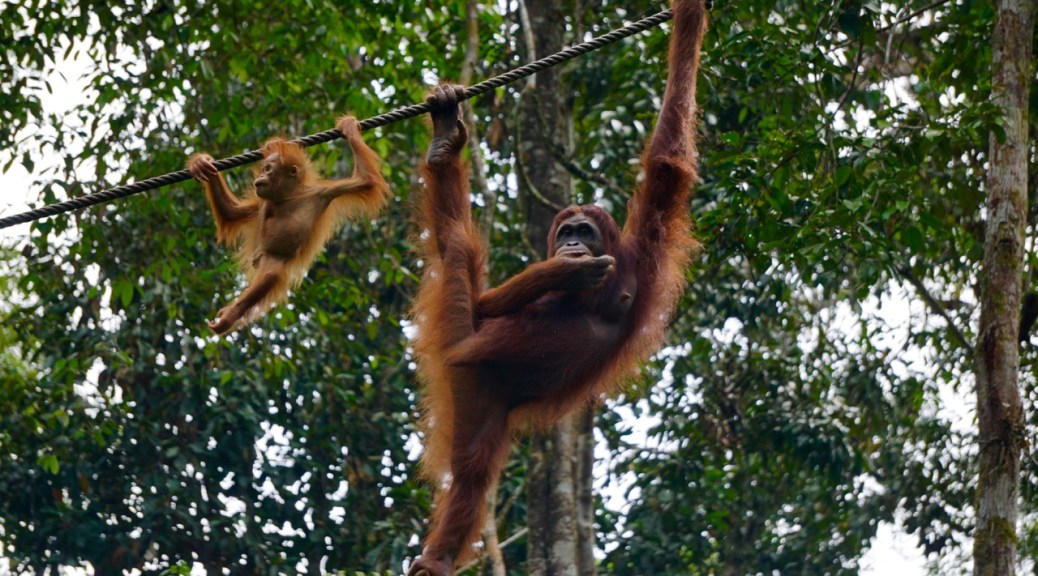
I left Malaysia in the spring of 2015. I hadn’t been back until four girlfriends and I decided to take a quick weekend trip to Kuching, a wonderful town in Sarawak, one of the two Malaysian states on Borneo.
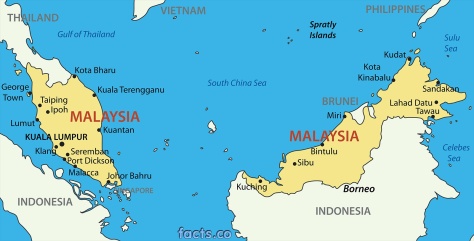
I visited the area once before (though my photos are way better this time, thanks to a fancy camera) and was excited to go back. Other than booking flights and a hotel, the entirety of our planning took place in the airport.
Friends: What are we doing in Kuching?
Me: Seeing the orangutans.
Friends: Anything else?
Me: Eating. Drinking tuak.
Friends: Cool. Anything else?
Me: Last time, I visited the Annah Rais Longhouse. Really enjoyed it and would go back, but I really don’t mind. It’s a nice town to wander through.
Friends: Sounds good.
And that was that!
As promised and planned, Semenggoh Nature Reserve was the highlight of our trip. We arrived in time for the morning feeding, which begins around nine. I love rainforests (or any forests) and enjoyed the walk to the reserve’s feeding platform.


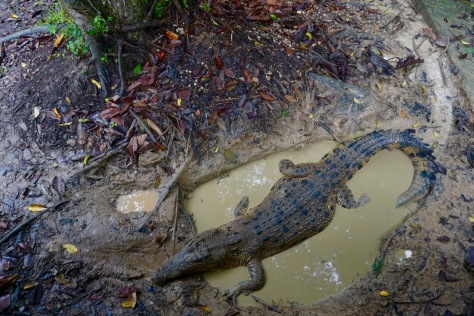
The purpose of Semenggoh is to teach rescued or orphaned orangutans how to live in the wild, so the orangutans really only come to the reserve for a meal when there’s no food in the forest. They mostly stay away during fruiting season. My last visit was in October and we saw groups of orangutans during both feeding times, but this time around wasn’t as lucky. We did see the resident crocodiles, though!
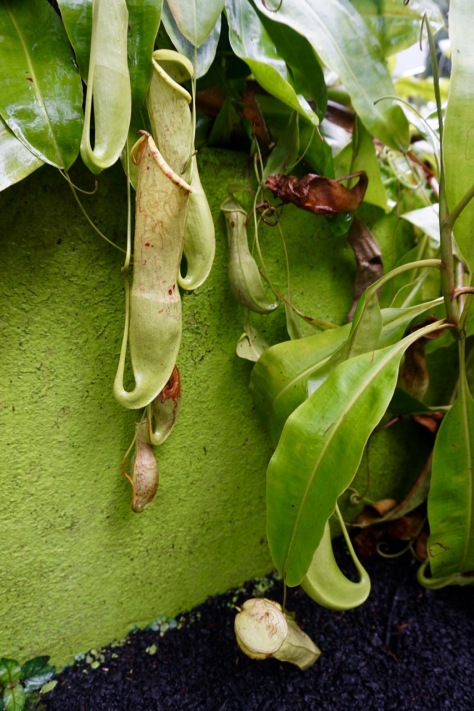
We also saw some really cool pitcher plants, which are really fun to look at because a) they’re carnivorous and b) they come in a surprisingly wide array of sizes. We didn’t know it at the time, but we were going to learn more about them later in the day.
One friend and I decided to leave the reserve on foot, doubling back on the one kilometer path we’d followed on the way in. The rest of the gang went ahead in a car and I thought we’d meet at the gate to decide what to do for the rest of the morning. Since we hadn’t seen any orangutans, we agreed to return to Semenggoh for the afternoon feeding but that was as far as we’d planned.
When my friend and I got to the bottom, however, our other friends were nowhere in sight. We asked the guard if he’d seen them and he gestured vaguely down the road, telling us they’d walked. One look at the two-lane shoulder-less highway convinced us otherwise. We waited 15 minutes and then, as if answering an unspoken cry, a man in a small purple car pulled up and asked if we needed a ride.
We looked at each other. Yes, we did. We got into the car and asked him to take us to the closest town in the direction of Kuching. The hornbill statue indicated that we’d arrived in Padawan and the man in the purple car, who may or may not have been a taxi/Grab, drove off.
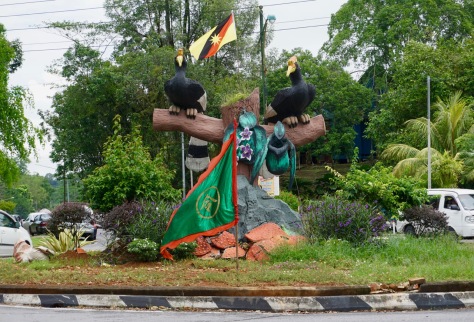
We went immediately to the closest hawker for bowls of soup and noodles and cups of strong coffee. After lunch, we saw a sign for a pitcher plant museum, so of course we went!


Padawan was also home to a wonderful market. I love markets in all forms and we leisurely wandered through it, wishing we could buy some vegetables and take them home. I was less enthralled with the fish and meat, but that’s local life.


The market was also exciting because the lady selling jewelry told us she’d seen our friends! They’d been looking for a short one and tall one, they told her, and that certainly described us. And truly, how likely was it that two groups of white women wandering through a wet market in a tiny town in Borneo didn’t know each other? The woman knew they were heading back to Semenggoh and we went off to join them. The woman didn’t know, however, how we should get back. There was no bus, she told us, and while I had my phone, I didn’t intend to turn it on to call a Grab.
Luckily, my friend talks to literally anybody and after we stood on a corner for a few minutes and tried making eye contact and looking friendly and in need of help, she walked up to a man and asked how to get a taxi. Someone else overheard and told us he’d give us a ride. We followed him to his white truck and hopped in. We looked at each other. All I could think was, “Oh gosh, her husband will kill me if she doesn’t get back!” How I stayed alive in that scenario, I’m not quite sure.
But the man was lovely and pointed out several landmarks along the way. He took us exactly where we needed to be and even agreed to take our money after we asked twice. After all, we would have paid a taxi! We were greeted by our friends and a really cute lizard!
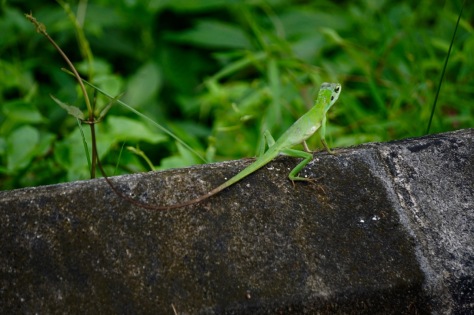
We saw another neat lizard later on . . .
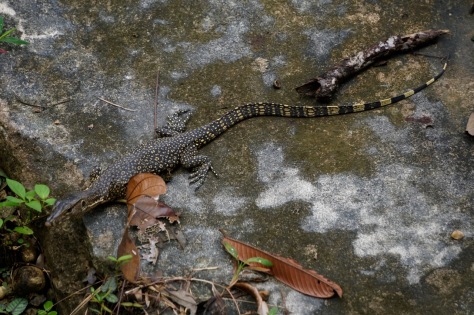
. . . and then were back in forest looking for orangutans. In Malay, “orang utan” means “people of the forest” and that’s exactly what they are. Watching the orangutans is breathtaking because it’s like watching evolution. It’s watching yourself in a different form. Watching the orangutans play and interact leaves no doubt that we are very close relatives and that they have been around for a long time. Visiting the orangutans at Semenggoh was, and remains, the single most amazing experience I’ve had in Southeast Asia.


We took a very long bus ride back to Kuching and agreed that we probably should have turned on the cellular data and taken a Grab, mostly because we were all hot and tired by that point. The walk along the water from the bus station, however, which we repeated in the opposite direction the next morning, was really lovely and I was not sorry to end the afternoon there. Orangutans and boats, all in one day!


In addition to being located on the Sarawak River, which I like very much, Kuching is home to brightly colored buildings and a few cat statues (because “kuching” is the Malay word for “cat”) . . .


. . . and a great array of street art. I liked that very much, too!


Our wandering through the street art district took us to a few lovely cafés and one of the proprietors suggested we check out the Textile Museum. We did, and were pleasantly surprised at the range of artifacts on display. Since we decided to have an easy coffee morning and not visit a longhouse, the textiles provided us with a glimpse of traditional life that I think is important for any trip to Sarawak.
And, of course, there were temples. We only stopped into one and it was lovely and colorful, which is really the best way I can describe the city of Kuching itself.


All in all, it was a great weekend. Kuching is a quick hour and twenty minutes from Singapore and there are cheap flights that leave after work. It was fun to be back in Malaysia both because of what I remembered (accurately and inaccurately) and what I’d forgotten. It’s fun to experience a bit of your own past every now and then.
But most importantly, this trip to Kuching was a great break from real life with a wonderful group of women. Thanks, ladies!





 By Rebecca Michelle