Category Archives: Education

Just a Number

Being You Isn’t Enough
I overheard a conversation between two young women in the subway earlier this week that provoked a reaction that was at once horror, heartache, and shock. The conversation went like this:

Girl A: How do I get nice skin like yours?
Girl B: Girl, you gotta wash your face twice a day. Do you do that?
Girl A: Ugh no. That’s so much work.
Girl B: But you’ve got to do it. Otherwise there’s no hope.
Girl A: Well, I think if he’s going to like me, he’s going to like me.
Girl B: Yeah, but you need to be realistic. I mean, if you’re a 7 shooting for 11 . . . you have to be realistic.
Girl A: Yeah, that’s true. I think I’m probably . . . well . . . what would you say I am?
Girl B: Haha um maybe 8?

Wow.

Wow.

As the girls got off the train, I was stunned. Since when do women refer to themselves not as people but as numbers on a rating scale, where 1 is presumably synonymous with “troll” and unattainable 10 isn’t even high enough if we’re suddenly including 11? (Not to mention that Girl B clearly needs friends who value all that lies below the surface, which is everything that actually makes a person beautiful.)

Exploring Language
I wonder how we’ve gone so wrong. Have we forgotten to tell our girls to care about who they are rather than what they look like? Have we forgotten to communicate that being a good person, whether male or female, is what actually matters?

Perhaps we have forgotten.

Perhaps we have been so caught up in trying to understand recent world events that we lost track of what’s happening right in front of us. Perhaps we need to take a step back, look at ourselves, and make changes to the ways we talk to and about each other, and interact with each other.

I wonder if this conversation would have taken place in such stark terms (“you’re probably an 8 so wash your face and maybe there’s hope that he’ll like you”) prior to Donald Trump’s election. I wonder if this conversation would have taken place if the popular vote actually decided the next president. There has been a steady devaluing of diversity in this country over the past few months. Reducing any person to a number is just one example.

As an educator, it is my responsibility to model behavior that I want my students to emulate. The way I talk about people matters. The way I talk about world events matters. I want my students to live in a world that is more peaceful than the world they have lived in thus far.

As 2016 draws to a close, I’m thinking about how much more work there is to do and how far we have to go. I’m comforted by the feeling of inclusiveness and community at my school and the way students rally around each other when difficult circumstances arise. Cultivating these behaviors will go a long way in a world that desperately needs a collective spirit.

We are, at the end of the day, all human. We are all responsible for the world we live in and the world we’re building.

Let’s make it a better one.

Building Peace: Reflecting on Conversations in the Classroom

This post is the fourth in a series of posts where I’ve explored the importance of peace in the classroom and how we are working (or need to work) to cultivate peace with students. Previous posts discussed peace as the purpose of education, ways we view and need to reframe masculinity and femininity, and words that we use with and around young people.


Back in April, I read Peace Education: How We Come to Love and Hate War by Nel Noddings as part of an ongoing personal mission to become more conscious of how I discuss peace and war with my students. I’d been interested in the Freedom Schools movement and restorative justice since graduate school and was looking to enhance my understanding of what peace means in a classroom context where, as a social studies and humanities teacher, I spent a lot of time talking about war. In most curricula, conflict and war are central themes. Noddings highlights that our history textbooks are often organized chronologically around wars, our literature glorifies warriors, and we emphasize competition, power, and patriotism as we attempt to tell the stories of who we are and how we got here. It should come as no surprise that our society is less peaceful than we would like, and less peaceful than it should be.

Three particular instances in my classroom have stood out to me as essential examples of why we need to rethink how we talk about peace and war in the classroom.

Today in History
Since the day I began teaching, I’ve kept a Today in History section of my whiteboard where I post a fun fact about something that happened in history. I almost always use the History website section devoted to this particular feature to get my fact of the day. When I can, I use a fact that relates to something my students are learning or have learned. When I can’t, I try to find something they’ll connect to or find particularly compelling.

As I’ve become more focused on discussing peace rather than war (i.e. we’re currently studying the Civil War’s social, political, and economic impacts on the United States rather than what happened militarily during the war), however, it’s become harder to use the History website to find facts for my students. History categorizes its daily factoids into seventeen sections, six of which are devoted to the major wars that the US has fought. If I skip all of those, I’m down to eleven options. I don’t want to include crime or disasters, so that’s nine options. Automotive, Hollywood, and Sports don’t seem relevant enough, and my students are generally unfamiliar with anything pertaining to Music, Literary, and Old West. That means I have three options: Lead Story, General Interest, and Presidential. There have been some years where I don’t teach American history, which means Presidential is out, too.

Not a lot of choice when I want my students constantly confronted with collaborative, constructive, global events.

Dissatisfied with History’s options, I’ve started turning more regularly to On This Day, which reaches far more broadly in providing three categories (Miscellaneous, Music, Birthdays) and upwards of thirty events in each category. It’s not that some days are historically busier than others, as any avid news reader knows. Instead, it’s that History curates information to a population fed stories of war, patriotism, and nationalism. These are divisive ideas and not what I want in front of my students on a daily basis.

ISIS
At the end of the last school year, my tenth graders sat in a circle and we discussed ISIS. One of their ongoing class assignments was a current events report that asked them not only to find an event and summarize it, but also to consider it in a local, national, and global context, as well as consider whether the event would have been handled or approached differently in different time periods.

Understandably, ISIS was constantly a topic in their write-ups. Students submitted their assignments via GoogleDocs, which allowed us to have digital conversations about what they’d written. Many students expressed anxiety, fear, anger, frustration, and uncertainty about the stability of the world and about their own futures. I commented back to them in the most positive ways that I could, encouraging them to consider solutions that were diplomatic, dialogic, and international. More than one student replied to my comments explaining that they found these suggestions unrealistic.

That’s when I decided to have an open conversation as a class instead of repeating myself to individual students. Together, we chose our first discussion question: How can we peacefully resolve global conflict?

My students were creative thinkers and suggested everything from global partnerships of young people to add a new voice to increased efforts towards volunteering for organizations that raise money to aid developing countries.

And then came the second discussion question: What should we do about ISIS?

Almost unanimously, all of my tenth grade students in two class periods suggested war, economic sanctions, bombing, and providing the UN with an army.

I called the discussion to a halt and pointed out the inconsistencies between what they’d just said about global conflict and how they suggested responding to ISIS. My students countered with statistics of death and destruction, which have unfortunately become common knowledge. When I brought up anti-radicalization programs like this one in Denmark, most students said that the problem is that there aren’t enough resources and there isn’t enough time. I suggested community building to stop radicalization and pointed to several of the many examples that exist. Students were frustrated, again pointing to the numbers. This would take generations, they said. We don’t have generations.

We might not have generations, but the “solutions” that we’ve tried – economic sanctions, airstrikes, increased access to arms – to stop ISIS aren’t working either. Again, peace is not nearly as much a part of our discourse as war. And this is a problem.

Farmers and Artisans
Just last week I introduced my sixth graders to the concept of civilizations. We started by making a flowchart of how civilizations form. When we began discussing the job specialization that results from increased food supply (as a result of settling and farming rather than being nomadic hunter-gatherers), the following conversation (edited to highlight main points) took place:

Me: Let’s assume this half of the class are farmers and growing all the food we need for our civilization.
Farmer half of class: Woohoo!
Me: The other half are artisans.
Artisans: Woohoo!
Me: So the artisans don’t farm and the farmers don’t make anything (As I’m saying this, the kids start pointing fingers and laughing and saying things like “You’re gonna starve!”) But our civilization has to come together.
Farmers: They’re gonna steal all our food!
Me: No, something else has to happen because we all need to survive so we have to work together.
Artisans: Oh, we’ll trade.
Me: Exactly.
Farmers: Oh.
Me: So then we have a civilization of great artisans . . .
Artisans: Yay!
Me: . . . and great farmers . . .
Farmers: Yay!
Me: . . . and we’re so successful that lots of other people come join our civilization.
Farmers: So THEY steal all our food!
Me: . . .

After class, I reflected on this conversation. What was going on here? My students came across extremely aggressively and competitively but then recognized the interdependence that existed between the two groups. I thought we’d had a breakthrough. We’d peacefully resolved a conflict that my students thought they saw . . . but then headed straight back to conflict when faced with an outside group. I understood that my students saw the outside group as a threat, even though I hadn’t explicitly framed it that way. That certainly has not been a thread of discussion in my classroom, which suggests a narrative of conflict and competition in their previous experiences. How much of this comes from schooling?

Ending Friday afternoon like this was uncomfortable and I’m looking forward to Monday so we can discuss the role of government figures in early civilizations. I’m curious to know whether they’ll see government as a leader in justice or a dispenser of punitive measures necessary to maintain order. In either case, I need to clearly articulate the goal of peace if I want my students to begin thinking in that framework. Peace is rarely an explicit discussion in our schools and I firmly believe that it needs to be.

Why It Matters
We do not live in a peaceful world. But we can. We need to begin to talk about peace and actively work on it instead of devolving into conflict. Peace will undoubtedly improve the world for all who inhabit it, which is why peacebuilding should be a central component in education. We need to agree to create an educational climate that develops world citizens who actively work to end suffering, creating a better and more peaceful world for all.

We will not find the solution to problems of violence, alienation, ignorance, and unhappiness in increasing our security, imposing more tests, punishing schools for their failure to produce 100 percent proficiency, or demanding that teachers be knowledgeable in the subjects they teach. Instead, we must allow teachers and students to interact as whole persons, and we must develop policies that treat the school as a whole community. – Nel Noddings

Learning That Free Will Does Not Exist

At some point in my fifth grade class at a Jewish day school, a teacher explained that there was a predetermined, irreversible, unalterable plan for the world. This aligned neatly with all of our religious studies and we accepted the idea. However, the teacher went on, individuals had the power to choose how the world arrived at that predetermined outcome. We had the free will to influence the path the world would ultimately take.

I was comfortable with this explanation throughout middle and high school and well into college. It fit with my religious beliefs at the time and gave me a sense of agency and empowerment – I could have an impact on the world. Maybe not the world in hundreds, thousands, or millions of years, but the world today and in the near future. My decisions could help people who needed it, impact lives, and transform society.

After college, however, my thinking changed. I grew much less enamored with the religious teachings I’d held in the highest regard, which led to a great deal of questioning that remains ongoing. A much more recent development was a shift in my belief in the existence of free will.

The more questions I asked, books and articles I read, and thinking I did led me to this conclusion: There is no such thing as free will.

Talking
Until relatively recently, I was unaware that the existence or illusion of free will was even up for discussion. As far as I’d ever considered, people made choices and therefore had free will (master plan for the universe or not). If someone offered me a chocolate and I declined, I was exercising free will. If I accepted, I was doing the same. End of story.

During the last school year, though, I had lunch every day with a group of science, math, and humanities teachers who made me laugh until I cried, were a bright spot in every day, waxed poetic on everything from the optimal type of sandwich to the size a pool would need to be to fit the world’s gold, and made me ask more questions (both out loud and silently) than any other group of people ever had. Many questions I have been asking recently about compassion, the purpose of education, and the importance of congruence in personal beliefs and behavior stem from discussions with people in that lunch group. I am indebted to them for the evolution of my ideas on free will, too.

Over a year of lunches, we had a series of discussions around the International Baccalaureate’s Theory of Knowledge course, in which students explore questions about what it means to know and the different forms that knowledge can take. As a psychology teacher, I worked with students to understand sociocultural, cognitive, and biological explanations for human behavior, some of which aligned with what they were learning in ToK. What became increasingly clear to me was the misalignment between factual, scientific knowledge and many of the ways we explained ourselves in the world.

Reading
A friend once started a conversation by asking me why I decided to have breakfast that morning. After a few question-and-answer exchanges, I realized that I didn’t have an answer. I was hungry for breakfast because I hadn’t eaten since the previous day, but how did I know to define that feeling as hunger? Why did I feel satisfied after my eggs and toast? Had I chosen to feel hungry? Had I chosen to be sated after my plate of food? No.

Ah, but feeling hungry is not the same as making a decision, I figured. But feeling hungry had led to the decision to eat in the first place. I hadn’t decided to feel hungry and yet that sensation led not only to eggs and toast but also to coffee, pleasant conversation, exercise, a healthy meal, and an early bedtime. How many of those decisions was I responsible for? How many had I actually made? Alternatively, to what degree did the firing of neurons determine everything I did?

That’s when I started reading.

One of the first articles that compelled me to actively rethink my understanding of free will was this one from the Atlantic. (It’s long, but I highly encourage a read!) Stephen Cave writes,

The 20th-century nature-nurture debate prepared us to think of ourselves as shaped by influences beyond our control. But it left some room, at least in the popular imagination, for the possibility that we could overcome our circumstances or our genes to become the author of our own destiny. The challenge posed by neuroscience is more radical: It describes the brain as a physical system like any other, and suggests that we no more will it to operate in a particular way than we will our heart to beat. The contemporary scientific image of human behavior is one of neurons firing, causing other neurons to fire, causing our thoughts and deeds, in an unbroken chain that stretches back to our birth and beyond. 

This was an important realization in my understanding of free will. The brain is the organ that literally brings us to life. It makes us who we are. We can’t substitute it with any of the modern technology that we use when other organs fail. The brain is responsible for everything that we do, whether we recognize it or not. If this is the case, how can free will exist?

I read The Moral Landscape by Sam Harris in part because of the summary of Harris’ views that Cave provides throughout the Atlantic article. I was curious and the source was readily available. Harris explains the stimulus-response relationship that influences our behavior whether we are aware of it or not. The brain constantly reacts to stimuli and our actions are a result of that reaction. When you accidentally touch a hot pan, you jerk your hand away. Did you decide to move your hand? No, but your brain did. For the first time, I connected that understanding to free will instead of only to science.

Furthermore:

A voluntary action is accompanied by the felt intention to carry it out, while an involuntary action isn’t. Where our intentions themselves come from, however, and what determines their character in every instant, remains perfectly mysterious in subjective terms. Our sense of free will arises from a failure to appreciate this fact: we do not know what we will intend to do until the intention itself arises (p. 105-106).

We feel like we have free will once we have choices or situations in front of us. However, we neglect to consider the circumstances under which those situations arose. Hint: We did not create them.

That was the point at which I sighed with resignation and sent a message to a friend: “Everything that I have read over the past many months has led me to the conclusion that free will does not exist. Disappointing, but makes unarguable neurological sense.”

Understanding
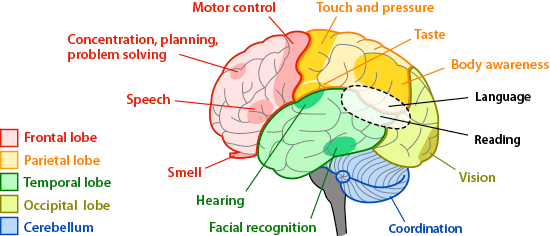
Free will is an illusion. Although I might be conscious that I am choosing between A and B, there are a multitude of nonconscious factors at play that are highly influential when I am making decisions – genetics, data from previous decisions, emotions, my physiological state at the specific moment, etc. These unconscious factors influence the options that my brain perceives. My frontal lobe is responsible for most of my decision-making and it processes information that I don’t even realize I have. Harris explains in The Moral Landscape, “I, as the subject of my experience, cannot know what I will next think or do until a thought or intention arises; and thoughts and intentions are caused by physical events and mental stirrings of which I am not aware” (p. 103).

And that’s okay.

If I’m not completely in control of the decisions and choices I make, neither is anyone else. The unconscious factors that determine my conscious choices are the same for me as they are for those around me. Therefore, we are all part of the same complex system and working to adapt to circumstances that exist today, and also prepare for what we anticipate in the future. What actually matters is not how decisions are made or what part of my brain makes those decisions. What matters is how my actions and behaviors influence those around me because we are all part of the same complex system.

What becomes important is avoiding fatalism, the idea that everything is inevitable. In many ways, this is the idea that I initially accepted when my fifth grade teacher first inadvertently introduced me to the concept of free will. However, I have now moved past that because I understand that complex systems are dynamic rather than static. Due to basic physics, I know that it is impossible for seven billion people to move about the planet without impacting the future. Therefore, the future cannot be predetermined. As a result, the seven billion and growing people on the plant have a profound and unavoidable impact on every area of our lives. We all impact one another’s realities whether we intend to or not.

Being
My responsibility within this complex system is to help develop a society that is better and more peaceful than the world that we have today. Whether or not I have free will, I have a responsibility to do as much right as I can for as long as I live in order to increase the well-being of all humanity. Part of my role, then, is to educate for peace and for the development of a sustainable world. My job is to provide students with the tools they need to navigate a world that will dramatically change between now and the time they enter the workforce, and then dramatically change again throughout their working lives and my own.

The most I can do is approach each of my decisions as though I have free will in order to make the choice that will be most beneficial for humanity as a whole. In the end, it doesn’t matter whether I have free will or not. Instead, what matters is what I do with the resources that I have in order to maximize sustainable well-being for all people.