Category Archives: Education

Learning That Free Will Does Not Exist

At some point in my fifth grade class at a Jewish day school, a teacher explained that there was a predetermined, irreversible, unalterable plan for the world. This aligned neatly with all of our religious studies and we accepted the idea. However, the teacher went on, individuals had the power to choose how the world arrived at that predetermined outcome. We had the free will to influence the path the world would ultimately take.

I was comfortable with this explanation throughout middle and high school and well into college. It fit with my religious beliefs at the time and gave me a sense of agency and empowerment – I could have an impact on the world. Maybe not the world in hundreds, thousands, or millions of years, but the world today and in the near future. My decisions could help people who needed it, impact lives, and transform society.

After college, however, my thinking changed. I grew much less enamored with the religious teachings I’d held in the highest regard, which led to a great deal of questioning that remains ongoing. A much more recent development was a shift in my belief in the existence of free will.

The more questions I asked, books and articles I read, and thinking I did led me to this conclusion: There is no such thing as free will.

Talking
Until relatively recently, I was unaware that the existence or illusion of free will was even up for discussion. As far as I’d ever considered, people made choices and therefore had free will (master plan for the universe or not). If someone offered me a chocolate and I declined, I was exercising free will. If I accepted, I was doing the same. End of story.

During the last school year, though, I had lunch every day with a group of science, math, and humanities teachers who made me laugh until I cried, were a bright spot in every day, waxed poetic on everything from the optimal type of sandwich to the size a pool would need to be to fit the world’s gold, and made me ask more questions (both out loud and silently) than any other group of people ever had. Many questions I have been asking recently about compassion, the purpose of education, and the importance of congruence in personal beliefs and behavior stem from discussions with people in that lunch group. I am indebted to them for the evolution of my ideas on free will, too.

Over a year of lunches, we had a series of discussions around the International Baccalaureate’s Theory of Knowledge course, in which students explore questions about what it means to know and the different forms that knowledge can take. As a psychology teacher, I worked with students to understand sociocultural, cognitive, and biological explanations for human behavior, some of which aligned with what they were learning in ToK. What became increasingly clear to me was the misalignment between factual, scientific knowledge and many of the ways we explained ourselves in the world.

Reading
A friend once started a conversation by asking me why I decided to have breakfast that morning. After a few question-and-answer exchanges, I realized that I didn’t have an answer. I was hungry for breakfast because I hadn’t eaten since the previous day, but how did I know to define that feeling as hunger? Why did I feel satisfied after my eggs and toast? Had I chosen to feel hungry? Had I chosen to be sated after my plate of food? No.

Ah, but feeling hungry is not the same as making a decision, I figured. But feeling hungry had led to the decision to eat in the first place. I hadn’t decided to feel hungry and yet that sensation led not only to eggs and toast but also to coffee, pleasant conversation, exercise, a healthy meal, and an early bedtime. How many of those decisions was I responsible for? How many had I actually made? Alternatively, to what degree did the firing of neurons determine everything I did?

That’s when I started reading.

One of the first articles that compelled me to actively rethink my understanding of free will was this one from the Atlantic. (It’s long, but I highly encourage a read!) Stephen Cave writes,

The 20th-century nature-nurture debate prepared us to think of ourselves as shaped by influences beyond our control. But it left some room, at least in the popular imagination, for the possibility that we could overcome our circumstances or our genes to become the author of our own destiny. The challenge posed by neuroscience is more radical: It describes the brain as a physical system like any other, and suggests that we no more will it to operate in a particular way than we will our heart to beat. The contemporary scientific image of human behavior is one of neurons firing, causing other neurons to fire, causing our thoughts and deeds, in an unbroken chain that stretches back to our birth and beyond. 

This was an important realization in my understanding of free will. The brain is the organ that literally brings us to life. It makes us who we are. We can’t substitute it with any of the modern technology that we use when other organs fail. The brain is responsible for everything that we do, whether we recognize it or not. If this is the case, how can free will exist?

I read The Moral Landscape by Sam Harris in part because of the summary of Harris’ views that Cave provides throughout the Atlantic article. I was curious and the source was readily available. Harris explains the stimulus-response relationship that influences our behavior whether we are aware of it or not. The brain constantly reacts to stimuli and our actions are a result of that reaction. When you accidentally touch a hot pan, you jerk your hand away. Did you decide to move your hand? No, but your brain did. For the first time, I connected that understanding to free will instead of only to science.

Furthermore:

A voluntary action is accompanied by the felt intention to carry it out, while an involuntary action isn’t. Where our intentions themselves come from, however, and what determines their character in every instant, remains perfectly mysterious in subjective terms. Our sense of free will arises from a failure to appreciate this fact: we do not know what we will intend to do until the intention itself arises (p. 105-106).

We feel like we have free will once we have choices or situations in front of us. However, we neglect to consider the circumstances under which those situations arose. Hint: We did not create them.

That was the point at which I sighed with resignation and sent a message to a friend: “Everything that I have read over the past many months has led me to the conclusion that free will does not exist. Disappointing, but makes unarguable neurological sense.”

Understanding
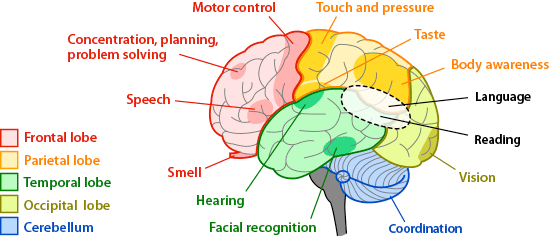
Free will is an illusion. Although I might be conscious that I am choosing between A and B, there are a multitude of nonconscious factors at play that are highly influential when I am making decisions – genetics, data from previous decisions, emotions, my physiological state at the specific moment, etc. These unconscious factors influence the options that my brain perceives. My frontal lobe is responsible for most of my decision-making and it processes information that I don’t even realize I have. Harris explains in The Moral Landscape, “I, as the subject of my experience, cannot know what I will next think or do until a thought or intention arises; and thoughts and intentions are caused by physical events and mental stirrings of which I am not aware” (p. 103).

And that’s okay.

If I’m not completely in control of the decisions and choices I make, neither is anyone else. The unconscious factors that determine my conscious choices are the same for me as they are for those around me. Therefore, we are all part of the same complex system and working to adapt to circumstances that exist today, and also prepare for what we anticipate in the future. What actually matters is not how decisions are made or what part of my brain makes those decisions. What matters is how my actions and behaviors influence those around me because we are all part of the same complex system.

What becomes important is avoiding fatalism, the idea that everything is inevitable. In many ways, this is the idea that I initially accepted when my fifth grade teacher first inadvertently introduced me to the concept of free will. However, I have now moved past that because I understand that complex systems are dynamic rather than static. Due to basic physics, I know that it is impossible for seven billion people to move about the planet without impacting the future. Therefore, the future cannot be predetermined. As a result, the seven billion and growing people on the plant have a profound and unavoidable impact on every area of our lives. We all impact one another’s realities whether we intend to or not.

Being
My responsibility within this complex system is to help develop a society that is better and more peaceful than the world that we have today. Whether or not I have free will, I have a responsibility to do as much right as I can for as long as I live in order to increase the well-being of all humanity. Part of my role, then, is to educate for peace and for the development of a sustainable world. My job is to provide students with the tools they need to navigate a world that will dramatically change between now and the time they enter the workforce, and then dramatically change again throughout their working lives and my own.

The most I can do is approach each of my decisions as though I have free will in order to make the choice that will be most beneficial for humanity as a whole. In the end, it doesn’t matter whether I have free will or not. Instead, what matters is what I do with the resources that I have in order to maximize sustainable well-being for all people.


Building Peace: Choosing Our Words

This post was initially supposed to be about mental health in the classroom because of a PD from this week. However, I was sidetracked by a conversation I overheard on the train on the way to the  café where I am now. (If you clicked on the link and are imagining the delectable smell of cinnamon rugelach, you’re right here with me.)

As a result, I’ve reframed this post as a discussion about the power of language with a specific focus on how we talk to children and to students in our classrooms.

The Conversation
I don’t always eavesdrop on the people on either side of me on the subway platform, but I generally start to pay attention when I hear the voices of very young children. That’s mostly because I think they’re adorable but also because I’m curious about parenting. My mother is an early childhood educator and has always maintained a running commentary on how people dress, talk to, and generally treat their children in public. Though I am not a parent myself but really hope to be someday, my mother’s ideas have influenced my opinions on parents and parenting. As an educator, I know that deliberate language makes a huge difference in many activities that take place in the classroom, including the formation of relationships between teachers and students.

The conversation I overheard just a few minutes ago reminded me how important it is for parents to also be cognizant of how they talk to their children and what they say when their children are around. I wasn’t paying attention until the little girl in a tutu and ballet bun tried to break into her parents’ heated discussion. I caught phrases like “if we have a boy” and “you can’t just save all that money” and “she also wants to have a career”. The child tried three times before being able to complete a sentence, stopping herself when neither parent glanced at her as they continued speaking. When her parents finally paused, the little girl announced, “Yeah, Dad, and you don’t do nothing with me!”

Both ignored her. The train arrived and all three squeezed inside.

The non-interaction made my heart hurt.

How We Talk
Two things in particular stood out to me regarding the parents’ dismissal of their child and what the child had actually said:

  1. Need for acknowledgement. When a child clearly wants to speak, the adults in discussion need to acknowledge the child’s desire to participate and let the child know when it is an appropriate time to do so. We want our children and students to be able to engage in dialogue, a true back-and-forth exchange of ideas and opinions. We want them to develop autonomy, agency, and a sense of empowerment in their ability to express themselves. If we ever expect them to talk, we need to listen when they’re ready. This happens constantly in the classroom when students want their voices heard. I can’t try to count the number of times I have said something like, “Hold on, someone else is talking now” and then followed up with, “Okay, what would you like to add?” when the other student had finished. I remember my parents telling us, “Mummy and Daddy are talking right now and in one minute you can say something. Please wait.” Acknowledging that children want to speak and then helping them determine when to do so is essential if we truly want to listen to and interact with one another in any capacity.
  2. Awareness of surroundings. Regardless of what her parents were arguing over, I know that this girl had heard too much. She was probably around four years old and clearly parroting what she’d been told about her father or what she’d overheard others say. I expect she’d heard her parents engage in a similar exchange more than once before since she was so intent on this particular phrase. “You don’t do nothing with me.” Does she even know what it means? She very happily grabbed her dad’s hand as they boarded the train, so I suspect not. When we speak, we are modeling behavior. If we want our children to grow into respectful young people and ultimately respectful adults who care about those around them, we need to model respectful language. Students hear the words that we use and absorb them. We send messages that we don’t realize we’re sending. Certain words and phrases stand out more than others and we don’t necessarily know what children will latch onto. Young people hear a lot and interpret what they hear. If we want to cultivate certain ideas over others, we need to be careful that it is those ideas we express when we’re speaking.

Why It Matters
Actions and words create environments and expectations. This is true at school, at home, and in the workplace. In the heat of the moment, that’s easy to forget. We all make mistakes and we all say things that should be left unsaid. From a pedagogical perspective, I try to be very aware of what I say and do in order to create a classroom environment where students feel accepted, validated, safe, and important. I make choices about the words I use, ideas I express, how I deal with challenges, and how I interact with students in order to create that classroom environment and culture. I can’t expect my students to act a certain way if I don’t explicitly show them what that is and insist that they engage that way with each other.

“People will forget what you said. People will forget what you did. But people will never forget how you made them feel.” – Maya Angelou

We all know that words matter. A lot. In each of our interactions, we need to remember that the connection we form with others does not disappear when we stop talking and part ways. I don’t always know what the people around me take away from the time we’ve spent together, but I do know what I take away. Young people are constantly learning from example, which is why I urge mindfulness in all interaction, verbal and nonverbal. If I want my students to work to construct a better, more peaceful world I have to work on that with them at a micro level before I can expect them to do that on a global scale.


The conversation I overheard on the subway platform is also relevant in terms of a really excellent presentation from PD this week about dealing with mental health issues in the classroom. I have always been interested in mental health and I’ve taught psychology in the past so little in this presentation was new in itself, but it was refreshing to attend a PD session focused on supporting students with mental health issues.

We don’t talk about mental health often enough. I’ve been trying to raise awareness about educational issues lately, which is why I want to share some thoughts on mental health in the classroom and a resource the presenters introduced that I find very useful.

The Numbers
Most of us are experts at pretending we’re okay when we’re not. When’s the last time someone asked, “How are you?” and you actually answered the question instead of providing the cursory, “Finethankyouhowareyou?” response? Society has decided that we’d rather delude ourselves than actually see the people around us.

This is a problem because many people are not fine at all. In 2014 alone, one in five American adults experienced some kind of mental health issue. It’s also a problem with young people. There has been increasing research about the number of adolescents who are struggling with mental health issues. Suicide rates are the third leading cause of death in young adults ages 15-24, and 90% of those who committed suicide struggled with mental health problems. Being able to talk about openly about mental health is a step in the right direction towards an emphasis on greater well-being for all.

The Need to Talk
Stigma is a huge problem when addressing mental illness. As noted above, we have decided that we are all “fine”. Many people would probably be taken aback if a polite, “How are you?” was followed up with, “I haven’t slept in three months, my appetite is gone, I have almost constant headaches, and I can’t stop thinking about my parents dying in a car accident. How are you?”

The simplest thing for a concerned educator to do is to make mental health awareness part of the classroom community. Teachers are in a position to indicate to students that it is okay for them to feel anything they’re feeling. It is okay for them to ask for help. Many schools have already developed (yay!) a culture around safe spaces for LGBTQ students and we are beginning to do the same for students with mental health concerns. Students need to know that they do not have to be okay all the time. They need to know that mental illness is a very real part of being human. Look at the numbers. We hide it when we avoid talking about it, but it’s more than common.

The clinicians and researchers who ran the PD session provided this website that they have developed as part of their work. This is the first time I’m sharing a teacher resource on this blog and I’m doing it because I think it is so important to allow mental health to be a very real part of classroom dialogue. My AP Psych teacher in high school said that society will have come a long way once we decide it’s as necessary to seek medical help for mental illness as it is for a broken arm. That was 2008. We talk more now than we did then, but it’s still not enough.

From Talk to Action
Let me preface this by saying that I am not trained to treat anyone for anything. That’s not my job. My job is to get to know my students so that I know when something is not right. My job is also to provide a safe space for students who want to talk, have questions or concerns, or need somewhere accepting to go during the day. The language I use, behaviors I model, topics I discuss, and the ways in which I interact with my students are very powerful in shaping relationships. There is the necessity of congruence in what I believe, what I claim to want for my students, and how I show that to them.

As I’ve written before and linked above, I believe that peacebuilding is the goal of education. That means purposefully developing real connections with one another, working towards increased well-being for all, and creating a culture in which we are caring and compassionate towards each other. The language that we use goes a long way in promoting this overall aim. With a new school year either very fresh or about to begin, I urge all educators to think about the messages they want to send and they way they go about doing that. Our students deserve a better, more peaceful world. Together, we can build that.


In addition to my educational interests, I am always intrigued about the way language has changed over time. One of my favorite papers in graduate school had me researching the clinical uses of words like “moron” and “idiot”. The next book on my ever-growing To Read list, How Happy Became Homosexual, will likely address some of my curiosities but I’m eager for your thoughts!

Please feel free to comment below. I’d love to hear about the use of language in your classroom/workplace/any area of your life (always aiming for inclusivity here), any educational resources you have about mental health, or your thoughts on/experiences with parenting. Really, I’d like to hear about anything you want to say. I love learning. Thanks for reading!

Building Peace: Reconsidering Masculinity and Femininity

Over coffee a few months ago, a friend and I asked ourselves the following question: What character traits and values should society be promoting in order to best create sustainable well-being for all?

Because we had both recently finished reading Peace Education: How We Come to Love and Hate War by Nel Noddings, one lens to use in answering this question jumped out. We began discussing it as the difference embodied in masculine and feminine traits and values. It appeared obvious to us at the time that the majority of masculine traits and values, which are promoted, advertised, and sold to us, largely stand in the way of universal well-being and their opposite traits and values, embodied in feminist ideology, mostly contribute to a better, more peaceful world.

There seemed to be a clear disconnect between what society espouses it desires and the values it endorses in attempting to actualize those visions of a better society for individuals to live in. This post aims to explore the masculine and feminine values in our society, and the ways that we actually do (or do not) promote a better world.

What We Teach
The easiest way to think about this question is to consider what we teach our youngest children or students. We want them to be kind, caring, and compassionate. We show them how to cooperate, collaborate, play together, and form friendships. We praise children who are gentle with other children and who help those around them.

All of these qualities are undoubtedly positive and certainly enhance the relationships between individuals for the better, thus contributing to overall well-being. When we teach our children to take turns in the sandbox so that no one feels left out or left behind, we do it with the hopes that they will grow into adults who are responsive to others’ needs. When we do not care about others, including those we do not know, we are less likely to see them as deserving of the same rights, privileges, and opportunities as we are. An accepting, non-discriminatory society therefore depends on caring relations between individuals. The time we spend teaching caring to our children demonstrates its importance in all aspects of our societies and communities.

Similarly, we spend countless hours teaching our children to cooperate and work together. We want them to entertain themselves as a group, solve problems collaboratively, and develop strong bonds with others. When children see themselves as friends, they are happy to be around those people; adults are the same way. There is a certain satisfaction to a high-five for teamwork after completing a difficult puzzle or solving a challenging problem in tandem with others that is not the same alone. Cooperation towards a common goal, whether with one person or with hundreds around the globe, means that any number of people will benefit from the realization of that goal. The aim of achieving greater well-being on a large scale is clearly embraced through cooperation.

Cooperation naturally leads to and stems from connection to others. This connection can be brief and shared only for the time that the problem or project lasts, or it can extend beyond into a true friendship. As people spend more time working together, their connection will deepen, whether they are friends or not. We help children interact with others and engage in activities with like-minded individuals in the hopes that they will form friendships. This way, we know that they have people to rely on, people to turn to in times of need, and people who make them feel good about themselves. Those who have deep connections with others tend to be happier in their personal lives, which also leads to taking more actions that increase the well-being of others.

Femininity
The qualities discussed above (caring, compassion, kindness, collaboration, friendships, and gentleness) are traditionally associated with girls and women. These feminine qualities clearly enhance existence and society should promote them in order to best contribute to well-being for all. However, society has an unnecessarily complicated relationship with feminine qualities. We praise girls and women when we call them caring, kind, and gentle but we have actively turned these words into insults for boys and men. We derisively ask, “Why do you care so much?” We hurl at young men, “Don’t be such a pussy!” “Boys don’t cry,” we remind young children who are hurting. As a society we have deliberately chosen not to associate compassion, kindness, and caring (positive feminine qualities) with the qualities that undoubtedly serve to increase the well-being of others.

Instead, femininity is tied to physical beauty, as indicated in this Google Image search:

Screen Shot 2016-07-11 at 5.00.13 PM

When we whittle femininity down to physical appearance, we devalue everything else that comes with it. Furthermore, we turn femininity into an abhorrence and an embarrassment. If femininity is merely associated with physicality, who wants to be considered feminine? Even the images of “strong women” above are first and foremost images of physical beauty.

This realization is troubling because it indicates that while we consider feminine traits and values of utmost importance when teaching children, we do not carry that message through as children develop into adults. Instead, we focus on femininity’s foil: masculinity.

Masculinity
In direct contrast to femininity, masculinity is generally associated with strength, competition, aggression, individualism, and violence. Overwhelmingly, these are the qualities that society has chosen to promote. A great deal of media are devoted to exercise, sports contests, how to promote oneself, and how to stand out of the crowd. Violence is an accepted part of television and film. Street fights and scuffles among adolescents to solve conflicts are considered “kids being kids” or, more often, “boys being boys”. (Physical fighting between girls, interestingly, is a spectacle.)

The Google Image search below clearly reflects these ideas of masculinity:

Screen Shot 2016-07-11 at 5.00.36 PM

As demonstrated in the above examples, a society that aims to increase well-being for all must promote the opposite qualities. Competition lies in direct contrast to cooperation. When we teach children that there must always be a winner and a loser, we are sending the message that equality and equity are neither desirable nor possible and that success is equal to winning. Furthermore, we indicate that the way to win is to do it alone, which is incompatible with working for the betterment of all.  We have objectified others, literally turning them into objects that we need to overcome, rather than looking at them as subjects that we to know and understand. We have thus stolen their humanity.

Similarly, the all too common displays of aggression are far from caring for those around us. Aggression means a continuous display of strength and a celebration of strength. Where does that leave those who need help? What role are they relegated to in society? Choosing to value aggression automatically devalues anyone who is not aggressive, and those who are not aggressive are not strong. Traditionally, this refers to women, children, and the elderly, leaving younger men as the ones who matter the most. Obviously, this is a ludicrous statement. However, that is the decision we have made as a result of our emphasis on aggression, strength, and violence.

Moving Forward
It is clear that what society espouses it desires for the world does not match the values it actually endorses. We are not promoting the values that would create sustainable well-being and a better, more peaceful world for all. We need to move away from masculine traits and qualities and embrace feminine traits and qualities if we hope to increase well-being and develop a more peaceful world.

One way to accomplish this would be to adjust the language that we use, especially around young people. Let’s use emotion as an example. Many young boys will decide it’s not okay to show emotion (caring and compassion are feminine values) and this is because of the message that we have chosen to send (men are strong and the strong don’t cry – aggression is very much a masculine value). Instead, we need to reframe how we approach those around us. If we can see tears as a sign of what they are, feeling, and if feeling is a demonstration of concern for others, we should embrace the tears and feelings that tie us together as humans.

Rather than referring to strength as a physical quality, we need to reframe it as the ability to endorse the values that we espouse, these feminine qualities that will actually make the world a better place. It takes a far stronger individual to resist conformist and socialization pressures than to hit harder or run faster than the next person.

We also need to exercise caution with words of praise. Girls are often told that they are beautiful, but this is a comment on what they look like rather than who they are. If we value our girls as more than their appearance, we need to use words that emphasize precisely what we value about them. Perhaps they are helpful, kind, or generous. Developing an identity around being helpful, for example, provides a way forward to developing a more peaceful world.

The same is true for boys. Commenting on how big and strong they are does not go a long way when what we actually care about is their humanity. Instead of emphasizing these qualities that lead to competition and violence, we are better off focusing on what makes our boys helpful, kind, or generous.

If we truly want a better, more peaceful world with sustainable well-being for all, rethinking how we talk to one another is a good place to start.