I recently started my time in Mutterschutz, the period from six weeks before my due date until eight weeks after the baby’s birth in which I am not supposed to work but receive my full salary, paid partially by health insurance. This time of “mother protection” is there to help avoid physical or mental strain, which increases risks for both mama and baby, and to allow a heavily pregnant woman to step back from certain aspects of daily life in order to prepare for what is to come. As I’ve been writing my to-do list, I’ve kept this time firmly in mind, which is what had me starting on task one, wash all baby clothes, first thing Saturday morning.
After a day of hanging in the living room to dry, everything was ready to be folded. We’ve received some baby clothes as gifts, but mostly been given gently used items from friends, meaning we are entirely lacking an overview of what we have. My partner and I looked at each other helplessly.
“How do you fold something so small?” “I dunno.” “Like this?” “But now we can’t see what it is. Like this?” “What is it?” “This one has feet.” “Oh okay. This one has arms but no feet.” “Oh. Okay so start a new pile.” “Which pile does this go in?” “I dunno. Is that a onesie or does that go over a onesie?” “How should I know? How do we even put this on? It has no snaps.” “Do we need a pile for things without snaps?” “These two things are different but neither has snaps.” “I am not dressing her in anything without snaps.” “Okay, put it here.” “What’s the name of this pile?” “Should we write signs?” “Where does this go?” “I’m serious about the signs.” “This is so tiny.” “There’s only one thing in this pile.” “So combine it with this pile.” “Oh wait, no, these are different. Fold the arms out so we can see that there are arms. Long arms.” “We got this.” “This is so tiny.” “The next round is socks. How do we even dry socks?”
Savour everything now, they say. This time will never come again, they say.
To that end, we bought a new board game and borrowed one from friends. We started going out for dinner once a week and lie in bed weekend mornings until hunger drives us into the day. Alongside the ease with which we are living right now, there’s extensive paperwork to complete (welcome to Germany), a hospital bag to pack, bottles and pump to sanitize, a photo album to start. There’s a life to get ready for.
But there’s also the relationship between the two people who decided to be a family before there was a third member involved. Although no one has said so, maybe one idea behind Mutterschutz is to put relationships, rather than work, at the forefront in order to protect them at a time of great change. I would imagine that the stronger and more centered we are together, the easier the transition into a new phase of our lives.
Time will tell about that. In the meantime, the socks are drying on the radiator.
When I accepted a job in Weimar, Germany, I knew exactly two things about the town:
Its location on a map.
Its historical significance as the place where the Weimar Republic was founded in 1919.
I didn’t know that Weimar’s position in founding Germany’s first democracy continues to hold political significance today, but this is very much the case. The Weimar Republic period brought a flourishing of arts and literature, much of which was due to the new focus on civil liberties that was written into the Weimar Constitution. Women received the right to vote, freedom of speech was protected, censorship banned, the right to education guaranteed, and the freedom to negotiate for better working conditions granted.
These and other social and political rights are critical to a functioning democracy, and it is for this reason that Weimar is still a gathering place for people who have something to say. A significant point for many are the Monday Walks, in which far-right supporters and activists come to town with drums, whistles, flags, and placards. The march routes are protected by police, as are the gatherings from other groups often located along the route, accompanied by their own music and placards.
A particularly large far-right demonstration was scheduled for Saturday and the city put out a statement urging anyone without essential business to avoid the city centre. In response, left-wing activist groups did what they usually do and gathered in pedestrian zones of town around the square where the right-wing demonstration was set to take place. In doing so, they effectively blocked the route the demonstration was supposed to follow through town. Considering that the counter-protest wasn’t registered in advance, it wasn’t legal. But this would only become a problem if the counter-protest and far-right protest actually came into contact.
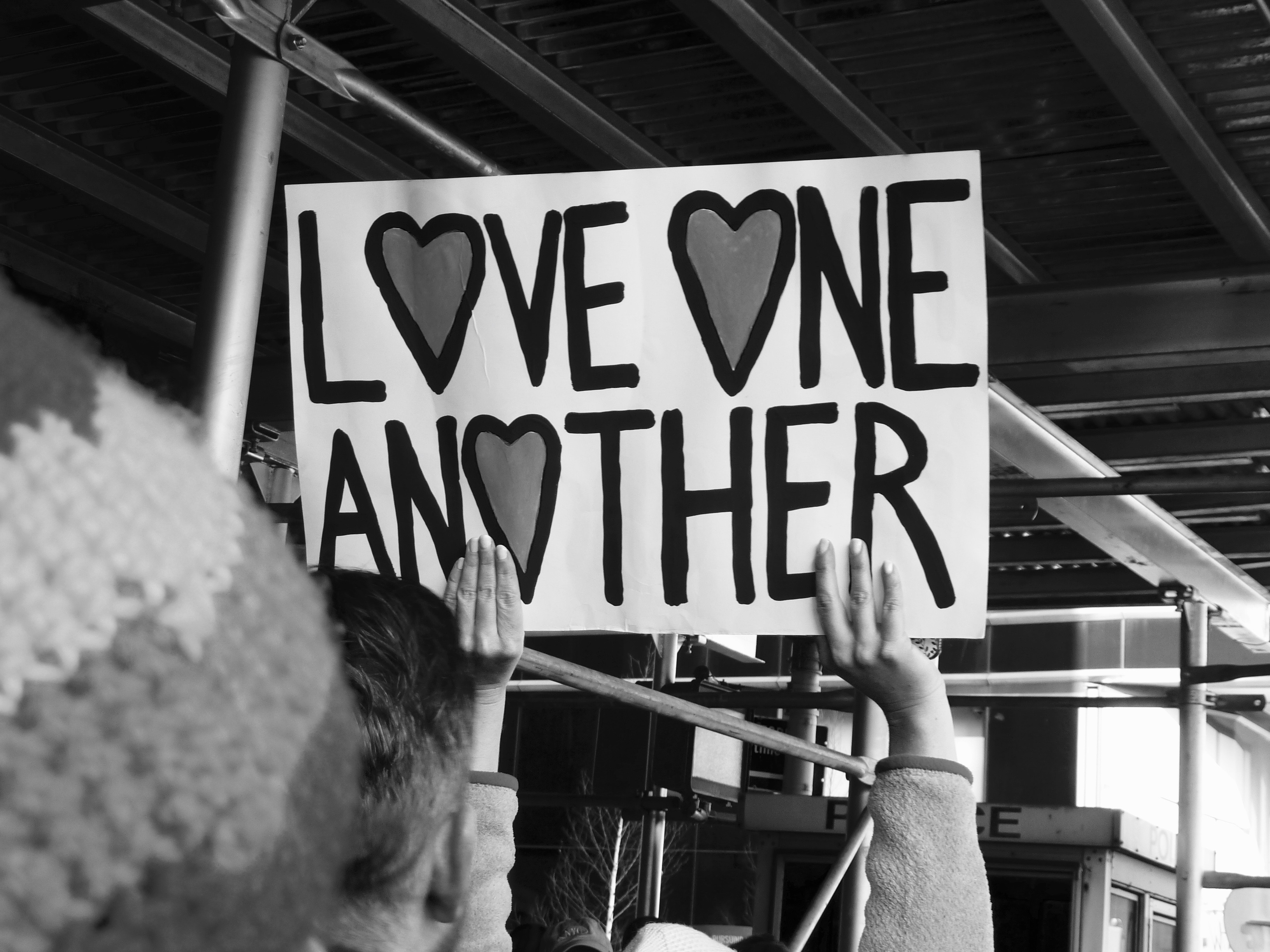
Following a breakfast discussion about freedom of expression, Germany’s laws against hate speech, and the role of discourse in a democracy, my partner and I headed into town. Listening to the far-right tropes made me nauseous, but I didn’t feel much better standing with the counter-protestors. The music they had chosen was largely political and aggressive, and the slogans they chanted were not much better. Although a number of people sported pride flags and t-shirts with statements like “Love is love” or “I greet all people”, the mood did not reflect these sentiments. Why, I asked my partner, were we not listening to Summer of Love music? Where were the guitars and the hand holding? Why was the counter-protest, in being against a group of people, just as negative as the far-right protest?
What would the world be like if we were for peace, for love, for humanity rather than against these people and their idea of peace and their idea of humanity? Wouldn’t finding commonality be much more effective if we spoke for people rather than against them?
This is not to say that far-right extremists, many of them the very definition of neo-Nazis with clothing and tropes only thinly vailed, should be allowed to spread the hate that they spread. And due to hate speech laws in Germany, there are limits on speech. This is rather to say that we, the people for justice and diversity, do not have to sink to their level. We can be for our beliefs rather than being against theirs. And considering that the rise in far-right extremism has not been accompanied by a rise in support of democratic ideals, it seems that the “against” message has turned people off or away.
As the newspaper reported the next day, there were no clashes between the two groups. Fewer right-wing protestors had come to town than expected and nearly the same number of ad-hoc left-wing protestors had turned out. Through force of numbers alone, opinions were made apparent.
Nevertheless, I was left with a feeling of disquiet that I cannot quite shake. There is something very wrong when one side speaks of freedom and screams, “Foreigners out!” and the other side speaks of equality and screams, “Nazis out!”. What these groups actually stand for is hidden behind the curtains of what they are against.
We live in a time in which there is a political weakness in standing for. Online and social media have created an environment in which the air time is given to those who are against, regardless of which side. Anger receives more clicks than attempts at common ground, but anger does not win. It destroys, and then something else picks up the pieces.
I am not an activist, but an educator. It’s my job to listen to young people and their ideas, my job to ask them where the evidence comes from, why they believe what they believe. I ask them to try on different hats, to empathize. We talk about what was surprising or challenging, what was comfortable or uncomfortable. My job is to encourage the formation of informed opinions, not to tell young people which opinions to have. I work in a school, one of the few places where, changing one’s mind is normal and it’s a sign of learning, not of weakness.
And I didn’t feel comfortable out on the street, just behind a crowd of counter-protestors lying in wait for another group of protestors. I might be on their side if we have to pick sides, but these were not my people. Their slogans were not my slogans.
Without discourse, the exchange of beliefs, only hate and anger remain. I refuse to do nothing, which is why I was there, but I also refuse the detestation with which these two sides regard one another. Over a glass of wine a couple weeks ago, I learned that the evening’s host had voted for the AfD, Germany’s far-right political party. Reminding myself that I stand for democratic values, I asked about his opinions and then gave him mine. A tiny drop might not make a difference, but a few more drops could do just that.
Back in 2020, I read a New York Times article about a crowdsourced, online project to digitize records with the Arolsen Archives, the keepers of the world’s largest archive on victims and survivors of National Socialism (Nazism). The goal of the #everynamecounts initiative is to create a digital memorial with records accessible to all.
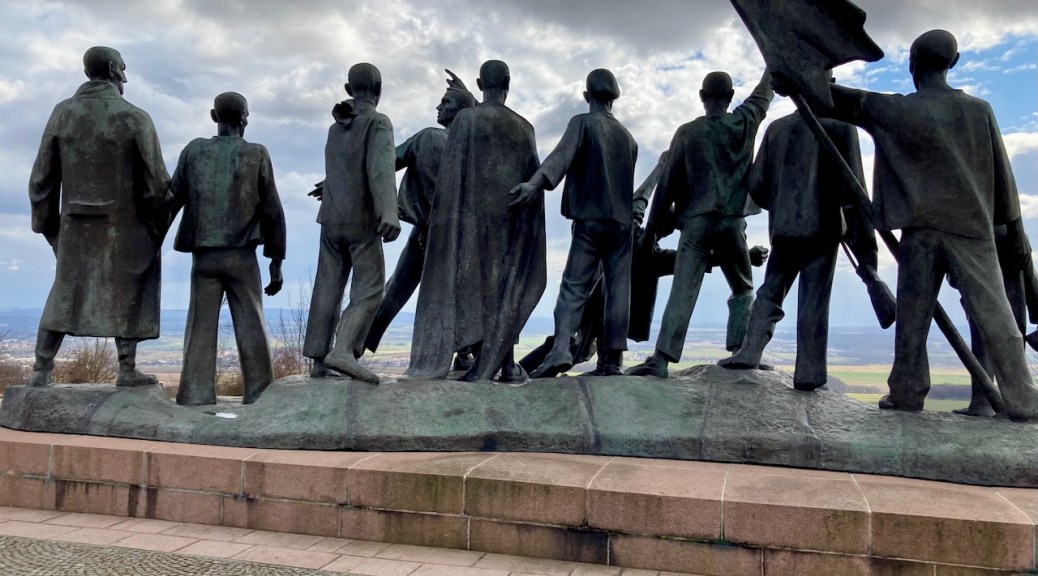
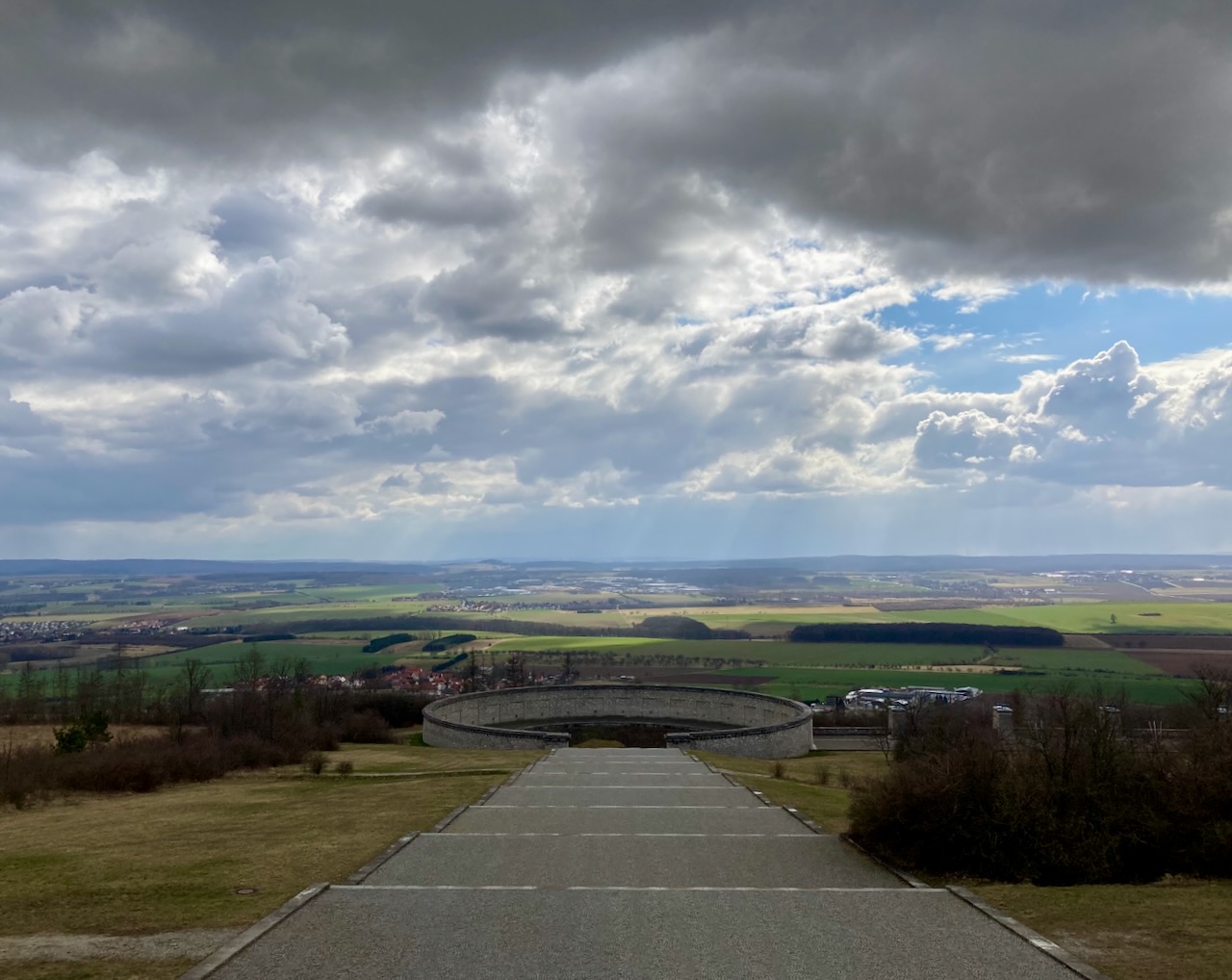
With thousands of volunteers around the world, I type whatever information there is. Sometimes I’m familiar with the names because of the community I grew up in and where I live now. Sometimes I recognize locations. One project involved documenting records of prisoners held in the concentration camp Buchenwald. I live within cycling distance of Buchenwald and have been up there more than a handful of times.
I most enjoy working on records of displaced people. These are the survivors, the young children with huge names, the defiant elders, the unbreakable adults. The documents indicate where they came from, and where they were sent to, and when. People were living in DP facilities until the early 1950s. Sailed to New York. Flight to London.
I wonder about the workers who took down these records, the handwriting of people all over the world, the very human touch of both condemning and saving a life. There is handwriting that loops and weaves, handwriting that took the time, handwriting that scratched and scrawled. Name. Marital status. Birthplace. Last address. Location. There are typed records, too, an indication that all of this happened in a world different from ours, yet not so long ago.
As I record lives lost and lives saved, I think about the internationalism of these records. Europe in ruins, its condemned minorities and those unlucky enough to have a non-conformist opinion collected and shipped off. To somewhere. Europe’s ravaged population surviving wherever they ended up, many so far from home.
And the internationalism of 175,000 volunteers around the world who painstakingly transcribe documents holding the stories of 17.5 million people. To guard against mistakes, each document is read by several volunteers. Any areas that cannot be read according to the usual guidelines are then checked by a member of the Arolsen Archives team. Seventeen and a half million individuals and their stories are too precious for error.
Two weeks ago, quite by accident, we drove past the town where the International Centre on Nazi Persecution, home of the Arolsen Archives, is located. I transcribed a few more documents the next day.
Every name counts.
View from the Buchenwald Memorial – March 2022
Photos, travels, musings, and ideas on education by someone trying to make the world a better and more peaceful place


 By Rebecca Michelle