I’m not sleeping very well, and I can guess why. International moves are not easy at the best of times, and a pandemic is a far cry from the best of times!
It’s an adventure, they say. A story to tell your grandchildren! I have all sorts of cynical responses to that. It certainly is an adventure, but so far not quite the one I had hoped it would be.
But life is like that, isn’t it? And that’s why life is a journey. If we could sit over a cup of coffee and write the whole thing before even starting, there really wouldn’t be much point.
Lately I’ve been doing a lot of cooking, which I find fulfilling, relaxing, and a productive way of maintaining a sense of control over my world. Along with this, I’ve also been leafing through my cookbooks and rereading my notes. My mum taught me to annotate my recipes and so I have. My first attempt at making something and how it went, changes to ingredients or methods, any special occasions or memories.
But what really makes me laugh, what makes me wish I could give my younger self a hug, are all the mentions of who was with me when I first tried different recipes. How many times did that person appear in the cookbook? And then what happened to them? My attempted love stories through cooking. And it makes me laugh because I remember purposely not writing in someone’s name because I didn’t think they’d be around that long (I was wrong) and I remember proudly doing just the opposite because I thought I’d found something meaningful (also wrong).
My oldest cookbooks are eleven years old and it’s wonderful to reflect upon myself through them. The notes remind me how far I’ve come as a cook and how long it has been since I first made a recipe or got to know a particular person. Not only have my tastes, culinary skills, and cuisine interests changed significantly, but I have changed, too. I have to smile at the thought of what might be recorded in cookbooks to come.
Perhaps I’m feeling nostalgic because I’ve made the choice to conclude this chapter and I know what I’m leaving behind. I am not nearly as confident about what I am going toward. But that’s why they call it an adventure. And my future cookbooks will doubtless reflect the ride.
Rochester Public Market, Rochester, New York – June 2019
is not a word that I use. It is not a word that I like because it connotes being taken over by something – this is, after all, what happens when we are sick. It is one thing to miss my family, which is the case every single day, but this is an emotion like love. It’s beautiful to notice because it means they matter to me. Missing my family is a deep sensation, one that I feel through my whole body, but one that comes in waves.
However, it seems that to be homesick is beyond what I feel. It is what I am, and it is consuming.
I settled on this word because I could not otherwise describe how I felt after a perfectly normal, pleasantly busy day over the weekend. Out of nowhere came the sense that a physical space was suddenly empty, as though it had been full of energy mere minutes before and something was now gone. In that empty space came the feeling that anything I tried to do, and I tried a number of things, had a missing piece that had not previously been missing.
Writing these words brings to mind when I was a child and I used to have a hard time during our one-night sleepover at camp. By the second or third year, we figured out that as long as I “didn’t plan to stay” and my dad had to bring my bag or pillow, I would be alright. I just needed a hug. When I was little, my dad could put my whole world back together when it seemed to fall apart.
Both age and life experience assure me that my world has not fallen apart. Quite the contrary, in fact. Rather, it seems like the larger world has moved on while my world is floating aimlessly, looking for somewhere to land. There is a fist over my heart and it is keeping me awake at night, which makes it difficult to focus during the day. I am exhausted when I get home and time ticks by more slowly than usual. Homesick. What else might I call it?
And just like being physically ill, this will pass. It will settle. Have some tea, take some time, and life in general will move on. Homesickness will quiet into its usual state, that of missing, and the world will fit itself back together.
Until then, let this be a visceral, bodily reminder that the people in my world are what make it go round.
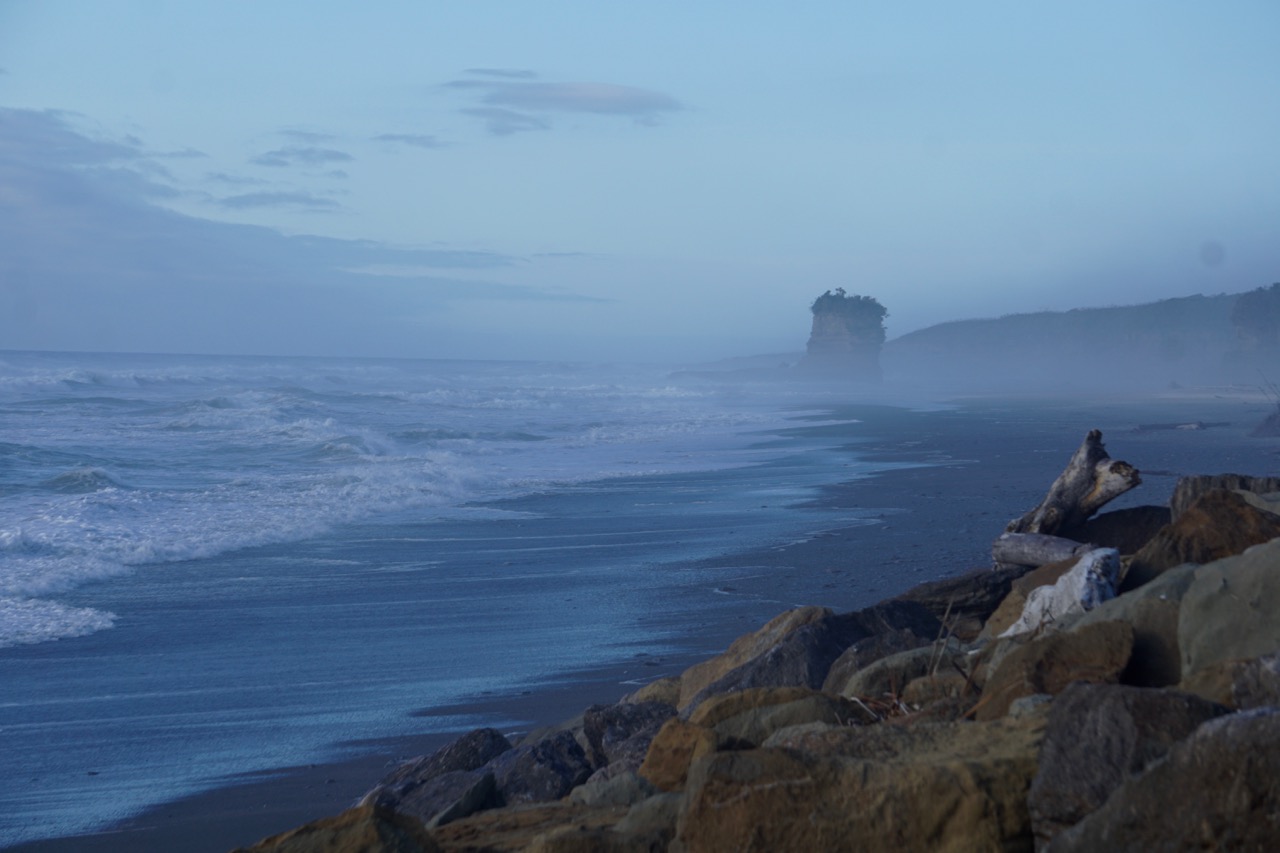
Punakaiki, South Island, New Zealand – December 2018
I learned to cook when I was very little, or at least that how I remember it. Jewish holidays revolve around food and my mum would involve me and my sister and brother in the preparation process as much as possible. It undoubtedly would have been less work and less time consuming to do it herself, but this gave us a sense of pride, accomplishment, and belonging as children. We had “our dish” that we would prepare each year, slowly growing in independence as we grew older. We had children’s cookbooks and children’s Jewish holiday cookbooks, and we knew how to use them.
These experiences were foundational in the way I developed as a cook. I grew so accustomed to going through my mum’s recipe file, the large collection of recipes clipped from newspapers and magazines over the years, that it was not uncommon for her to call when I moved out of the house for university to ask which category something was filed under. My mother’s filing system works best in her own head and requires interpreters when activated in the real world. For instance, “All kinds of burgers but not meat” is a category, and so are “Miscellaneous deliciousness” and “Mexican”. So where, I ask, would you find a recipe for a Mexican black bean burger with mango salsa? Well, it depends. Is the defining feature that it is a black bean burger, that the salsa is likely delicious, or that is is Mexican? Guess correctly and you have found your recipe.
I’ve moved a lot as an adult and finding a workable kitchen has been the most important feature of any place I’ve ever lived. Malaysia was particularly memorable in this way. I lived in a hotel room for four months and turned the desk, bathroom sink, and mini fridge into a working kitchen in order to prepare salads, for example, which are a staple of my diet and not found in a country that lacks clean water and is prone to food-borne pathogens. I’ve worked with a two-burner stove and no oven, four-burner stove and toaster oven, “apartment sized” stovetop and oven, and full sized kitchens. And the point is that it works. If you want to cook, you make it work.
And I have always wanted to cook.
More than many other pursuits, cooking brings me to a place where I am centered. I find a sense of calm and belonging, a sense of home. Growing up, cooking was communal, joyful, relaxing, and a source of pleasure and conversation. This is still what I find. It is a place for solace and creativity, to activate the senses, to turn something into something else. When my life is spinning out of control, when I can’t understand my own thoughts, when I don’t know where to go or who to turn to, I refocus when I am cooking. It doesn’t matter whether I’m following a recipe, and it doesn’t matter which ingredients I’m using or how long it takes. There is something deeply satisfying in taking many parts and bringing them together into a whole. There is something soothing in the washing, preparing, sautéing or frying, grilling or roasting, and in mixing, stirring, tasting, seasoning. Wash up at the end, dry and put away the crockery, spray and wipe down the work surfaces. One more satisfied look around. The world makes sense again.
I noticed this tendency, my turning to the kitchen when in need of balance, after a really difficult day with a friend once upon a time. We didn’t fight but we argued and I was drained, exhausted, angry, and afraid by the end of it. When I got home, the first thing I did was heat up a grill pan. I sliced and seasoned eggplant and zucchini, and I had them on the hot pan before even taking a moment to have a glass of water or consider taking a shower. Once the vegetables were done, I could breathe again. The world had reformed into a shape that I knew, and I again understood who I was and how to be.
In many ways, I cook the way my mother taught me. Follow the recipe (more or less) with the understanding that the ingredients are suggestions, the method and preparation depend on the amount of time and effort you actually want to put in, and you only have to measure when baking, which is why it just makes more sense to cook rather than bake, although gingersnaps are just as delicious without ginger. There’s no such thing as too much pepper, herbs and spices exist to be used, garlic makes everything taste better, and even if you have “nothing in the fridge”, a good meal just takes a sense of fun . And cooking with my mum means reading the recipe and the notes on the side of the recipe, asking her what she actually wants me to do, and then doing it my own way, which is similar to watching her cook with my grandmother.
This love of cooking has made it possible to find a place where I feel at home everywhere I have lived. Once I know my way around a new kitchen, I know everything will be okay. I write this mere months from moving to a new country and I’ve seen photos of what will be my new kitchen. I don’t love it but I know it will work. It always has, and it has always given me what I need. Working in the kitchen provides nourishment in more ways than in body, and everything is easier after a good meal.
Busan, South Korea – October 2019
Photos, travels, musings, and ideas on education by someone trying to make the world a better and more peaceful place





 By Rebecca Michelle