Category Archives: On My Mind

On Strength

I first tried to climb the black route on lane one at the climbing gym some time ago. After weeks of alternately attempting and staring at the tricky holds in dismay, I climbed it. The next day, I tackled the purple route, the one with the big sloping handholds. I got higher than I ever have, fell, and then climbed one hold higher. While I had developed my strength since that first attempt, I have also become more deliberate and more precise. In climbing, as in much of our lives, this makes a difference.

Feeling stronger has me thinking about what strength means and where I have found it over time. As a friend once pointed out, I have written about human fragility and vulnerability but I have not focused nearly as much on strength and resilience. I think there are good reasons for this, but that was then. Now is a different time.


I would like to talk here about physical strength in the sense that it takes mental strength to grow physically stronger. I’m reading The Rock Warrior’s Way by Arno Ilgner right now and much of what I’m reading aligns beautifully with my experiences learning meditation. The mind has a remarkable influence on the body and, as Eastern philosophy suggests, there may not be any separation between the two. When I’m feeling happy and positive, the world looks prettier. So too, my body moves more easily. Conversely, when my shoulders are cramped from hunching over a desk and my mind is already in a rut because my shoulders are sore, my body responds unhappily when I ask it to move and my mind continues to complain.

But there is more to strength than the link between mind and body. There is, for example, the sensation of soaring when the two work in concert.

Strength is the feeling that whatever comes next is within my grasp. It is reachable. It is possible.

Strength is the feeling of trust in myself and courage in the face of difficult choices. Strength is the commitment to this thing right here right now rather than acquiescence, resignation, or tacit agreement.

Strength is the ability to challenge oneself and to ask, as I learned in a Coursera course during Singapore’s circuit breaker, “What would you do if you weren’t afraid?”. Listening to the answer to that question is far more frightening than asking it, but crucial to ask if we are to learn who we are and what we are capable of.


A long time ago, I knew a group of people who measured worth, achievement, and level of respect due someone based on their estimate of the person’s 5k run time. It didn’t matter if you were better than them in any other thing; you couldn’t run a 5k as well as they could. To these young men, speed was the form of strength.

I have been running for about ten years now and I, too, measured my running in terms of speed. A good day was a fast run and a bad day was characterised by a slow run, regardless of how much I might have enjoyed it. Taking time off running, whether for injury or travel or anything else, was sapping the physical strength that defined my understanding of how strong I was or could be. Slowing down, be it physically or mentally, was a sign of weakness, despite how much I might have needed it.

I am older now, older, wiser, and a bit more beaten around by the world than I was back then. I took seven weeks off of running and recently started again, very slowly. But I breathed the air, felt the heat from the sun, and experienced the expansiveness of my heart that comes from being along the water and moving my body in the company of strangers doing the same. Would I have noticed this in the way I did without the time off?

This ability to notice, and then to see, is a sign of strength. Otherwise, I am merely going through the motions without ever doing the hard work of asking why. And without noticing, I fail to take the opportunity to learn.

To be strong means to attempt, to err, and always aim to learn. We are in this life to grow and to leave the world a better place than we found it. Having the humility to recognise that others have things to teach us and that we do not know all is a form of strength.


Recent global events have tested my capacity to tolerate, to embrace, and to be flexible when confronted with things I disagree with, dislike, or wish were different. Personal experience has taught me that while it is important to know what I can and cannot tolerate, there is also a difference between cannot and will not. In many ways, this is a choice.

And I believe I am stronger for having learned that.

And I believe I am stronger for looking at those black and purple climbs and asking, “What if I?” instead of telling myself, “You can’t”.

“Life will break you. Nobody can protect you from that, and living alone won’t either, for solitude will also break you with its yearning. You have to love. You have to feel. It is the reason you are here on earth. You are here to risk your heart. You are here to be swallowed up. And when it happens that you are broken, or betrayed, or left, or hurt, or death brushes near, let yourself sit by an apple tree and listen to the apples falling all around you in heaps, wasting their sweetness. Tell yourself you tasted as many as you could.” -Louise Erdrich, The Painted Drum

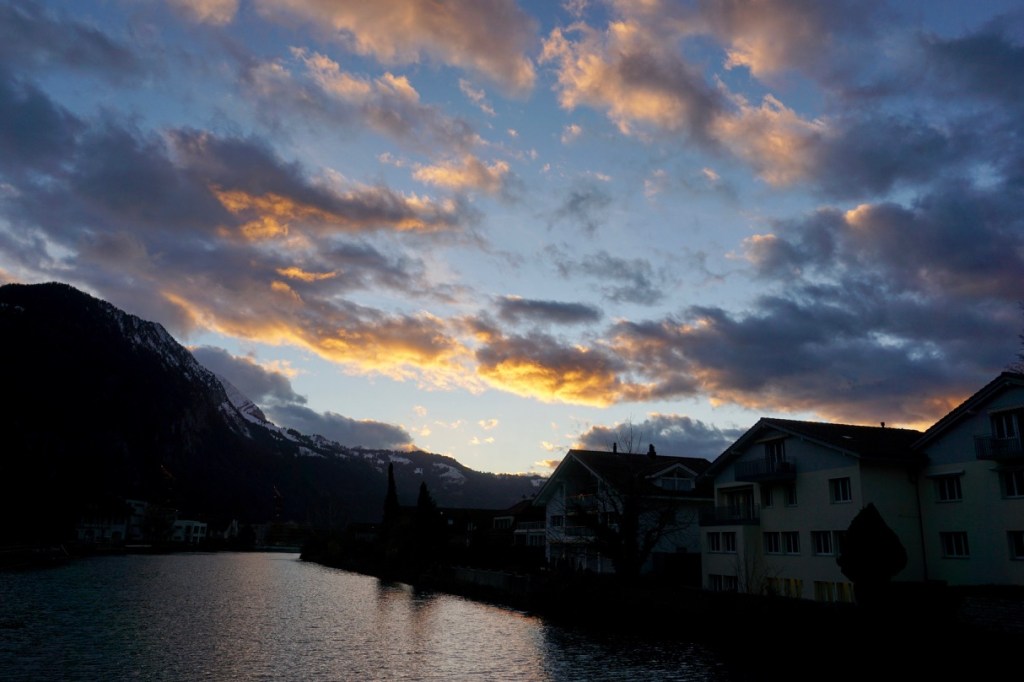
Interlaken, Switzerland – December 2019

Dancing in the Kitchen

This year, for the first time ever, I am not spending the summer with my family. In the past, much of this summertime has seen me with my mum playing together in the kitchen, but, unfortunately this cannot be. So for the moment, I’ve been sharing meals with friends and reflecting on times past.

I’ve written many times that if love is a verb, love requires action. This means behaving in ways that give love. We can show love in many ways, such as holding those who need holding, listening to those who are speaking, helping when help is needed, and giving of our time. Another way to show love, I deeply believe, is through cooking. A few years ago, my mum sewed me an apron embroidered with the words, “Love people. Cook them tasty food.” I think that sums it up.

In terms of cooking, there are two ways to show love: preparing food for others and preparing food with others.

In preparing food for others, the acts of chopping, slicing, dicing, washing, peeling, and whisking (to highlight just the tip of the iceberg) are not accidental – all are intentional. These acts require us to consider others and are the visible evidence of a desire to nourish, which is an act of care. Care in this context is a way to love.

Cooking for others may not involve the seeking of reciprocity. We prepare food that we think others will enjoy, and not with the purpose of raising ourselves in their eyes. So, when we sometimes cook for others in order to impress them, that is not an act of love. Preparing a meal for those in need, however, whether due to the demands that a joyous arrival of a newborn baby or the sorrow of a loss may bring, is something we do for those we care about – for those we love.

In such circumstances, when I cook for others out of love, my favorite meal to prepare is a hearty soup. (Admittedly, this is challenging in the tropics and I have modified my approach.) Soup is a meal that warms from the inside out and is filling, healthy, and tasty. It is simple to enjoy with no more than pepper and bread, and unpretentious with ingredients that are easy to find. There is love stirred into the soup pot.

In addition to showing love in the preparation of food for others, there is also cooking with others. When done with love, this can be analogous to an indoor version of running through the sprinkler on a hot day. It can be glorious or it can be a complete disaster (think thunderstorms and mud flung into eyes) but either way, if it is done with love, it ends in smiles and laughter.

Cooking with others is joyful and spirited. It is the creative interplay of working together, a fluid dynamic that involves trust and tolerance of another person. As my mum has said, “We dance the kitchen dance really well.” And yet, sometimes we get in each other’s way. This is when we take a step back and respect each other’s space, and this requires a significant degree of humility on our part, a willingness to simply let the other person be. We welcome their playfulness, their mistakes, and their laughter – because we do the same.

The kitchen dance, as I know it, is what I think walking hand in hand through the world might look like. It is beautiful and intricate in parts, yet it also requires the discipline to take on the responsibility that it brings. It is not simply preparing food but also caring for all parts of the journey; the sharpening and honing of knives, the clearing of counters, the washing of dishes, and the scrubbing of pots and pans, and finally, the clearing of the table. Together. Us. Rejoicing, frolicking.

A word of warning, however. It is important to recognise that there is a difference between two people working in a kitchen and combining food, and two people dancing in the kitchen and creating food. There is a synthesis of senses in the latter that may not exist in the former. There is a give-and-take between us as texture, taste, scent, and sight of the elements are explored. What I do now will influence the choices you make later. We bounce off and augment each other while incorporating individual creativity. Your taste and my taste guide the next element, the next move. We share as we explore, and in doing so laugh and love.

Playing in this way has led me to compose food that one would never find in recipe books. And in doing so I have found that not all of them merit repeating. But that isn’t what is important. What is meaningful, is that I have played with others in the kitchen and shared in the love that this brings. I will continue to cultivate and cherish those times and urge you and your loved ones to do the same.

Jean Talon Market – Montreal, Quebec

Back When We Had Souls

I’m not sure if souls exist. I used to know for sure, I know I did, but now I don’t think I believe in souls anymore. As we all do, I’ve drifted from the pretty imagery of childhood stories into a world in which souls do not make rational sense.

And yet.

And yet.

I met a person who, if souls do exist, I would have to say has a soul. The word came into my head one day, suddenly and unbidden, but I knew it was right. I looked at this person across the room and sensed a soul. I knew this in the way that we know it’s going to rain when the sky grows dark and the wind changes. It was immediate and obvious and it frightened me. 

As adults, we live by routines and patterns, by socially accepted and endorsed ways of interacting with one another. We go to work, to meetings, out for drinks, out for meals. We entertain ourselves and each other. We pass the time. We have ‘responsibilities’.

But once upon a time, before all of that, we were children. We laughed and played and made up stories. We turned sticks into airplanes and we flew. We put on wigs and became witches. The sandbox became quicksand and the neighbor’s dog was a predatory dinosaur. In our fantasies, our younger siblings were the pets and our parents came from a different planet. We threw balls of fire and some of us got burned, but still we kept throwing. We claimed the swings as our boundaries and let our friends claim the tree line as theirs. Jumping from the roof with an umbrella was faith that, just like Mary Poppins, we could fly.

As children, we believed in magic. We believed that what we wished for could be, and we dared to make it so. In the eyes of a child, the child that I was, souls were possible because everything was possible.

It is in adulthood that we forget about magic. Instead we have practical, everyday worries. We laugh less often and we forget how to play. We’re too important and busy for that. We’re too concerned with the things we have learned that ‘matter’. We make sure to meet all our basic needs, to pursue and court relationships that allow us to belong to different groups, and to elevate our status to the levels that we believe we are entitled to.

We know that we have to get promoted before we can afford the mortgage on the house, and we have to do it soon because there are already three wedding invitations and one birth announcement on the fridge. Everyone else is ‘moving forward’, so what are we waiting for?

And so, magic is left behind. We forget the spells and potions, we forget the carefully delineated safe zones of tag, and we forget the glee of tearing barefoot across the grass yelling as loudly as we can. We increasingly channel our time to the pursuit of ‘personal progress’ and leave behind that was once so pure and central to who we were. We stop playing, and we stop being.

It is here, I think, that we lose the idea of souls.

As adults, we stop pretending and stop believing in things we cannot see. Looking beyond our adult boundaries into the joyfully cultivated worlds of children is a chore. And so souls, which are intangible, cease to exist.

Such a transformation, one which takes the imagination and supplants it with the material goals brought to us by ‘logic’ and ‘reason’, robs us not only of the existence of souls but of all those other beliefs that children are made of. Words which carried hopes and dreams are now said out of habit, if at all.

And so the progression through life’s journey continues and the price is the loss of the soul that made us who we were.

But such is the way of tacit acceptance of change. We do not recognise that this is what we are doing. We don’t notice the gradual shifts and how these lead us away from one world and into another.  

Once, we were pirates searching for buried treasure that we knew we would never find. The joy then was in the adventure of solving the clues. 

But as time passed, we imperceptibly became preoccupied with the treasure; the joy of adventure got lost and our souls vanished.

But what if?  

What if souls do not disappear, but are simply masked by the habits we develop, by the actions we mimic, by the words we pull together to intellectualise our actions? What if we suspend who we have become, if only for a little while, and simply look? And what if another was to do the same?

I looked across that room and without warning, without reason, I remembered. 

Once upon a time I was a child and I believed in magic. Back when we played pretend. Back when we trusted in our newest inventions. Back when finding all the pieces to build the perfect snowman was as much fun as playing in the snow.

Once upon a time I was a child and I knew we each had a soul. 

And it frightened me that I had forgotten.

Milford Sound, New Zealand – January 2019