Last week, I spent three days in Washington, DC with the seventh grade students at school. The most difficult part of the trip for me was not knowing any of the students I was chaperoning. It’s hard to manage a group of 60 when I’m constantly trying to describe what I’ve seen or overheard to other colleagues because I don’t know who I’m talking about. For example:
“Three boys with glasses and brown hair are standing in the back of the bus.”
“A tall skinny girl is crying in the hallway.”
“I think two kids were out in the hall after lights out but I don’t know if they go to our school.”
Etc.
But DC itself was fun! The highlight for me was seeing my brother, who is a sophomore (second year, for those not attuned to American school slang) at a university just outside of DC. He joined us for lunch and a trip to the National Archives one afternoon.
But I’m getting ahead of myself. How did our 60 students spend three days in DC? We ate a lot and visited a lot of washrooms, but managed to take in a few cultural sites, too.
Washington, DC is about six hours from New York City by bus, so we left first thing Monday morning. Our first stop upon reaching DC was the National Museum of African American History and Culture, which I cannot recommend enough. It opened in September and it’s quite difficult to get tickets – and I completely understand its popularity. The museum is designed so that visitors begin at the bottom, in the “belly of the boat,” as it was explained to us. From there, visitors work their way up through the darkest hours of African American history in the United States, including the slave trade and the aspects of America that were built on the backs of slaves. The exhibits devoted to the civil rights and Black Power movements were fascinating, too. The museum ends in sun-soaked galleries highlighting achievements in sports, the arts, and politics, as well as a look at how discrimination stills plays a huge, ugly role in American history and culture.
The design reminded me a lot of Yad Vashem, Israel’s Holocaust memorial, and the stories run parallel to each other in dark, sad ways. When we “other” the people around us, we lose our collective humanity and we do terrible things to each other. That’s the sorry moral of the story that society has yet to learn.
I truly wish we had time in the museum without students. I could have read every single artifact description, all the names of slave ships etched on the walls, all the names of those sold at auction. Like when visiting Holocaust museums, I felt this pressing need to pay my respects to those who died at the hands of people who didn’t consider them people. I’d love to go back on my own when tickets are easier to get so I can spend more time learning than I was able to on this trip.
That evening, we took a boat cruise on the Potomac and I was completely in my happy place. I love water and boats and it was sunny and the kids, though not the best museum-goers, were excellent DJs.
The next morning started with a visit to the US Capitol, which I don’t remember doing the only other time I was in DC about seven years ago. We had a really interesting tour and learned about the architecture of the building. There’s an awful lot of patriotic symbolism in there! And, no surprise, there were differences in political opinion each step of the way, lately regarding selection and placement of statues, which are gifted by the states but placed by the federal government.
I was responsible for picking up House and Senate passes from our local Congressional representative, which was fun because the Congresswoman’s aide gave me a behind-the-scenes tour of the underground connecting hallways of the Capitol when she brought me back to my group. She told me how the whole underground structure was redesigned after 9/11 to allow safe access from the Capitol to other government buildings across the street.
The House wasn’t in session (what do they do, exactly, aside from pass healthcare bills that will ruin all of us and then promptly exempt themselves from regulations?) but the Senate was! After yet another round of metal detectors, locking up all of our belongings, and still another metal detector, we were let into the gallery overlooking the Senate with strict instructions to remain silent. For a few minutes, all we could see were pages fetching water or sitting around and talking to each other. Senators occasionally entered the chamber and walked through it to one of the three or four doors along each wall. Just as we were about to leave, Massachusetts Senator Ed Markey began to speak. From where I was sitting, all I could see was the cameraperson filming his speech. Without that speck of a visual, he was just a disembodied voice, though one speaking very passionately about healthcare. The strange thing, at least to me, was that he was speaking to an empty chamber. He addressed the presiding officer who was seated on a dais looking out over the Senate desks. A few minutes in, Markey noted Senate Minority Leader Chuck Schumer’s entrance to the chamber and gave Schumer the floor. Again, Schumer spoke into a camera in a room empty but for pages, Markey, and the presiding officer. It appears that the senators often watch speeches from the comforts of their offices rather than on the floor. Who knew?! Schumer, too, lambasted the Republican healthcare bill and it was so exciting to hear him. Especially because I know I was not alone among our trip staff in voting for him!

We lunched in the Sculpture Garden across from the National Archives and that’s where my brother met us. We fed him and he joined us for our exploration of the Archives. As a former student of history, I love old documents. It’s fun to piece stories together and to find accounts that corroborate and contradict each other. I still remember the thrill of finding the source when I was writing my undergrad thesis on the Hitler Youth movement. There are some really amazing memoirs out there by people who were children in Nazi Germany! The National Archives are a lot of fun because they freeze moments in time, moments when key decisions were made that shape the history of this country.
Every school trip to Washington, DC includes visits to the monuments. We started at the Lincoln Memorial . . .
. . . which is where Dr. Martin Luther King, Jr. delivered his “I Have a Dream” speech . . .

. . . and provides a great view of the Washington Monument, which we did not visit because it’s closed.

A lot of the kids were tired after the Lincoln Memorial but about half wanted to see the Vietnam Veterans Memorial, and we gladly obliged. The kids know very little about Vietnam and they’re not alone in that. While most students can talk about World War II starting in elementary school, the vast majority of students I’ve taught know nothing about Vietnam until we bring it up in class. And they have a lot of questions. One of my favorite lessons involves Vietnamese textbooks that explain the Vietnam War in very different words than the (*cough*) big name, biased, overly simplistic, corporate, Texas-influenced US textbooks (*cough cough*) use. Having been to the War Remnants Museum (formerly known as the Museum of American War Crimes) in Ho Chi Minh City, Vietnam since my last visit to the Vietnam Veterans Memorial, I had a different understanding of the pointlessness and devastation of Vietnam. Land was burned, lives were lost, and stories were buried. That’s what shame means, I think. And that’s why the memorial is important. It’s a black expanse of wall that lists names of the fallen, explains nothing, and invites questions for everything. The kids asked those questions and I was glad for the opportunity to answer them.
I was also glad to spend a moment at the Vietnam Women’s Memorial, which I hadn’t seen before.

The next day, we spent the morning at the Newseum, which was full of flashing headlines about the FBI. As good a time as any to talk about freedom of speech (and the press and religion and assembly and petition)! Now that I’ve lived in Malaysia and Singapore, neither of which have all of those freedoms, I find myself wondering about the merits of such a free society. For instance, freedom of speech in the US led to an acceptance of hate rhetoric, which led to Trump. So I wonder.
Before hitting the road for our drive back to New York, we stopped at the Martin Luther King, Jr. Memorial, which was a nice bookend to the National Museum of African American History and Culture that started the trip. Martin Luther King, Jr. was my professor’s chosen case study for a required college course on rhetoric and argumentative writing, so I am very familiar with King’s life, writing, speeches, and civil rights partners, including the SCLC, SNCC, and the NAACP. It was really powerful to see his words carved into stone, especially because of their implications for our choices and policies today.
One of my coworkers kept laughing at my penchant for taking pictures with my well-traveled Converse and suggested I try one with my hand instead. So I chose to photograph my hand with the word that seemed the most meaningful, the most important, the most pressing.
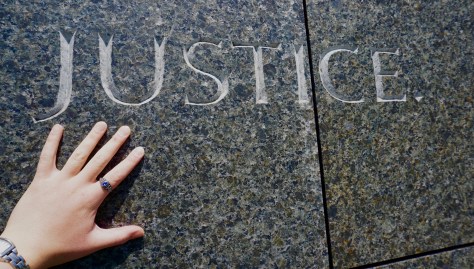
At the end of the day, that’s what we’re working for.



 By Rebecca Michelle