In the midst of, or perhaps to stave off, sudden emotional turmoil, I did what I often do to gather, collect, and find myself: I headed out into nature.
I had just wrapped my arms around a tree when a phone call came, one I had been expecting. I answered, telling the caller which bridge I’d just crossed and added that I was currently hugging a tree.
“He’s sleeping and will probably not hug you back,” came the reply.
“That’s okay,” I said. I love that trees are living creatures with rhythms.
Berkeley, California – June 2018
We set a meeting time and location and the call ended. I gave the tree one more gentle touch and walked away.
The next time out in nature that day, I was calmer, quieter in body though not quite in mind. We walked for hours and, among the sleeping trees, I began to feel better.
It was not lost on me that the fact that I’d been out hugging trees was treated as the most normal thing to do. The recognition warmed my heart and settled my mind, and by the time the walk ended, I was home.
I recently heard the question, Would you like someone to sit with you, or would you like to be alone? The question was asked in the context of one person seeing another doing just that, sitting alone, in a setting where that could be perfectly appropriate or desperately lonely. It’s a question I ask my students when their table partner is absent, whether they are happy where they are, whether they would like someone to sit with them, whether they would like to move seats.
Would you like someone to sit with you, or would you like to be alone? suggests that the individual has been seen as part of something rather than a spectator, that an introduction to a group will be there when the individual is ready. It suggests that being alone is a choice rather than a condition and that being alone is not the same as being lonely. And it suggests that there are times for both aloneness and togetherness without placing a value judgement on the choice.
I found this question beautiful in its simplicity. Beautiful in its openness and honesty. Beautiful in the way that it required the individual to do nothing but answer, while the person asking the question had done so making a promise to be there when the fitting answer was given.
Such a question opens the door not only for dialogue, but also for recognition, perhaps of a kindred spirit or of a searching soul. A beautiful question is one with which we can all imagine ourselves confronted or asking, a sign of shared humanity.
I am reminded of the people I know at the climbing hall, groups forming based on casual questions about who is coming that day, who is looking for a partner, who is there for a solo training session. I have both extended and accepted the standing offer to climb with another group when no one from one’s regular group is available. I am reminded of my colleagues who are clearly searching for something, and to whom I have recently asked a form of this question.
Would you like someone to sit with you, or would you like to be alone?
It could only be a good thing, a kind thing, the right thing, to ask. To answer honestly is to trust. So are connections built, relationships formed. To ask and answer is to recognize, and with recognition comes being, in a particular time and particular place.
Would you like someone to sit with you, or would you like to be alone?
It’s no secret that I love books. I love reading, I love learning, I love getting lost in a story, fiction or non.
Anna Amalia Bibliothek, Weimar, Germany – October 2022
I love how books feel in my hands, how they smell, how new ways of seeing the world ever so gradually reveal themselves. I love bookstores, used, new, antique, and I cannot walk in without buying something, anything, even if it’s not a book.
Singapore Library @ Orchard, Singapore – May 2021
(I have a hard time with the many bookstores in Weimar because only one has books in English, but I have bought something at each of them.)
As a frequent traveller, I’ve learned to love the convenience of e-readers and have read thousands upon thousands of pages on the tiny screen of my phone. I often feel a sense of panic when I don’t have a book on me, and my digital library is a comfort, particularly in airports.
Housing Works Bookstore Café, New York City – March 2018
I have sought out bookstores on my travels, retreated to libraries when I didn’t have anywhere else to go.
Riva del Garda, Italy – April 2022
So I was immediately touched when a book appeared in my mailbox last week, a volume smaller than my hand and so old that I was initially afraid to open it. German fairytales, I recognized from the title. The text inside was from long enough ago that even if I could discern the words from the intricate type, my rudimentary German would certainly not be up to the task of translating.
New York Public Library Main Reading Room, New York City – December 2016
But wait – a book in my mailbox?
I sent a message to the person I suspected would be behind such things. The response led to reaching out to four more people and then, with some prompting, returning to the first. It wouldn’t be the first book we’ve shared, after all.
Julian, California – December 2017
It’s incredibly dear, really, gifting a book. It means knowing someone well enough to know what speaks to their heart, or their soul, and to know that there are so many people in my life who have given me books is an astonishing feeling.
Budapest, Hungary – May 2023
And it brings me real joy to return the gift, whether through beautifully illustrated books for children, carefully considered volumes for friends and family, or the booklist I finally put together after years of requests from psychology students.
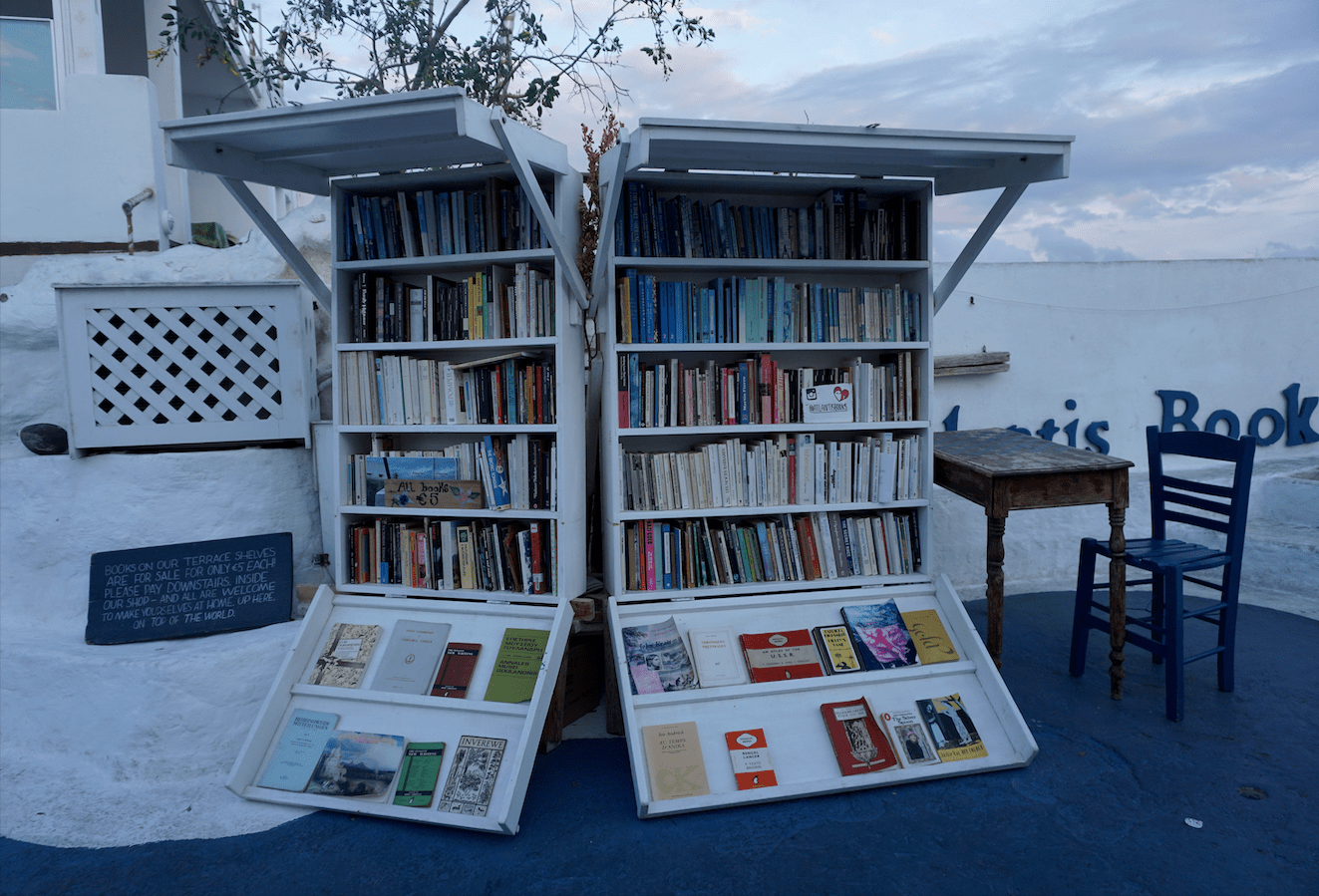
Atlantis Books, Santorini, Green – October 2018
But a book in my mailbox? A book printed in Vienna with original illustrations, but unfortunately lacking a publication date?
A book slipped into my mailbox, no additional details, was a first, and I am honoured.
The Strand, New York City – November 2016
“What are you reading?” isn’t a simple question when asked with genuine curiosity; it’s really a way of asking, “Who are you now and who are you becoming?” – Will Schwalbe