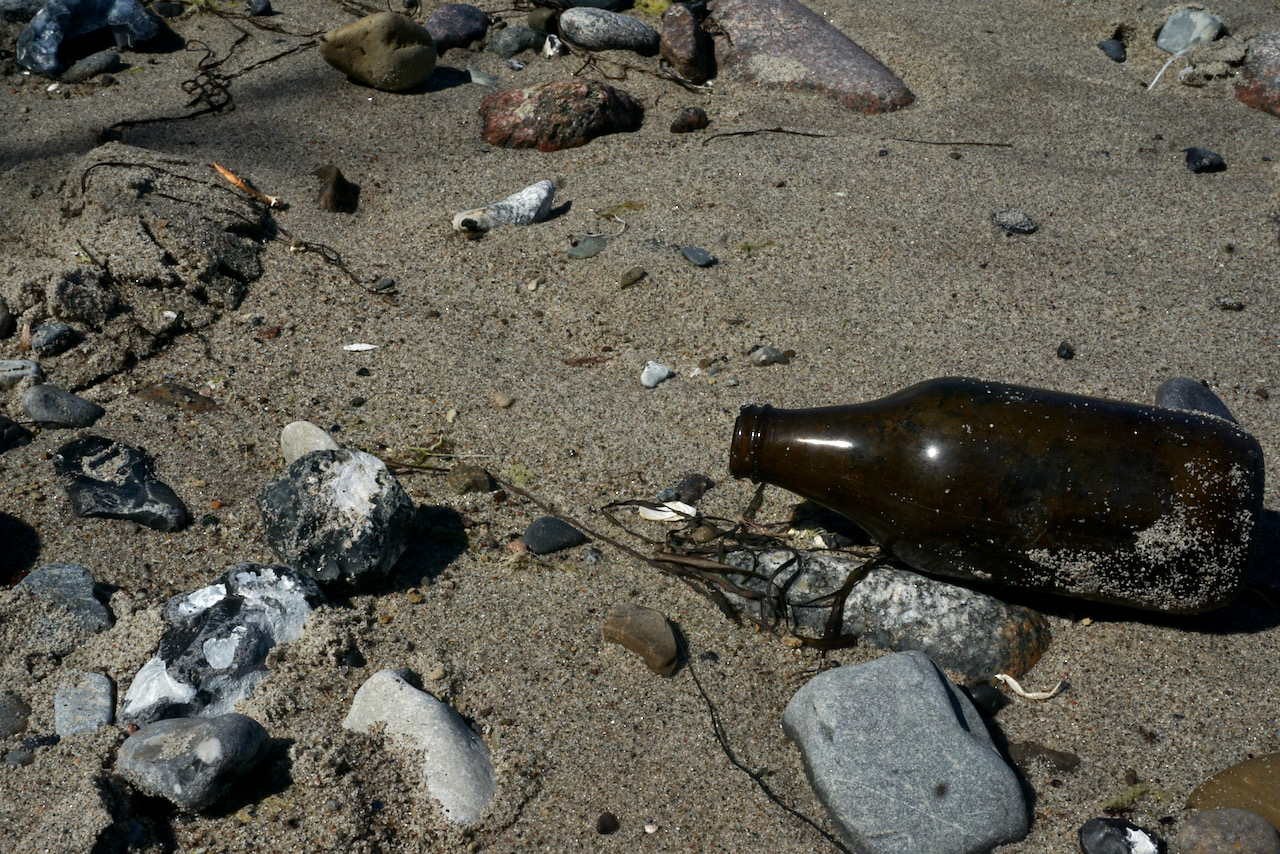
The Beach

I’m not sure how my parents chose the beach that ultimately became the beach we visited every summer, and then every other summer, and then one last time. I think it was advertised in a catalogue or maybe as part of a vacation package at a wholesale store. Whatever it was, we loved our family beach holidays, which started as soon as we got into the car and began the sixteen-hour or so adventure of reading, license plate spotting, occasional bickering, and listening to Garrison Keillor’s A Prairie Home Companion after dark. Throughout my childhood, the ocean was my happy place.

Until last week, it had been a while since I’d spent a holiday at the ocean, several years since the order of events upon arrival followed a familiar pattern: Unload the car, have something to eat, buy groceries, walk on the beach. It was my first trip to Warnemünde on the Ostsee, or Baltic Sea, where I was thrilled to have been invited, and my heart felt almost like I’d been there before.
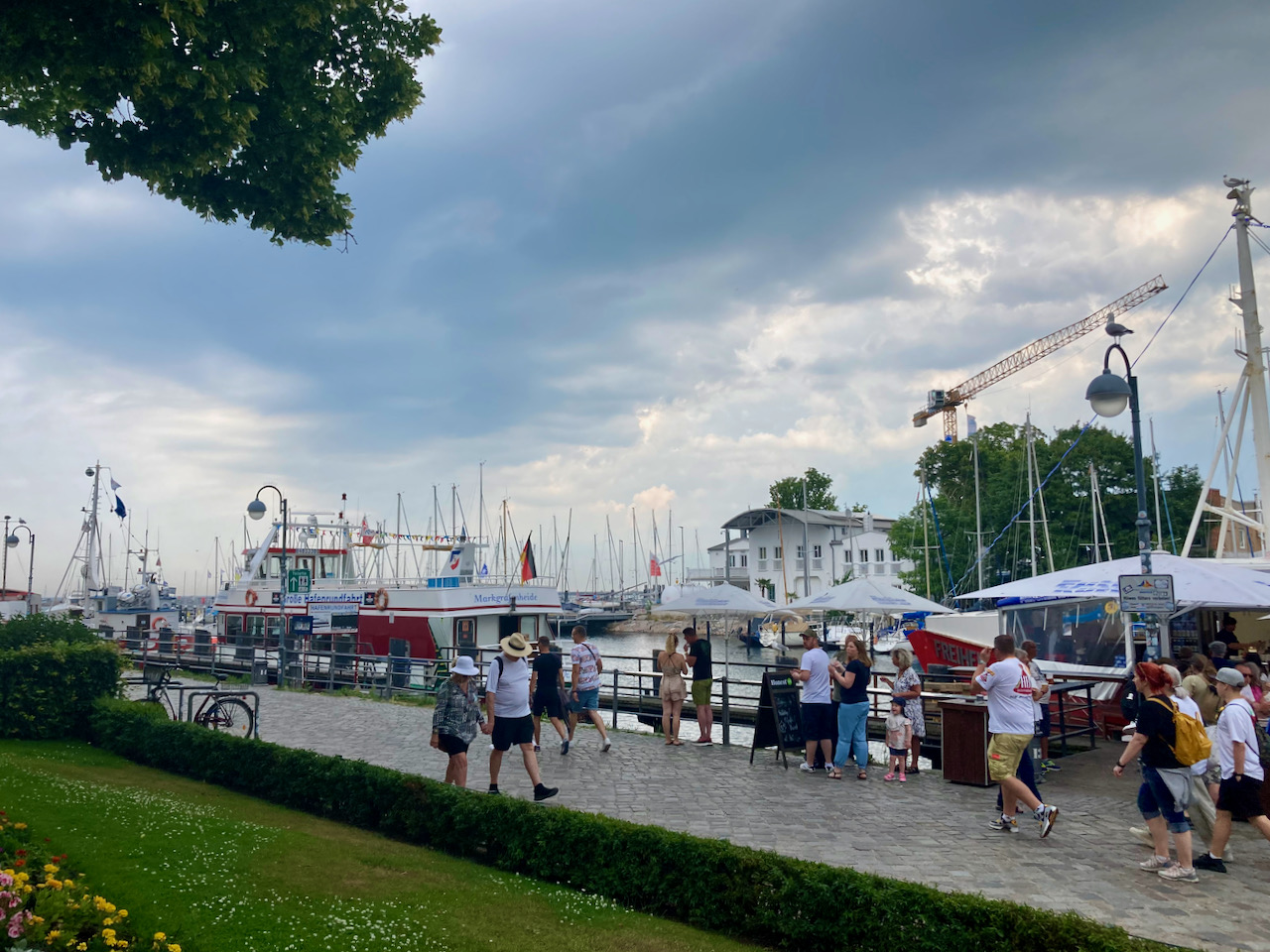
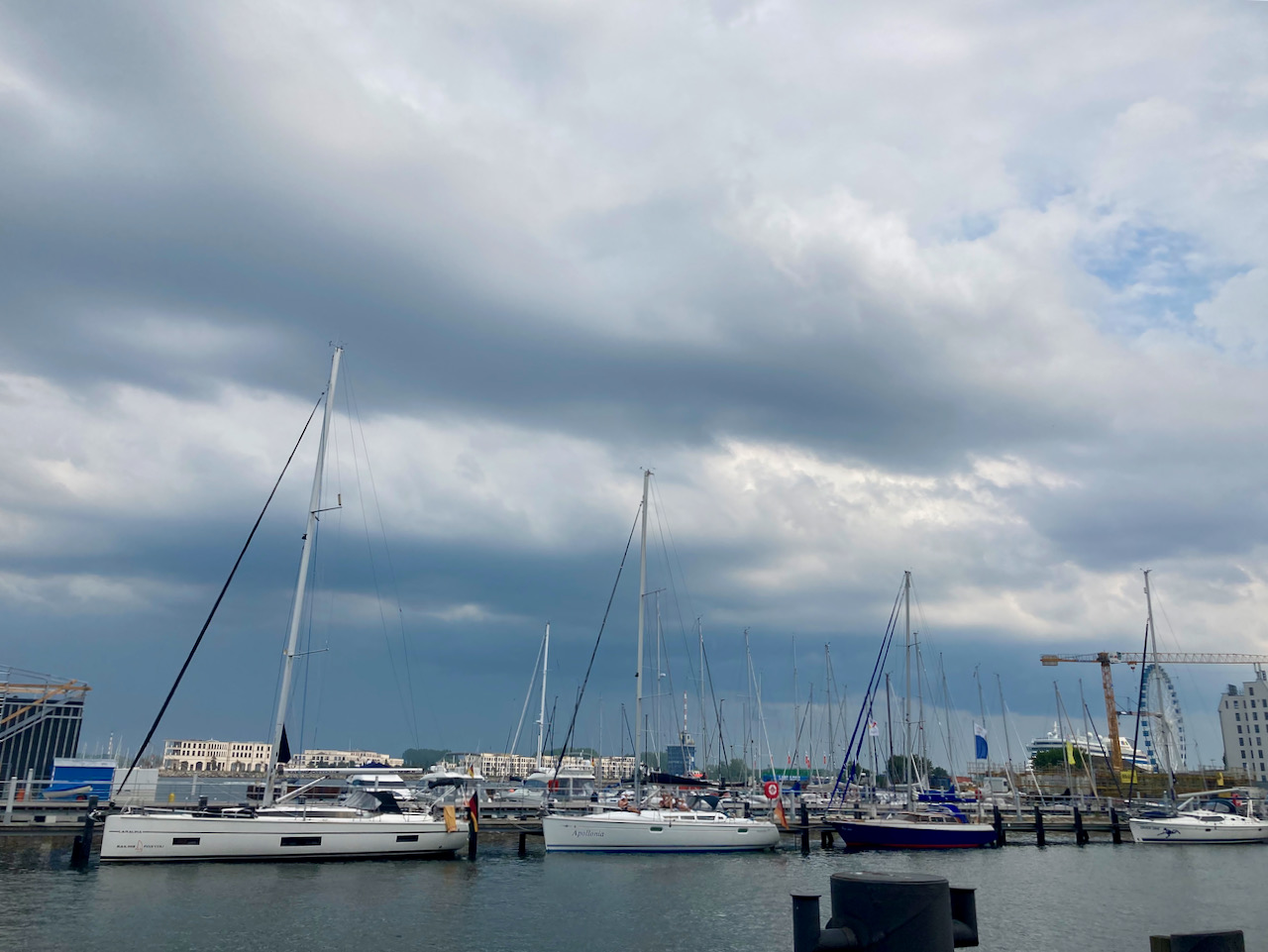
Warnemünde is a fishing town with an active port and a popular destination for tourists and cruise ships. A port means boats and lighthouses, both of which remind me warmly of my years working on boats and never fail to capture my attention.

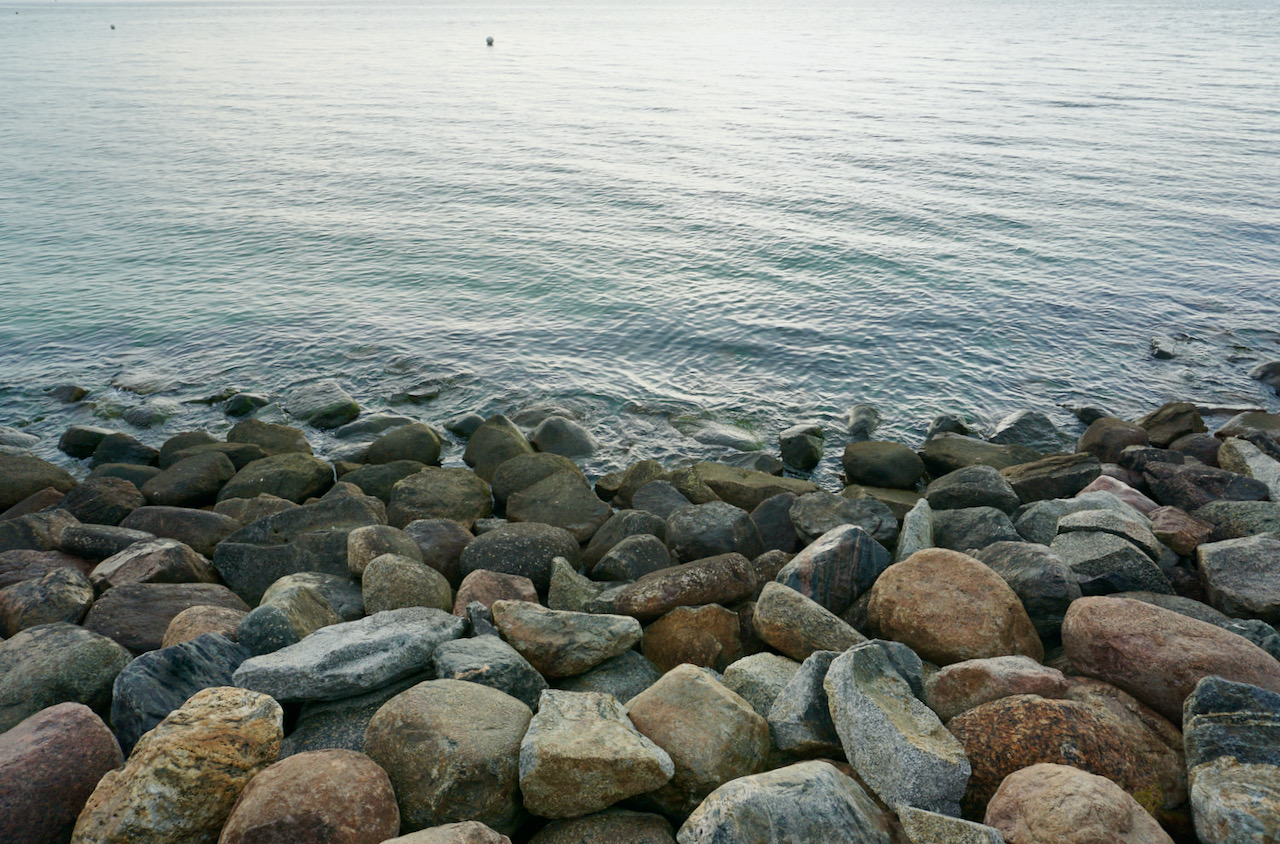
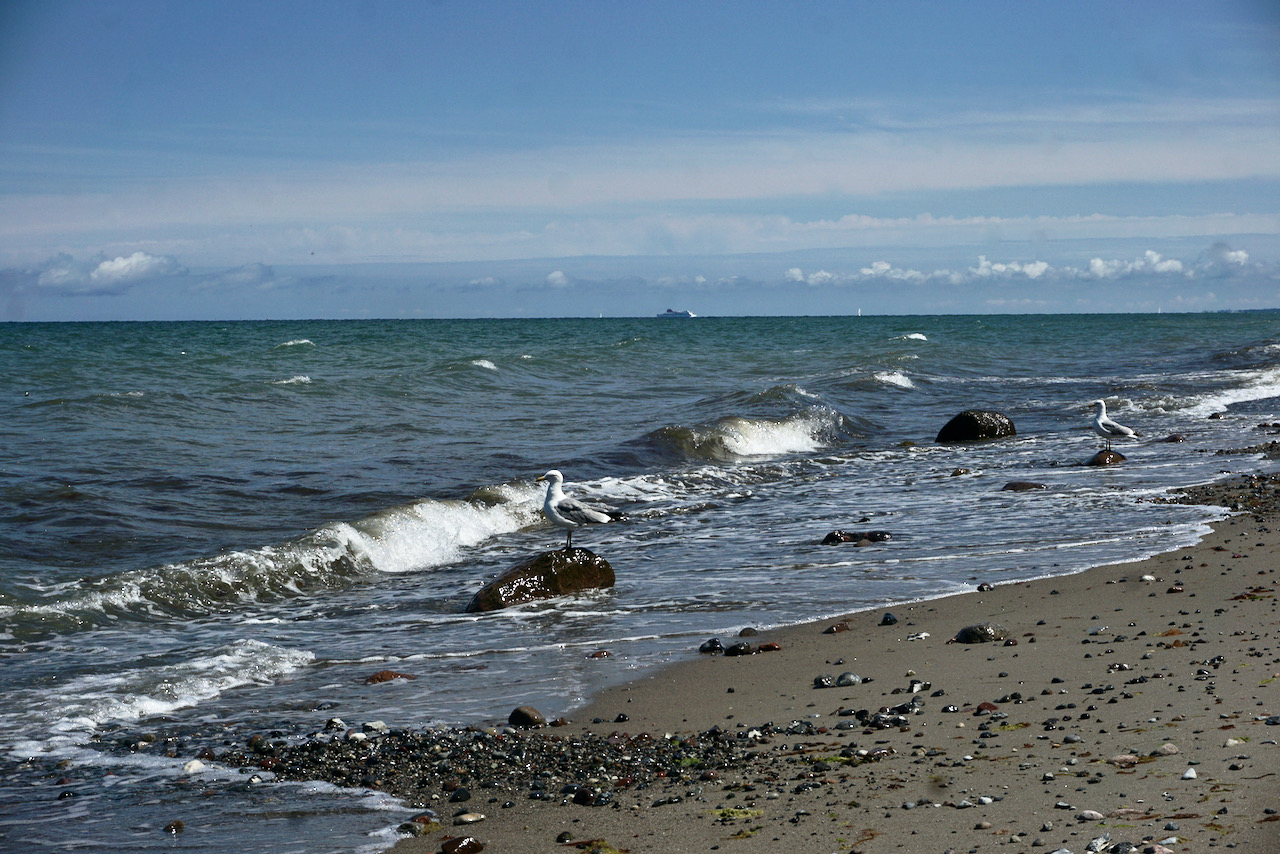
The water was warmer than I’d expected though still a shock each time we waded carefully in, laughing, slipping on rocks, getting tangled in seaweed, playing. The ocean was surprisingly flat even on windy days, and the beach rockier than usual, I was told. We tasted salt on our lips, dried off under the sun and wind, watched the seagulls marching along the sand. And when the sun went down, we walked quietly and in awe.

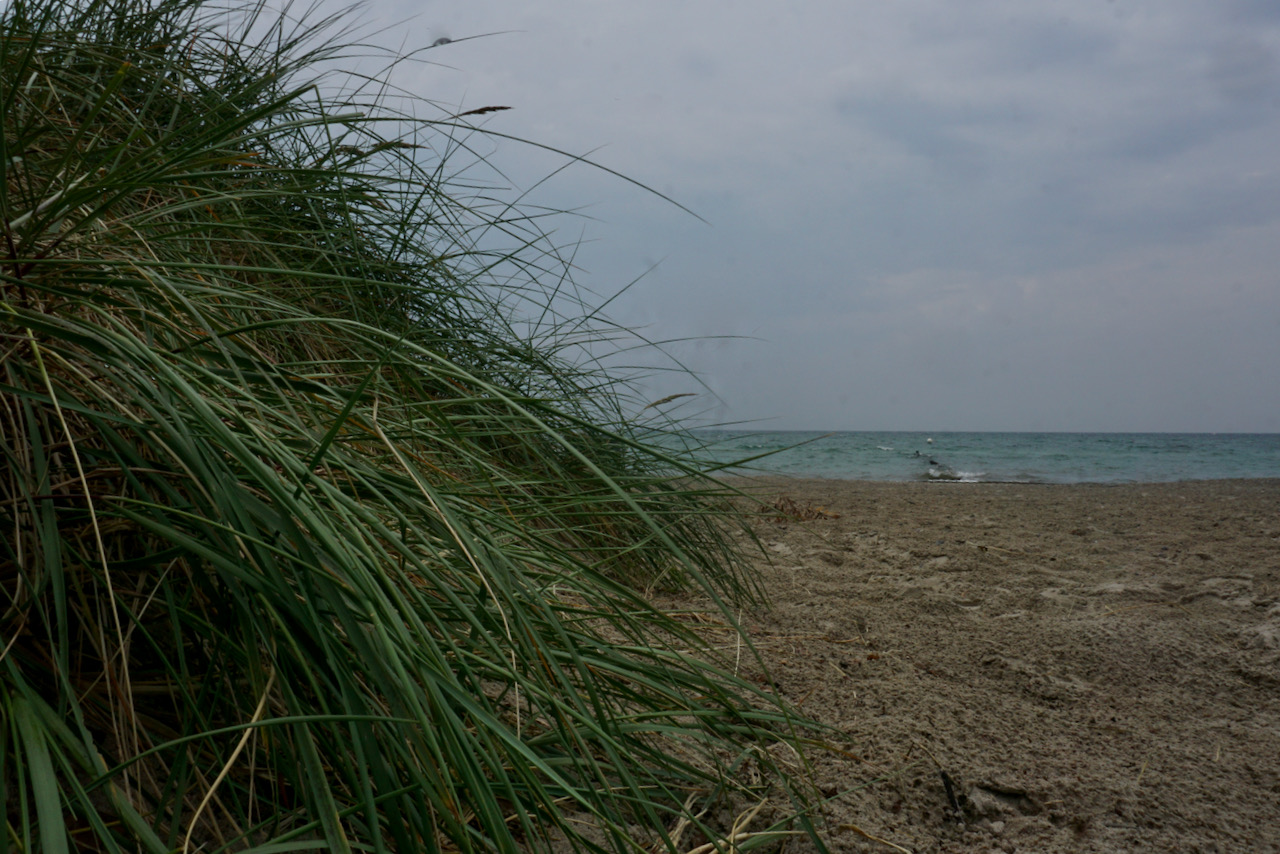
On the Ostsee, I learned, much of the beach emerges from the forest and this was completely new to me. We found a cozy spot, watched the approaching rainclouds, and walked calmly back in the storm that followed.

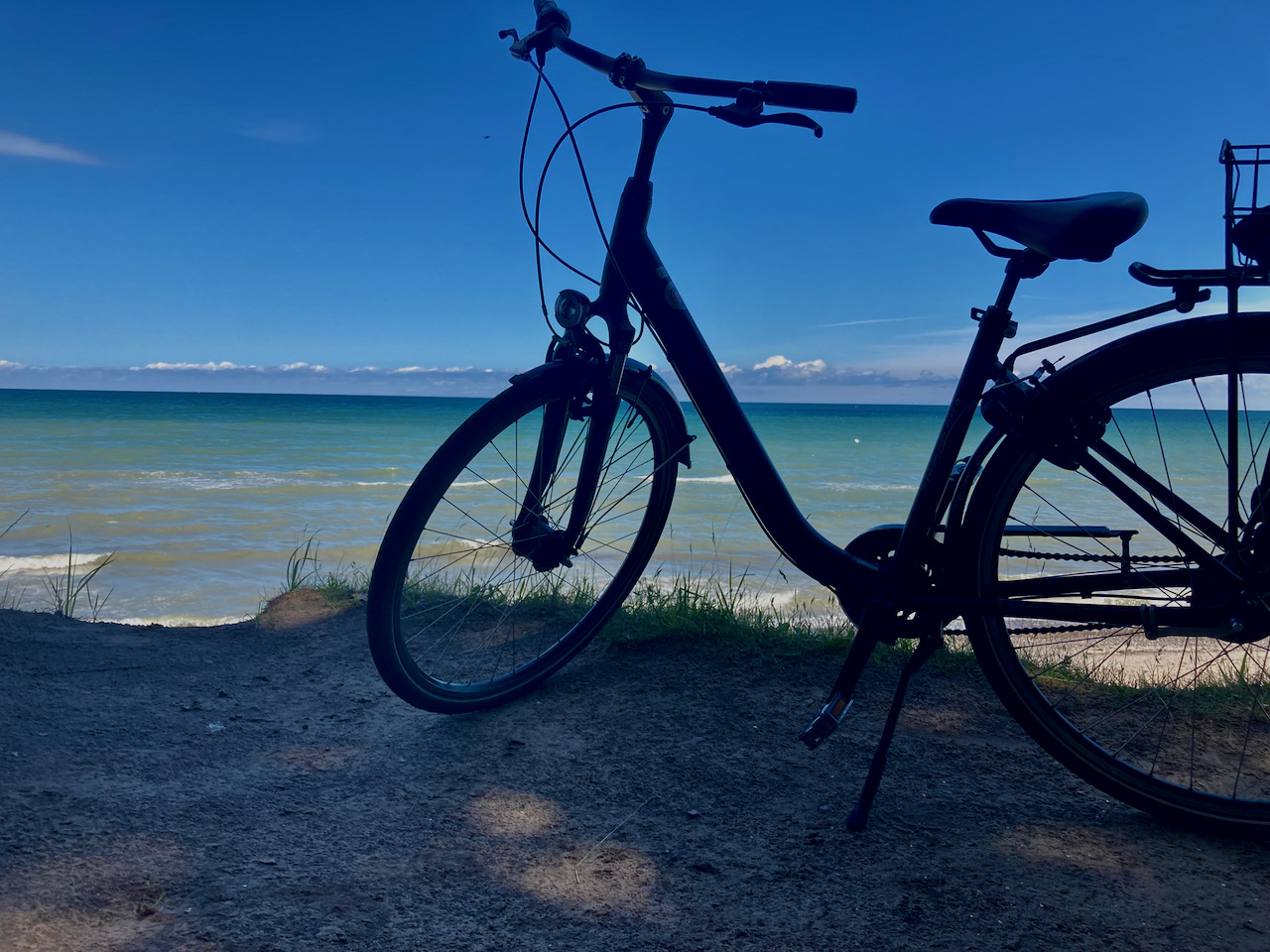
In the bright sunshine of my last day, we rented bikes and followed a path through the forest and along the coastline. We passed farms and little towns, stopped to eat and drink overlooking the ocean, and went swimming in the warmest water yet. We searched unsuccessfully for Hühnergotter, stones with a small hole through them that are supposed to bring good luck. The sound of the ocean was soothing and I nearly fell asleep on the sand.

The world is a beautiful place and I was lucky to be somewhere new to me, lucky to share it with people who have such fond memories of being there. The world is a beautiful place and to be part of it is a gift. I am glad to know this – every day.
On Women and Power

8 November 2016 – There were tears in my eyes when I voted for Hillary Clinton.

9 November 2016 – There were tears in my eyes throughout the silent ride to school. My carpool of strong women could think of nothing to say. Like many of my colleagues, I cried at work that day. I sat in a school-wide meeting called by our director, stunned, as he explained to the students that at our school, we value dignity and respect. We accept everyone, he emphasized, and we do not believe in hate. How to explain this to middle school students who, like the rest of us, had just watched hate win?

10 November 2016 – Our carpool was no longer silent. Shock and despair turned to anger and we realized the most important of lessons: Our voices were all that we had. I had the good fortune to be living in New York City and I was well aware that life would remain largely unchanged, despite the persistent chill in my chest.

22 November 2016 – It took about two weeks to accept that I was afraid.

December 2016 – Plans were formed and we waited.

18 January 2016 – Preparations finalized and we waited.

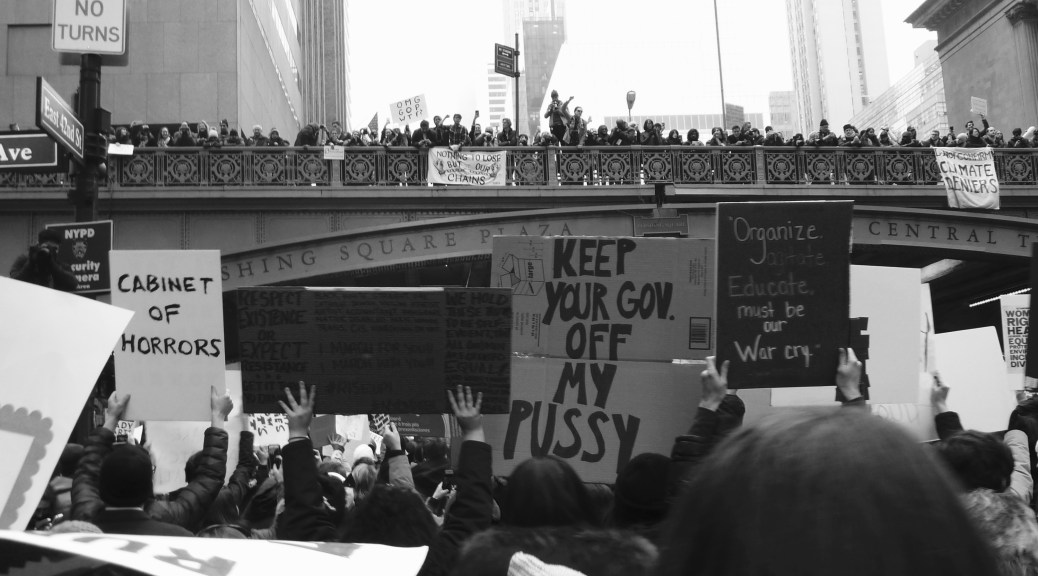
21 January 2017 – Women’s March on New York City. Women’s marches everywhere.

February, March, April, May, June 2017 – The carpool to and from school became an opportunity to call government officials at the local, state, and federal levels. We gave donations, signed and circulated petitions, read the news aloud, listened to the radio, joined online interest groups. We attended marches and protests. We spoke up because we could. We spoke up because we could not stop reading about people living in places that had become openly repressive and dangerous. We spoke up because these people could not speak.

And we realized, our voices were all that we had.


My political awakening came during the Obama years. I voted for the first time my first year in university, there was a financial crisis and promises for changes afoot, and I was studying to be a social studies teacher. Politics took on a relevance it never had before and I was excited to be involved. By the time Hillary Clinton won the Democratic Party nomination for president, I assumed the United States was ready to join the nations that had already elected women to the highest offices. It was 2016, after all.

Like more than half of the country, I was wrong. The people may have been ready but the Electoral College was not, and it is the Electoral College rather than the people who make this decision. So much for demokratia. The people hold power . . . except when they don’t.

This was not an issue of politics. This was an issue of women.


I have watched from afar, in horror, as the United States has increasingly restricted what can be taught in schools and what books are available for young people. I have watched from afar, that sinking feeling again in my stomach, as the nation’s courts deny women the right to their own bodies, again and again and again.

And I ask: What are they so afraid of? What are they running away from? What are they scrambling to hide?

I am a student and teacher of history, and this is the pattern of the world repeated over and over.

So I answer: Power.

After all, we do not silence people who we do not fear. We do not delegate inferior status to those we exclude without repercussion. When we do not feel threatened, we need not respond at all. In fact, we likely don’t even notice.

This leads me to the conclusion that men in power fear women. They fear opposition. They fear ideas that could harm the illusion they have built around themselves. And this illusion? That whatever power they think they have is, in fact, theirs. If it were, if that power were rightfully earned and positively utilized, there would be nothing to fear. Nothing to hide. Nothing to silence.

Clearly, there is a great deal to repress.

And this says a great deal about power.

Criminalizing a woman’s right to her own body suggests that the people making these laws are afraid of everything that makes a woman. And so I ask: If this is the case, who actually has power?


Head held high, I needn’t answer. I need only act. With my very self as the threat, my existence proves stronger than your resistance. Power lies in me and of me and through me. And no amount of you can take that away.

Women’s March on New York City – January 2017

Big School, Small School

Almost ten years ago (where has the time gone?) I wrote my Master’s thesis on the school where I worked at the time, an all-girls school in the town where I grew up. I had had myriad stereotypes about the place as a student in the area, and I couldn’t have been more wrong about it. This interested me enough to conduct a case study to answer the question of why different stakeholders choose all-girls education. (Short answer: It depends. Long answer: Contained in aforementioned thesis.)

As part of regular practice, I’ve been conducting informal research throughout my time as a teacher. What happens if I refer to this as a “task” rather than “assignment”? What happens if the “rough draft” becomes the “initial submission”? If I want to encourage dialogue in class, should students sit with their friends or not? How does the environment change when the tables are in a U shape, rows of three, groups of four? How does the environment change when student-led discussions are an assessed part of the course?*

I have learned to be a teacher not only through deliberate training, observation, and practice, but also through a lot of trial and error. What works in one environment or for one group may or may not work for another, and there is a significant level of adaptability and flexibility that is required to help students learn. (Insert home-based learning here.) This is why some teachers argue that every class is a different prep, even if the class is a second section of the same subject – two grade 9 Individuals and Societies classes, for example. I don’t usually go this far; the plan and materials remain the same, though the approach might differ. The conversation will surely be different with different groups, and the response should follow naturally from the conversation. The environment matters.

A significant way in which environment matters is in terms of school size. If I were looking for another Master’s research project, I’d be interested in exploring the relationship between school size and culture. I deliberately moved from a school of around 3,000 students to one of around 300, both of which serve students in nursery school through grade 12. The larger school had more course offerings, activities, facilities, and resources. It had more options for students, professional growth opportunities for teachers, and the possibility of just about anything for a project or event. At the same time, it could be slow, bureaucratic, and frustrating to work within that system. With so many projects running at once, it sometimes seemed like nothing was ever thought through before execution, leading to problems that individuals had anticipated and wanted to address, but the meeting to discuss the idea was likely never held because something else took priority.

This is not to say that a small school is the answer to the above dilemma. In a small school, everyone goes above and beyond because the school’s daily functioning depends on teachers acting as support staff where needed. Due to budget concerns, there’s an awareness of cost when organizing large projects, but the projects themselves are easy to pull off in a relatively short time because the scale is so manageable. A limited number of adults also means no middle-management, which gives students and teachers immediate access to the school administration when it comes to presenting ideas or addressing problems. This proximity also contributes to visibility. Students are known by most teachers and teachers are known by most students; everyone is around and relatively easy to find, making for casual rather than formal interactions. While small staff size makes for relaxed meetings and easy dissemination of information, the opportunities for teacher growth and development are minimal.

At the moment, I’m curious about school culture and how the different issues faced by schools of different sizes contribute to the development of a learning environment. On the one hand, I truly miss the closeness of colleagues and friends of the large school and the community that we built among ourselves because the sheer size of the place could be overwhelming. The small school functions more as a collection of individuals who happen to work in the same place; people are comfortable enough that they don’t need a community.

But in the small school, I’ve been able to work with a group of students who come up with school-wide ideas and carry them out without too much interference. The small school also has fewer rules and procedures because individual students are easier to catch and redirect. But I miss having an overview of a process before it begins and clear steps of what to do in different situations, which was the case at the large school. That being said, I don’t miss the time it took to go through processes just so that all relevant parties would have the time to participate. It is easier to get things done in the small school because fewer people are involved, but I miss the teamwork in the large school. I miss having people around who know what I’m doing, but I’m glad to have the freedom to do what I think is right.

As for the students, it seems to me that there’s less academic pressure in the small school but perhaps more social pressure. A smaller number of students means less competition, which may or may not be a good thing, but fewer social opportunities for those who might actually find “their people” in a large environment. When there’s a social problem, everyone is affected, everyone knows, and there’s nowhere to hide. But there are perhaps fewer social problems because the students are closer to one another than they would be in a larger environment. By the time they graduate, many of these students have been together as a class for the majority of their lives, which means they function like a family. There may be some frustration and disfunctionality, but they grit their teeth and get along.

The flip side is that the sadness and apprehension palpable in grade 12 is far greater than anything I’ve seen before. The students understand the school because they have grown up in it, and being in such a small, safe environment with constant supervision has preserved their innocence. Again, this may or may not be a good thing. In a large school, perhaps some students would have been pushed by their peers to be more academically successful, or perhaps they would have been offered courses better suited to their needs. With peers less tolerant of immature behaviours, perhaps some students would have been forced to act differently. As before, this may or may not be a good thing.

I look around and ask these questions because it all comes down to the most significant question: How can I be the most effective teacher for this group of students in this environment?

Step one: Ask the questions.
Step two: Watch carefully.
Step three: Try something. And then try something else.
Step Four: Repeat.


*The last question was actually my first action research project as part of my Master’s program and what I learned from it fundamentally shaped my approach to teaching and learning.

Photos, travels, musings, and ideas on education by someone trying to make the world a better and more peaceful place