Tag Archives: Culture

Travel Guide: Marrakech

Both my partner and I have long dreamed of going to Marrakech, and this seemed to be a good point in our lives to make that happen. After consulting with friends who had lived in Tangier, we had a sense that this would not be our only visit to Morocco, and this feeling only intensified after our three nights in Marrakech. We’ve both had the fortune and opportunity to see a bit of the world and neither of us have ever been anywhere quite like Marrakech.

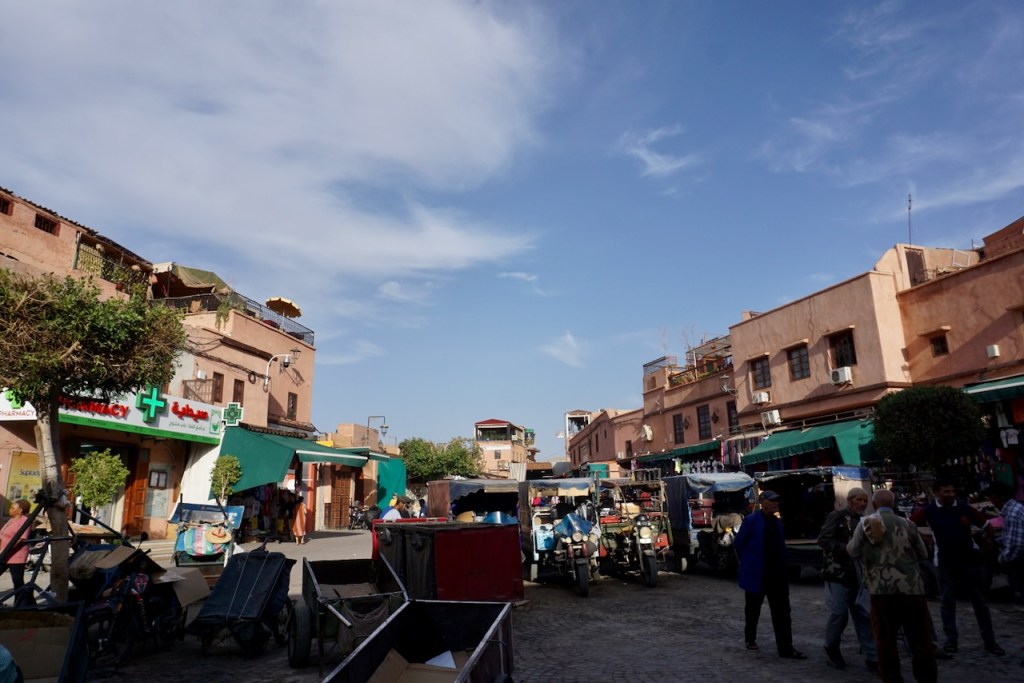
Upon landing in the late afternoon, we took a bus from the airport to Jemaa El Fna, the main marketplace in the old city, or medina, of Marrakech. From there, we navigated twists, turns, bikes, mopeds, and donkeys before arriving at the alley that we would have missed had we not been looking for it. A few twists and turns later, we entered our riad, the guesthouse build around a courtyard that would be our oasis during our visit. Riads are quiet havens that have existed for centuries as family homes; the windows face the courtyard, so there is practically no noise that comes in from outside. Ours contained, as is traditional, a fountain of running water and a good deal of flora, including a date palm that was home to a family of birds. No alarm clock needed, assuming you’ve slept through the call to prayer that comes in the middle of the night and then earlier than the birds. (Spoiler alert: You haven’t slept through anything, but it’s all rather charming.)

Breakfast was served on the rooftop terrace and the suite that we booked (yes, we went all out for this one) included a living room and a sitting area in the airy corridor. We were served sweets and mint tea on arrival, and we knew we were in a different world.

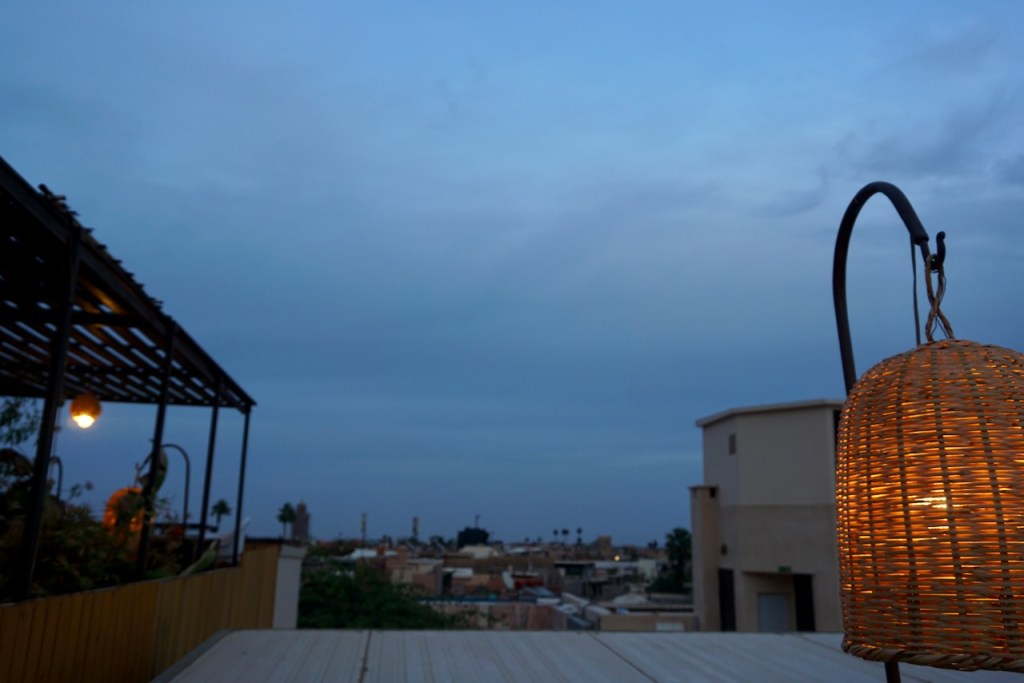
As we would learn, rooftop eateries are common and we intentionally sought them out.

We could usually see cats, a common feature of Marrakech, jumping around the rooftops, and while they are very pretty, they do come along and beg. Understandably, the restaurant cats are definitely better off than the cats eking out a living under park benches.

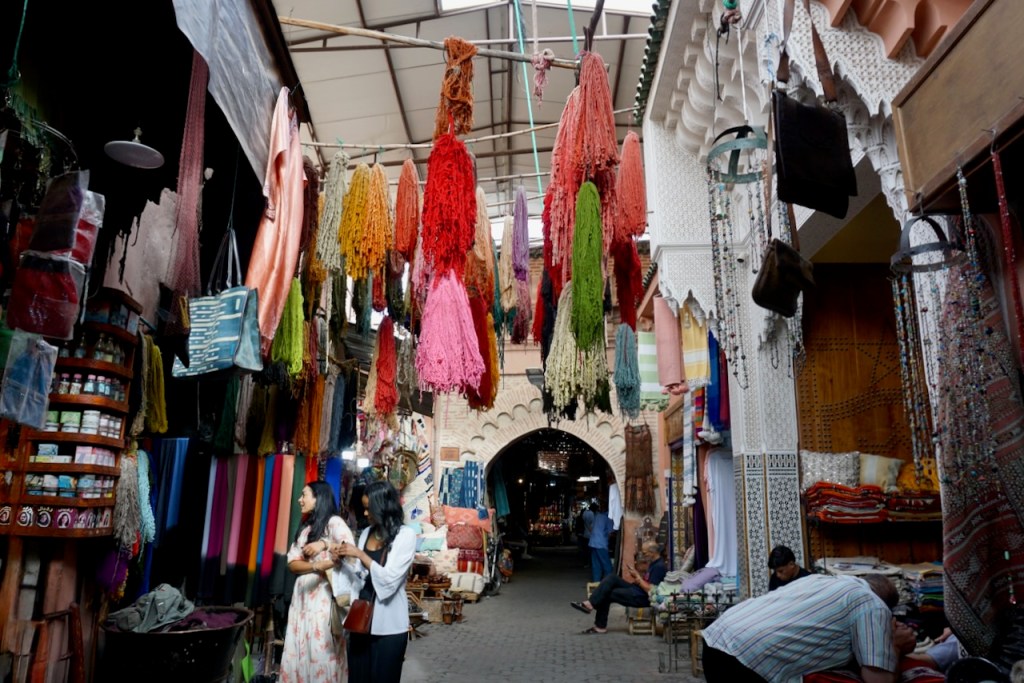
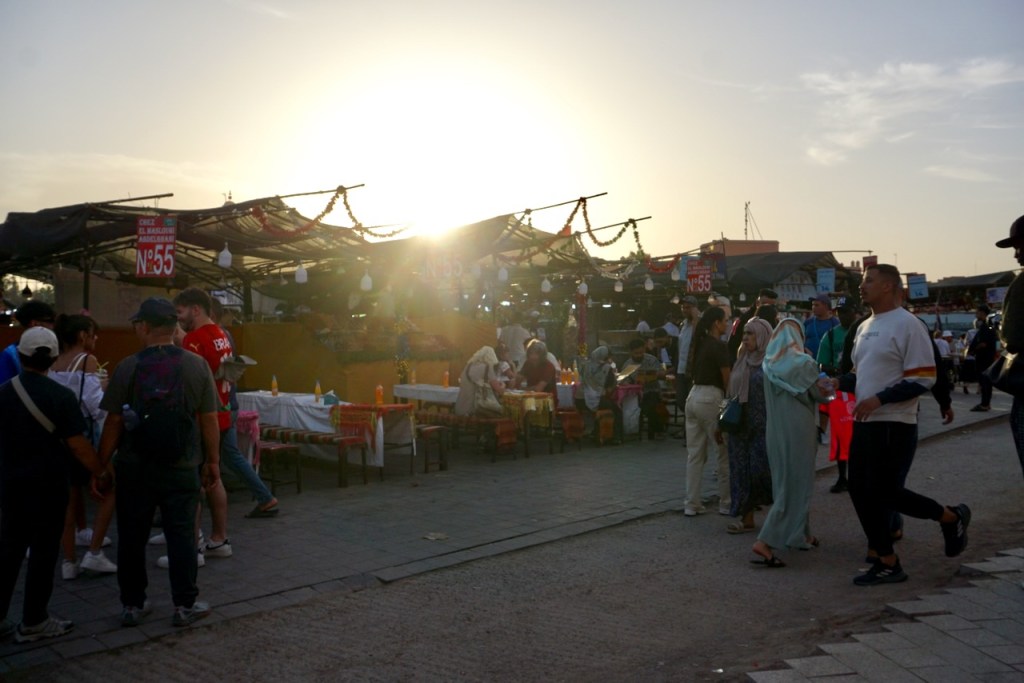
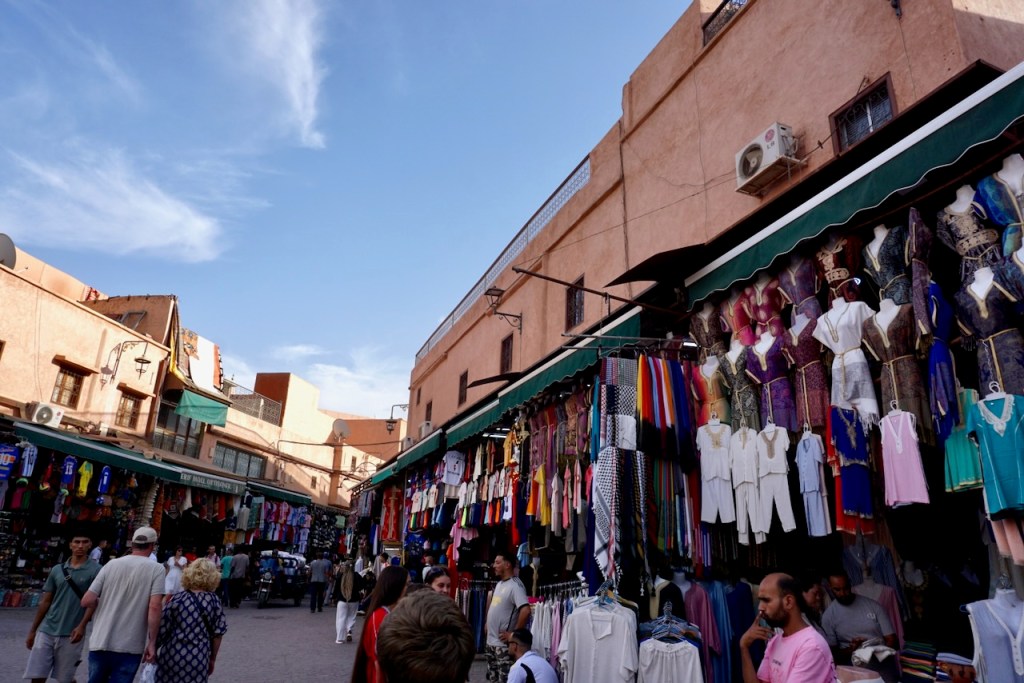
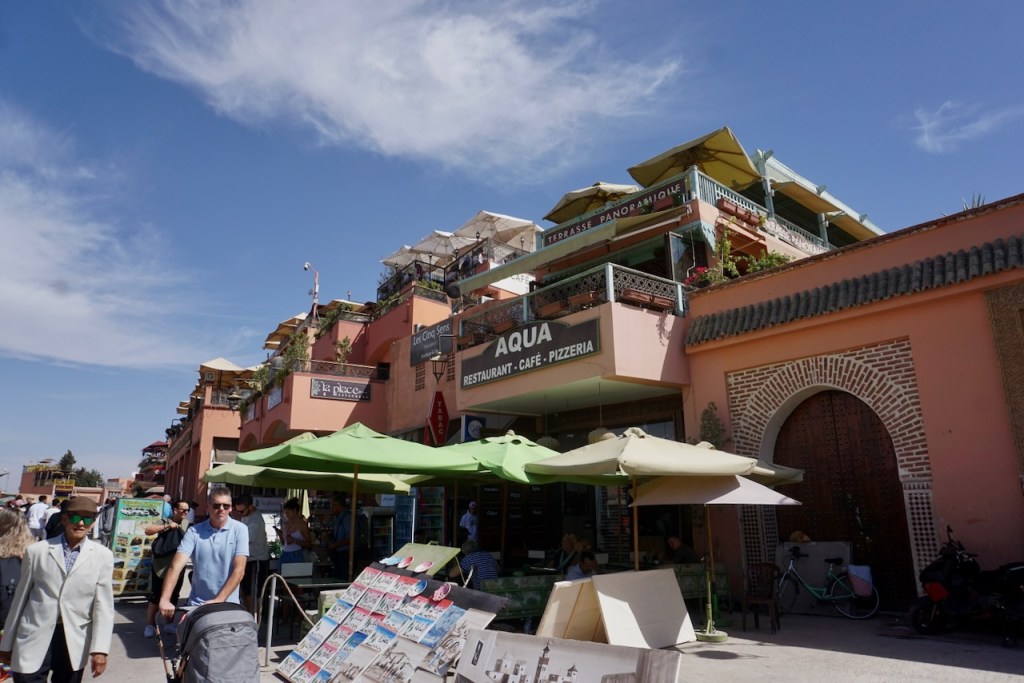
From that first walk through Jemaa El Fna, however, we were enchanted. The market, and particularly the main square, contained everything we’d always imagined about Marrakech, and we spent our time there grinning at being caught on a film set, surreal snake charmer music (and snake charmers!) included. In addition to the snake charmers, monkeys on leashes, and horse-drawn carriages, there were vendors selling all manner of items to buy, in all colours, in all scents. We never tired of looking, and the indoor market sections were surprising cool due to the slatted wooden ceilings that kept out the sun.

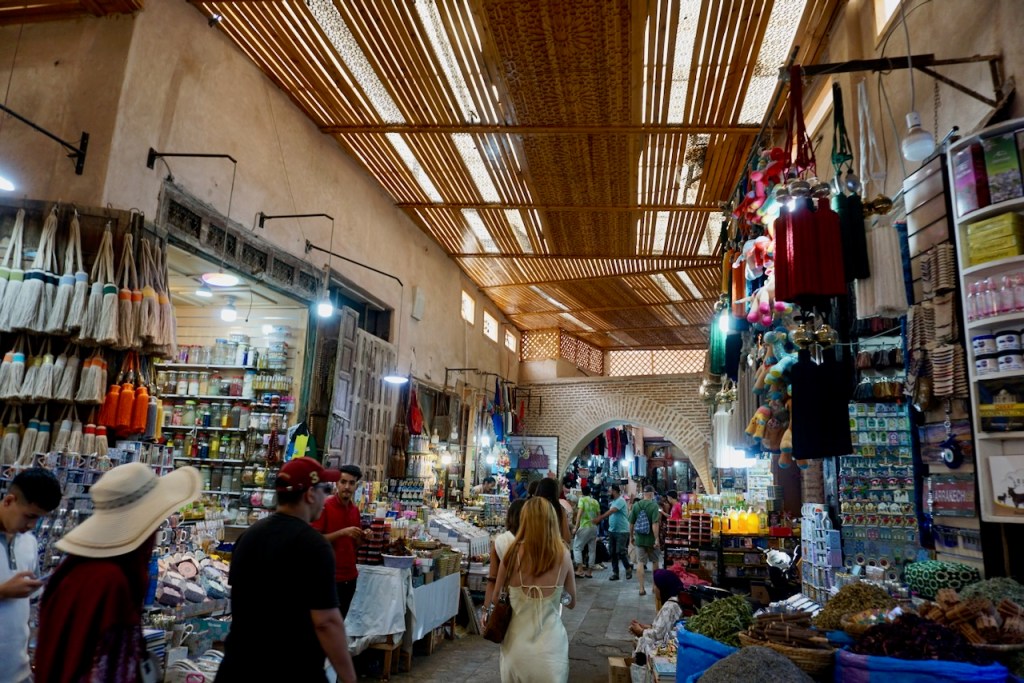
Taking the advice of our riad host, we did our best to bargain prices down at least 60% of the original asking price. We weren’t entirely successful, and we definitely bought a few things priced for tourists, regardless of haggling, but we never paid full price and we did walk away a couple of times. Overall, we found the vendors and shopkeepers respectful and less pushy than we’d been told to expect. They were also extremely flexible, switching immediately into a different language if we didn’t respond in whichever one they tried first. Just for fun, I used as much French as I could, but it’s amazing to see how little French I can still speak.

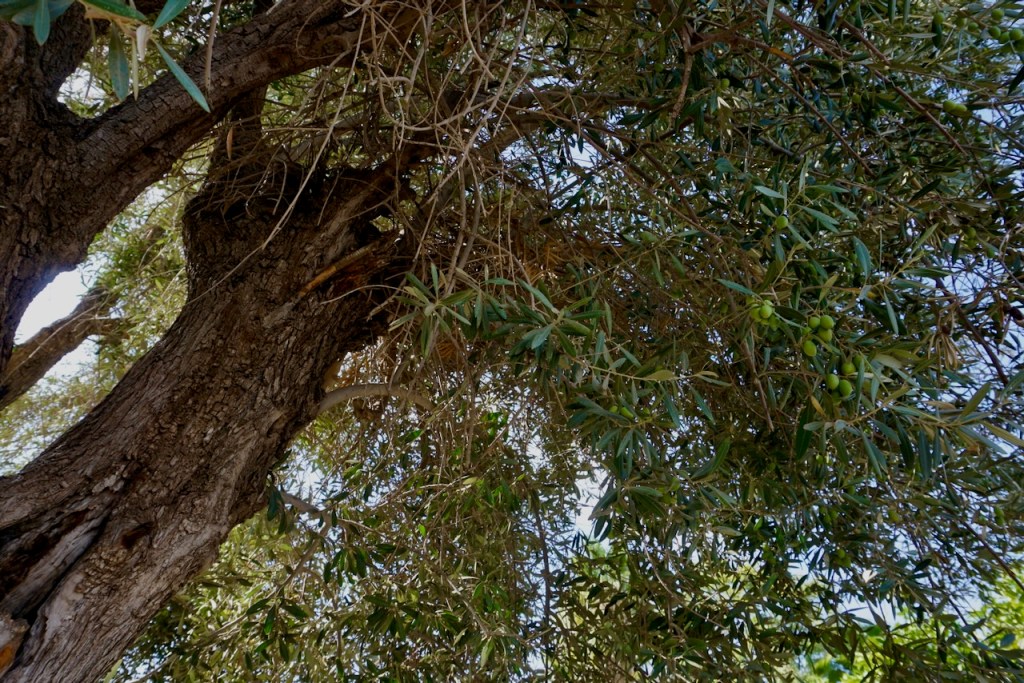
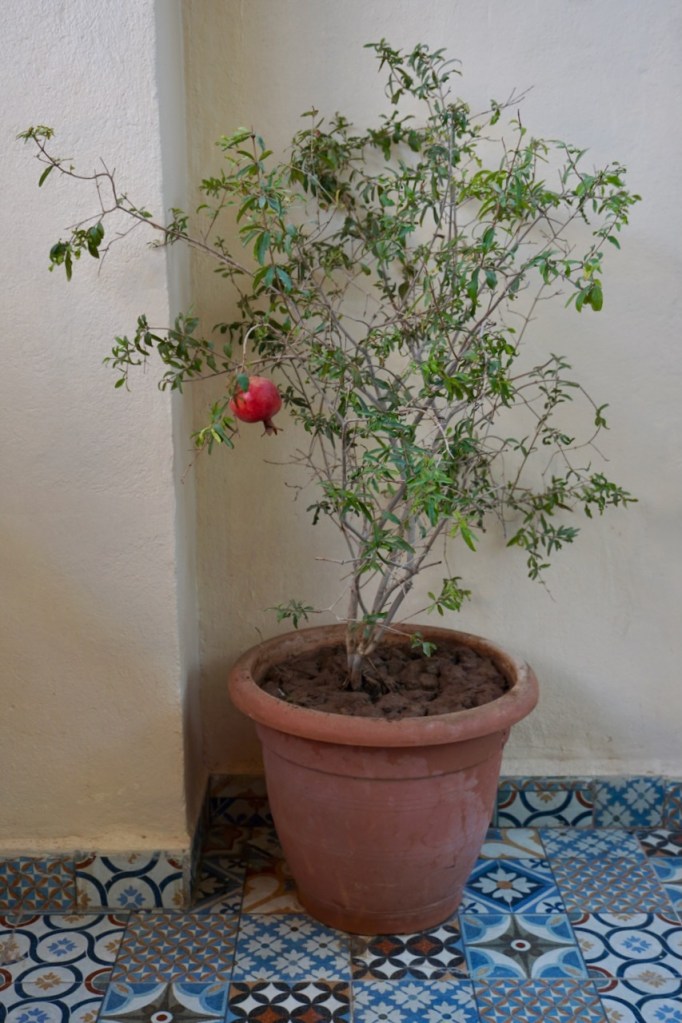
We were also pleasantly surprised by the amount of green in the desert of Marrakech. Our tour guide on our first morning told us that the water comes from the north, from the Atlas Mountains where mint grows, and that the centuries-old irrigation systems were hidden underground as protection against invasions. We saw pomegranates, olives, dates, and oranges growing from trees, and the tour guide explained that fruit from trees in the parks are free for the taking.

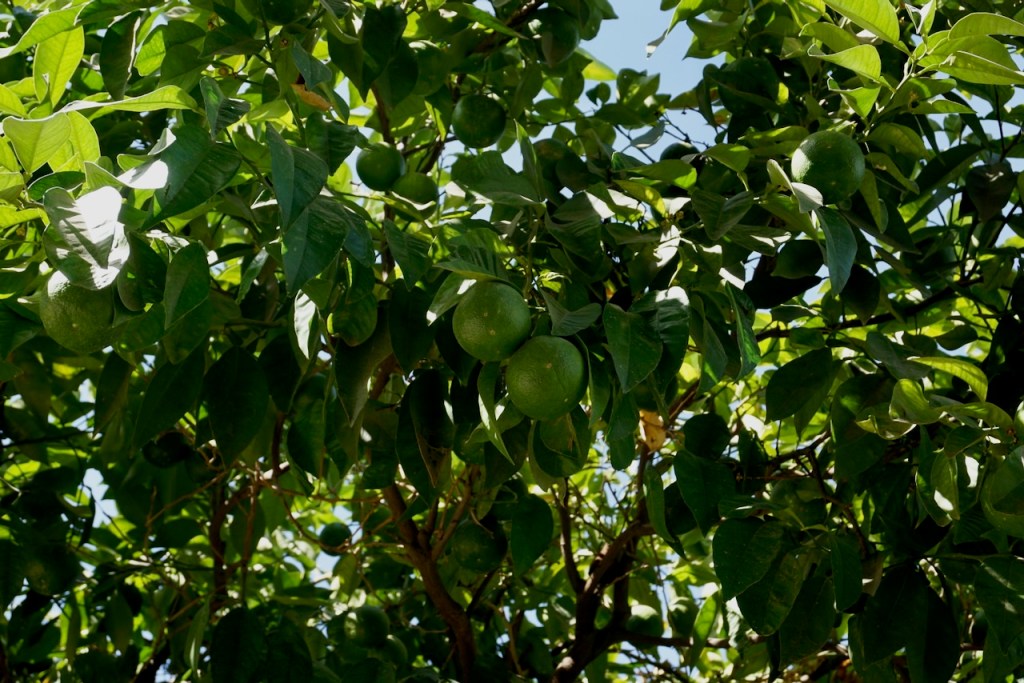
Standing in the shadow of Koutoubia Mosque, we learned about the history of Marrakech . . .

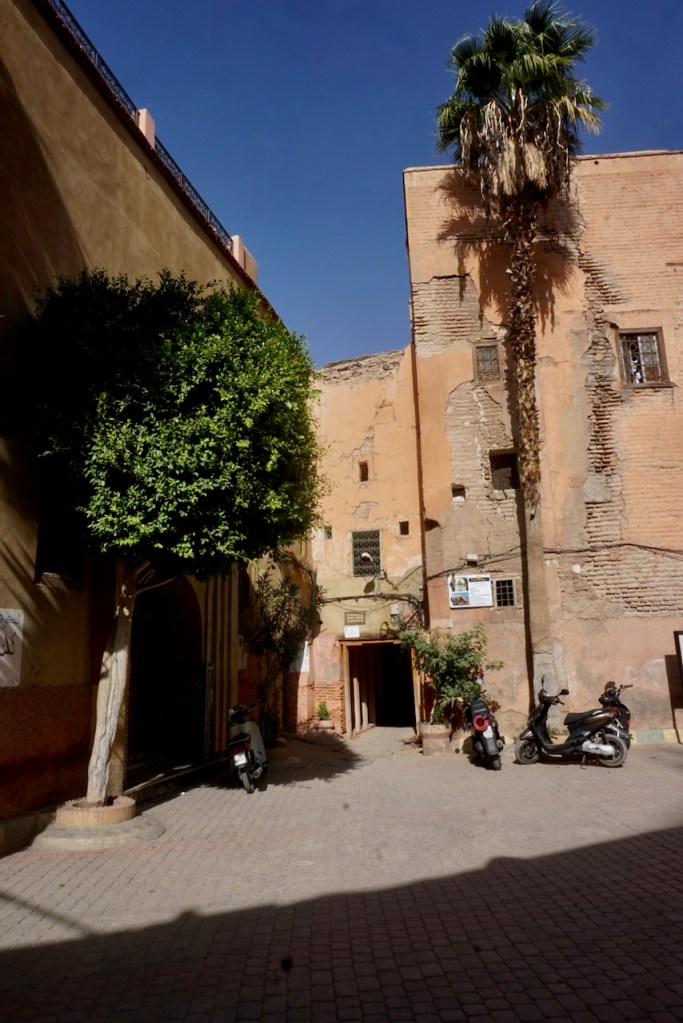
. . . and later walked through a couple of the ancient gates to the city.
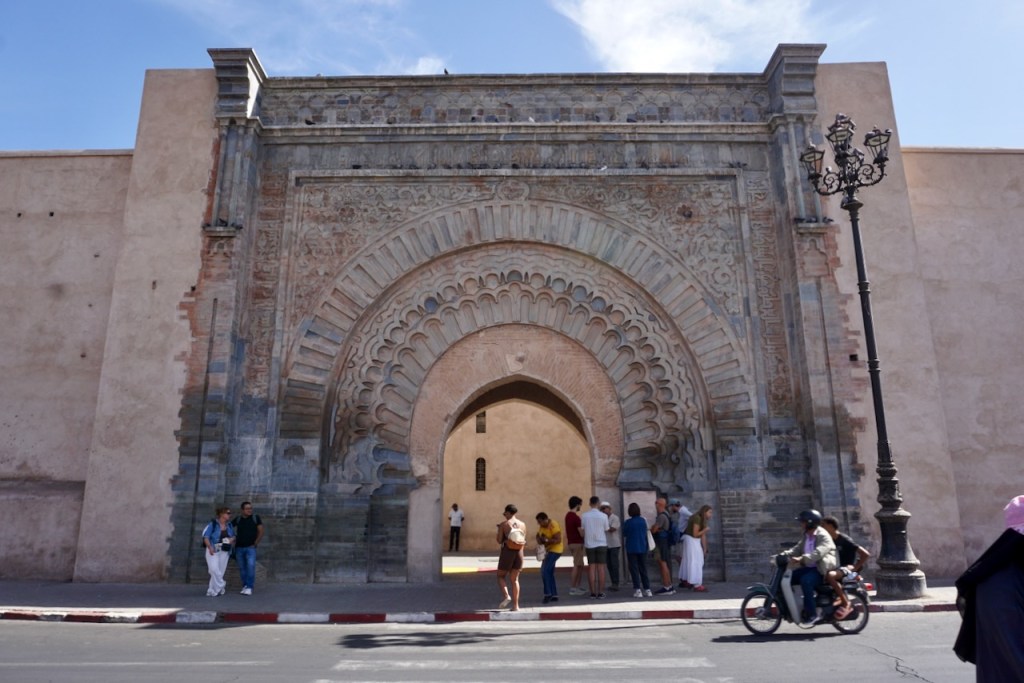
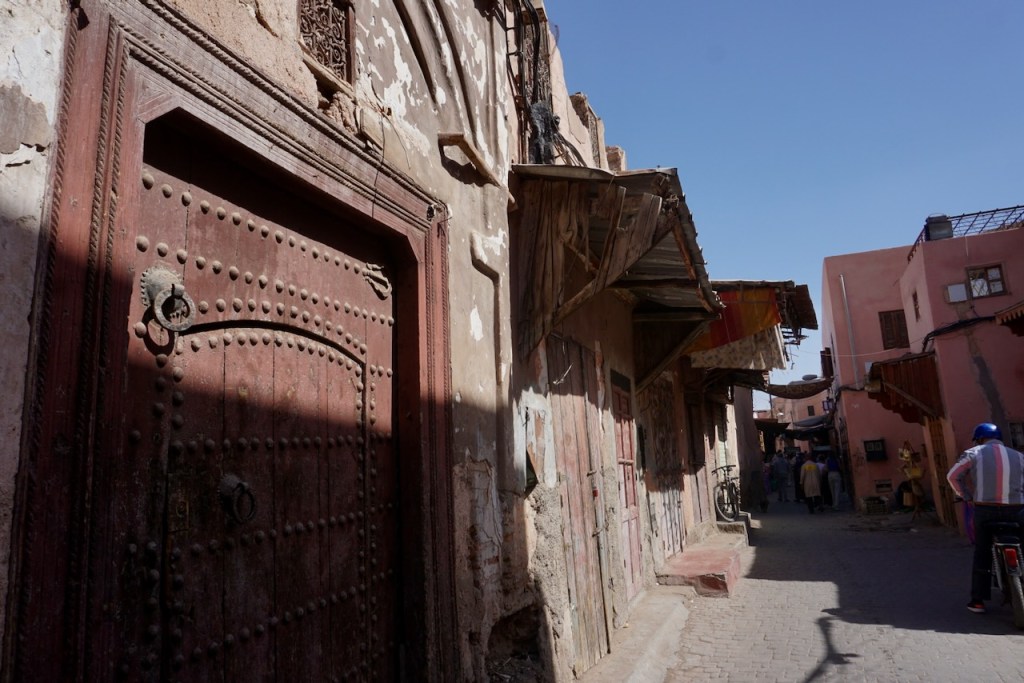
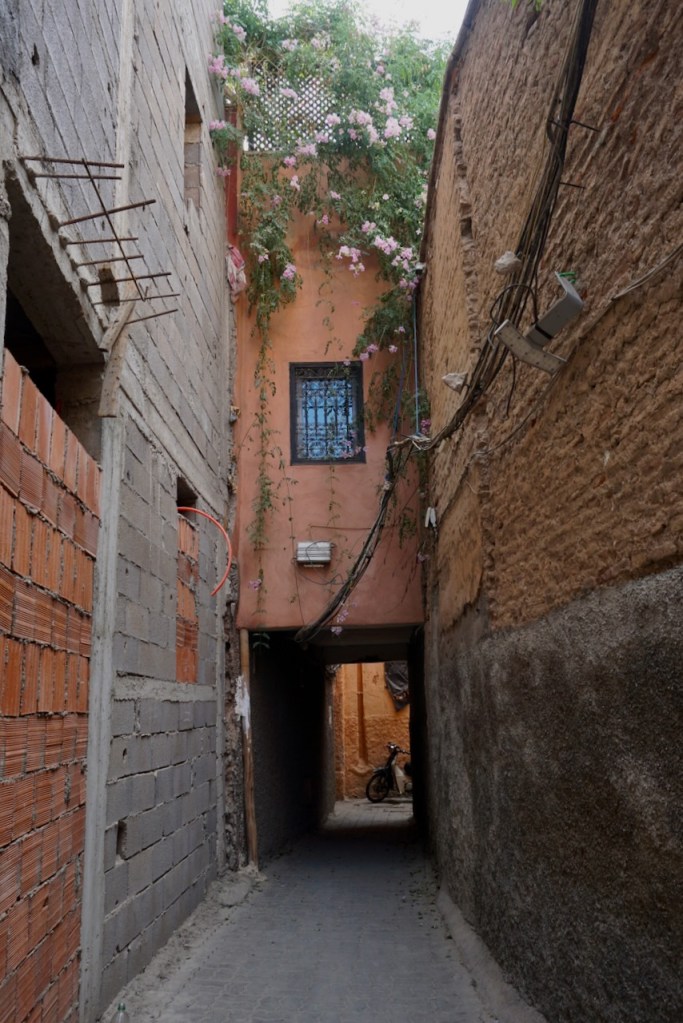
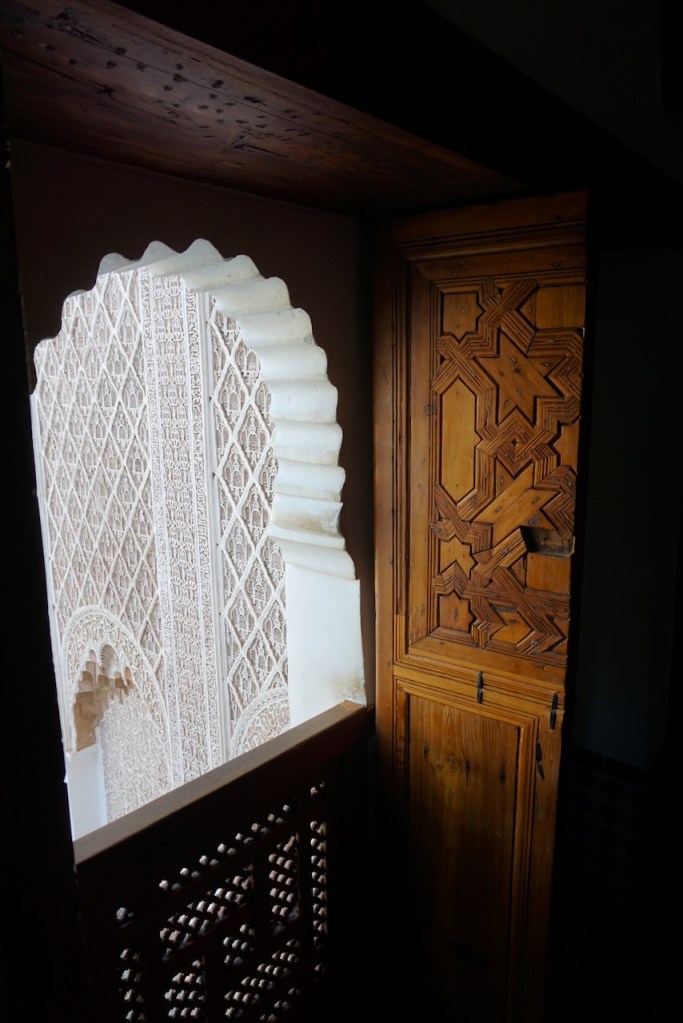
We so taken with the winding, narrow alleyways, designed for protection from invaders and sunlight. Additionally, the windows and doors were in shapes that we are not used to seeing, adding to the sense of being in a different world.

One of the best opportunities to see the architecture, tiles, carved and painted ceilings, and ornate calligraphy that characterize Marrakech is to visit the Ibn Yusuf Madrasa, which dates to the sixteenth century. This former Qur’an school has been preserved as a museum, and it is stunning.

The same can be said for the Bahia Palace, built in the nineteenth century, which also contains beautiful gardens in the riad courtyards. Much of the palace, like much of the city, was undergoing renovations from the earthquake in 2023, however, so there was a lot we were unable to see.

The former Jewish Quarter is located nearby, and it was heartwarming to have heard from the tour guide about the very positive and protective relationship between Muslims and Jews in Morocco. He explained that while Jews were not persecuted there, considering Judaism is an Abrahamic religion and the Abrahamic religions are traditionally recognized and protected under Islam, there were fears of invaders, and the Jewish Quarter was deliberately surrounded by other sections of the medina as a means of security.

It took us several alleyways to make our way to the Slat al-Azama (or Lazama) Synagogue, founded in 1492 following the expulsion of Jews from Spain. A small museum located on the other side of the riad courtyard contained images of Jewish communities, life, and culture across Morocco and other parts of Africa.

A visit to Marrakech, we were told, is not complete without a view of Jemaa El-Fna at night. We climbed the stairs to a rooftop café that exists for the purpose of said view, purchased the required beverage per person, and took in from above the hustle and bustle that we had experienced from below.
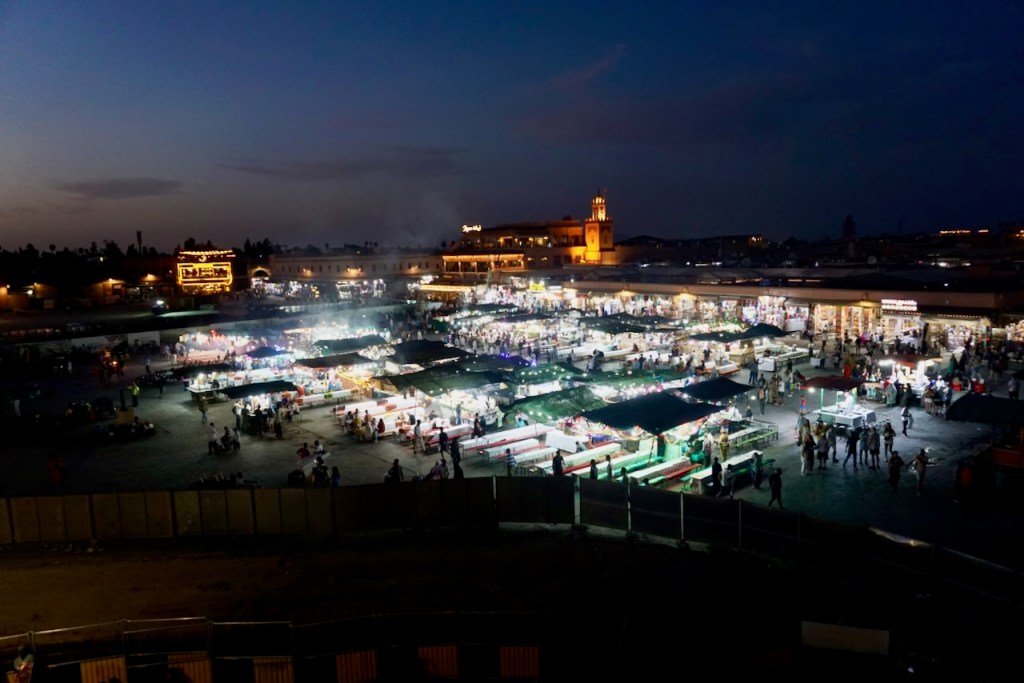
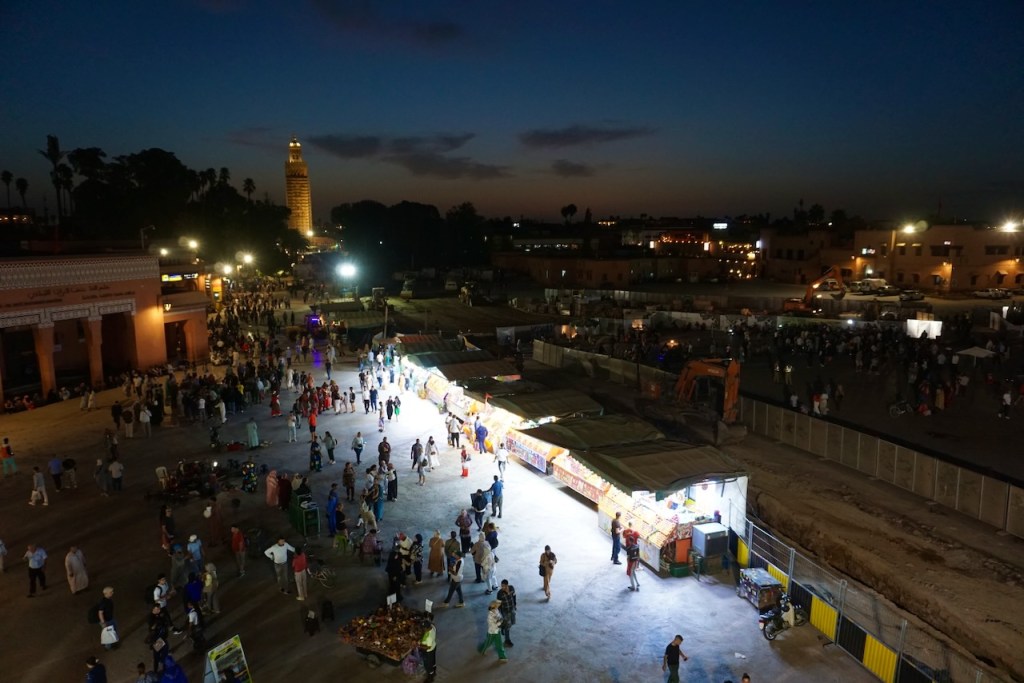
Marrakech is an overwhelming sensory experience and we retreated to the quiet of our riad each afternoon to gather and recentre ourselves. By the time our third and final morning came around, we had seen what we wanted to see and were ready for a change of pace. We basked in the calm of our riad before heading to the airport and I fell asleep immediately on the plane, exhausted from everything we’d taken in. The snake charmer music, which I was delighted to find out is real, had acted like a portal into a different world and, grateful for our time there, we could leave it behind. I never need to go back to Marrakech, but I’m so glad to have been there.
On Cultural Differences

I had a moment of insight recently while on the phone with my oldest friend. The conversation addressed a conflict between people who have known each other for a very long time, do not see similarly on many issues, and have found themselves unable to communicate with one another. As we talked, I thought about the communication challenges I’ve been navigating in an increasingly deep way. My partner and I come from different cultures that are steeped in different styles of communication, express ourselves most easily in different languages, and have different levels of proficiency in each other’s first language. As with anyone building a life together, it makes sense that we will have conflicts; considering our backgrounds, it also makes sense that areas of our conflicts will be due to cultural or linguistic differences. What has surprised me is how often this is the case, especially in situations where “cultural differences” seems the least likely culprit.

Could it also be the case that people who grew up in the same culture, were raised in a similar manner, and speak the same language can experience intercultural conflict?

I listened to one side of the story, thought back to what I’d previously heard from the other party involved, and realized I was hearing much the same from both sides. There was hurt, abandonment, lack of support, lack of understanding. There was frustration and anger, there was a desire to end the conflict, there was the helplessness of not knowing how to move forward, the sorrow of making decisions that were deemed necessary but also clearly hurtful.

Most significantly, I heard, “I’m sure they think they’re doing X but they’re actually doing Y. They just don’t understand.”

This brought me to the challenges I have experienced in intercultural communication. It is not uncommon that either my partner or I will do X and the other will interpret it as Y. And then when we try to talk about X or Y, it becomes clear that we’re not talking about the same thing because we didn’t experience or interpret the event in the same way. While this is likely often the case in relationships, I find that we often get into a discussion of language, tone, or expectation, all of which run far deeper than the event itself. In the end, it’s the deeper aspect we discuss, navigating through that how we want to be with one another.

So I wondered if maybe this was happening with my oldest friend. I wondered if maybe these people, whose lives had been so similar and interconnected, had moved far enough away from that beginning that their foundation was no longer a basis, no longer a fundament. And if this was the case, maybe their situation was similar to that of my partner and me, who come from different cultural backgrounds. A key factor is perhaps that ours is obvious (and therefore easily forgivable) and theirs is not.

This made me wonder about communication overall, whether much political screaming and social media furor is an example of multiple groups, different enough to be defined as their own culture, lambasting the other about what they think is the same thing, but missing the mark. If society is so fractured into its own subgroups, each with its own media and ethos, it’s reasonable to think that our realities and therefore ways of seeing the world have shifted, and that a “common culture” is not as common as it once was. And maybe this is hard to recognize. Perhaps we talk past each other when we have gone in directions different enough to no longer have a common base. We might expect such behaviour from distinctly different groups, but maybe it is harder to see as such when the groups, at least on the surface, are the same.

Perhaps the error is the assumption that all parties understand X and Y in the same way. We have expectations and assumptions of others and we don’t stop to consider that others’ expectations and assumptions might be different. For aspects of culture that we take for granted, it is unfathomable that anyone else might see a situation differently – simply because we only know what we know.

In the past few weeks, my psychology students have been learning about cultural dimensions in class, the universal facets by which national cultures can be characterized or defined. The point I emphasize with my students is that while the values that make up a culture differ wildly, there is not better or worse, desirable or undesirable. We might not consider that cultures have different perspectives on the importance of time or response to uncertainty, but they do. We are enculturated without realizing that to be the case; norms, values, and expectations are taught naturally and indirectly, and it is often only through looking at another culture, bemused by the differences that we notice, that we begin to learn about our own.

Having lived in and alongside multiple cultures, I have tried to let go of my own assumptions and expectations and put myself in different mindset when the occasion requires. If I’m the only one annoyed at a process, chances are it’s my problem and not the process. The process does what it is meant to do, though maybe differently than I have experienced in the past. It is much more comfortable, indeed after a significant amount of discomfort and uncertainty, to simply accept this to be the case rather than to lament other processes that fulfil the same functions. It can be very difficult to avoid value judgments at first, but it is much more pleasant to move within another culture having done so.

As I navigate a life that seems to be setting down roots, and as I find myself spending increasingly more time in what international school parlance calls “local culture”, I recognize more of where I come from, my ideas of norms, assumptions, and expectations shifting along the way. I get scared sometimes, scared of losing myself and what shaped me. There are certain aspects I cling to because it is very hard to navigate while adrift. Even those of us who wander have moments with both feet firmly planted on the ground.

When I think about the conflict my oldest friend described, I see cultural differences. I see people whose understandings of the world around them come from fundamentally different places, and there may be multiple reasons why that’s the case. I see people who do not see that they experience the world differently, but rather assume that their understandings are held in common. It could be that a conversation needs a moderator to tease these things out, to gently prod feelings about X and Y toward a discussion of what I think are much deeper origins.

The humility and vulnerability that it requires to engage in such a conversation cannot be understated, and the very real fear that one might experience under such circumstances is in itself an act of tremendous courage. We have relatively little practice stripping ourselves bare. We are made up of many, many layers and sometimes, to move forward, we need to find out what they are and why they formed. I believe that it is the soul that shines more brightly in the end; looking for the soul of another is what makes such a conversation possible. Getting to know another is an act of bravery because of what it requires of oneself.

And I believe it is never too late to begin again.

The surface of the earth is soft and impressible by the feet of men; and so with the paths which the mind travels. How worn and dusty, then, must be the highways of the world, how deep the ruts of tradition and conformity! I did not wish to take a cabin passage, but rather to go before the mast and on the deck of the world, for there I could best see the moonlight amid the mountains. I do not wish to go below now. – Henry David Thoreau, Walden

A Little Bit Outside

Every so often there are moment that remind us of the groups we are fully, intrinsically, unquestionably part of . . . and the groups we are not. The groups where, for one reason or another, we stand a little bit on the outside. This is not necessarily a negative thing; we cannot be an invested member in all of our groups, simply because there’s not enough of us to go around. Furthermore, we might not want to be so deeply involved, perhaps because this would present us with obligations that we are not interested in or prepared to shoulder. It can be painfully difficult to come to terms with the groups that we want to be part of that do not want us, but that is not of interest in this post. Rather, this post is about recent circumstances in which group membership was unspoken but thrown into focus.

Language and Culture

Before I moved overseas, I helped out with the international student exchange program at my school. This opened my eyes to the question of integration: How do I help young people integrate into a group that is relatively homogeneous . . . and very different from what they are used to? This question changed in form when I had the opportunity to work in a very diverse environment in which integration was a question caught between language and culture. (Danau Tanu’s phenomenal Growing Up in Transit deserves mention here for its impact on the way I think about schools and language.)

In my somewhat nomadic adulthood, I find that language plays a more important role in my interactions and friendships than I would have guessed. For example, there is a difference in the shared understanding that I immediately sense with those who come from the same linguistic background as I do. I almost always know who is American (accents aside) based on the words that they choose in certain situations, or the way that they explain past experiences. Having worked with so many Brits, Canadians, Australians, and Kiwis over the years has tuned me into the differences in our cultural contexts, and therefore also informed the words that I use when talking to certain people. My favourite example here is “college”. This has a meaning in the US that does not match the meaning used by English speakers, and sharing the context is important. Telling a story about a high school experience needs a different explanation when I’m speaking with people who had a similar educational experience to mine. I am immediately “in” with those people, and forever “a little bit outside” of others.

A few weeks ago, my partner and I had dinner with friends and talk turned to just that – our school experiences. Not only did I have to ask clarification questions about what was clearly a shared understanding among the others, but I also had to provide background context before much of what I said could make sense. I laughed along with them as we talked, fully aware that the picture in my head of their world was likely as inaccurate as their picture of mine. The pleasure is in finding common ground despite the differences, and seeing my own experiences through new eyes.

Things like this happen so often. There are many instances in which my partner and I interpret actions or events differently, to say nothing of the differences in our language. Because I am the one who has moved, it is my responsibility to adapt to where I am rather than expecting to find what I chose to leave elsewhere. I find that I am sometimes caught unexpectedly unaware simply because I didn’t know that there could be another idea, interpretation, or action. I am simply “not from here” and haven’t run into this particular circumstance yet. A little bit outside, as it were.

I’m not sure when one begins to feel at home in a culture, though I have had years of experiences being surprised at what I found when I returned to North America. Sometimes I know how to live the way people in Germany live and I do it automatically, and sometimes it’s like seeing yourself in a mirror and forgetting that you got a haircut. It’s familiar but not quite right.

Social Groups

And now for a completely different example, one in which no one is talking about the groups that everyone knows are at the centre of the conversation.

In order to make plans for the summer holidays, I sent a message to a group of people who I had previously talked with about plans. The daily lives of these individuals are intertwined and I am the one clearly on the outside, a result of the choice made to live somewhere else. It is not a secret that this group interacts without me, that I fit in only at the seldom moments when I’m around. If I ever had different expectations, I lost them a long time ago. And I’m no more present for this group than they are for me; we interact infrequently, as has been the habit since before I knew it was a habit, and otherwise, it’s pretty silent.

For that reason, it didn’t entirely come as a surprise when my message went unanswered. I had anticipated precisely what I did not like, which is becoming a topic of conversation that I was not privy to. Being outside of this group means that I am not privy to very much, but it was obvious what was happening when I received no replies to a message that, among people who are part of each other’s lives, would have received replies. That the group responded (by not responding) en masse suggests that a discussion had occurred, a course of action deliberately taken.

This is a situation in which a group was clearly more than just one group, and being outside the group meant not being in the group at all. It’s interesting because this fact was always simmering under the surface and now it is fully out in the open, precisely by not being open. One of the things I learned when first working to integrate groups of students was that friendships thrive on shared experiences; it is difficult to feel connected to people when our shared experiences are few and far between, and especially when, looking back, what was ostensibly shared was only shared at the acquiescence of the group, and not those standing a little bit outside.

Reflections

Our daily lives are enmeshed in relationships, both those we’ve chosen and those we have been forced into, for a range of reasons. Building and maintaining relationships is a process with which we are all familiar, and it governs the way we structure our world. I love teaching the human relationships topic in psychology because it’s about the everyday experiences of all of us, immediately relatable and immediately captivating.

Maybe it’s because of teaching psychology that I am fascinated by the inner workings of my own relationships, and try to be conscious of the role I (and others) play in each of them. I think the important lesson here is that relationships are complex and there are more stories to explain them than the ones I can tell; just because I’ve interpreted a situation a certain way doesn’t mean someone else has. Humility plays an important role here, too. We must be humble enough to listen to other viewpoints, as well as confident enough to express when we disagree. We must be vulnerable enough to let others in, and strong enough to stand on our own. It’s a delicate balance, being human, and that is what we doubtless share, regardless of who is on the inside and who stands a little bit outside.

Bad Herrenalb, Germany – February 2023