Tag Archives: Decisions

Saying Yes

When I moved to New York City, a friend who had been living there for some time told me that the key to enjoying New York is to say yes to things. “This is how you meet people,” she said. “This is how you learn how to do New York.”

The problem was that I was living in New York at a time in my life when it was a victory to do the simple things, like go for a walk, leave the apartment in the rain, or smile at someone in a coffee shop. It was a time when I didn’t want to be in my own company, much less impose it on someone else.

(For what it’s worth, I said yes to a few things and that was hard to do. But I was always, always glad that I’d done it.)

This was on my mind a week ago when a friend asked if I was interested in attending a party hosted by someone I have spent time with, though wouldn’t yet call a friend. I said yes because I knew that yes was the answer. And as I answered, I also knew that the real answer was NO in glowing red letters, and that the NO told me something interesting – but was wrong. I had no good reason to say no and much better reasons to say yes even if the gut instinct was no. So I said yes.

And in saying yes, I worked myself up to look forward to the opportunity. When the question later came up of whether I wanted to join my friends in spending the night camping in a converted VW bus beloved in my friend group, I also said yes. (It’s a good thing we’re having a heatwave.) It didn’t take long to grow excited about this, too.

There’s a lot to be said for listening to yourself, for listening to that little voice screaming NO. It knows some things. But this experience made me think about times when the right thing to do is to close the lid on the voice and let the rational part of the brain (Tversky and Kahneman’s logical system 2 rather than intuitive system 1) do the talking. Understanding the choice I made and why I made it while acknowledging what the little voice wanted me to know may sound like a contradiction, but is not. Rather, taking the time to listen to the gut response allowed me to quiet it down and put it to rest and then embrace the decision I had made.

I like trying new things and the only way to do that is to say yes when the opportunities arise. There are certainly times when a resounding no is appropriate, unquestioned, and the right answer. But there are also times when there’s no good reason for the no, and that means the no can become yes. In the end, at least I know I’ve tried and with all the possibilities life has to offer, I can’t do more than that.

And it’s true what they say – you don’t know until you try, and you have to say yes if you’re going to try.

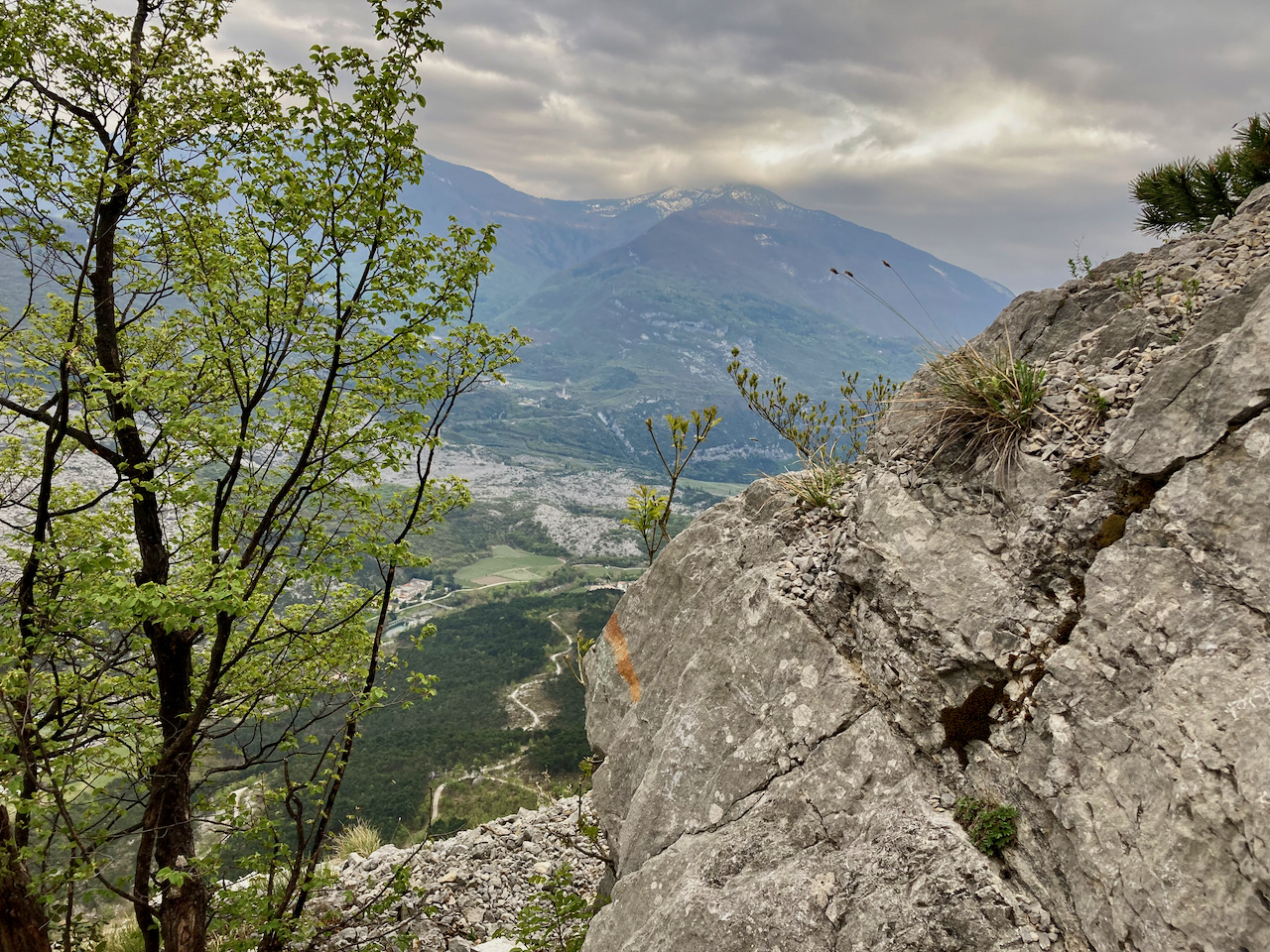
Arco, Italy – April 2022

How to Solve a Problem: Step One

The first step to solving a problem is identifying the problem. We cannot fix something or change something if we don’t see it.

But what happens if we can’t see it, won’t see it, or refuse to accept it? What happens when we refuse to take responsibility for problems that are brought to our attention, or brush them off as being someone else’s problem?

We can’t solve a problem if, for us, it isn’t there or it isn’t relevant. We can’t solve a problem if we don’t want to.

This might sound really obvious, but a certain attitude about problems is also pervasive in education. In my current context, there’s a deep reticence to addressing even the most visible problems, let alone the problems that lurk below the surface. This is troubling because refusal to see, admit to, and take ownership of problems harms both young people and the adults around them who are trying to do the right thing (because there are always people trying to do the right thing). Much contemporary education claims to be caring or compassionate and, in my experience, it often is not.

So, the first step to solving a problem: Admitting that it exists.

Problems in Schools

Every school I have worked in call itself a community. It’s common to hear, “In our community we believe X. We do Y. We are Z.” This means that we are all responsible for the development and action of X, Y, and Z, which also means that when there is a problem, we need to address it. Unfortunately, addressing the problem is often neglected and I think there are a number of reasons for that. These reasons will be explored below.

For context, my school uses the phrase “see it, own it” as a way of dealing with issues that are (arguably) detrimental to learning. I recently learned that “see it, own it” is an abstraction of The Oz’s Principle‘s “See It, Own It, Solve It, Do It”. Clearly, there are multiple parts here. If you see a problem, you need to do something about it. Claiming only “see it, own it” is an abstraction of this much larger idea, and it seems to have neglected a fundamental part.

My concern with an educational environment in which “see it, own it” is enough is the lack of collective responsibility. If we want a certain community, I say to my students all the time, we have to build it. We can’t just talk about it – we have to do something.

So why don’t we?

Fear: I can’t be wrong.

In evolutionary terms, fear is a primary human motivator. We are afraid of the dark, spiders, and heights because these things can harm us physically and limit our ability to reproduce. We are also afraid of losing face, losing a sense of self, and damaging our self-esteem. We are afraid of being wrong and looking like we don’t know the answers because we think we should. We are afraid of admitting failure because we put ourselves up on pedestals of expertise.

And when it’s very clear that something has gone wrong, we rationalise. We make excuses. We deflect. We remove ourselves from the situation and blame someone or something else. The fundamental attribution error, or FAE, applies here: If something goes well, it’s due to my disposition and I deserve credit, but if something goes poorly, it’s due to the situation and it’s not my fault. (Go figure.) We act like this because it is easier than accepting our part in what has gone wrong and doing something about it. It is easier to excuse than to solve or to do. I can’t be wrong so instead I push the problem away from myself.

As I explore with my students, psychology suggests that much of what we do is meant to protect us from what is mentally uncomfortable or difficult. This often comes in the form of cognitive dissonance. For example, I see myself as a person who cares for the environment and yet I fly many times a year. I recognise the contradiction and this makes me uncomfortable. Instead of giving up flying because that’s hard and frankly, I don’t want to do that (oh gosh, how environmentally conscious am I, really?) I tell myself that other people fly more often, or that the plane might as well be full, or that I don’t use plastic straws so at least I’m helping somehow.

I make excuses instead of solving the problem because I refuse to accept that I am part of the problem. After all, what would that do to my sense of self? What if I’m wrong? I am afraid of what I might find if I start to look. What if I’m not the person I claim to be? And what if everyone else sees that?

I am afraid and I choose to do nothing.

Indifference: This really isn’t my problem.

Another reason that people in schools fail to solve problems is indifference. They really don’t care about the problem because they don’t actually see themselves as part of a community that honours X, Y, or Z. These are the people who say, “I just work here” or “That’s not my job”.

While this might be valid in certain contexts and I accept that this may be the case in organisations, it is not an acceptable attitude when young people and adults are being harmed due to someone else’s indifference. If we do not all agree to be part of the community and build the community, there will never be a community. People who behave indifferently erode what could be and therefore actively harm everyone else and the very concept of community.

We have to recognise that the problem exists and this means caring enough about the environments that we are in to recognise that none of us exists in a vacuum. We have all chosen to be part of something and we have the option to choose differently if we realise we don’t want to be there. But we cannot simply opt out without having an adverse impact on others. Choosing not to participate is as much of an action as any other action.

Claiming that, “This isn’t my problem” is an action. It is an action of doing nothing.

Uncertainty: What am I supposed to do?

I think uncertainty is closely related to fear but I’m going to address it separately for the sake of clarity.

Many would argue that there are those who do care and do want to help but they just don’t know how, or there are obstacles at every turn. I agree that this is often the case. I have heard many, many teachers say, “Well what am I supposed to do? I don’t make the decisions around here.” Alright, yes. There are many decisions that teachers do not make, but there are also many decisions that teachers do make. One that has become increasingly obvious to me is the option to sit down with someone and point out a concern that they have clearly not considered, for whatever reason. There might not be a “fix” but at least there is now deliberate awareness of something that is not right.

Please understand, it is okay to be uncertain. But it is not okay to use uncertainty as an excuse for inaction. There’s a slippery slope from uncertainty to something deeper and I think it’s important to be aware of this. The question of what to do often has a real answer and we need to recognise when we are asking that question genuinely and when we are using it as a way to shield ourselves from having to act.

What are we supposed to do? We’re supposed to recognise that the problem is there, consider our role in the community, and act in accordance with that role. What kind of community do we want to build? Behave in the ways that reflect this community.

Callousness: I just don’t care.

This one is really tricky for me because for a long time, I didn’t believe that callousness actually existed in education. It was a very painful lesson to find that, in fact, some people are involved in education just because that’s how life went and not because they have any sort of interest in young people or in making the world a better place. In nine years as an educator, I have learned that some people really are involved in this field because the holidays are good and because, in many systems, they’re largely left alone to do whatever they want.

I can say a lot about such systems but I will stick with the topic of this post right now. As much as it deeply hurts me to say it, there are people in education who just don’t care. I wish this were not the case. These people should not have a place in any environment where their actions affect others, and particularly young people. Such people are concerned for themselves with utter neglect of anyone or anything else. And they are unlikely to change.

I am disturbed by people who pretend to care because that’s how to get away with doing whatever they want to do, and I have learned not to trust them. It has been a difficult lesson. These people, in and of themselves, are problems that schools need to solve.

Conclusion

The first step to solving a problem is identifying the problem. We must admit that it is there. Members of a community are often very happy to be part of what’s going well and toss their hat into the ring of what’s popular, but they often fail to act the same way when something is not going well and is not popular. No one wants to be the person who says, “This isn’t working. I know we spent a lot of time on it but I dropped the ball here and miscalculated there. I’m sorry. This is how I will move forward and help us all recover.” No one wants to be the person who says, “I wish this weren’t the case but this is what happened and I’m not in a position to fix the system. What can I do right now instead?”

Schools have problems when those difficult conversations are avoided and when band-aids are put on problems so that things look better. In reality, problems are perpetuated because the retrofitted system continues. Schools have problems when there is no sustainability because there were no deliberate systems in the first place. The way to develop sustainability is to stop patching up the problems and actually get your hands dirty and fix them.

No one ever said this was easy. It’s not. But it’s essential if we want to live in a world that is more just than this one. And it’s required if we claim to be part of a community.

Step one: Look the problem in the face.
Step two: Take a deep breath.
Step three: Do something about it.

A Path with a Heart

A few weeks ago, I ran out of books. I was travelling and realised that I was going to be on a plane for seven hours without anything to read. After a moment of paralysis, I messaged a friend who replied by sending me a digital copy of The Teachings of Don Juan: A Yaqui Way of Knowledge by Carlos Castaneda. It’s long and drags occasionally, but I’ve been reading it on and off since that flight and I’m enjoying it very much.

A week ago I read the passage quoted below and it’s been dancing around my mind ever since.

“Anything is one of a million paths. Therefore you must always keep in mind that a path is only a path; if you feel you should not follow it, you must not stay with it under any conditions. To have such clarity you must lead a disciplined life. Only then will you know that any path is only a path and there is no affront, to oneself or to others, in dropping it if that is what your heart tells you to do. But your decision to keep on the path or to leave it must be free of fear or ambition. I warn you. Look at every path closely and deliberately. Try it as many times as you think necessary.

This question is one that only a very old man asks. Does this path have a heart? All paths are the same: they lead nowhere. They are paths going through the bush, or into the bush. In my own life I could say I have traversed long long paths, but I am not anywhere. Does this path have a heart? If it does, the path is good; if it doesn’t, it is of no use. Both paths lead nowhere; but one has a heart, the other doesn’t. One makes for a joyful journey; as long as you follow it, you are one with it. The other will make you curse your life. One makes you strong; the other weakens you.

Before you embark on any path ask the question: Does this path have a heart? If the answer is no, you will know it, and then you must choose another path. The trouble is nobody asks the question; and when a man finally realizes that he has taken a path without a heart, the path is ready to kill him. At that point very few men can stop to deliberate, and leave the path. A path without a heart is never enjoyable. You have to work hard even to take it. On the other hand, a path with heart is easy; it does not make you work at liking it.” – Don Juan, The Teachings of Don Juan: A Yaqui Way of Knowledge by Carlos Castaneda

If this understanding is accurate in terms of how to live well, though there are a few areas that I question, it is worth considering what this actually means in terms of living in today’s world.

Finding a Path with a Heart

When I first read the passage, my own heart leapt. Yes, I thought. Yes. That’s what it means when something just feels right – it means that it has a heart.

Finding a path with heart is challenging and as Don Juan says, we probably have to try many, many times before getting it right. But maybe we know it when we find it. Maybe it’s one of those things where we might not know what we’re looking for but we’ll know it when we see it. Something about it just makes sense to us and so we carry on. A path with a heart, according to Don Juan, is followed not due to fear or ambition, but because it is the right path. This does not mean that the path is meant to take us somewhere in particular. Rather, it means that we are making disciplined choices to do the right thing because the direction we are heading is not relevant.

This is where it gets tricky. Much of society today is highly materialistic. We are conditioned to, or sold the idea of, working towards the next goal, which usually means attaining something – a job, car, partner, house, nicer car, nicer house. As soon as we’ve accomplished Thing A, there’s Thing B on the horizon and everyone else is probably getting it faster than we are. We should know, because we’ve been following them on social media they look so happy! What’s wrong with me?, we might ask. Why them and not me? One could argue that this is the way of the world; it’s difficult to then respond, Well maybe the world is wrong. But this is a subject for another time. If we are chasing an outcome, we are going somewhere. This is a path without heart.

A path with heart, on the other hand, rings clear to me as a way of being in the world, a way of living or relating to oneself, one’s environment, and those around us. A path with a heart can go anywhere or nowhere – how it goes is what matters. We know the beginning and the end but we don’t know the middle. At the beginning, we are born. In the end, we die. In the middle, we live a life. A path with a heart makes that a life well lived, and likely not the life we are sold as described above.

Assuming, and I know this post is rife with assumption, assuming that we have found a path with a heart, the question remains of how to stay on it. The question also remains of how we’re even supposed to know we’re on it in the first place.

Staying on the Path

According to Don Juan, we’ll know if we’re on a path with a heart if the path is easy but we’re also unlikely to realise we’re on a path without heart until it’s nearly too late. This presents a difficult position. Let’s first consider how to stay on a path with a heart.

I find it difficult to accept Don Juan’s assertion that a path with heart makes for a joyful journey and that it is easy. Anyone who has lived, really lived, knows that it can be painful and confronting to try to do the right thing. It can be difficult to even determine what the right thing is, let alone whether we are doing it. And it can be difficult to accept and learn from challenge if we come to understand that we are not doing the right thing. A further obstacle, from that point, is how to do better.

But, and this part is important, the easy part is in knowing that we are doing what is right by the principles we live by. I believe that one must have clearly articulated principles in order to walk a path with a heart. Otherwise, how will anything ever feel right or joyful or easy? As one of my friends says, he needs to walk out of work each day knowing he has done everything he can to do the right thing. Walking a path with heart, then, means living a principle. It means actually doing rather than merely speaking. It means being able to rest with yourself knowing who you are and why you have made certain choices, and then acting according to who you say you are.

From where I am right now, this is not easy. It is actually very difficult to peel oneself apart and ask questions. It is sometimes even harder to hear the answers. However, I see how it might become easier and perhaps this is Don Juan’s point. There are obviously bumps on the road, challenges and trials in many forms, but staying on the path itself might remain easy because it is the right one. Maybe it’s the knowledge of the path rather than the actions required to remain on it that Don Juan calls easy. This implies that life should be lived with purpose and our actions should be in accordance with our purpose. Once the purpose is clear, the rest of the way might not be easy, per se, but it might be congruent with one’s understanding of the world. There is an ease of being that comes through in such cases.

But I admit, I’m very much in this stage of my own journey. And that’s the thing – a path is a journey.

Switching Paths

As an educator, I’ve had some really interesting conversations with young people about their choices. We talk about who they are, what matters to them, and how to choose a life direction where life has purpose. Students change their minds a lot, but it’s also clear when they are sticking to something that just doesn’t seem like it will work. It’s hard enough for some young people to switch paths even before they really start on it; changing paths as an adult is even harder.

Don Juan claims that we should leave the path as soon as we realise it isn’t a good one but, since many people do not question themselves at all, this is unlikely to happen. He says that when we finally do realise we’re on the wrong path, the path without a heart, we’re essentially out of time.

Ever since I can remember, I’ve been interested in death and dying. Many people die with regrets and wishes for having lived differently. I suspect Don Juan would say that they followed paths without heart; life was likely a painful journey and, in the end, the traveler succumbed. Many people live their lives fighting for something, for anything, without acknowledging that this is what they are doing. The fight is so ingrained in them, so much part of who they have become, that they cannot look at what truly is. But they know when they have lost because there’s nowhere to go anymore. The path has swallowed them. Such is a path without heart. I understand why Don Juan implores us to step off.

The painful part of a path without heart is that we’re constantly fighting to make it work simply because it’s the path that we’re on. We don’t stop to ask how we got there or to consider why we’re still there. We’re there because we’re there, not necessarily because it’s the right place to be. Granted, learning to stop and think is very difficult. It requires us to be vulnerable and open with ourselves and with others. But often, doing what is difficult is also extremely valuable.

However, this is not to say that the right path might not also be difficult, as discussed above. The importance is in choosing the path that is congruent with who we are and the principles that matter to us – the path with a heart. Honesty, both with ourselves and with those around us, will help us determine the way we want to live. It will help us understand what it means to have a purpose, and give us a framework for the world we want to build.

Conclusions

Don Juan tells us that paths are just paths and they lead nowhere. This means that there is nothing to “get” at the end, no finish line, no prize. The path we travel, therefore, is a way of being in the world, a way of walking, a way of living. A path with a heart is the right path because it speaks to who we are, and how we understand the world around us and our place it in. This means we need to clearly understand our purpose and live each day according to it. What matters to us? Why? How do we get there?

It is important to understand here that purpose is not the same as a goal. We might not reach the goal; we might not get the trophy or the cocktails on the beach. We do not “reach” purpose, after all. We live it. If we have walked with purpose, we have lived in a way that is congruent with who we are. Purpose means knowing what matters to us, knowing what makes us whole, and building our lives in accordance with these principles.

Travel the path with a heart. This is living. This is life.

Yunnan, China – September 2019