Tag Archives: Dialogue

Bad Day

I caught up to a new colleague while cycling home through the park last week. We’d had our first real conversation just weeks earlier at a wine tasting, which led us to meet in a café days later to continue our conversation. Like many of us who move around, she was looking to find her people. We’re a small school without much transience, and I appreciate that this can be hard to do. I was new once, too.

As one does, I asked about her day and was surprised by the response. “Actually it wasn’t that great,” she said, and I asked if she wanted to tell me more. We rode together until the path forked and I continued towards home.

She’d had a bad day and thanked me for talking about it with her. I was happy to listen, had related some of my own experiences, and had tried to ask questions that might prompt a change of perspective. It wasn’t until I was cycling home the next day, alone, that I realized how seldomly we actually answer the question, “How was your day?”.

I had an administrator once whose classic reply was, “Do you care?”, meant to prompt the asker into thinking about the question. That there’s only one real answer to that question presents its own difficulties. Based on personal observation, Germans tend to avoid the question entirely and just ask how you are. Whether talking about one’s day factors into the answer is purely optional.

Thinking about it from this perspective, I was flattered that my colleague had given me a real answer. It had meant some vulnerability on her part, and that’s not easy with people we’re trying to get to know. But that is the way to get to know people, according to the social penetration theory that my psychology students and I study. Relationships tend to move from superficial and shallow to deeper and more intimate, and people tend to like individuals who share more deeply, leading them to do so in return.

Through the conversation about the bad day, my colleague and I learned a little bit more about each other. We found some commonalities, recognized that others are there for us when we’re open to them, and strengthened a connection. And that’s not a bad way to begin building a friendship.

What’s in the News?

At the beginning of December, a student gave a presentation in which he noted that the headlines of every major news source referenced Covid-19. He’d had to click through a website to find an article on a shooting at Kabul University that left 22 students dead. Why, he wondered, was this not headline news everywhere? He went on to talk about bias in the way that knowledge is presented and his presentation was compelling enough that I am still thinking about it over a month later.

I stopped listening to NPR for several weeks back in March and April when it seemed like the US had just woken up to Covid-19 and everything that had happened in the rest of the world was completely irrelevant. The myopia was stunning and it was exhausting to continuously come up against individuals’ seeming inability to look outside of themselves. It didn’t matter that Covid-19 had been in Asia and Europe for months by then. All of a sudden, it was not only headline news but the only news.

I wish I had been able to experience a world in which news was not all-consuming. I wonder what it would be like to read about events like Covid-19, or democracy protests in Hong Kong and Belarus, or the insurrection on the US Capitol as they became relevant and not as part of communal obsession. I wonder why we can’t let go and why we refresh webpages by the minute hoping for an update. I do not know a world in which we have patiently waited.

What would it be like if global events were not immediate fodder for anyone with a smart phone? What is the psychological impact of the constant barrage of breaking news, memes, and opinions from people who may or may not be qualified to give them? Would we become more deliberate, more thoughtful, more willing to listen if information flow slowed down? And would we be more humble and less partisan as a result?

In order to make the world a more peaceful, more just place, we need to be informed. We need to know what is happening and why, and we need to talk with or listen to those who know more than we do. Many people speak of the importance of different perspectives, but are also unwilling to engage with those who offer them.

Learning is not a zero-sum game. Entering a conversation with one idea and leaving with another does not mean you have “lost” and they have “won”. Rather, it means that your perspectives have broadened, ideas have become more nuanced, and you are able to appreciate complexity. After all, if global problem solving were easy, we wouldn’t have global problems.

When information sharing becomes a battle of who can yell the loudest, we have moved away from the process that builds democratic society. We cannot live in a world that has abandoned dialogue.

I had a conversation with an administrator recently in which he lamented that students are not willing to talk about their concerns or about issues they have raised. They want not just a solution but their solution, and they refuse invitations to sit down and actually have a conversation. This is not a surprise, for dialogue is not modelled for young people today. It is not part of politics, it is not part of the media, it does not appear in formal debate. The other side is vilified when it is presented at all, and experts sneered at. Again, this is not a surprise in an age where anyone can present an opinion and start a campaign on the basis of how many people they can convince to join them.

Yesterday I read an article from the US that mentioned increased interest in civics education, but my thoughts immediately went to the political divisions that will only deepen in written curricula. I would argue further that a lack of civics education is not at the root of the problem of political polarisation. Rather, there is an unwillingness to take a step back and listen. Perhaps there is even a real fear of what we might learn or come to understand. This is preventing us from doing the difficult work of coming together.

And until we are ready to feel uncomfortable, to honestly say, “Thank you for explaining that. I hadn’t thought of it that way”, we are going to remain exactly as we are.

Three Men on a Bench

Last weekend I went for a walk in Central Park and had a fascinating encounter with three men on a bench. When I lived on the Upper East Side I used to run in the park almost daily, but never carried a camera (or phone . . . or MetroCard . . . or ID . . . wherever I run . . . at whatever time of day . . .). I often wished that I did, though, because Central Park is just beautiful. I always forget, however, that everything looks different in the winter because you can see through the trees. That means noticing all sorts of things that weren’t visible before, like skyscrapers.

img_3403

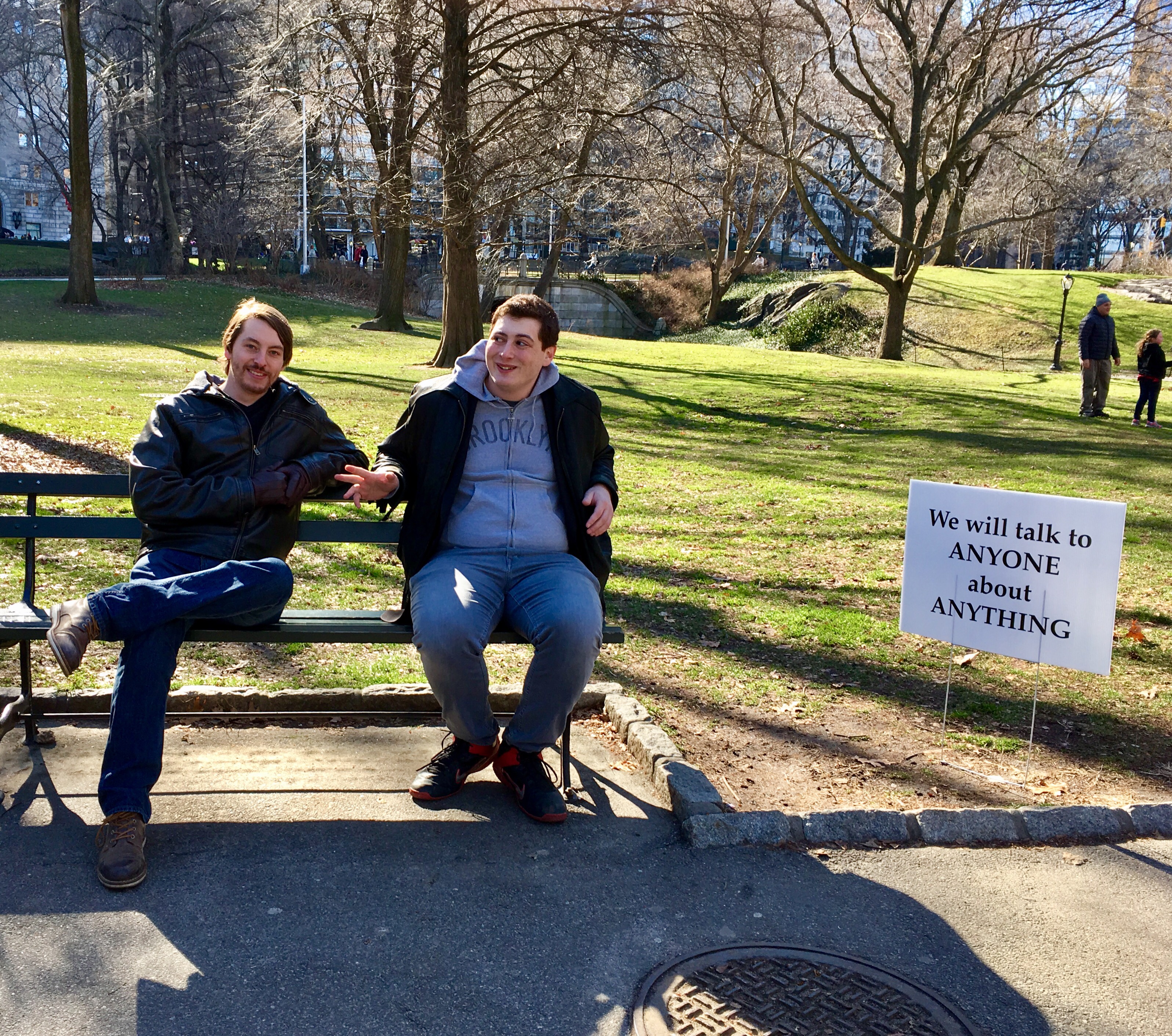
Perhaps more compelling, however, was another human-made object: The sign in the picture below.

img_3402

At first I grinned but walked by, not really sure if I wanted to engage in any sort of discussion with strangers. I’ve been trying really hard to meet people lately, but that still takes effort and I was feeling pretty good on my own. So I walked on by.

But I couldn’t stop thinking about that sign. Anyone? Anything? Really?

I turned around and asked the three gentlemen (yes, I know there are two pictured above) for permission to take a photo of them with their sign. After graciously posing, they asked if I wanted to sit and talk.

When I first moved to New York, my best friend told me that the best advice she could give me was to say yes to things. So I did.

For about 15 minutes, I sat between Sean on the left (or maybe it’s Shawn – apologies for not asking!) and Jared and chatted. Steve did some audio recording during our conversation to conduct a sound test for the web series they’re working on. One thing I do love about New York is that people are always up to something interesting. I always have a lot of questions about what’s happening and why, and was glad for the chance to ask some of them.

Jared asked what was on my mind and I mentioned politics because I’d been listening to a Sam Harris podcast on my way through the park. We chatted about that for a while and then our conversation switched to the experiences they’d been having when trying to engage people in discussion. We talked about how reluctant many people are to having a face-to-face conversation. People are very vocal about anything and everything on social media but talking in person is much more difficult. There’s a real vulnerability in sharing yourself with others. Despite how important authenticity is to me, which is one of the reasons I try to be pretty open on this blog, I probably would have walked away after taking my photo had these guys not said, “Want to have a seat and talk to us?”. Connecting with people requires a deeper level of engagement and commitment than a Facebook post, blog post, or tweet. It requires looking into someone’s eyes and saying what’s on your mind. That can be hard.

After my chat with Sean/Shawn, Jared, and Steve, I continued my Central Park walk with a feeling of buoyancy and euphoria. I had just sat on a park bench between two men I had never met and we’d had a perfectly lovely conversation about politics, the news, and the importance of being able to talk. I was glad to find openness and receptivity, which seem like scarce commodities in the often isolating world of New York City. The more I open up to people, however, the more I find that they do the same in return. So maybe that isolation is a shield, or a defense, for many of us. Maybe there’s a real desire for connection that isn’t being met because vulnerability is scary. Maybe the aloofness of many New Yorkers is just a mask.

I told Sean/Shawn, Jared, and Steve that I keep a blog and asked if they wanted me to share any contact information for them. So here it is! They mentioned that they were hoping someone would have a seat on the bench and just spill their heart out. So, gentle readers, if any of you want to talk to someone willing to listen, I can recommend three men on a bench in Central Park. I’m glad they asked me to stop and chat and I’m glad I said yes.

Gentlemen, thanks for making my day.