
Tag Archives: Honesty

Partner Check

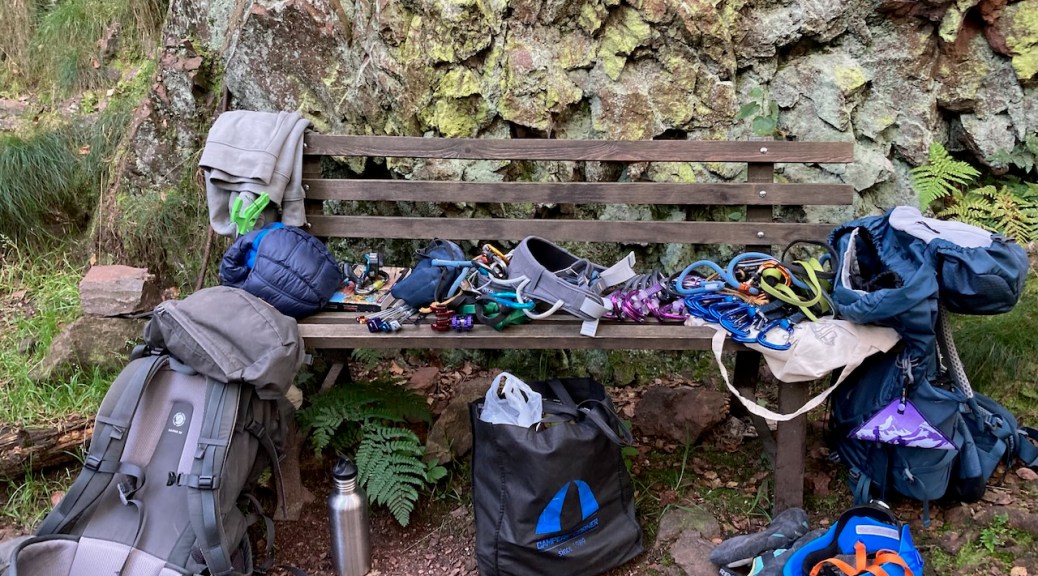
Climbing is a partner sport. There’s someone at the other end of your rope, someone whose life is in your hands and who is holding yours just as carefully. It requires communication, trust, and honesty – if I truly can’t climb something, I put us both in danger when I claim that I can. Likewise, if you are climbing, I’m watching the rope and it’s on me to tell you when it needs a quick tug to avoid a snag that could be dangerous.

In climbing, a partner check takes place every time one ties into the rope and the other clips in a belay device. We both look at your knot and we both check that my belay device has been set up correctly, that it brakes where it’s supposed to, and that the carabiner holding everything together is locked. Every time.

But sometimes we make mistakes. We take it for granted that this is something we’re used to doing and we forget. Sometimes we catch these mistakes before the climber gets off the ground. A quick, “Hey show me your knot” could be the difference between a fall and something much worse.

But sometimes we make mistakes. My climbing partner decided to follow a route in the climbing hall one day, meaning another climber had set up the rope and it was already hanging when she tied in. She climbed the route and I let her down. I had unscrewed my carabiner and was taking my belay device off my harness when she looked at me, face white, and said, “I didn’t finish my knot.”

I was horrified. She showed me where her half-completed figure eight had pulled tight onto itself as she climbed, how it had held fast even though there was every reason it might not have done that. She hadn’t finished her knot and, in making sure we were situated on the correct side of the rope as she got ready to follow the route, we had somehow skipped our partner check, therefore failing to notice.

We got damn lucky.

We apologized to each other immediately and continued to climb shortly thereafter, making an exaggerated show of doing our partner check. The friends there with us teased, but followed suit. Climbers do a partner check every time – we had just missed it that time.

And all it takes is one time.

Everything was okay, and we’ll never make this careless mistake again. To make ourselves feel better, we reasoned that we had now effectively saved our entire climbing group. But we know it could have had a very different outcome. We slowed down a little, went through the standard procedures as a matter of fixing them into the motion of our bodies, and kept climbing.

Nobody’s perfect, and that’s why I’m writing this post. Please do your partner check. Everything depends on it.

Thuringian Forest – September 2024

Three Right Things

Many, many years ago, the father of a dear friend told me, “You know, Becca, you need to make sure it’s the right person in the right place at the right time.” I don’t remember the context, but I remember being in the kitchen at the family’s home, one of those wonderful places that never seems to change, no matter how many years go by. I’ve forgotten everything else about that moment, but I’ve always held onto those words.

That’s what was in my mind when I received a call full of uncertainty and doubt. And after listening and affirming what I’d heard, that’s what informed my response. The voice on the other end remained doubtful and uncertain but sounded a little less torn, a little less fraught.

After hanging up, I thought about what I’d felt in my body while we talked; you’d told me what you were feeling in yours. The equanimity I had experienced and continued to experience assured me that I’d given the most honest answer I could, and I believe you heard that.

I hope your mind quieted and that you slept softly. To look around, consider whether the circumstances are right, and make a choice can be scary – and that’s how we know it’s important.

Saying “I’m Sorry”

A brief introduction to this post: I have been thinking a lot about growth lately. After reflecting on past experiences, I have watched myself act in ways that demonstrate that I have actually learned something. This has been critical but is not always comfortable. It is difficult to put myself in a position of vulnerability, but it is also the only way that I can live up to the pictures I paint on this blog. I am grateful for what I have learned and for all who have taught me. To those who were gracious enough to give me multiple chances, to those who heard my awkward apologies, to those who looked me in the eye when looking back was the hardest thing to do: I am still sorry and I thank you.

I am sorry . . . .
if
that
but
you

I thought . . .
meant
didn’t

But you . . .
and so
it’s just

I guess . . .
next time
differently.

It can be hard to apologize. It can be hard to admit that we were wrong, that we hurt someone else, that we misunderstood or misinterpreted or made a mistake. It can be hard to acknowledge that we didn’t behave in the ways that we should have and that our behaviour was harmful.

To apologize means to stand before another person and admit to being fallible, to having erred, to being human. It means wanting to do better and, significantly, taking the steps necessary to do so. To apologize means asking for forgiveness, and asking for forgiveness, we often think, means handing someone else power.

And that is scary.

I’d like to offer something else here: Saying “I’m sorry” and then acting upon what it actually means to be sorry is not only an act of courage, but also an act of recognizing the humanity inside someone else.

Saying “I’m sorry” acknowledges that a wrong has been committed, that a relationship has the potential for being repaired, and that this is work we want to do. And we cannot do it alone.

To come together and rebuild takes not only compassion, but also grace. It takes setting aside ego and hierarchy and control and everything that separates us, and requires us to sit down together and acknowledge, perhaps for the first time, that being human can hurt and that humans cause hurt.

Saying “I’m sorry” recognizes that maybe we are too far gone, and that maybe the gulf is too wide to cross again. Maybe the trust that was once between us has shattered into too many pieces to reconstruct. Saying “I’m sorry” admits that this might be possible.

And this is scary.

But it also might be the only way to move on, even if we aren’t moving on in the ways that we’d hoped. Sometimes life goes that way.

Given that our current cultural obsession with the self has created personalized environments in which each individual is at the centre, it is no wonder considering another perspective is challenging. After all, there are no other perspectives. It is no wonder that discourse and dialogue are anathema. After all, we “cancel” those with whom we disagree. To change one’s mind, which is what happens when we learn, is to flip-flop; to apologize is to capitulate, roll over, show weakness.

There is a great deal wrong here.

A genuine, heartfelt apology carries with it the possibility of making the world a better place. It is an act of building peace in our interactions, relationships, and everyday encounters. This is a powerful thing. No one ever said something so important was easy, though it might be easier than we think. Many things are this way when approached with honesty and openness rather than suspicion and competition.

Sometimes we are wrong, but we can mend those wrongs. This does not mean the harm disappears, or that everything goes back to the way it was before. It means that we forge new paths and learn new ways. We are marked by our experiences, and this is how our lives are constructed.

Treat others the way you want to be treated, or the way they might want to be treated.
Be kind.
Take a deep breath.
Do the hard thing.
Hold out your hand.

If we continue building this world into a better place, there will be someone there to take it.

Weimar, Germany – August 2021