Tag Archives: Humanity

What makes a man?

“Alexander Hamilton,” my friend declared after listening through Act Two of the musical, “was not a good man.”

Well. That depends. If we’re judging the measure of a man by his faithfulness to his wife then no, Alexander Hamilton was not a good man. And neither were Martin Luther King, Jr., John F. Kennedy, nor Albert Einstein. All of whom, I would argue, are key figures in building the world we live in today and who did more good than anything else. But to say they were not good men because of marital transgressions seems to unfairly dilute and discolor their legacies as individuals who built a world.

Yet, my friend’s comment leaves me wondering: What makes a man? What makes a woman? More importantly, what makes a good man or woman?

Is a good man one who puts his family or his wife first? To me, that sounds like a good father or a good husband.

Then, what is a good man?

Is a good man someone who puts work, money, and providing before everything else? To me, that sounds like an employee or employer, a breadwinner, a producer.

And I continue to wonder, what is a good man?

Is a good man someone who has ideals, stands for them, writes them, shouts them from the rooftops? That could be an orator. That could be a leader.

It seems to me that all of these characteristics comprise the entirety of a man, just as they also comprise what makes a woman.

So what is it about people who stray, who are unfaithful, who seek a plurality of relationships of varying types and intensities that puts them in the “not good” category?

I wonder about that.

And I wonder about the other categories that we all fall into. I’m an educator, a daughter, a sister, a friend. I’m a runner, a yogi. Once upon a time, I was a dancer, a singer, a girlfriend. Do any of those things make me a “good” woman? What is a good woman? Is a good woman different from a good man?

And so back to, what makes a good man?

I’d argue that we need a social conversation about our goals for the people that we are developing, the people that we are creating. I’d argue that what makes a good man or a good woman can be discussed as simply, what makes a good person? 

We want people who care about other people. We want people who work for sustainable worlds built on justice, happiness, security, and increased well-being for all. We want people who care about those around them and who are willing to put others first and do what is right for the good of the whole. That seems to me less about being a good man or good woman and more about simply being a good human.

What makes a good man? What makes a good woman? That depends on who you ask.

What makes a good human, at least as far as I’m concerned, is the much more important question.
 

Free Hugs

A few days ago, I was walking through Union Square and saw a cluster of people (two men, two women, multiple races, 20s or 30s) holding signs that said “FREE HUGS” in large, colorful letters.

Before even actively thinking about it, I knew I was heading straight for the people with the signs.

I walked towards a man with a bushy brown beard who asked, “Need a hug?”

I made a sound that was somewhere between an embarrassed chuckle and a nervous giggle and replied, “Yeah.” (Truth be told, I can really always use a hug.)

We hugged, I thanked him and wished him a great day, and he sent me on my way with a sticker.

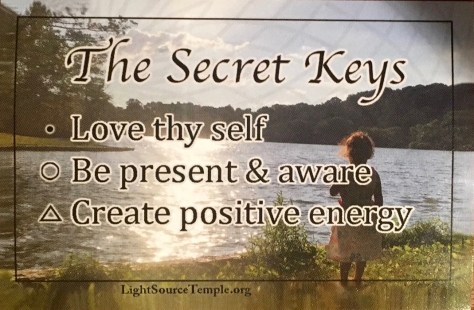
IMG_0598
Pretty good advice! Though not so secret if now printed on stickers.
Of course, I thought, noting the URL in tiny letters. Does anything simply come from the goodness of the heart? But then I looked up LightSourceTemple.org. If you’ve clicked on the link, you’ll notice what I noticed – the domain has expired. LightSourceTemple.org doesn’t exist.

So why give out free hugs? For a laugh? For fun? A dare? A cult initiation? Or because the world can be really hard and sometimes people just need hugs?

While I can’t answer what those four people in Union Square were aiming for, I can explain why I not only accepted the free hug, but also wanted it.

I believe very strongly that there is a lack of physical human connection in our society.

I’ve thought about this a lot but it struck me anew when I was recently in Israel with our eighth graders. After just a day away from school, in a completely different environment, open affection was acceptable and the norm. Even more illuminating, much of this behavior came from the Israeli staff who we met on the first day of our trip. It was perfectly fine to drape an arm over a colleague’s shoulder for no apparent reason. It was fine to say good morning with a kiss on the cheek. A touch to someone’s back was simply a way of saying hello.

We don’t do enough of that in the US.

While in Israel, I read Dacher Keltner’s Born to Be Good, which contains chapters on smile, laughter, touch, and love, among other things. He writes about oxytocin and its effects on our behavior, attitudes, and relationships. Humans need positive physical contact in order to bond, trust others, and feel happy. In more than one place in his book, Keltner blames the Puritans for the lack of lack of physical touch in American culture.

I mentioned the book during a conversation just before walking through Union Square and seeing the free hugs signs. A friend was talking about his frustration with the repressive nature of American society and how we don’t really permit deviating from the prescribed course of action (school, more school, job) to allow for authentic personal growth or exploration. Thinking of Keltner, I suggested use of the word “Puritanical” to describe typical American attitudes towards uncharted paths and lack of conformity to the few molds we have deemed acceptable.

All of this was on my mind when I walked through Union Square a couple days ago. Though the free hugs people don’t know it, they appeared with their signs at just the right time for me to say yes to their hug.

As a rule, I try to be as open with and responsive to others as I can. Accepting and being truly delighted by the free hug was just another way of trying to form a connection, however brief, with someone who was willing to be open, responsive, and vulnerable to those around him. Back in February, I sat down to talk to three men on a bench in Central Park for the same reason. When a college student who started a conversation with me at a nail salon last week asked if she could interview me for a school project, I gave her my phone number with true pleasure. I’m trying to make the world better, one positive interaction at a time.

We are all humans. Whether we like it or not, we are all in this together. If we can’t reach out and touch one another, what’s the point in living at all?

Let’s Talk About Sex: Part Two

I recently spotted this month’s issue of Glamour in the waiting room of my doctor’s office:

Screen Shot 2016-07-31 at 10.08.03 AM

There are a number of really invigorating, inspiring aspects to Glamour, including the Woman of the Year Award and a feature about college women around the US who are extraordinary in their community service, academics, and career achievements. Glamour supports and cultivates strong women, which is empowering to girls and women of all ages and walks of life.

However, I had a real problem with one of the headlines from this particular issue. Any guesses? Bottom right corner. This one:

Screen Shot 2016-07-31 at 10.08.21 AM

My problem with this headline is not that it uses the phrase “woman card” (what does that even mean?) but that good sex is labeled a “right” at all.

Yes, everyone should have good sex all the time. Yes, women (and men) should feel cherished, loved, adored, cared for, protected, and desired by their partners.

But that’s not a right. As I’ve come to understand it, any form of real intimacy is a product of open, honest human connection. In my experience, good sex doesn’t just happen. It develops through trust, reciprocity, mutual admiration, and the desire to make a partner feel everything you want to feel. Intimacy, then, is about acknowledging and accepting your own humanity.

When I first mentioned my frustration with the headline to my mum, she pointed out that Glamour writes for a wide range of women, and many older women have grown up with very different attitudes towards sex. When sex is viewed as a marital duty and obligation to which women submit because that’s what men want, it’s a very different conversation.

Thinking about girls and women today, however, makes me wonder whether that narrative has changed. Do we still think of intimacy as male-dominated and male-oriented? Are women viewed as a second thought? We tell girls and women to be careful how they dress so they don’t attract too much attention; do we tell boys and men to treat girls and women with the respect that they, as human beings, unequivocally deserve? There’s a lot in the media and even in the news that indicates that sex, as told by pop culture, is very much the domain of men.

That’s a problem. And that’s why I propose changing the conversation. Here are some questions that I’m considering. I’d love any and all thoughts and feedback!

  • How can we talk about sex as a product of human connection?
  • Does the nature of intimacy change if we see it as the natural result of deep feelings of care, respect, openness, reciprocity, and mutuality?
  • Can we have a conversation about intimacy that centers on the feelings and actions that lead up to it?
  • If anyone has a “woman card” at all, it’s a product of being human. How should we make human-ness, rather than divided roles as men and women, part of a better conversation?
  • What messages should we be sending young people about intimacy that are not currently transmitted?

If intimacy provides opportunities for us to be our most vulnerable around one another, we need dialogue about what makes us human and how we seek connection with those around us. That’s what I see as missing from that headline.

PS You can take a look at my first post about sex here.