Tag Archives: Judaism

So Long, 2015!

On New Year’s Eve, the clock strikes midnight and a new day starts. And that’s about it. I was about 10 years old the first time I was allowed to stay up to watch the ball drop, and I was sorely disappointed. The adults kissed, sipped champagne that no one wanted, turned off the TV, and ushered us kids up to bed. Happy New Year.

People in a variety of lunar-based religions and cultures around the world ring in a new year at different times, and follow different calendars that track different years. The Jewish new year celebration, Rosh Hashanah, takes place in the month of Tishrei (usually September or October) and this year we welcomed 5776. The Islamic calendar has changed a bit in recent years, but the new year often falls in October or November. Chinese New Year usually falls in January or February, and this year will be the Year of the Monkey.

However, most people live their daily lives on the solar Gregorian calendar, which has decided that December 31 is New Year’s Eve and that 2016 begins on January 1. Parts of the Western world adopted the Gregorian calendar in 1582; it replaced the Julian calendar, reforming leap years, leap days, and certain Christian holiday observances. As with any change, switching to the Gregorian calendar did not happen over night. Europe’s majority Catholic countries (Italy, Spain, Portugal) were the first adopters, with China waiting until the revolutions settled down in 1929. And because of time zones, we all ring in the new year at different times over a period of 26 hours. Yes, 26. Because not all countries have daylight savings time. Samoa and Christmas Island are the first countries to enter 2016 and most of the US Minor Outlying Islands are the last.*

As I wait for 2016 to cross over into Eastern Standard Time, I generally like to think about what I’ve done over the course of the past year, as well as what I hope to do in the coming year. I’m not one for New Year’s Resolutions, mostly because I’m stubborn and make commitments to myself on a regular basis (and then, because I’m stubborn, actually follow them). That being said, I have goals. While I’m not going to share them on my blog, I will write them down in my journal so they’re documented for the sake of progeny.

In the meantime, today is just another day – with a big party and a whole lot of glitter at the end.


*The information in this paragraph comes from this website. (I am forever reminding my students to cite their sources and feel guilty when I don’t do the same.)

Choices

I’m Jewish.

Among other things, that means I celebrate holidays that most people can’t pronounce. That also means my holidays aren’t included on most calendars. As a student, I always had to inform my teachers of the days I’d be out for Rosh Hashanah (New Year) and Yom Kippur (Day of Atonement). I was lucky in that I never had to explain myself; my teachers were aware of a) the existence of my holidays and b) my need and right to miss class to practice my religion.

When I moved to Malaysia, I wasn’t allowed to be Jewish. I wasn’t able to practice my religion. I had to go to work over Rosh Hashanah because I wasn’t allowed to miss work without medical documentation; I certainly was not going to spend the holiday in a doctor’s office faking stomach cramps. Yom Kippur fell on a Saturday, and while I couldn’t go to synagogue, I could pray on my own.

Now that I’m in Singapore, I had (note the past tense) different expectations. Considering the amount of diversity here in Singapore, particularly the diversity in an international school with a student body from over 60 countries, I did not anticipate having trouble obtaining recognition of my religious rights and freedoms.

But I’m having trouble.

My school does not allow paid sick days until the fourth month of our contracts, which means that I can’t be sick and get paid until November 1. This is ridiculous for multiple reasons, but mostly because we work with kids, all of whom are sick right now. That aside, I checked with HR to see if I could take time off and be paid for religious reasons in the first three months of the school year. HR said no, but a colleague encouraged me to take the question to the superintendent. In what I think was a very well-worded email, I expressed my disappointed with HR’s response and explained how upsetting it is to choose between pay and adhering to religious principles. I went as far as to “respectfully ask for a reconsideration of this policy.” (I didn’t point out that we have Christian, Muslim, Hindu, and Buddhist holidays off, which probably covers 99% of staff.) The superintendent assured me he would discuss it with HR and get back to me.

Two days later, I got an email apologizing and saying that school was unable to adjust the policy because, in a multicultural environment, they did not want to be seen as favoring one religion over another.

I didn’t point out that they were doing exactly that simply by following the existing calendar.

I didn’t point out that this wouldn’t be an issue if the holidays fell later in the year when I could take paid sick days.

I didn’t point out that I am now being treated differently than other members of staff.

I didn’t point out any of that because there’s no point. School has clear made a decision, and that decision reflects who the people in charge are and what they seem valuable. At least I have the satisfaction of knowing that the query is now on record and it might help someone else in the future. I do feel discriminated against and I do feel misunderstood. While I understand the need for consistency in HR policies, I also understand the need to treat everyone fairly.

Fair, however, does not always mean equal.

Travel Guide: Republic of Singapore

Being in Singapore with Mitch this weekend was a blast. It was also rather useful because Mitch has been there for a grand total of 12 days, which practically made him a local. He knew where we should eat and drink, which MRT (Singapore’s metro) stations would lead us where, which parts of town I should see, and how to get there.

Everything I’d heard about Singapore turned out to be true. It’s almost uncomfortably clean, people queue for everything, it’s incredibly safe, there are trees, plants, and parks everywhere, and it could easily pass for a Western city. The population is very diverse and all signs are posted in four languages: English, Bahasa Malay, Mandarin, and Tamil.

I really love the juxtaposition of traditional and modern that one sees all over Singapore

I arrived in time for a late dinner and drinks Friday night at a Japanese craft beer bar in one of Singapore’s many outdoor food courts. This one had restaurants serving cuisines from all over the world; we saw French, Italian, Irish, Japanese, and American eateries under brightly colored awnings next to a park.

P1040405

A quest for brunch on Saturday morning led us to Mark’s, a restaurant specializing in chocolate. (Yes, you read that correctly.) Patrons ordering a simple cup of hot chocolate choose from a list of chocolate-producing regions from around the world. The chocolate in Mitch’s hot chocolate came from Cuba! The other item in which Mark’s specializes is waffles! We got a “plain” waffle with real maple syrup and a cheese waffle with salad, eggs, and oranges. Yummy!

P1040410

P1040412

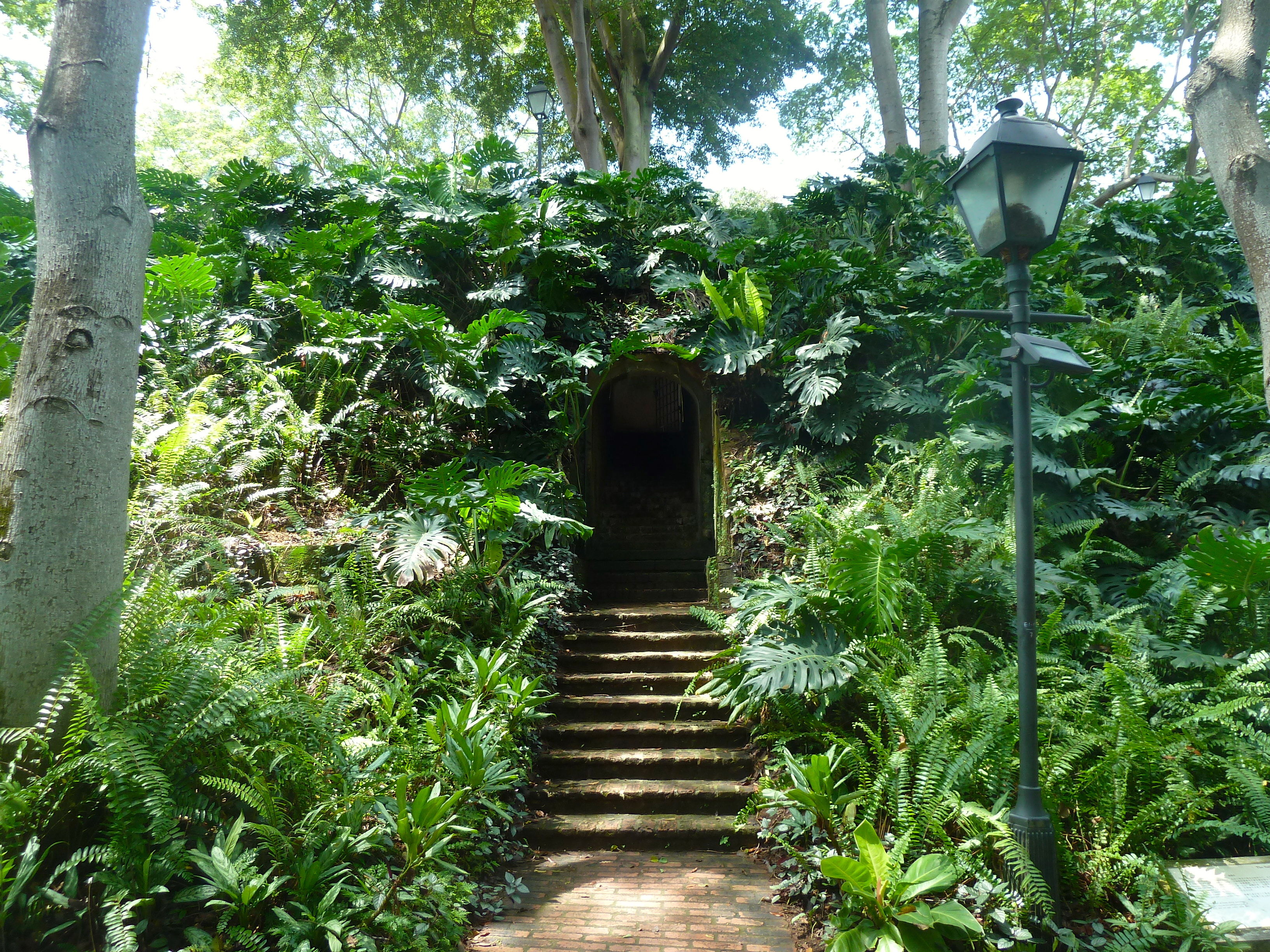
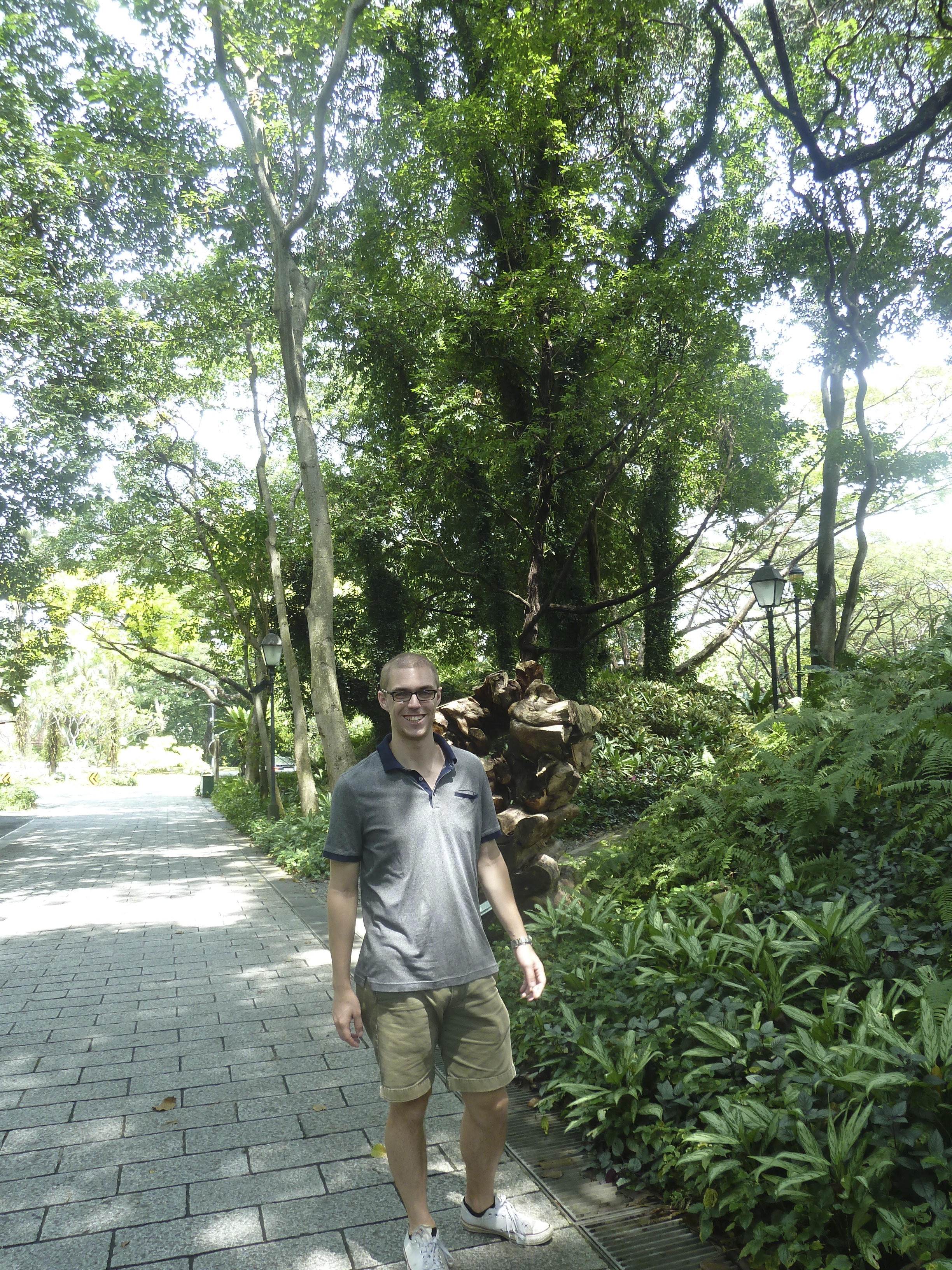
We spent a bit of Saturday morning wandering around Fort Canning Park on our way to the National Museum of Singapore. The park was lovely and had a really beautiful fountain that actually wasn’t on because the city is in a bit of a drought. Welcome to Southeast Asia.

P1040417

P1040419P1040420P1040421

The National Museum’s permanent galleries are closed for renovations until September 2015 (depending on how all of this works out, we might still be in the area) but there was a really interesting exhibit on the history of Singapore that I believe was a smaller version of one of the permanent exhibits. I knew next to nothing about Singapore before spending several hours walking through the exhibit. For example, one of Singapore’s earliest kings in the 1200s was a relative of Alexander the Great! I’m ashamed to admit that I didn’t know the Japanese were in control of Singapore during World War II and I didn’t know anything about Japanese wartime propaganda. Now I do and I’m glad we had the chance to learn!

Mitch introduced me to the gem of ABC juice. ABC stands for apple, beet, carrot and the juice is made out of those three ingredients blended with ice. One buys juices like that at stands like this:

P1040425

We spent some time exploring Chinatown on Saturday . . .

P1040426 P1040428 P1040429

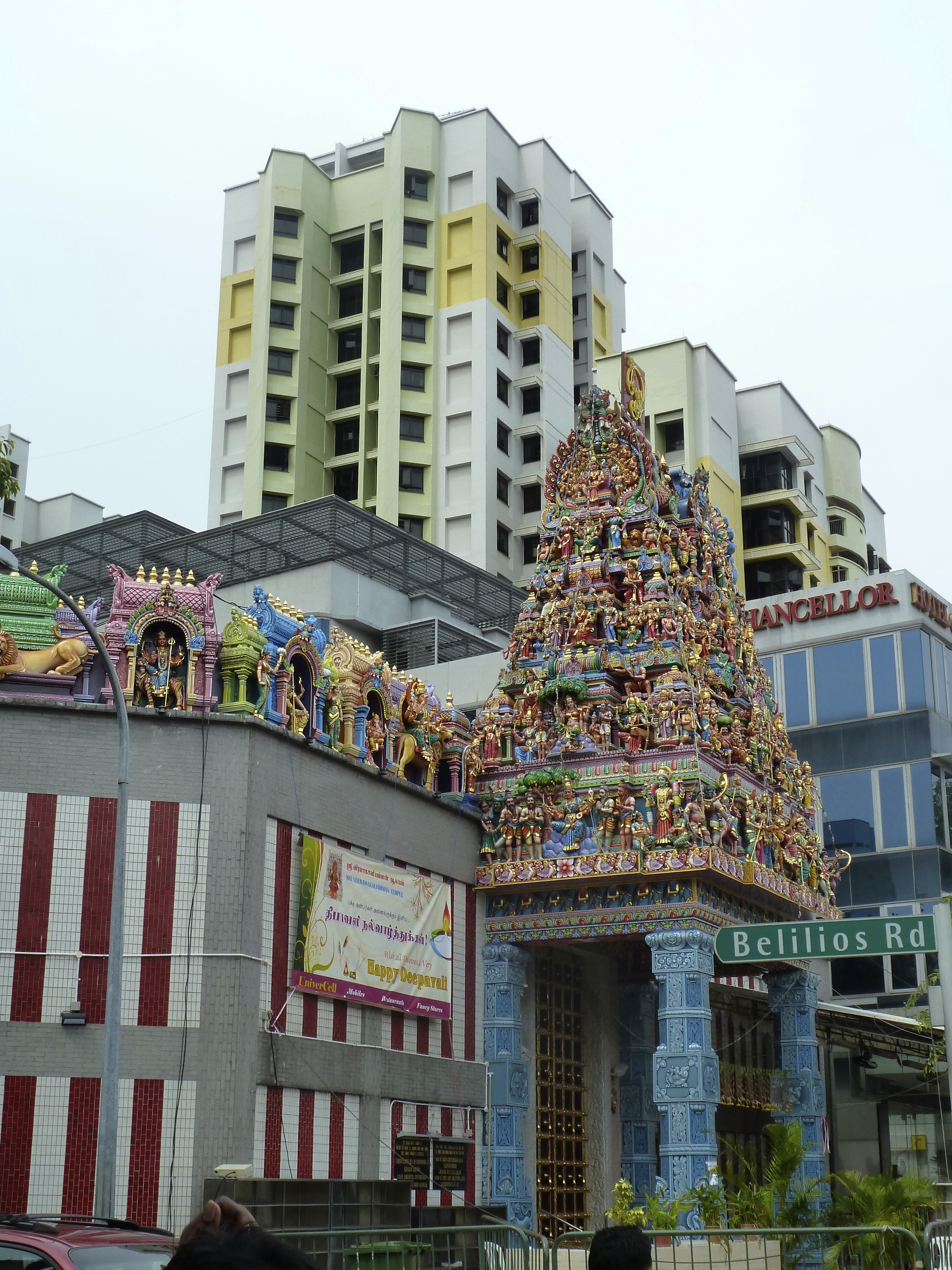
And Little India on Sunday . . .

P1040439P1040440

The socioeconomic differences are pretty obvious. Chinatown is definitely more affluent and the bigger attraction, definitely for tourists and possible for locals just based on location. However, every third restaurant in Little India is a vegetarian restaurant, which was both shocking and amazing. (Why is is that there are Chinatowns and Little Indias all over the world? Why not Little China and Indiatown?)

We made our way down to Marina Bay on Saturday, as well.

P1040431

In addition to the financial district’s tall building and the boats on the water there was a display of Christmas trees right next to the palm trees that are actually natural to the region. It made me laugh.

P1040430
Christmas in July! But not . . .

Other Singaporean adventures took us to a British pub, Red Dot Microbrewery (the best beer I’ve had since leaving the US), the club Zouk for a guest DJ show, and a restaurant called Strictly Pancakes (I had pancakes stuffed with leeks and potatoes and topped with mushrooms and cream cheese).

We also came across this building:

P1040441P1040442

Google was only marginally helpful in telling me who David Elias is, but I’m quite curious as David and I share a name . . .

Moral of the story: Singapore is interesting, exciting, cultural, modern, traditional, and very liveable. I can’t wait to go back!