View from my hotel room
I’m in Tel Aviv right now on a free weekend while the students are off at host families. I spent the day at the beach, which was beautifully relaxing and rejuvenating. We will be on a plane back to the US mid-week.
Over the last 11 days, we’ve had a stomach virus, several versions of the common cold, a camel bite, two sprained ankles, and dehydration. We’ve seen old friendships fracture and new friendships develop. We’ve crossed the country and spent time in the mountains, desert, and three bodies of water. We’ve met new people and learned about ourselves and others along the way.
Being on this trip with students, like doing anything with students, requires a level of confidence that I don’t normally have about my own life. It means being optimistic even when I’m anything but hopeful, calming when my own stress levels are high, and compassionate when my patience has completely dissipated.
Although the kids are constantly asking about what’s next, I try to remind them to focus on and enjoy what they’re experiencing now. Emphasizing mindfulness and gratitude for what there is now has been a helpful reset in my own mind, as well. For a change, I’m trying to figure out my own next steps. I’ve always been a planner and I’ve watched the plans I’ve made fall to pieces again and again. What has remained, however, is a feeling of serenity and internal peace when I am able to push the plans aside for just a moment. Those are the feelings I have been trying to help my students find on our whirlwind tour of Israel.
Today, think about today. Tomorrow will come when it’s time, regardless of whether you’re ready. Enjoy this moment for as long as you can hold it in your hands, and take that feeling, learning, and sense of awe with you to the next moment. Feel what you’re feeling, not what you think you should be feeling. Embrace the thoughts that come, recognize that they’re there, and use those thoughts to put yourself in a place where your current experience guides what happens next. Tomorrow will come when it comes. Now is already here.
And then my eighth graders asked some questions and I realized I was missing an opportunity to explore the complexity of what it means to be a woman and educator in today’s world.
As my students noticed, I did not participate in A Day Without a Woman on Wednesday, March 8. I did not participate in the demonstrations in New York City. Instead, I went to work.
This lack of participation is a sharp contrast to my activism in the Women’s March back in January, and my students were curious about it. Many of my eighth graders read this blog (and ask me about it in class when they’re supposed to be working on other things) so this post is for and because of them.
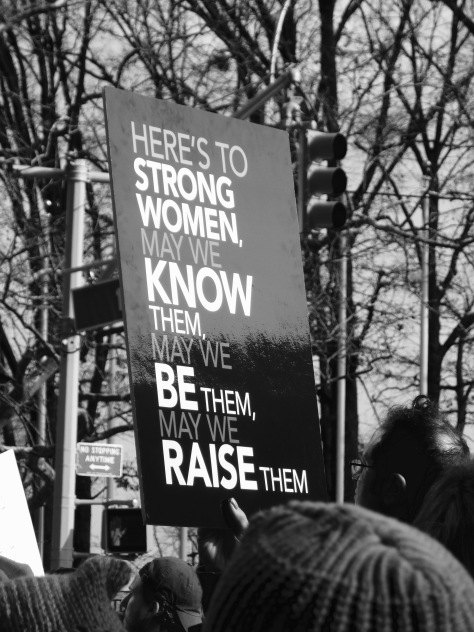
My favorite sign from the Women’s March in January
The Question
A number of my students come from households that talk politics. Some of them come to class echoing their parents’ conservative or liberal views, others come with questions, and still others want to be involved in the conversation but don’t know where to start. I don’t openly discuss my political views with my students, but I’m also not completely closed off when political questions intersect with deeply held personal views.
On Thursday, March 9, the day after International Women’s Day, two young women who usually present very different political narratives quietly and separately asked me, “Why were you here yesterday? I was expecting you’d be at a protest.”
I was surprised because I hadn’t even considered skipping school to demonstrate or protest. My identity as an educator is such that I feel a sense of moral responsibility in being there for my students to guide their learning. That is what I tried to convey in my answer to both of those young women on Thursday.
The Answer
That’s a really good question. The way I see it, my job is to make sure that you’re learning. I know that I can best do that when I am here helping you learn and guiding you along. When I’m not here, I have to leave that task to someone else. Yes, someone else can do it, but I know what my goals are for you and I know what I’m doing to help you reach those goals. My not being here is potentially harmful to your learning. So, to be the best teacher I can be, it’s important to me to be here with you.
I understand why some women made the choice to protest. I understand why it’s important to show the country what happens when women are silenced and shoved aside. But I think that an alternative way to demonstrate that is to be here with you and talk about it. So I support those women who didn’t go to work. I support their decision to make their absence felt. It just doesn’t fit with my job right now. I have a different agenda, which is to do what’s right for you.
The girls nodded. Both expressed their surprise and understanding. One of them told me she respected that decision.
In truth, the more I think about it, it’s far more complicated than that.
The Challenge
The challenge for me is to “talk the talk and walk the walk”. It’s all well and good to say that I support women who took time off work, either paid or unpaid, to stand in solidarity with other women on Wednesday. However, I did not take time off work. I did not physically stand in solidarity with women. Do my actions speak louder than my words? If so, do my words of support still count?
If I want to be a role model for my students and do what is right, am I obligated to stand up on behalf of women and join them in protest? Or is sticking to my beliefs about education modeling in itself?
I’m not sure.
I could be giving myself far too much credit as essential to my students’ learning. I know they could have gotten through a day without me and that the day would not have been a loss. So maybe I’m not as important as I think I am, and maybe I could have had a greater impact missing school and joining a protest.
Similarly, there are definitely things I could have done in class on Wednesday to draw attention to A Day Without a Woman. I could have addressed it explicitly and discussed the history of women’s protest with my students. I could have asked if they knew anyone participating. I could have pulled opinion pieces and even footage of protests and demonstrations and we could have had a class discussion on the purpose and effectiveness of protests.
Picking a Side
In truth, I didn’t think about it. Perhaps I should have. Perhaps this was a lost opportunity and my students and I all missed a valuable learning experience. Perhaps this was not simply a matter of another day at school.
Unfortunately, I think that’s all too common in schools. I think we often miss valuable learning experiences because we’re tied to other priorities, whether those are selected for us or by us. I don’t know if I made the right choice in going to work. I don’t know if I made the right choice in spending the day on “normal curriculum” instead of digging into protest in America or wage inequality or women’s issues around the world.
I do know that I’m walking a line between political and personal identities and I’m having trouble finding a bridge. I feel like I’m coming from two almost opposing camps and I don’t always know where they should intersect.
On Wednesday, I chose to go to work and do my job because I felt like it was the best thing I could do for the young people under my care. Yes, there are others who care for them. But I can only control what I do and the messages that I send. It was more important for me to stand by my promise to be present with my students than it was to embrace my role as a woman and skip school that day. At this point, all I can do is recognize that choice for what it is and perhaps consider what other options I might have in the future.
Eighth graders, you ask good questions. Keep doing that.
In just a few days, I’m joining the eighth graders on their two-week B’nai Mitzvah trip to Israel. I’m excited to share a country I love with students who have never seen it, glad to experience it again with colleagues who have visited often, and curious to hear yet another narrative about this land that generates so much passion from all sides.
I’ve written about Israel before and I’m interested about what stories will and will not align with my evolving views on peace and war. I’ll get back to you on that.
Recently, I heard a Hidden Brain podcast about the Israeli-Palestinian conflict that provided an update on two men featured in a previous episode. The 30-minute update, which you can listen to and understand without the original story, is here:
If nothing else, begin listening at 22:38. Podcast host Shankar Vedanatam leaves listeners with a scene from Westling Jerusalem, a one-man show that reflects the multidimensional relationships between Arabs and Israelis and provides even more complexity to a persistent problem. The soundbite from the show is about 6 minutes long and, I believe, worth your time.
There’s a lot of work to be done in this world. I’m hopeful that this trip will instill in my students the need for such work. The world needs fresh minds and clear heads.
There are only two days in the year that nothing can be done. One is called Yesterday and the other is called Tomorrow. Today is the right day to love, believe, do, and mostly live. – The Dalai Lama
Photos, travels, musings, and ideas on education by someone trying to make the world a better and more peaceful place



 By Rebecca Michelle