Category Archives: On My Mind

My 2017 Reading List

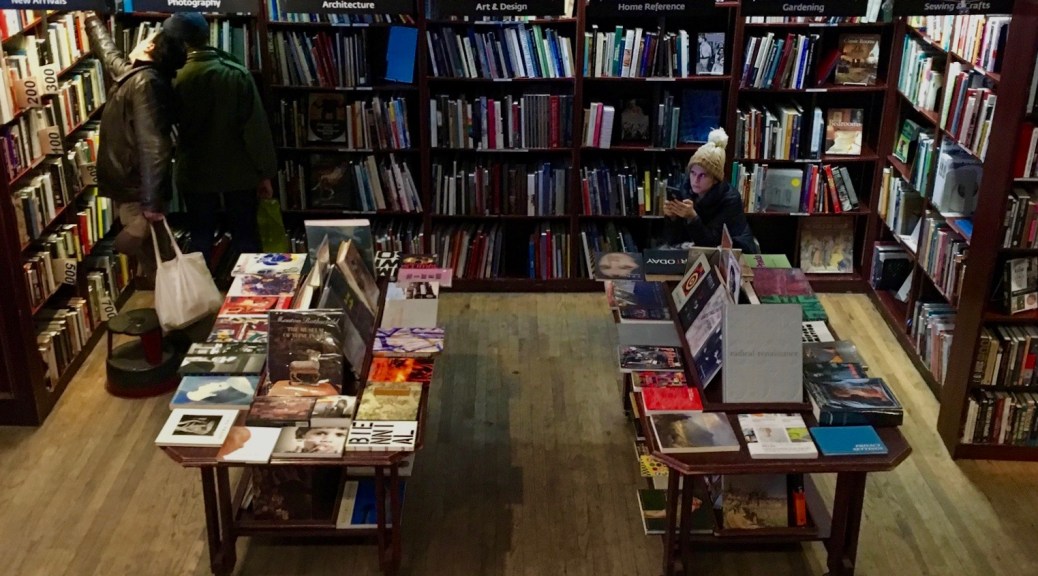
Another year gone and more books in the, well, book! My list of 2016 reads sparked some conversation with people in my life and finally convinced me to get on Goodreads, so I wanted to share this year’s list, too. The lists are in alphabetical order by title and grouped into nonfiction and fiction categories.

Nonfiction
Behave: The Biology of Humans at Our Best and Worst
Robert Sapolsky

The Better Angels of Our Nature: Why Violence Has Declined
Steven Pinker

Between the World and Me
Ta-Nehisi Coates

The Black Swan: The Impact of the Highly Improbable
Nassim Nicholas Taleb

Blended: Using Disruptive Education to Improve Schools
Michael Horn and Heather Staker

Born to Be Good: The Science of a Meaningful Life
Dacher Keltner

Caring: A Relational Approach to Ethics and Moral Education
Nel Noddings

The Conspiracy Against the Human Race: A Contrivance of Horror
Thomas Ligotti

Cosmopolitanism: Ethics in a World of Strangers
Kwame Anthony Appiah

The Courage to Be
Paul Tillich

Cultivating Humanity: A Classical Defense of Reform in Liberal Education
Martha Nussbaum

Democracy and Education: An Introduction to the Philosophy of Education
John Dewey

Emotional Agility: Get Unstuck, Embrace Change, and Thrive in Work and Life
Susan David

Empire of Illusion: The End of Literacy and the Triumph of Spectacle
Chris Hedges

Flow: The Psychology of Optimal Experience
Mihaly Csikszentmihalyi

A Fragile Life: Accepting Our Vulnerability
Todd May

Good Citizens: Creating Enlightened Society
Thich Nhat Hanh

The Hero Handbook
Nate Green

Hidden Figures: The American Dream and the Untold Story of the Black Women Mathematicians Who Helped Win the Space Race
Margot Lee Shetterly

A History of Reading
Alberto Manguel

A History of the World in 6 Glasses
Tom Standage

Homo Deus: A Brief History of Tomorrow
Yuval Noah Harari

How to Spend $75 Billion to Make the World a Better Place
Bjørn Lomborg

The Importance of What We Care About
Henry Frankfurt

The Knowledge Illusion: Why We Never Think Alone
Steven Sloman and Philip Fernbach

Life 3.0: Being Human in the Age of Artificial Intelligence
Max Tegmark

Machine Learning: The Ultimate Beginners Guide For Neural Networks, Algorithms, Random Forests and Decision Trees Made Simple
Ryan Roberts

Machine, Platform, Crowd: Harnessing Our Digital Future
Andrew McAfee and Erik Brynjolfsson

The Man Who Mistook His Wife for a Hat: And Other Clinical Tails
Oliver Sacks

Misbehaving: The Making of Behavioral Economics
Richard Thaler

Modern Romance
Aziz Ansari

Moral Politics: How Liberals and Conservatives Think
George Lakoff

Moral Tribes: Emotion, Reason, and the Gap Between Us and Them
Joshua Greene

Moving Toward Global Compassion
Paul Ekman

On Dialogue
David Bohm

On Tyranny: Lessons from the Twentieth Century
Timothy Snyder

One Student at a Time: Leading the Global Education Movement
Fernando Reimers

Philosophy in the Flesh: the Embodied Mind & its Challenge to Western Thought
George Lakoff

Political Order and Political Decay: From the Industrial Revolution to the Globalization of Democracy
Francis Fukuyama

The Portable Atheist: Essential Readings for the Nonbeliever
edited by Christopher Hitchens

Read This If You Want to Take Great Photographs
Henry Carroll

Robot-Proof: Higher Education in the Age of Artificial Intelligence
Joseph Aoun

A Room of One’s Own
Virginia Woolf

Sapiens: A Brief History of Humankind
Yuval Noah Harari

The Shipwrecked Mind: On Political Reaction
Mark Lilla

Simone Weil: An Anthology
Simone Weil

Superintelligence: Paths, Dangers, Strategies
Nick Bostrom

Thinking, Fast and Slow
Daniel Kahneman

The Tibetan Book of the Dead
Chogyam Trungpa and Francesca Fremantle

We Should All Be Feminists
Chimamanda Ngozi Adichie

Weapons of Math Destruction: How Big Data Increases Inequality and Threatens Democracy
Cathy O’Neil

What I Talk About When I Talk About Running
Haruki Murakami

What’s Worth Teaching?: Rethinking Curriculum in the Age of Technology
Allan Collins

White Trash: The 400-Year Untold History of Class in America
Nancy Isenberg

Why Buddhism is True: The Science and Philosophy of Meditation and Enlightenment
Robert Wright

The Wisdom of Insecurity
Alan Watts

Word by Word: The Secret Life of Dictionaries
Kory Stamper

World Class Learners: Educating Creative and Entrepreneurial Students
Yong Zhao

Fiction
2 B R 0 2 B – Kurt Vonnegut
As I Lay Dying – William Faulkner
Cat’s Cradle – Kurt Vonnegut
Catch-22 – Joseph Heller
East of Eden – John Steinbeck
Frankenstein – Mary Shelley
Interpreter of Maladies – Jhumpa Lahiri
Invisible Man – Ralph Ellison
Jonathan Livingston Seagull – Richard Bach
Last Night in Twisted River – John Irving
Men Without Women – Haruki Murakami
The Nun’s Story – Kathryn Hulme
Strange Case of Dr. Jekyll and Mr. Hyde – Robert Louis Stevenson
The Three Muskateers – Alexandre Dumas
Tropic of Cancer – Henry Miller

As the year turns over, I wish you a 2018 full of peace, joy, and good books. Happy reading!
IMG_0387

Love people. Cook them tasty food.

Today was the kind of day that I describe as quiet but very, very loud. Quiet because I didn’t venture more than a few kilometers from home and loud because my thoughts have been racing. There aren’t many days like these.

It’s the end of the calendar year, which means that nearly every conversation I’ve had over the last few days has led inevitably to a discussion of who’s staying or going at work. Who has resigned their contracts, who has decided to move on at the end of the school year, who’s attending which job fair, who has signed up with which recruitment agency. Who’s moving on, adventuring elsewhere, pursuing different dreams.

Even though they’re commonplace and repetitive, these conversations leave me very sad because saying goodbye is hard, and it doesn’t help to think that it’s six months away.

I went for a run today in the rain – on purpose. I figured that if I was going to cry, I might as well do it when the sky was crying, too. But I ended up laughing because I was squinting to see, jumping to avoid puddles, and absolutely soaked about two minutes in. And while laughing, I realized that I had a choice.

I could be sad because people were leaving, or I could be happy for the times we’ve spent together, the ways we’ve known each other, the laughter and ideas and conversations that we’ve shared.

And I realized it was okay to feel sad, but that the sadness would never be stronger than the joy I have felt around the friends that I’ll be sending down new roads when the time comes. Basking in that joy is what allows me to feel sadness and that’s okay, too.

My mum has a dishtowel that aptly sums up my philosophy towards the people in my life. “Love people,” it says. “Cook them tasty food.”

I’m bringing gingersnaps to work tomorrow.

Dance Class

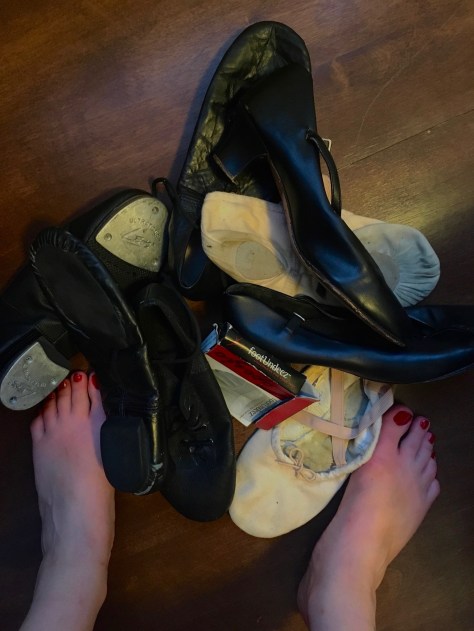
I grew up dancing. I started in dance classes when I was three, competed for a few years in elementary school (think: sequins, makeup, anxious mothers fluttering around), taught dance in high school, joined a dance troupe the first or second week of college, took a ballroom dance class for credit. In addition to ballroom, I’ve danced ballet, tap, jazz, lyrical, hip hop, and modern.

And then I stopped.

I guess other things took priority. At first I was a new teacher and grad student, and then I started spending a lot more time running or working out at the gym. I started doing yoga instead of dance because I could follow videos on YouTube and it seemed like less of a commitment when I was trying to write a thesis.

And then dance just melted away. It became this thing I had loved and had done – past tense. As years passed, apprehension and ego took over each time I thought about trying again. What if I’d forgotten everything? What if my feet slipped out from under me? What if my legs got twisted around and I turned the wrong way? What if, oh gosh, what if I was bad?

This was a concern because I used to be good, good at tap in particular. What if that was no longer the case?

But I knew that I missed it. I’d taken my dance bag with me to multiple countries and let it sit in the back of the closet, a not-so-gentle reminder of a love I’d let lapse.

Back in September, I took a step towards a new thing by starting meditation through a program at school and I learned, actually learned, what I tell my students all the time: It’s okay to be inexperienced. It’s okay to ask for clarification or advice or express uncertainty. Meditation reminded me that we all start somewhere and that it’s okay to start over.

So just last night, I took my first tap class since college. I will admit that I was nervous. I slept fitfully the night before and woke up early with a hint of anxiety just under my sternum, which is usually where I find anxiety when I (mindfully – thank you, meditation) probe for and analyze it.

But when I walked out of class, I felt like I was flying. I’d forgotten a lot but there were more steps that started to come back to me. I’d forgotten to keep my knees bent and toes pointed outwards. I’d forgotten when to shift my weight to the opposite foot and I did get twisted around a few times. But I remembered the three distinct sounds of a riff and how to spot a turn (on my right side, at least). I remembered flaps, shuffles, cramp rolls, and the ball changes that go along with them (at slower speeds, anyway).

I’d forgotten that dance is why I never used to paint my toenails and that it consistently leaves me with a high beyond anything running usually accomplishes. I’d forgotten that I used leave class laughing, testing out steps on the sidewalk, silently chanting the rhythms we’d been practicing. I’d forgotten why dance had been a priority for so long and I’m still not sure how I lost it.

I could not be happier to find it again.

IMG_0386