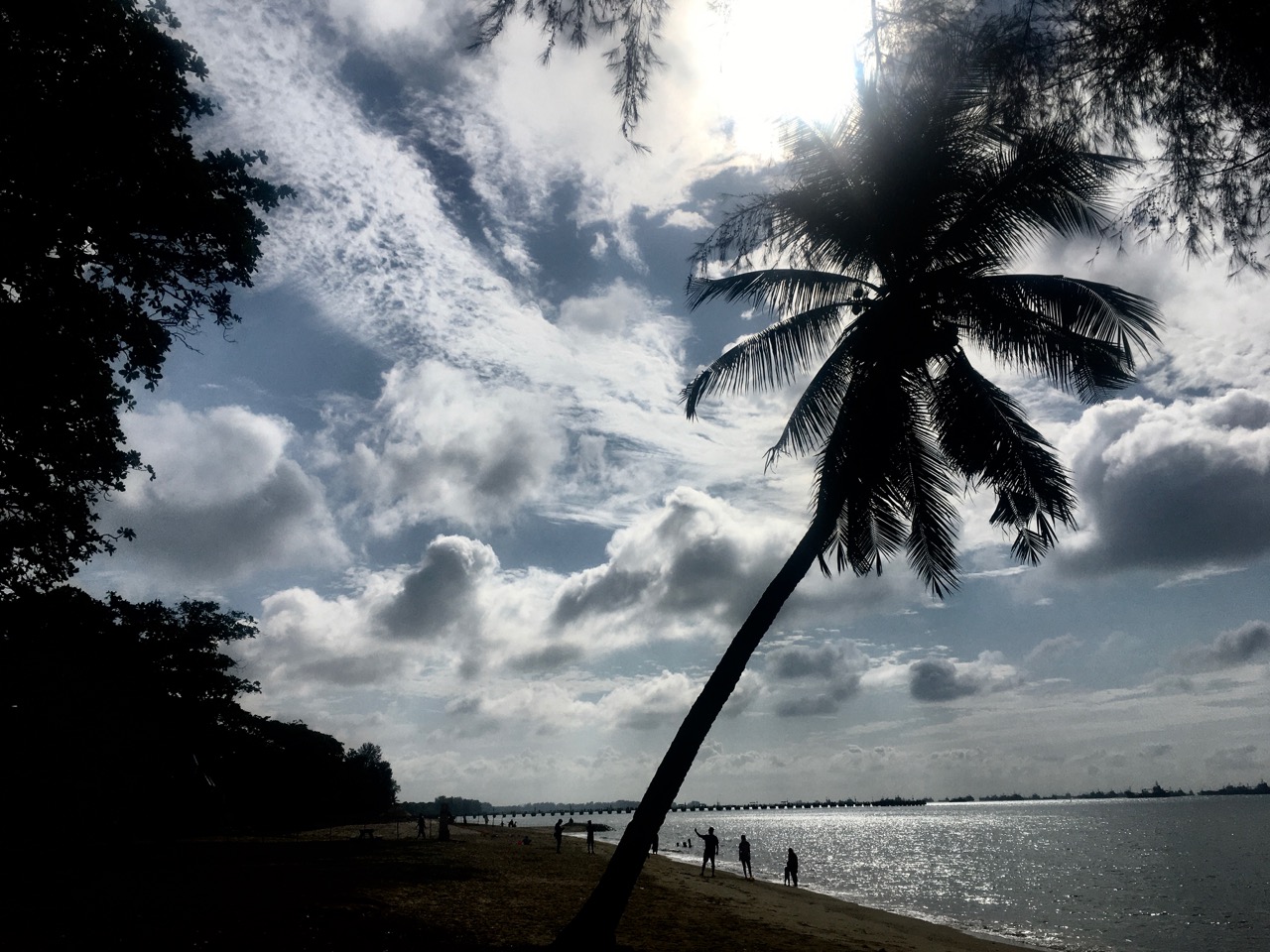
Shifting Ground

My mind is in a weird place, somewhere between finishing my time in Singapore and moving again, though with little knowledge of what will come in the month between jobs. I’m looking forward to what’s coming next, but the thought of what may or may not happen first keeps me up at night.

There’s so much I wanted to do and whether any of that is possible remains to be seen under the Covid regulations of four different countries. And it doesn’t help that every time I try to talk about it, I end up fighting back tears. There is no good solution to a problem that shifts every time I look at it.

It’s interesting to hear my students, who have been in school, clubs, and recently also the cafeteria since school resumed in August, say, “There was Covid last year so we couldn’t do X.” This was further highlighted as I read National Honor Society applications earlier today. “Because of Covid, X was cancelled. Because of Covid, we did X virtually instead.”

Life has stopped and yet goes on. Life is ruined and yet this is living.

Spending this pandemic in Singapore is fascinating and I am going to carry the lessons I have learned from here for a long time. We are very, very lucky to be able to live relatively normally but with masks. That being said, being a foreigner in Singapore has meant that we could not leave because we would not be allowed to reenter.* This has been an enormous hurdle and one that has led many of my colleagues to resign when they otherwise would not. Additionally, we have all learned that something we loved and miss about living here, the privilege of travelling frequently, was indeed a privilege. The way we used to live was not normal and it’s good to relearn this.

And so I find myself in an interesting place. I am preparing to move countries at a time when the status of international borders is tenuous. And this reminds me that my pretty blue passport is what allowed the borders to be so porous in the first place. I am again between worlds and there’s life everywhere I look.

A friend from yet a different country asked recently, “Is it normal for people from your country to be so far from home?”

No, it’s not normal.

No, it doesn’t get easier.

And what’s home? People, not places. I’ve written about this before, but mostly I’ve constructed it. Home has to be fluid for my heart to make any sense at all.

So we arrive at now. Now I’m questioning the life I’m pursuing because the premise on which it is based has changed. And this means that it will change again. And likely again. There are many more “what ifs” now, at least in my awareness though they were probably always there, and I’m grateful to have a moment to reflect on the axioms we grow up with – “When life hands you lemons, make lemonade” – and that sort of thing.

But life hasn’t handed me lemons. Life is this day and the next day and the day after that. And life, as we remember every time we forget, is ours to be part of every day and never ours to control.

To live is to learn and to learn is to make choices, choices that we never thought we’d have to make. And the thing is, we never thought. This is an opportunity to do just that.

The surface of the earth is soft and impressible by the feet of men; and so with the paths which the mind travels. How worn and dusty, then, must be the highways of the world, how deep the ruts of tradition and conformity! I did not wish to take a cabin passage, but rather to go before the mast and on the deck of the world, for there I could best see the moonlight amid the mountains. I do not wish to go below now. – Henry David Thoreau, Walden


*This was the case over the summer holidays and has now changed. Instead of being denied reentry, there’s a mandatory $2,000 per person 14-day hotel stay upon return, which renders travelling impossible for me and my colleagues.

Kranji Marshes, Singapore – December 2020

Dear Diary

“I write because I don’t know what I think until I read what I say.” Flannery O’Connor

I was nine years old when I started keeping a journal, the first of many I received as a birthday gift. It was pink with some sort of design, possibly ballet slippers. It came in a little pink box with a clear plastic lid and keys that I kept conveniently tied around the lock.

I don’t remember why I started to write, but I remember sitting at the kitchen table one morning, looking over at my baby brother who was watching a children’s television show that I did not like. “Can I write that he’s watching a dumb show?” I asked my mum. “It’s your diary,” she said. “You can write whatever you want.”

That’s what I remember when people ask how long I’ve kept a journal. A long time.

I’ve recently spoken with a couple of people who look back on old writing. They write so they can reread later, verify their memories, reflect on situations and decisions, and understand who they are now. I’ve always just thought I’d burn everything one day.

When I think about reading old journals, my insides turn cold. My writing tells stories and relays events that I do not like to think about. I’ve been places I don’t want to revisit, and certainly not alone. My younger self needed to be held, needed to be shaken awake, needed to connect the dots in the writing on the wall, needed to learn, to grow, to love. The person I am now, as is the case with all of us, is a product experiences, responses to challenges, choices made. My writing on this blog tells me that I’m very consistent in many ways, but my personal writing is not nearly so tidy. Our public and private lives are often very different in that way. Is it enough to understand what is now without looking back to see how I arrived here?

And yet, there is a box of two decades of journals in my parents’ basement. Why did I once take the time to sort them, a harder task than it sounds because I didn’t always write the date when I was young? Why have I packed them into suitcases over summer holidays to place in that box? What am I saving them for? I’ve asked myself that question many times and I don’t know the answer. I’m saving them. The end.

I think better on paper. I understood what that meant to me long before I knew anything about cognitive processing, neural pathways, or emotional reactivity. I need to write like some people need a cigarette, and I get fidgety when I feel this way. I carry my journal around during difficult times and sometimes it’s enough to jot a note about what I want to chronicle (that’s usually the word I use) later on. It literally takes the edge off.

Sometimes I write with the intention of remembering, of preserving for as long as I can. But sometimes writing gives me permission to let go, to free up space in working memory so I can focus on something else. If it’s written down, I needn’t actively remember.

Writing is the only pursuit that I do not compromise, no matter how exhausting the day. At the minimum, it’s three things I’m grateful for. And I am grateful, every day, for knowing that there are things to be grateful for.

My journals: 6 June 2019 – Present

Talking with Young People

Educating is about building relationships and this is what makes it emotionally demanding. Our students need us to be present, to be with them, to recognise and name what they either cannot or will not name. When I say that I work with young people, I mean that we work together, side by side. We go through concepts, ideas, information, and assessments together. We are often not doing the same thing, but we do it together.

One of the textbooks assigned in my education methods courses as an undergrad was Discipline with Dignity by Curwin, Mendler, and Mendler. It spoke of respect, responsibility, of treating young people first and foremost as people. This sounds funny to say, but think about it. Educators have a lot of power and that power can build a child up or totally, utterly cut them down.

In the words of Haim Ginott, words that still give me chills:

“I’ve come to a frightening conclusion that I am the decisive element in the classroom. It’s my personal approach that creates the climate. It’s my daily mood that makes the weather. As a teacher, I possess a tremendous power to make a child’s life miserable or joyous. I can be a tool of torture or an instrument of inspiration. I can humiliate or heal. In all situations, it is my response that decides whether a crisis will be escalated or de-escalated and a child humanised or dehumanised.”

And this means that teachers must recognise the human role they play in the classroom. We are all beings with dignity and honouring this is critical in the way we treat others – who they are, what matters to them, and the demands we place on their time and energy. Throughout my career, students have come to me just to talk. I’ve heard, “You’re the only one I trust” more times than I can count. I’ve been thanked for saving lives years after the fact. How hard is it, really, to treat a young person the way all people should be treated?

But it is hard. All meaningful relationships are hard. Doing this requires vulnerability and courage. It requires understanding that we are in this together and this can be a difficult position for teachers who do not understand that educating is about relationships. Students know when we are authentic and they know when we are disingenuous. Like all of us, they respond to what is genuine and protect themselves from what is false. I want my students to be good people and this requires me to walk beside them.

At the beginning of this school year, I finally had the chance to get to know a group of young men who had made cafeteria duty a miserable experience the two years before. I smiled while greeting them and said to the class, “To those of you who I have encountered, this is a great opportunity to prove that you’ve grown up.” And they have. Each interaction that we have with young people is a new interaction. Each day really is a new day. If we are going to work together for a year or two, we need to set ourselves up for doing so. I’ve learned to take a deep breath each time I address a question or comment from a student who just grates on me. He deserves the same chances, the same positive attention, as anyone else, time after time. This is how we learn, and I want my students to leave my class knowing more about themselves and the world around them than they did before.

When we feel valued for who we are, we respond. We know this as adults and it is ever more true of young people. A smile, making eye contact, tone of voice, and gestures are all part of communication. Just like how we might know how someone feels about us without them saying so, students know this, too. We like to know someone is looking out for us. This is why teachers should pay attention when a student gets new shoes, a haircut, or looks like they’re having a tough day. It’s a powerful thing to close the laptop and look young people in the eye when having a conversation, or to sit on the same side of the desk that might otherwise act as a barrier. When we sit side-by-side, we are working together. Each member of the classroom community matters, so take the time to do the small things that set a tone.

These are emotional investments that make what we do real rather than abstract. Educating is about building relationships. It is work. It is time intensive, meaningful, deeply fulfilling, and it has the power to change lives. Young people are worth it.

Coney Island, Singapore – April 2020

On loving, learning, and living