
Tag Archives: Love

Acting Means Doing

The purpose of this post is not to chronicle the protests taking place across the United States and, in response, the rest of the world.

The purpose of this post is not an outcry against society or systems. It’s not a tirade against power and authority.

This is a post about love.

I’m rereading Erich Fromm’s The Art of Loving, a remarkably rich and very short book on what it means to love in all of its forms. Today I read the following:

The most fundamental kind of love, which underlies all types of love, is brotherly love. By this I means the sense of responsibility, care, respect, knowledge of any other human being, the wish to further his life. . . . If I have developed the capacity for love, then I cannot help loving my brothers. In brotherly love there is the experience of union with all men, of human solidarity, of human at-onement. Brotherly love is based on the experience that we all are one. The differences in talents, intelligence, knowledge are negligible in comparison with the identity of the human core common to all men.

Towards the end of the paragraph, Fromm quotes Simone Weil, whose writing is incredibly vibrant and actually quite apt for this current point in time. In his quotation she writes:

The same words [e.g. a man says to his wife, “I love you”] can be commonplace or extraordinary according to the manner in which they are spoken. And this manner depends on the depth of the region in a man’s being from which they proceed without the will being able to do anything. And by a marvelous agreement they reach the same region in him who hears them. Thus the hearer can discern, if he has any power of discernment, what is the value of the words.

Love is a verb. Verbs are actions. Love that is truly meant on the basis of our humanity and interdependence then requires us to act.

This post is a call to action, a call to doing something beyond what is immediately visible.

Participating in the Women’s March in New York City following the US election of 2016 was an eye-opening moment for me. I watched similar marches around the world. I watched as we were all swept up in solidarity and excitement and a sense that this was our time.

And then I watched as everything continued more or less as usual.

And I asked why. I had raised my voice in an outcry and continued to do so, but with the growing awareness that an outcry is only that. What is needed is action.

Thank you to those standing up for justice. Please do more than stand up. Please act in ways that may not be visible but play into the systems you’re trying to dismantle. If history tells us anything it is that protests are easy to organize, easy to join, and easy to let go. Although perhaps not electrifying, there are far more concrete ways to stand up and actually make the difference you believe in.

There are organizations that need your support to take cases to trial. There are organizations that need your support to provide meals, transportation, shelter, job training, clothing to those who need it. There are organizations that need your support to make laws. There are organizations that need your support to keep the doors to their clinics and offices open so that they can run campaigns to change the balance of power. And on. And on.

Yes, attend a peaceful protest and raise your voice.

And then act on what you say.

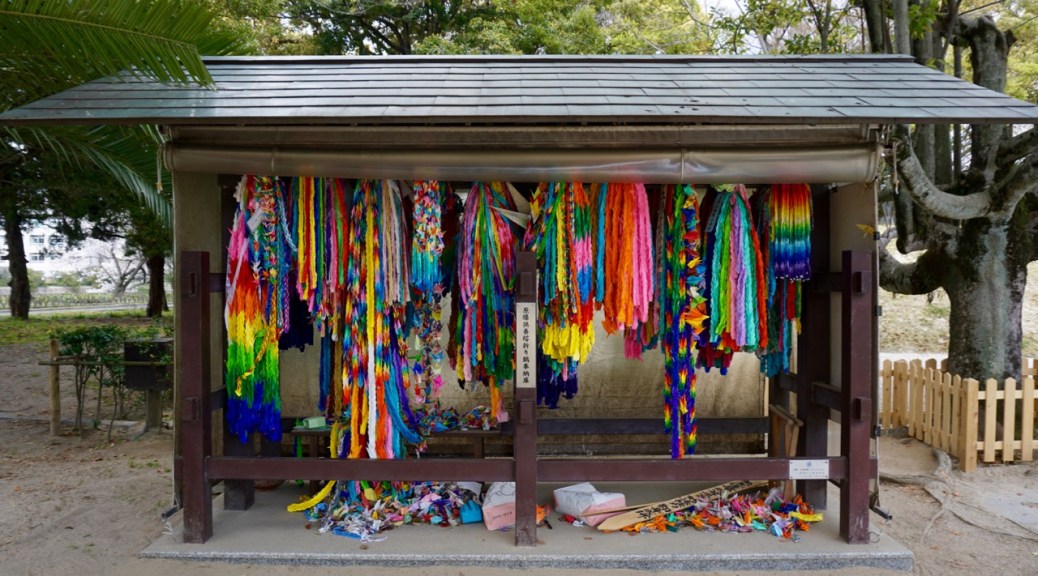
Hiroshima Peace Memorial Park – April 2019

What is it with people?

I moved apartments at the end of July and I now live an easy bike ride away from school. I often ride in the company of a friend who lives in the neighbourhood. As we rode in this morning, my friend asked, “What is it with people? Do they actually not care or do they really not look?”

It’s a good question, one that I ask of myself and of others with some regularity. Let’s explore further.

“What is it with people? Do they actually not care?”

Care is a verb. As I have written similarly about love and about giving, it is very important to understand this. Caring means acting in a way that is responsive to those around us. I actually disagree with the standard dictionary definition here, which suggests that caring is a feeling or an action.

A feeling is not enough. To care is a verb and verbs are actions.

We cannot claim to care if we then proceed to do nothing, though unfortunately I think this is often the case. I suspect that for many people, feeling is enough. A moment of pause in their own lives while they look in the general direction of someone else and then right back to normal. After all, how often do we hear, “I do care but I just can’t do anything about it”?

I think this is wrong.

Again, caring is an action. True caring requires something from us, some sort of participation that goes beyond personal acknowledgement of a situation. We don’t need to donate a kidney to the next person who walks by in pain, but if we claim to care about people, it’s not too much trouble to look them in the eye and genuinely ask, “How are you?”.

Interestingly, however, there is a lot of literature about “self-care” out there and we’re pretty clear what we mean in regards to ourselves. We do what makes us feel good because we want to do it. It only makes sense to apply the same to others, but we don’t stop to think about what others might need. We are too wrapped up in our own minds for that.

Do some people actually not care? Yes, I think that is the case. Care is one of those words we have thrown around and we have neglected what it actually means. We talk about it but we don’t act on it. This is a problem.

“What is it with people? Do they really not look?”

I know a lot of people who use “being busy” as an excuse for their myopia. The problem is that this excuse becomes our way out of interacting with anyone or anything not directly related to our personal wants and needs. We avoid looking because looking would mean that we have to do something. And if we turn away, who are we? We aren’t willing to go here.

Not looking is an active choice to disengage. This choice is indicative of indifference to those around us, and both history and life experience teach that indifference is at least as harmful as outright harm. Sometimes, people really don’t look. Sometimes, people really cannot be bothered. This is a problem.

Likewise, it is common to assume other people will look, perhaps people who better understand a situation or who have been around longer. The argument might go, “Perhaps I’m not the right person to get involved.” Well, why not? Who is? It is also easy to deny responsibility with excuses like, “It’s just not my place to intervene.” Well, what is your place? How would you like to be treated in this situation if roles were reversed? You are now culpable.

We could go down a rabbit hole of hypotheticals here and if we do that, the principle must remain. For instance, if you see a child drowning, do you jump in? Psychology would say that you’re more likely to act if you’re alone than in a crowd of people, but I think this one is pretty easy. Yes, you see the child and you jump in. Are other situations so different?

How do we fix this?

I admit that this post is largely negative and I’m sorry about that. My friend’s question on our ride to work really got to me because I really do try to make the world a better place. I really try to do the right thing and to be involved even when I’d rather not be. This is true in a variety of situations, from answering the phone call or message that will likely lead to a very late night to approaching an administrator when I have concerns about a colleague.

Doing the right thing matters.

How do we make the world a better place when people refuse to acknowledge that there’s anything amiss at all?

Here is what I can suggest:

  1. Decide what matters to you and live according to those principles. Become the person you uphold in your mind as a good person.
  2. Understand that everything you do is a choice and make choices based on your principles.
  3. Hold yourself and others accountable to what has been said and done. Ensure that what is done aligns with what is said.
  4. Treat people well. Think long and hard about what that means and act accordingly.
  5. Do the hard work to do the right thing because these are the things that matter.

For a long time, I’ve collected quotes that I’ve come across in any number of places. I don’t remember where I first read the motto of Jainism, but I think it fits well here. Allow me to close with that.

Parasparopagraho Jivanam – The function of souls is to help one another

A Valentine for Online Dating

Dear Online Dating,

Roses are red and violets are blue,
and today’s the day I break up with you.
That’s it, we’re done, we’re through.
But don’t worry – it’s me, not you.
You have millions of users, I know,
so it’s not a problem for this one to go.
Violets are blue and roses are red,
and there are other things I’d like to do instead.

Our time together began when I was newly single in New York and it’s going to end here in Singapore where I’ve come to define myself in myriad other ways. Single, I’ve learned, is an adjective. It’s not a punishment or a judgement and it’s not written across my forehead in sparkly red glitter. In many ways, it’s as much a choice as anything else. So sure, I’m single, but I’m many other things, too.

Was our time together all bad? No, certainly not. I must acknowledge that you gave me some laughs and some good stories. You taught me that I need to stand up for what matters to me because if I don’t, no one will.

Perhaps I know myself a little better now.

I don’t regret our relationship and I am grateful for the good friend (singular) that I made through you. I don’t regret the outings I went on and the places I explored. I’d don’t regret the people that I met, and oh there are all kinds of people out there! I don’t regret stepping outside of my comfort zone because this, after all, is how we grow.

I admit, there was a time when you made me feel admired, a time when your notifications would fill me with excitement (read: when the instant gratification meant a hit of dopamine) and I’d eagerly open you up to see what there was to see. I used to swipe on your apps and flip through your profiles and imagine conversations with your users.

But all you care about is a pretty face and there’s a lot more to me than that.

There were times when you were, dare I say it, entertaining. You were a good way to spend 10 minutes after a run when I was flooded with endorphins. You were a way to pass a few minutes in line at the grocery store. There was a time when I’d excitedly share our experiences with real friends, the in-person kind, and thought maybe, just maybe, something good would come of you.

Something did, but it wasn’t your promise of everlasting love and eternal happiness. You’ve turned loving and living into something that can be bought and sold with ads and algorithms. I don’t know where that world is but it isn’t the world I live in.

I’ve loved and been loved and I live in a world that’s hard but filled with so much beauty. You’re trying to create a different world but I’m not finished with this one yet.

With the help of your technological guidance and curated profiles, I’ve grown up and moved on and I don’t need you anymore. You’re all about the next thing and the best thing and the new thing and for me, well, today is enough. It’s been nice knowing you. Thanks for the ride.

Love,

Rebecca Michelle