Tag Archives: New York

Free Hugs

A few days ago, I was walking through Union Square and saw a cluster of people (two men, two women, multiple races, 20s or 30s) holding signs that said “FREE HUGS” in large, colorful letters.

Before even actively thinking about it, I knew I was heading straight for the people with the signs.

I walked towards a man with a bushy brown beard who asked, “Need a hug?”

I made a sound that was somewhere between an embarrassed chuckle and a nervous giggle and replied, “Yeah.” (Truth be told, I can really always use a hug.)

We hugged, I thanked him and wished him a great day, and he sent me on my way with a sticker.

IMG_0598
Pretty good advice! Though not so secret if now printed on stickers.
Of course, I thought, noting the URL in tiny letters. Does anything simply come from the goodness of the heart? But then I looked up LightSourceTemple.org. If you’ve clicked on the link, you’ll notice what I noticed – the domain has expired. LightSourceTemple.org doesn’t exist.

So why give out free hugs? For a laugh? For fun? A dare? A cult initiation? Or because the world can be really hard and sometimes people just need hugs?

While I can’t answer what those four people in Union Square were aiming for, I can explain why I not only accepted the free hug, but also wanted it.

I believe very strongly that there is a lack of physical human connection in our society.

I’ve thought about this a lot but it struck me anew when I was recently in Israel with our eighth graders. After just a day away from school, in a completely different environment, open affection was acceptable and the norm. Even more illuminating, much of this behavior came from the Israeli staff who we met on the first day of our trip. It was perfectly fine to drape an arm over a colleague’s shoulder for no apparent reason. It was fine to say good morning with a kiss on the cheek. A touch to someone’s back was simply a way of saying hello.

We don’t do enough of that in the US.

While in Israel, I read Dacher Keltner’s Born to Be Good, which contains chapters on smile, laughter, touch, and love, among other things. He writes about oxytocin and its effects on our behavior, attitudes, and relationships. Humans need positive physical contact in order to bond, trust others, and feel happy. In more than one place in his book, Keltner blames the Puritans for the lack of lack of physical touch in American culture.

I mentioned the book during a conversation just before walking through Union Square and seeing the free hugs signs. A friend was talking about his frustration with the repressive nature of American society and how we don’t really permit deviating from the prescribed course of action (school, more school, job) to allow for authentic personal growth or exploration. Thinking of Keltner, I suggested use of the word “Puritanical” to describe typical American attitudes towards uncharted paths and lack of conformity to the few molds we have deemed acceptable.

All of this was on my mind when I walked through Union Square a couple days ago. Though the free hugs people don’t know it, they appeared with their signs at just the right time for me to say yes to their hug.

As a rule, I try to be as open with and responsive to others as I can. Accepting and being truly delighted by the free hug was just another way of trying to form a connection, however brief, with someone who was willing to be open, responsive, and vulnerable to those around him. Back in February, I sat down to talk to three men on a bench in Central Park for the same reason. When a college student who started a conversation with me at a nail salon last week asked if she could interview me for a school project, I gave her my phone number with true pleasure. I’m trying to make the world better, one positive interaction at a time.

We are all humans. Whether we like it or not, we are all in this together. If we can’t reach out and touch one another, what’s the point in living at all?

A Night at the Opera

Without music, life would be a mistake. – Friedrich Nietzsche

The first image that comes to mind when I think “opera” is a scene in Anastasia, the animated film that came out in 1997. Anastasia gets all dressed up in pearls and a floor-length gown and watches the opera from a luxury box through a pair of gold binoculars. Since then, opera has meant elegance, finery, glamor, culture.

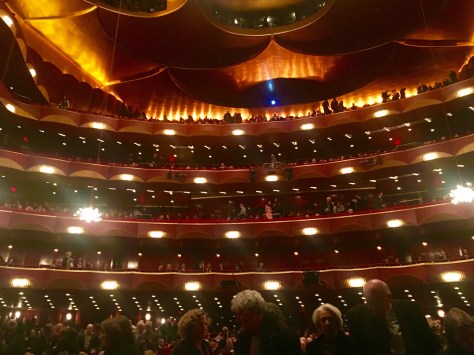
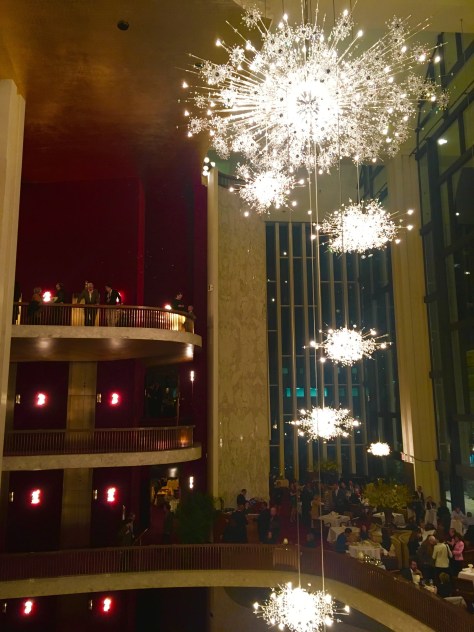
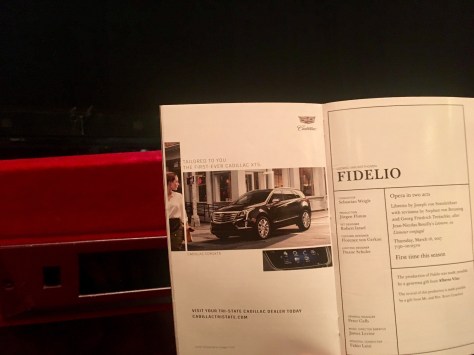
On Thursday, a colleague took me to the Met for a performance of Beethoven’s only opera, Fidelio. While it didn’t involve a floor-length gown or gold binoculars, it was absolutely stunning and also changed my schema of opera.

IMG_3457

IMG_3465

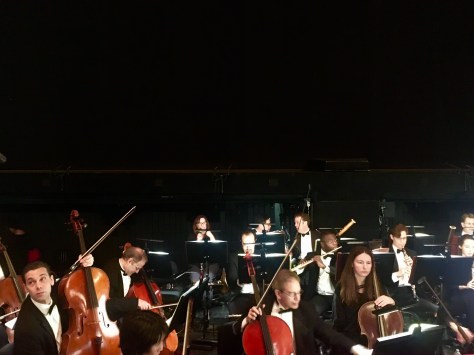
IMG_3461

IMG_3466

My coworker neglected to mention that her season tickets are in the front row. This gave me a view of the orchestra that I’ve never had, which was fascinating in itself. During intermission, for example, the musicians chatted to each other, took pictures, sent text messages, and suddenly became regular people. Other than a few small live music venues, I’ve never been close enough to a stage to watch orchestral musicians perform. To say that music is alive is to underestimate the role of the people who bring it to life.

IMG_3459

IMG_3462

I grew up listening to many of the Classical Kids cassette tapes – Beethoven Lives Upstairs, Mozart’s Magic Fantasy, Vivaldi’s Ring of Mystery, Tchaikovsky Discovers America, Mr. Bach Comes to Call were often our choice of car music. (Barenaked Ladies and Smash Mouth took over for a while after that, but I think we had CDs by then.) As soon as the Fidelio overture began, it was like being at a Beethoven concert. My knowledge of music theory is unfortunately limited and I can’t actually describe what “being at a Beethoven concert” sounds like, but I recognized him immediately.

The singers, of course, were equally amazing. Their voices were so big and so full of every emotion, making them instantly relatable and making the story easy to follow. I likely had a huge smile on my face the whole time. Live performance always has that impact on me.

Overall, the opera was far more approachable than I had expected. On the back of each seat is a small screen that you can choose to turn on to view the subtitles for everything being sung onstage. For Fidelio, the available languages were German (the language of the opera), English, and Spanish. The words are red on black screens that are constructed in such a way that it is very difficult to see the screen of the people next to you. Having the captions on is not at all distracting while also allowing the audience to  follow tradition and watch the opera without translation.

IMG_3460

There was something in Fidelio for everyone – unrequited love, ambition, crime, marital fidelity, revolutionary undertones. Opera is definitely an experience that I want to have again, which is feasible considering tickets at the Met start at about $30 for the highest section in the auditorium. Again, approachable. Who knew?

In addition to the opera, I was really interested in the audience. My coworker had told me to expect everything from tuxedos with tails to jeans and backpacks. She was not exaggerating. I saw multiple people who were clearly tourists and backpackers in the city for a few days, and multiple people who have clearly attended opera for decades and embrace all the glamor that opera has always had. My favorite by far was a couple in our row who were well into their advanced years and epitomized fabulous. He sported a tuxedo with a patterned cummerbund matching his bowtie and pocket square, and she wore a velvet pantsuit with a spangly rhinestone front and no back with a white feathered fedora. They were beautiful.

As far as cultural experiences go, I’m trying to do as much as I can for my time here in New York. I’ve been to live music venues, Broadway shows, comedy clubs, and now the opera. I haven’t seen a dance performance here so that’s next on the list.

Music expresses that which cannot be said and on which it is impossible to be silent. – Victor Hugo

Hey, curly girls! This one’s for you.

I got my hair cut today. This is a big deal because I think the last time I got my hair cut was three years ago. And it’s an even bigger deal because I asked the stylist to straighten it.

IMG_0066

I normally wear my hair down and just let it do whatever it’s going to do. This is a coping mechanism – equal parts resignation, exasperation, and experience. Sometimes it looks great and I love it, like in the picture above. It really is that curly and I really do have natural red highlights, which sometimes show up.

Since I’m asked this a lot, these are my current hair products:

Most people have never seen me with straight hair. I’ve rarely seen me with straight hair, actually. Once upon a time, about three years ago, I wrote about having curly hair and I straightened my hair to make a point. I don’t think I’ve had straight hair since.

And yet, here we are again!

On a recommendation from my mum’s stylist at Tru Salon in Rochester, NY, I went to the Aveda Institute here in New York City to have my hair trimmed by a student stylist. I’ve had enough bad haircuts as a curly-haired person to avoid a) getting my hair cut entirely and b) paying a lot of money for a haircut. Rachel, my mum’s stylist, assured me that the Aveda Institute sees a lot of curly patrons because getting a good curly haircut can be such a challenge and a huge expense.

It’s only hair, right? It’ll grow back, right?

Ha.

Normally I’d say yes, but that’s precisely the problem.

I haven’t cut my hair in three years because it doesn’t grow. I’ve dreamt of long, flowing curly locks for enough years to know I’ll never have them, even though I follow all of these tips.

Oh yeah. Except for the one about regular trims. Oops.

So off the the Aveda Institute I went!

At the Aveda Institute, student stylists have to get the procedure and each stage of the process approved by an instructor. While this might make some patrons nervous, I understand the need to practice on real humans to learn your trade (I’m a teacher, after all). I truly encourage everyone to look into the Aveda Institute if you’re looking for a top-quality, inexpensive service. After all, students are very careful and deliberate because they’re still learning and you have the benefit of an expert stylist watching each step of the way.

My student stylist, Mary, told me everything I already knew about my hair – it’s surprisingly healthy and hydrated, surprisingly soft, and surprisingly fine. She was surprised that I haven’t cut it in so long. People usually are. What made me happy is that she understood exactly what I wanted and clearly explained how she was going to make my hair look even healthier (and hopefully grow). Even better, the instructors agreed with her! I dread the oft-heard question, “How do they usually cut your hair?” from a stylist, indicating that curly hair like mine is unfamiliar. Mary’s confidence made me feel at ease and since she had the scissors, that was probably a good thing.

Reasons to Visit the Aveda Institute

  1. They provide a wide range of salon services (I’ll probably be back soon for a facial)
  2. They serve tea
  3. It’s fun to watch the students style and color mannequins’ hair
  4. The students are very conscientious
  5. Instructors check every step of the process and make some adjustments along the way
  6. It’s very, very affordable and reasonably priced

One thing to note: If you want to tip, they only accept cash and don’t have an ATM.

When Mary was done, I asked her to take some pictures:

Hey, everybody! I have long, flowing locks! Amazing. Darn all that curl shrinkage.

Unfortunately, my hair won’t look like this tomorrow. I don’t own a comb, brush, blow dryer, or straightening iron (or blush, eyeshadow, or lipstick) so it’ll either be back to curls or up in a ponytail. But it’s super fun to feel it swish against my back and the sides of my face! It’s always the little things, right?

So after three years, about a 1/2-inch of split ends have been cut off and my layers are relayered. I’m looking forward to seeing what my hair looks like curly!

If you have tips, tricks, or hints to share, I’d love to hear them! I’m pretty low-maintenance (could you tell?) but surprisingly vain when it comes to my hair. Happy to hear anything you’ve got! Comment below or through the contact page. Cheers, curly girls!